


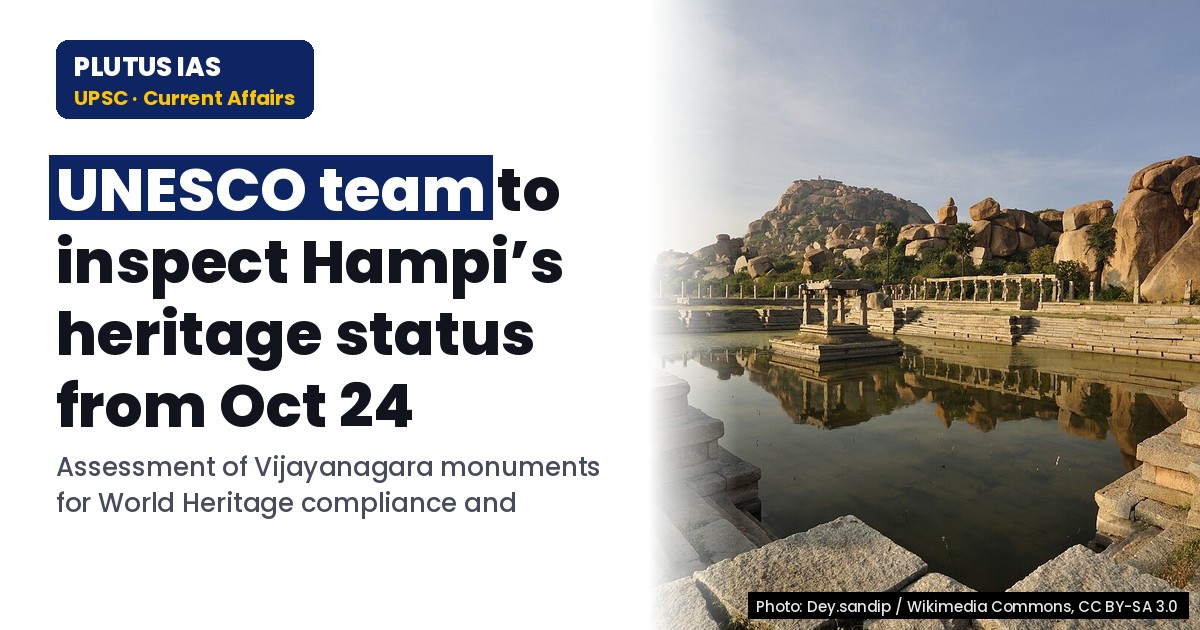
14 Oct UNESCO team to inspect Hampi’s heritage conservation status
✎ UNESCO’s World Heritage Site inspections evaluate conservation status, management frameworks, and compliance with global standards to ensure the long-term preservation of culturally significant sites like Hampi.
Subject Relevance — Where This Topic Fits
- GS Paper I — Indian Heritage and Culture | GS Paper II — International Organisations and Agreements
- Prelims: World Heritage Sites, UNESCO, Hampi, Vijayanagara Empire, heritage conservation, monument management, cultural heritage, sustainable tourism
- Essay: The role of international organisations in preserving global cultural heritage, Balancing conservation and development: lessons from World Heritage Sites
Quick Revision: UNESCO’s World Heritage Site inspections evaluate conservation status, management frameworks, and compliance with global standards to ensure the long-term preservation of culturally significant sites like Hampi.
Why is this in the news?
A UNESCO expert team, including international heritage specialists, will inspect Hampi from October 24 to 27, 2026, to assess its conservation status and compliance with World Heritage Site guidelines. This visit is critical for the long-term preservation of Hampi, a UNESCO World Heritage Site of immense historical and architectural significance, and reflects broader global efforts in heritage governance.
Background
- Hampi, located in Karnataka, was declared a UNESCO World Heritage Site in 1986 under the ‘Group of Monuments at Hampi’ category, recognising its outstanding universal value as a testimony to the Vijayanagara Empire’s cultural and architectural achievements (14th–16th centuries).
- The site encompasses over 1,600 surviving remains, including temples, palaces, market streets, and waterworks, spread across 4,100 hectares, making it one of India’s largest and most complex heritage sites.
- UNESCO’s World Heritage Convention (1972) obligates member states to protect and conserve their listed properties, with periodic evaluations to ensure adherence to conservation and management standards.
- Hampi faces challenges such as urban encroachment, environmental degradation, unregulated tourism, and structural decay, necessitating continuous monitoring and adaptive management strategies.
- India has ratified the 1972 Convention for the Protection of the World Cultural and Natural Heritage, committing to the preservation of its World Heritage Sites.
What is the UNESCO World Heritage Site Inspection Process?
- UNESCO conducts periodic evaluations of World Heritage Sites to assess their conservation status, management effectiveness, and compliance with the Operational Guidelines for the Implementation of the World Heritage Convention.
- The inspection team typically includes heritage conservation experts, representatives from UNESCO’s World Heritage Centre, and, where relevant, external specialists in archaeology, architecture, or environmental science.
- Key evaluation criteria include the authenticity and integrity of the site, the robustness of legal and institutional frameworks for protection, community involvement, and sustainable tourism practices.
- The assessment may result in recommendations for corrective measures, technical assistance, or, in extreme cases, a ‘List of World Heritage in Danger’ designation if conservation fails to meet standards.
- India’s Archaeological Survey of India (ASI) and state-level heritage agencies, such as the Hampi World Heritage Area Management Authority (HWHAMA), are responsible for implementing conservation measures and coordinating with UNESCO.
- The inspection process is collaborative, involving site visits, stakeholder consultations, and reviews of documentation such as conservation plans, funding allocations, and monitoring reports.
- UNESCO’s recommendations often include capacity-building initiatives, infrastructure upgrades, or policy reforms to enhance heritage governance.
- The outcomes of such inspections influence global funding, technical support, and India’s reputation in international heritage conservation circles.
Key Features
| Feature | Significance |
|---|---|
| UNESCO Expert Team Visit | Conducts a technical assessment of Hampi’s conservation status under World Heritage Site guidelines, ensuring alignment with international preservation standards. |
| Focus on Monument Management | Evaluates the effectiveness of existing conservation measures, including structural integrity, visitor impact, and site documentation protocols. |
| Multi-disciplinary Assessment | Involves heritage experts, archaeologists, and site managers to provide a holistic evaluation of Hampi’s preservation challenges. |
| Tourism Preservation Balance | Assesses how tourism promotion can be harmonised with conservation to prevent degradation of historical assets. |
| Long-term Preservation Strategy | Provides recommendations for sustainable conservation practices to safeguard Hampi for future generations. |
Why it Matters
Cultural Heritage Preservation
- Hampi, a UNESCO World Heritage Site, embodies the architectural and cultural legacy of the Vijayanagara Empire (14th–16th centuries), necessitating rigorous conservation to maintain its historical authenticity.
- The assessment ensures compliance with the Operational Guidelines for the Implementation of the World Heritage Convention, which mandates periodic evaluations of heritage sites.
- Preservation of Hampi’s monuments, including the Virupaksha Temple and Vittala Temple complex, safeguards India’s intangible cultural heritage and global standing in heritage conservation.
Tourism and Economic Impact
- Hampi is a major tourist destination, contributing to local economies through heritage tourism; effective conservation enhances its appeal while preventing over-commercialisation.
- The assessment’s recommendations can guide infrastructure development that balances accessibility with preservation, such as controlled visitor pathways and waste management systems.
- Improved conservation status may attract international funding and partnerships for heritage projects under UNESCO’s World Heritage Fund.
Institutional Governance
- The visit underscores the role of district administrations and state governments in implementing heritage conservation policies under the aegis of UNESCO.
- It highlights the collaboration between central and state agencies, such as the Archaeological Survey of India (ASI) and the Department of Tourism, in managing heritage sites.
- The assessment process reinforces the importance of data-driven decision-making in heritage management, including GIS mapping and condition monitoring of monuments.
Global Heritage Standards
- The evaluation aligns with UNESCO’s 1972 World Heritage Convention, which India ratified in 1977, committing to the protection of cultural and natural heritage of outstanding universal value.
- It provides an opportunity to benchmark Hampi’s conservation practices against global best practices, such as those employed in sites like Angkor Wat (Cambodia) or Machu Picchu (Peru).
- The findings may inform India’s future nominations for UNESCO’s Tentative List, ensuring adherence to international heritage criteria.
Challenges
1. Structural Deterioration of Monuments
- Monuments in Hampi face risks from natural weathering, seismic activity, and human-induced factors such as pollution and unregulated construction in buffer zones.
- The ASI’s limited manpower and resources for continuous monitoring exacerbate the challenge of timely intervention.
- Linkage: UNESCO’s Operational Guidelines (Para 163–165) mandate structural stability as a prerequisite for maintaining World Heritage status.
UPSC Link: GS I: Indian Art and Culture
2. Tourism Pressure and Visitor Management
- Hampi’s popularity leads to overcrowding, particularly during festivals like Vijaya Utsav, causing wear and tear on fragile structures.
- Lack of a robust carrying capacity framework results in ad-hoc measures, such as unregulated parking and littering, which degrade the site.
- Linkage: UNESCO’s 2018 ‘Global Guidelines for Sustainable Tourism at World Heritage Properties’ emphasise visitor management as critical to conservation.
UPSC Link: GS III: Tourism
3. Inadequate Funding and Resource Allocation
- Conservation projects often face delays due to budgetary constraints, with funds diverted to competing priorities like infrastructure development.
- Limited public-private partnerships (PPPs) in heritage conservation restrict access to specialised expertise and technology.
- Linkage: The World Heritage Convention (Article 4) obligates state parties to allocate adequate resources for heritage protection.
UPSC Link: GS II: Government Policies and Interventions
4. Regulatory and Legal Gaps
- Buffer zone regulations are inconsistently enforced, allowing encroachments and commercial activities that threaten the site’s integrity.
- The absence of a unified heritage law at the state level complicates coordination between multiple agencies managing Hampi.
- Linkage: The Ancient Monuments and Archaeological Sites and Remains Act (AMASR Act, 1958) governs protected monuments but requires updates for modern challenges.
UPSC Link: GS II: Statutory and Non-Statutory Bodies
5. Community Engagement and Local Livelihoods
- Local communities, while stakeholders in heritage tourism, often lack awareness of conservation practices or face displacement due to tourism-driven gentrification.
- Insufficient integration of traditional knowledge (e.g., local artisans’ skills) into conservation efforts undermines sustainable heritage management.
- Linkage: UNESCO’s 2003 ‘Convention for the Safeguarding of the Intangible Cultural Heritage’ highlights the role of communities in heritage preservation.
UPSC Link: GS I: Indian Society
Challenges — UPSC Perspective
| Issue | Concern |
|---|---|
| Natural Decay | Accelerated deterioration of stone structures due to monsoon rains, humidity, and biological growth (e.g., lichen, moss). |
| Human Impact | Vandalism, littering, and unauthorised construction within the core and buffer zones of the heritage site. |
| Institutional Coordination | Fragmented responsibilities among ASI, state archaeology departments, and local bodies leading to policy gaps. |
| Technological Gaps | Limited use of modern conservation techniques such as 3D laser scanning or drone-based monitoring for large-scale sites. |
| Climate Change | Increased frequency of extreme weather events (e.g., cyclones) posing new risks to structural stability. |
| Economic Prioritisation | Heritage conservation often deprioritised in budget allocations due to competing developmental goals. |
Way Forward
- Conduct a comprehensive condition assessment of all monuments in Hampi using advanced technologies like LiDAR and photogrammetry to identify structural vulnerabilities.
- Develop a carrying capacity framework for Hampi, including timed entry slots, guided tours, and designated visitor zones to mitigate overcrowding.
- Strengthen buffer zone regulations by enforcing the AMASR Act (1958) and introducing state-level heritage protection laws with stricter penalties for violations.
- Establish a dedicated conservation fund for Hampi, sourced from tourism revenue, CSR contributions, and international grants (e.g., UNESCO World Heritage Fund).
- Enhance community participation by training local artisans in traditional conservation techniques and integrating them into tourism value chains.
- Implement a real-time monitoring system for heritage sites, using IoT sensors to track environmental conditions (e.g., humidity, temperature) and structural stress.
- Collaborate with global heritage institutions (e.g., Getty Conservation Institute) for knowledge exchange and capacity-building in conservation practices.
- Launch a public awareness campaign to educate tourists and locals on responsible heritage tourism, including waste management and respect for cultural norms.
UPSC Value Addition
Keywords for Mains Answer-Writing
World Heritage Sites · Cultural Heritage Conservation · UNESCO World Heritage Committee · Vijayanagara Empire · Hampi heritage management · Monument conservation guidelines · Intangible cultural heritage · Heritage site monitoring mechanisms · Cultural resource management · Sustainable tourism at heritage sites · Archaeological Survey of India · National Mission on Monuments and Antiquities · UNESCO Operational Guidelines for the Implementation of the World Heritage Convention · Heritage impact assessment · Community participation in heritage conservation
Concept Flow
World Heritage Convention (1972) → India’s ratification (1977) → Nomination of Hampi as World Heritage Site (1986) → Periodic UNESCO monitoring → Current expert team visit (Oct 2026) → Conservation of Hampi → Structural assessment by ASI → Identification of vulnerabilities → Implementation of mitigation measures → Compliance with UNESCO guidelines → Tourism growth in Hampi → Increased visitor footfall → Pressure on monuments → Need for carrying capacity planning → Sustainable tourism framework → Heritage conservation funding → Government budget allocations → PPP models → International collaborations → Long-term sustainability → Local community engagement → Traditional knowledge integration → Livelihood generation → Reduced encroachments → Enhanced site stewardship → Climate change impacts → Extreme weather events → Structural risks → Adaptive conservation strategies → Resilience planning
Prelims Practice Questions
Q1. Consider the following statements regarding the UNESCO World Heritage Convention:
1. It was adopted in 1972 to protect cultural and natural heritage sites.
2. The World Heritage Committee is responsible for the implementation of the Convention.
3. India is not a signatory to the Convention.
4. The Operational Guidelines for the Implementation of the World Heritage Convention provide the framework for the inscription of properties on the World Heritage List.
How many of the above statements are correct?
- Only one
- Only two
- Only three
- All
Answer: Only three — Statements 1, 2, and 4 are correct. Statement 3 is incorrect as India is a signatory to the UNESCO World Heritage Convention, ratified in 1977.
Q2. Assertion (A): The Archaeological Survey of India (ASI) is the nodal agency for the protection and conservation of centrally protected monuments in India.
Reason (R): The ASI derives its mandate from the Ancient Monuments and Archaeological Sites and Remains Act, 1958.
Options:
A. Both A and R are true, and R is the correct explanation of A.
B. Both A and R are true, but R is not the correct explanation of A.
C. A is true but R is false.
D. A is false but R is true.
Answer: ? — Both the assertion and reason are true, and the reason correctly explains the assertion. The ASI is indeed the nodal agency for centrally protected monuments, and its mandate is derived from the Ancient Monuments and Archaeological Sites and Remains Act, 1958.
Q3. Match the following pairs related to heritage conservation in India:
Column I (Institution/Body)
A. Archaeological Survey of India (ASI)
B. National Mission on Monuments and Antiquities (N MMA)
C. UNESCO World Heritage Committee
D. Hampi World Heritage Area Management Authority
Column II (Function/Role)
1. Implements the World Heritage Convention and monitors global heritage sites.
2. Manages and conserves centrally protected monuments and archaeological sites in India.
3. Promotes research, documentation, and conservation of India’s cultural heritage.
4. Oversees the conservation and management of the Hampi World Heritage Site.
Options:
A-1, B-2, C-3, D-4
A-2, B-3, C-1, D-4
A-3, B-2, C-4, D-1
A-4, B-1, C-2, D-3
Answer: ? — The correct match is: A-2 (ASI manages centrally protected monuments), B-3 (N MMA promotes research and conservation), C-1 (UNESCO World Heritage Committee implements the Convention), D-4 (Hampi World Heritage Area Management Authority oversees Hampi).
Mains Practice Question
✍ The conservation and management of World Heritage Sites in India face multifaceted challenges, including environmental degradation, urban encroachment, and balancing tourism with preservation. Critically examine the institutional and legal frameworks governing the protection of such sites, with specific reference to the Hampi World Heritage Site. (15 Marks)
Approach: MODEL-ANSWER SKELETON:
1. **Introduction (1 mark)**: Define World Heritage Sites and their significance, citing the UNESCO World Heritage Convention, 1972. Mention Hampi’s inscription on the World Heritage List in 1986 and its cultural importance as a symbol of the Vijayanagara Empire.
2. **Institutional Framework (4 marks)**:
– **Archaeological Survey of India (ASI)**: Role under the Ancient Monuments and Archaeological Sites and Remains Act, 1958; powers to declare protected areas, conduct excavations, and enforce conservation.
– **State and Local Bodies**: Role of the Hampi World Heritage Area Management Authority (HWHAMA) and the Vijayanagara district administration in site management and visitor regulation.
– **UNESCO and World Heritage Committee**: Role in monitoring compliance with Operational Guidelines for the Implementation of the World Heritage Convention, including periodic evaluations and advisory missions.
3. **Legal Framework (4 marks)**:
– **Constitutional Provisions**: Reference to Entry 67 (Art and Culture) and Entry 12 (Archaeological sites) in the Union List (Seventh Schedule).
– **Legislative Acts**: Ancient Monuments and Archaeological Sites and Remains Act, 1958; Provisions of the Environment (Protection) Act, 1986, and the Wildlife (Protection) Act, 1972, where applicable.
– **Policy Instruments**: National Mission on Monuments and Antiquities (N MMA) and its role in documentation, research, and conservation.
4. **Challenges and Critiques (4 marks)**:
– **Environmental and Anthropogenic Threats**: Soil erosion, vegetation encroachment, and unregulated tourism impacting structural integrity.
– **Institutional Gaps**: Overlapping jurisdictions between ASI, state agencies, and local bodies; lack of integrated management plans.
– **Community Engagement**: Limited participation of local communities in conservation efforts, despite their traditional knowledge.
– **Tourism Pressure**: Balancing economic benefits of tourism with the need for preservation, citing examples from Hampi.
5. **Recent Initiatives and Way Forward (2 marks)**:
– **UNESCO Advisory Mission**: Role of the upcoming UNESCO team visit (October 24–27, 2026) in assessing conservation compliance and recommending corrective measures.
– **Sustainable Management Plans**: Need for heritage impact assessments, zoning regulations, and community-based conservation models.
– **Technology Integration**: Use of GIS, remote sensing, and digital documentation for monitoring and conservation.
6. **Conclusion (1 mark)**: Summarize the need for a multi-stakeholder, legally robust, and technologically enabled approach to preserve Hampi’s heritage for future generations.
Source: The Hindu
Generated by AanyaAi for educational purpose.
Related guides on our sites
- How to prepare for GS paper 1 for UPSC CSE mains exam
- Best UPSC coaching for IFOS exam
- Best mentorship programme for upsc
- UPSC+BA degree

- दिल्ली में प्रदूषण नियंत्रण हेतु निर्माण गतिविधियों पर प्रतिबंध: एक विश्लेषण - November 7, 2026
- OBC Creamy Layer: SC Ruling & CSE Impact - November 7, 2026
- दिल्ली प्रदूषण निगरानी में खामियां: GRAP-III के बीच कई स्टेशन निष्क्रिय - November 7, 2026

No Comments