


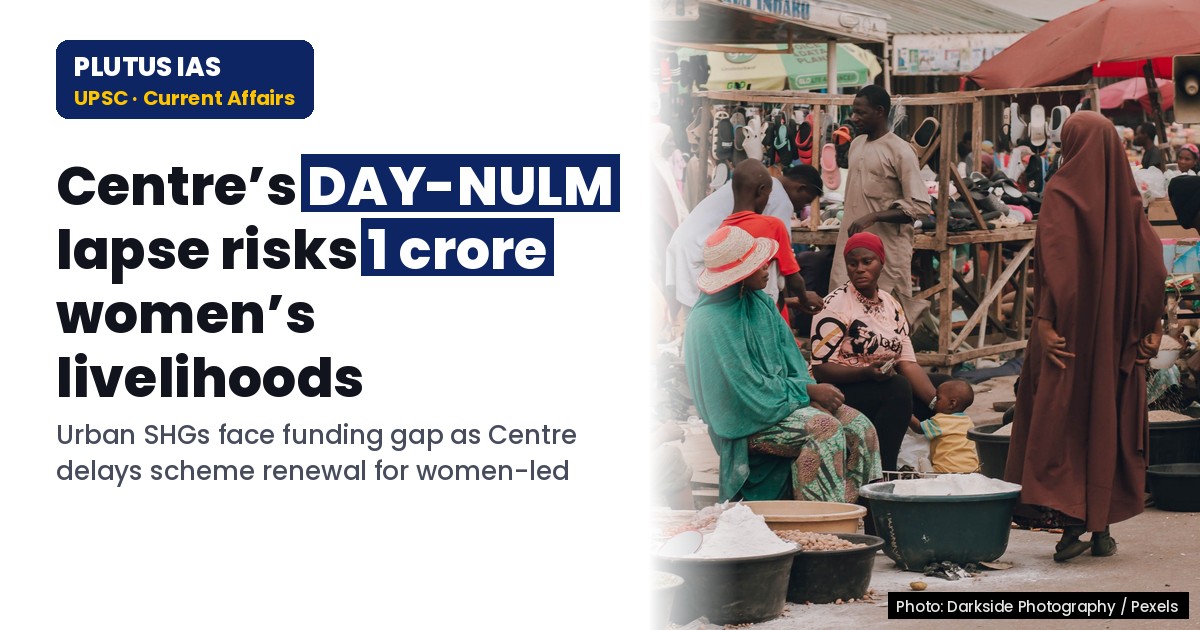
15 Oct Why DAY-NULM’s lapse risks women’s empowerment gains in cities
✎ DAY-NULM is a flagship scheme for urban poverty alleviation that leverages SHGs to empower women through self-employment, skill development, and access to credit and markets.
Subject Relevance — Where This Topic Fits
- GS Paper II — Governance, Welfare Schemes for Vulnerable Sections | GS Paper III — Development, Employment, Women and Child Development
- Prelims: Deendayal Antyodaya Yojana-National Urban Livelihoods Mission (DAY-NULM), Self-Help Groups (SHGs), Women’s entrepreneurship, Urban poverty alleviation, Institutional credit linkages, Financial inclusion, Skill development for women
- Essay: Women-led development as a pathway to inclusive growth, The role of grassroots institutions in achieving Sustainable Development Goals
Quick Revision: DAY-NULM is a flagship scheme for urban poverty alleviation that leverages SHGs to empower women through self-employment, skill development, and access to credit and markets.
Why is this in the news?
The discontinuation of the Deendayal Antyodaya Yojana-National Urban Livelihoods Mission (DAY-NULM) in October 2024 without a successor scheme has raised concerns about the sustainability of livelihood opportunities for over one crore women across urban India. States such as Tamil Nadu, Karnataka, Maharashtra, Madhya Pradesh, and Tripura have highlighted the policy vacuum, citing disruptions in access to institutional credit, training, and market networks for Self-Help Groups (SHGs). This development underscores the need for a renewed policy focus on urban livelihoods to ensure continued socio-economic empowerment of women.
Background
- Launched in 2014 under the Ministry of Housing and Urban Affairs, DAY-NULM aimed to reduce poverty and vulnerability of the urban poor by enabling them to access gainful self-employment and skilled wage employment opportunities.
- The scheme targeted women, particularly those from economically weaker sections, by promoting the formation and strengthening of SHGs to foster collective entrepreneurship and financial independence.
- By 2024, DAY-NULM had facilitated the creation of 10.02 lakh SHGs, covering over one crore women across urban areas, with significant impacts on financial inclusion and social empowerment.
- The scheme’s discontinuation in October 2024 has left a policy void, with states reporting disruptions in access to institutional credit, training, and market linkages for SHGs.
- Concerns over funding and policy continuity have been raised across party lines, reflecting a bipartisan recognition of the scheme’s importance in urban poverty alleviation.
- Evidence from state-level initiatives such as Bihar’s JEEViKA and Kerala’s Kudumbashree demonstrates the transformative potential of SHG-based models in enhancing women’s economic agency and mobility.
What is the Deendayal Antyodaya Yojana-National Urban Livelihoods Mission (DAY-NULM)?
- DAY-NULM is a centrally sponsored scheme under the Ministry of Housing and Urban Affairs, launched in 2014 to reduce urban poverty by promoting self-employment and skilled wage employment among the urban poor, with a focus on women.
- The scheme operates through the formation and strengthening of SHGs, which serve as platforms for collective entrepreneurship, financial literacy, and access to credit and markets.
- DAY-NULM’s objectives include providing skill training to urban poor women, facilitating access to institutional credit through bank linkages, and supporting the establishment of micro-enterprises.
- The scheme also aims to build social capital by fostering leadership and decision-making roles for women within their households and communities.
- DAY-NULM’s implementation involves a three-tier structure: the National Urban Livelihoods Mission (NULM) at the central level, State Urban Livelihoods Missions (SULMs) at the state level, and Urban Local Bodies (ULBs) at the grassroots level.
- DAY-NULM’s interventions include the establishment of shelters for urban homeless, support for street vendors through the PM SVANidhi scheme, and promotion of community-based organisations for service delivery.
Key Features
| Feature | Significance |
|---|---|
| Deendayal Antyodaya Yojana-National Urban Livelihoods Mission (DAY-NULM) | A centrally sponsored scheme launched in 2014 to enhance urban livelihoods, particularly for women, through self-help groups (SHGs), skill development, and credit linkages. |
| Self-Help Groups (SHGs) | Institutions that empower women by providing access to credit, financial literacy, leadership training, and market networks, thereby improving household decision-making and economic independence. |
| Credit Linkages | Formal banking and financial institution connections that enable SHGs to access loans, savings facilities, and insurance, reducing dependence on informal credit sources. |
| Skill Development and Training | Capacity-building initiatives under DAY-NULM that equip women with vocational skills, entrepreneurship training, and digital literacy to enhance employability and income generation. |
| Market Networks and Entrepreneurship | Facilitation of market access for SHG products and services, including linkages with government procurement schemes, e-commerce platforms, and local markets to ensure sustainable livelihoods. |
| Women’s Empowerment | Holistic impact on social and economic empowerment of women, including increased mobility, leadership roles, and decision-making authority within households and communities. |
Why it Matters
Economic Empowerment
- Enhances women’s participation in the urban economy through skill development, entrepreneurship, and access to credit, contributing to poverty alleviation and inclusive growth.
- Reduces financial dependency by enabling women to generate sustainable income streams through SHG-led enterprises and micro-businesses.
- Strengthens household resilience by improving financial literacy and asset-building among women, particularly in low-income urban households.
Social Empowerment
- Promotes gender equality by fostering leadership and decision-making roles for women in SHGs and community initiatives.
- Improves social mobility and mobility of women by providing access to training, markets, and institutional support outside domestic confines.
- Enhances community cohesion through collective action in SHGs, which often undertake social initiatives like waste management, nutrition programs, and local governance participation.
Policy and Governance
- Demonstrates the efficacy of decentralized, participatory models in addressing urban poverty and unemployment through grassroots institutions like SHGs.
- Highlights the need for sustained policy support and funding continuity to ensure long-term impact of livelihood schemes.
- Serves as a model for integrating women’s empowerment into urban development policies, aligning with national goals of inclusive and sustainable urbanization.
Institutional Capacity Building
- Strengthens the institutional framework for urban livelihoods by building the capacity of SHGs, banks, and local governments in facilitating credit, training, and market linkages.
- Encourages state-level innovation in livelihood schemes, as seen in models like Kerala’s Kudumbashree and Bihar’s JEEViKA, which have expanded beyond credit groups to community enterprises.
Challenges
1. Policy Vacuum and Funding Gaps
- Termination of DAY-NULM without a successor scheme risks disrupting ongoing livelihood support for over one crore women across urban areas.
- States report funding shortages for SHG operations, credit linkages, and training programs, threatening the sustainability of women-led enterprises.
- Lack of clarity on the future of urban livelihood schemes creates uncertainty for SHGs, banks, and beneficiaries regarding continued access to institutional support.
UPSC Link: GS2: Centre-State Relations, GS3: Poverty and Employment
2. Inadequate Infrastructure and Market Access
- Limited access to training facilities, incubation centers, and mentorship programs restricts the scalability of SHG-led enterprises.
- Weak market linkages and limited e-commerce integration hinder the visibility and profitability of SHG products, reducing their competitiveness.
- Insufficient infrastructure for storage, transportation, and value addition limits the ability of SHGs to meet quality standards and demand in urban markets.
UPSC Link: GS3: Infrastructure and Industrial Policy
3. Human Resource and Institutional Capacity Constraints
- Shortage of trained personnel in banks, local governments, and NGOs to manage SHG operations, credit disbursement, and training programs.
- Low financial literacy among SHG members, particularly in newly formed groups, impedes effective utilization of credit and savings facilities.
- Inadequate monitoring and evaluation mechanisms to assess the impact of livelihood schemes and identify areas for improvement.
UPSC Link: GS2: Governance and Capacity Building
4. Gender-Specific Barriers
- Cultural and social norms in urban areas may restrict women’s mobility, participation in training, and engagement in market activities, limiting the effectiveness of SHG programs.
- Unequal access to digital tools and financial services among women, particularly in marginalized communities, exacerbates the digital divide in livelihood opportunities.
- Limited representation of women in local governance bodies reduces their influence in shaping policies that directly impact their livelihoods.
UPSC Link: GS1: Social Empowerment
5. Fragmentation and Coordination Gaps
- Lack of coordination between central and state governments, and among various departments, leads to duplication of efforts and inefficiencies in scheme implementation.
- Inconsistent policies across states regarding SHG registration, credit linkages, and market access create disparities in outcomes for women in different regions.
- Weak partnerships between government agencies, private sector, and civil society limit the scope for innovative livelihood models and resource mobilization.
UPSC Link: GS2: Inter-State Relations and Governance
Challenges — UPSC Perspective
| Issue | Concern |
|---|---|
| Termination of DAY-NULM | Disruption of livelihood support for over one crore women, loss of institutional credit linkages, and uncertainty for SHGs. |
| Funding Shortfalls | Insufficient resources for training, credit, and market linkages, threatening the sustainability of SHG-led enterprises. |
| Limited Market Access | Weak linkages with urban markets, e-commerce platforms, and government procurement schemes reduce income-generating opportunities. |
| Human Resource Gaps | Shortage of trained personnel to manage SHG operations, credit disbursement, and monitoring, leading to inefficiencies. |
| Gender-Specific Barriers | Cultural norms, digital divide, and lack of mobility restrict women’s participation in livelihood programs. |
| Coordination Gaps | Fragmented implementation across states and departments results in duplication and inefficiencies. |
Government Initiatives — Must-Memorise for Prelims
- Deendayal Antyodaya Yojana-National Urban Livelihoods Mission (DAY-NULM)
- Kudumbashree (Kerala)
- JEEViKA (Bihar)
- National Rural Livelihoods Mission (NRLM)
- Pradhan Mantri Mudra Yojana (PMMY)
Way Forward
- Revive DAY-NULM or launch a successor urban livelihood scheme with enhanced funding and institutional support to ensure continuity for SHGs.
- Strengthen credit linkages by expanding formal banking partnerships, digital payment systems, and microfinance institutions to improve access to finance for SHGs.
- Invest in skill development and entrepreneurship training programs tailored to urban markets, including digital literacy and value-addition for SHG products.
- Enhance market access through e-commerce integration, government procurement policies, and local market linkages to boost the visibility and profitability of SHG enterprises.
- Improve institutional capacity by training bank officials, local government staff, and SHG leaders in financial literacy, governance, and market dynamics.
- Address gender-specific barriers by promoting women’s mobility, digital inclusion, and representation in local governance to create an enabling environment for SHG operations.
- Establish a robust monitoring and evaluation framework to assess the impact of livelihood schemes, identify gaps, and inform policy adjustments.
- Foster multi-stakeholder partnerships between government, private sector, and civil society to mobilize resources, share best practices, and scale successful models.
UPSC Value Addition
Keywords for Mains Answer-Writing
Deendayal Antyodaya Yojana-National Urban Livelihoods Mission (DAY-NULM) · Self-Help Groups (SHGs) · women’s economic empowerment · urban poverty alleviation · financial inclusion · credit linkages · market networks · Kudumbashree model · JEEViKA scheme · women-led development · institutional support for SHGs · entrepreneurship development · poverty alleviation strategies · social empowerment of women
Concept Flow
Urban poverty and unemployment → Launch of DAY-NULM (2014) → Formation of SHGs and skill development → Access to credit and market linkages → Women’s economic and social empowerment → Policy vacuum due to termination of DAY-NULM → Disruption of livelihood support → Need for revival or successor scheme → Strengthening institutional capacity and market access → Sustainable urban livelihoods for women.
Prelims Practice Questions
Q1. Consider the following statements regarding the Deendayal Antyodaya Yojana-National Urban Livelihoods Mission (DAY-NULM):
1. It was launched in 2014 to address urban poverty through self-help groups (SHGs).
2. The scheme provides credit linkages and skill development exclusively for women in rural areas.
3. DAY-NULM has helped create over 10 lakh SHGs covering more than one crore women across cities.
4. The scheme is currently operational in all states and union territories of India.
How many of the above statements are correct?
- Only one
- Only two
- Only three
- All
Answer: Only three — Statements 1 and 3 are correct. Statement 2 is incorrect as DAY-NULM focuses on urban areas, not rural. Statement 4 is incorrect as the scheme’s operational status varies by state and is not uniformly implemented across all regions.
Q2. Assertion (A): The Kudumbashree model in Kerala has evolved from credit groups into a comprehensive network involving community kitchens, waste collection, and training for SHGs in other states.
Reason (R): Kudumbashree demonstrates the potential of SHGs to transition from financial inclusion to broader social and economic empowerment.
Options:
A. Both A and R are true, and R is the correct explanation of A.
B. Both A and R are true, but R is NOT the correct explanation of A.
C. A is true, but R is false.
D. A is false, but R is true.
Answer: ? — Both Assertion (A) and Reason (R) are true, and R correctly explains A. The Kudumbashree model’s expansion from credit groups to broader social enterprises exemplifies how SHGs can drive multi-dimensional empowerment.
Q3. Match the following schemes with their respective states/regions:
Column I (Scheme) | Column II (State/Region)
——————————————–|—————————
A. Deendayal Antyodaya Yojana-NULM | 1. Bihar
B. JEEViKA | 2. Kerala
C. Kudumbashree | 3. National (Urban)
D. Didi ki Rasoi | 4. Bihar
- A-3, B-1, C-2, D-4
- A-3, B-4, C-2, D-1
- A-2, B-1, C-3, D-4
- A-1, B-3, C-2, D-4
Answer: A-3, B-4, C-2, D-1 — A-3: DAY-NULM is a national scheme for urban areas. B-4: JEEViKA is Bihar’s rural livelihoods mission. C-2: Kudumbashree is Kerala’s flagship SHG network. D-1: Didi ki Rasoi is a component of JEEViKA in Bihar.
Mains Practice Question
✍ The lapse of the Deendayal Antyodaya Yojana-National Urban Livelihoods Mission (DAY-NULM) without a successor scheme risks undermining the economic and social empowerment of women in urban India. Critically examine the role of DAY-NULM in addressing urban poverty and women’s entrepreneurship. Also, discuss the institutional and policy measures required to sustain and scale the gains achieved under the scheme. (15 Marks)
Approach: MODEL-ANSWER SKELETON:
1. **Introduction (2 marks)**: Define DAY-NULM, its launch (2014), and objectives (urban poverty alleviation, women’s empowerment, SHG formation, credit linkages, and skill development). Mention its coverage (10.02 lakh SHGs, 1 crore+ women) and the lapse in 2024.
2. **Role of DAY-NULM in Urban Poverty Alleviation (4 marks)**:
– **Financial Inclusion**: SHGs as vehicles for credit access, reducing dependence on informal lenders.
– **Skill Development and Entrepreneurship**: Training in trades, market linkages, and support for micro-enterprises (e.g., Didi ki Rasoi under JEEViKA as a model).
– **Social Empowerment**: Leadership roles for women, improved mobility, and decision-making power within households.
– **Data/Examples**: Cite Kerala’s Kudumbashree model (expansion from credit to community enterprises) and Bihar’s JEEViKA (Bank Sakhis, Didi ki Rasoi) as benchmarks.
3. **Gaps and Challenges (4 marks)**:
– **Policy Vacuum**: Lack of successor scheme post-2024, funding uncertainties, and disruption in credit linkages.
– **State-Level Variations**: Inconsistent implementation across states (e.g., Tamil Nadu, Karnataka, Maharashtra seeking funds).
– **Institutional Constraints**: Limited human resources, inadequate infrastructure, and weak market networks for SHGs.
– **Sustainability Issues**: Over-reliance on numbers (SHG formation) without investment in capacity-building, mentorship, and market access.
4. **Institutional and Policy Measures (5 marks)**:
– **Strengthening Institutional Support**: Revival of DAY-NULM or a successor scheme with enhanced funding, training modules, and mentorship programs.
– **Credit and Market Linkages**: Partnerships with banks, MFIs, and e-commerce platforms to expand market access for SHG products.
– **State-Level Coordination**: Empowering state nodal agencies (e.g., Kudumbashree in Kerala) to replicate successful models.
– **Monitoring and Evaluation**: Robust MIS for tracking SHG performance, impact assessments, and adaptive policy adjustments.
– **Inter-Ministerial Collaboration**: Integration with other schemes (e.g., PM SVANidhi for street vendors, Stand-Up India for entrepreneurship).
5. **Conclusion (1 mark)**: Emphasise the need for a holistic, multi-dimensional approach to sustain women’s economic empowerment in urban India, balancing SHG expansion with institutional and market strengthening.
Source: The Indian Express
Generated by AanyaAi for educational purpose.
Related guides on our sites
- Anthropology VS PSIR
- Best PSIR optional coaching
- Best PSIR optional coaching online
- Best PSIR optional teacher

- सीएक्यूएम ने दिल्ली में धूल प्रदूषण नियंत्रण के लिए उठाए कदम, एमसीडी को मिले निर्देश - October 22, 2026
- India-Australia AUSTRAHIND 2026 Exercise: Key Highlights for UPSC & State PCS - October 22, 2026
- एससीओ बैठक में भारत का आतंकवाद विरोध: क्षेत्रीय सहयोग पर जोर - October 22, 2026

No Comments