


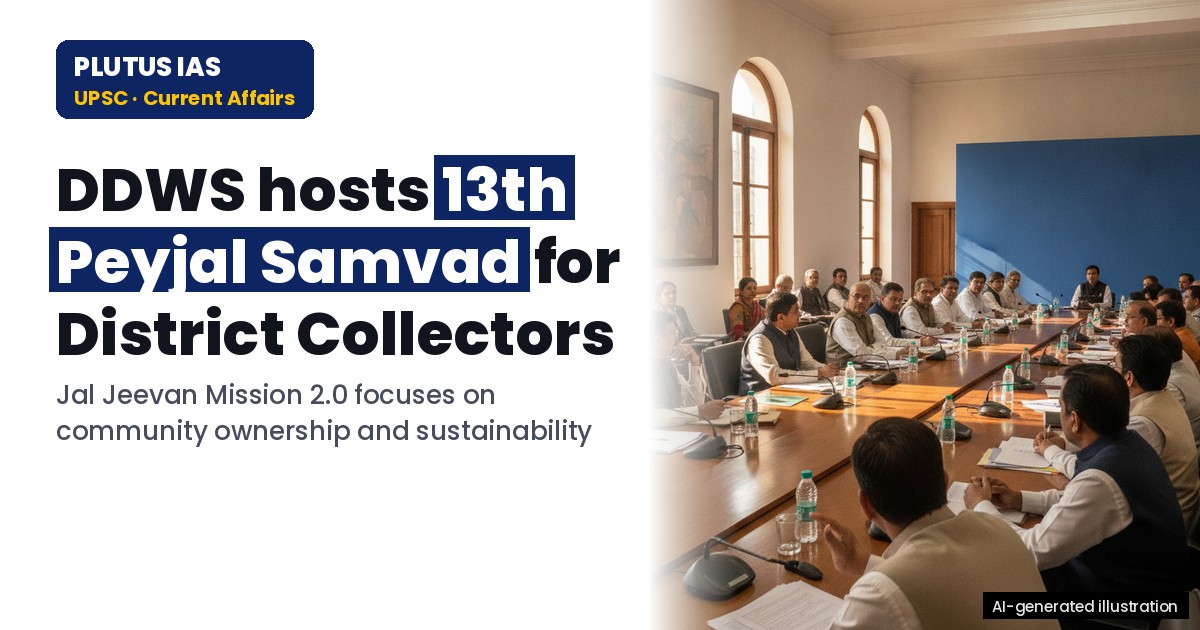
15 Oct Jal Jeevan Mission 2.0: DDWS Hosts 13th Peyjal Samvad for District Collectors
✎ Peyjal Samvad under JJM 2.0 institutionalises district-level governance through community-led water management, ensuring source sustainability, service delivery, and constitutional alignment with Panchayati Raj Institutions.
Subject Relevance — Where This Topic Fits
- GS Paper II — Governance, Public Policy and Good Governance | GS Paper III — Water Resources, Conservation, and Participatory Management
- Prelims: Jal Jeevan Mission (JJM), Jal Jeevan Mission 2.0, Community-led water governance, District Collectors’ role in rural water supply, Source sustainability, Peyjal Samvad, Water User Associations (WUAs), Service delivery under JJM
- Essay: The Role of Local Governance in Sustainable Development: Lessons from Jal Jeevan Mission 2.0, Community Participation as a Catalyst for Public Service Delivery: A Case Study of Water Governance in India
Quick Revision: Peyjal Samvad under JJM 2.0 institutionalises district-level governance through community-led water management, ensuring source sustainability, service delivery, and constitutional alignment with Panchayati Raj Institutions.
Why is this in the news?
The Department of Drinking Water and Sanitation (DDWS), under the Ministry of Jal Shakti, organised the 13th edition of the District Collectors’ Peyjal Samvad to reinforce community ownership, ensure source sustainability, and enhance service delivery under Jal Jeevan Mission 2.0. This initiative underscores the critical shift from centrally-driven water provision to a participatory, decentralised model of water governance, aligning with the constitutional mandate for local self-governance and sustainable development goals.
Background
- Jal Jeevan Mission (JJM), launched in 2019, aims to provide Functional Household Tap Connections (FHTCs) to every rural household by 2024, with a focus on sustainability and equity.
- JJM 2.0, announced in the Union Budget 2025-26, extends the mission’s scope by integrating source sustainability, grey water management, and convergence with other rural development schemes.
- The 73rd Constitutional Amendment Act, 1992, empowers Panchayati Raj Institutions (PRIs) to manage local water resources, including maintenance of water supply systems.
- The National Rural Drinking Water Programme (NRDWP), 2009, laid the foundation for decentralised water governance, emphasising community participation and local ownership.
- District Collectors, as key administrative authorities, play a pivotal role in coordinating multi-stakeholder efforts for water governance under JJM.
- The Peyjal Samvad series, initiated in 2019, serves as a platform for District Collectors to deliberate on challenges, best practices, and innovative solutions for rural water supply.
What is the Peyjal Samvad initiative under Jal Jeevan Mission 2.0?
- Institutionalised dialogue platform: Peyjal Samvad is a periodic convening of District Collectors, senior officials, and local stakeholders to review progress, address bottlenecks, and strategise for sustainable water governance under JJM 2.0.
- Community ownership focus: The initiative prioritises the formation and capacity-building of Water User Associations (WUAs) and Village Water and Sanitation Committees (VWSCs) to ensure local stewardship of water sources and infrastructure.
- Source sustainability emphasis: Peyjal Samvad integrates water source mapping, recharge interventions, and grey water management to mitigate depletion risks and ensure long-term water security.
- Service delivery enhancement: The platform addresses operational challenges such as O&M (Operation and Maintenance) of water supply systems and grievance redressal.
- Multi-stakeholder convergence: The initiative fosters collaboration between PRIs, line departments, NGOs, and community-based organisations to align resources and expertise for holistic water governance.
- Data-driven governance: Peyjal Samvad leverages the JJM dashboard and GIS-based monitoring systems to track progress, identify gaps, and prioritise interventions at the district level.
- Capacity building and knowledge sharing: The platform facilitates peer learning through case studies, best practices, and technical guidance, particularly in water-scarce and aspirational districts.
- Policy alignment with constitutional provisions: The initiative operationalises the directive principles of state policy (Article 47) and the 73rd Amendment, ensuring that water governance is participatory, equitable, and sustainable.
Key Features
| Feature | Significance |
|---|---|
| District Collectors’ Peyjal Samvad | Institutes a multi-stakeholder platform for local governance of water supply, aligning district administration with community needs under Jal Jeevan Mission 2.0. |
| Community Ownership | Emphasizes participatory management of water sources, ensuring sustainability through user involvement and local accountability. |
| Source Sustainability | Focuses on the preservation and augmentation of water sources, integrating traditional knowledge with modern hydro-geological practices. |
| Service Delivery | Strengthens last-mile delivery of potable water, reducing inefficiencies in infrastructure and ensuring equitable access across rural and peri-urban areas. |
| Data-Driven Monitoring | Leverages real-time monitoring systems to track water quality, quantity, and distribution, enabling evidence-based policy adjustments. |
Why it Matters
Governance and Institutional Strengthening
- Enhances the role of District Collectors as nodal officers for water governance, bridging the gap between policy formulation and field-level implementation.
- Fosters inter-departmental coordination among line departments such as Rural Development, Panchayati Raj, and Water Resources, ensuring convergence of schemes.
- Promotes decentralization of decision-making, empowering local bodies to tailor solutions to regional hydrological and socio-economic contexts.
- Strengthens the principle of cooperative federalism by integrating district-level initiatives with national missions like Jal Jeevan Mission 2.0.
Sustainable Development Goals (SDGs)
- Directly contributes to SDG 6 (Clean Water and Sanitation) by ensuring universal and equitable access to safe drinking water.
- Supports SDG 13 (Climate Action) through sustainable water resource management, reducing vulnerability to climate-induced water stress.
- Aligns with SDG 15 (Life on Land) by promoting eco-friendly water harvesting and conservation practices in rural ecosystems.
- Facilitates SDG 1 (No Poverty) and SDG 2 (Zero Hunger) by improving agricultural productivity and reducing the drudgery of water collection, particularly for women and marginalized groups.
Technological and Scientific Integration
- Integrates hydro-geological surveys and remote sensing data to identify water-stressed regions and prioritize interventions.
- Adopts low-cost, low-energy water purification technologies (e.g., solar-powered reverse osmosis) for remote and off-grid habitations.
- Utilizes digital platforms for real-time monitoring of water quality parameters (pH, TDS, bacterial load) and leak detection in distribution networks.
Social Equity and Inclusion
- Ensures gender-sensitive design of water infrastructure, reducing the time burden on women and girls who traditionally bear the responsibility of water collection.
- Prioritizes marginalized communities (Scheduled Castes, Scheduled Tribes, and Other Backward Classes) in water allocation and service delivery, addressing historical inequities.
- Promotes inclusive participation by involving Self-Help Groups (SHGs), Village Water and Sanitation Committees (VWSCs), and local NGOs in planning and monitoring.
Challenges
1. Hydro-Geological Variability
- High spatial variability in groundwater availability and quality across districts necessitates region-specific solutions.
- Depletion of aquifers due to over-extraction and poor recharge mechanisms in arid and semi-arid regions.
- Presence of geogenic contaminants (e.g., arsenic, fluoride) in groundwater, requiring advanced treatment technologies.
UPSC Link: Geography: Water Resources of India
2. Institutional and Administrative Bottlenecks
- Fragmented governance structures with overlapping mandates among multiple departments (e.g., PHED, Panchayati Raj, Rural Development).
- Limited capacity of local bodies (Panchayats, Municipalities) to manage complex water supply systems without external technical support.
- Slow pace of convergence with other central and state schemes (e.g., MGNREGA, PMKSY) due to bureaucratic delays and lack of coordination.
UPSC Link: Polity: Local Governance
3. Financial and Resource Constraints
- Inadequate budgetary allocations for Operation and Maintenance (O&M) of water supply systems, leading to premature system failures.
- Dependence on external funding (e.g., World Bank, ADB) for large-scale projects, raising concerns about long-term sustainability and debt burden.
- Limited private sector participation due to low commercial viability of rural water supply projects.
UPSC Link: Economy: Public Finance
4. Technological and Infrastructure Gaps
- Inadequate last-mile connectivity in hilly and tribal regions, hindering the reach of piped water supply networks.
- Lack of standardized protocols for water quality testing and treatment, leading to inconsistent service delivery.
- Underutilization of indigenous knowledge systems (e.g., traditional water harvesting structures like johads and ahars) due to preference for modern solutions.
UPSC Link: Science: Water Technology
5. Behavioral and Cultural Barriers
- Resistance to behavioral change among communities accustomed to traditional water collection practices (e.g., open wells, hand pumps).
- Low awareness about water conservation and hygiene practices, particularly in areas with high illiteracy rates.
- Caste-based discrimination in access to water sources, perpetuating social inequities despite policy interventions.
UPSC Link: Sociology: Social Inequality
Challenges — UPSC Perspective
| Issue | Concern |
|---|---|
| Groundwater Depletion | Overexploitation of aquifers in regions like Punjab, Rajasthan, and Tamil Nadu has led to declining water tables and increased salinity. |
| Contamination Risks | Geogenic contaminants (e.g., arsenic in West Bengal, fluoride in Rajasthan) pose long-term health risks, requiring costly remediation. |
| Institutional Fragmentation | Overlapping roles of PHED, Panchayati Raj, and Water Resources departments create confusion and delays in project implementation. |
| Financial Sustainability | High capital expenditure for piped water supply systems in remote areas is often not matched by adequate O&M budgets. |
| Climate Vulnerability | Increased frequency of droughts and erratic rainfall patterns exacerbate water scarcity, particularly in rain-fed regions. |
| Community Participation | Low engagement of local communities in planning and maintenance phases reduces project ownership and sustainability. |
Government Initiatives — Must-Memorise for Prelims
- Jal Jeevan Mission 2.0
- National Rural Drinking Water Programme (NRDWP)
- Swachh Bharat Mission (Gramin)
Way Forward
- Constitute District-level Water Management Committees with representation from Panchayats, SHGs, and technical experts to oversee implementation and monitoring.
- Integrate hydro-geological mapping with GIS-based decision support systems to prioritize interventions in water-stressed districts.
- Develop standardized O&M protocols and capacity-building programs for local bodies to ensure long-term sustainability of water supply systems.
- Promote convergence with MGNREGA for natural resource management (e.g., check dams, farm ponds) to enhance groundwater recharge.
- Leverage CSR funds and public-private partnerships (PPPs) to bridge financial gaps in O&M and technology adoption.
- Launch targeted awareness campaigns in collaboration with NGOs and educational institutions to foster behavioral change and community participation.
- Establish a national-level monitoring framework with real-time dashboards to track progress under Jal Jeevan Mission 2.0 across districts.
- Incorporate climate resilience into water infrastructure design, including rainwater harvesting and drought-proofing measures.
UPSC Value Addition
Keywords for Mains Answer-Writing
Jal Jeevan Mission 2.0 · community ownership in water governance · District Collectors’ Peyjal Samvad · source sustainability · service delivery in rural water supply · decentralised water management · 5th Schedule Areas and water governance · Panchayati Raj Institutions and water management · National Rural Drinking Water Programme · Sustainable Development Goal 6 · water quality monitoring · localised participatory models · institutional mechanisms for water governance · convergence of schemes for water security
Constitutional & Policy Linkages
- Article 243G: Empowering Panchayats to manage water supply and sanitation as part of local governance.
- Article 243W: Functions of Municipalities to include planning for water supply and sanitation in urban areas.
Concept Flow
District Collectors’ Peyjal Samvad → Multi-stakeholder dialogue platform → Identification of local water challenges → Integration with Jal Jeevan Mission 2.0 → Community ownership and source sustainability → Strengthened service delivery → Real-time monitoring and adaptive governance → Sustainable water access and SDG 6 compliance.
Prelims Practice Questions
Q1. Consider the following statements about Jal Jeevan Mission 2.0:
1. It is a centrally sponsored scheme aimed at providing tap water connections to all rural households by 2024.
2. The mission emphasises community ownership and source sustainability for long-term water security.
3. It mandates the establishment of Village Water and Sanitation Committees (VWSCs) in every Gram Panchayat.
4. The mission includes a component for grey water management and reuse in rural areas.
How many of the above statements are correct?
- Only one
- Only two
- Only three
- All four
Answer: All four — Statements 1, 2, and 4 are correct. Statement 3 is incorrect as the mission encourages the formation of VWSCs but does not mandate their establishment in every Gram Panchayat.
Q2. Assertion (A): Jal Jeevan Mission 2.0 prioritises decentralised governance through District Collectors’ Peyjal Samvad to enhance community participation in water management.
Reason (R): The mission recognises that sustainable water supply requires convergence of local governance, technical solutions, and community ownership rather than top-down approaches alone.
Options:
A. Both A and R are true, and R is the correct explanation of A.
B. Both A and R are true, but R is not the correct explanation of A.
C. A is true, but R is false.
D. A is false, but R is true.
Answer: ? — Both Assertion (A) and Reason (R) are true, and Reason (R) correctly explains Assertion (A). The mission’s focus on District Collectors’ Peyjal Samvad is a strategic move to integrate local governance, technical expertise, and community participation for sustainable water management.
Q3. Match the following initiatives with their respective objectives under Jal Jeevan Mission 2.0:
Column I (Initiative)
A. Community Water Plus (CWP) programme
B. Har Ghar Jal Suraksha
C. Grey Water Management
D. Source Sustainability Plans
Column II (Objective)
1. Ensuring water quality through regular testing and monitoring
2. Promoting reuse of wastewater for non-potable purposes
3. Achieving ODF+ status with 100% functional household tap connections
4. Ensuring long-term viability of water sources through recharge and conservation
Options:
A-1, B-3, C-2, D-4
A-3, B-1, C-4, D-2
A-4, B-2, C-3, D-1
A-2, B-4, C-1, D-3
Answer: ? — The correct match is: A-1 (Community Water Plus programme focuses on ensuring water quality), B-3 (Har Ghar Jal Suraksha aims for 100% functional household tap connections), C-2 (Grey Water Management promotes wastewater reuse), and D-4 (Source Sustainability Plans ensure long-term viability of water sources).
Mains Practice Question
✍ The Jal Jeevan Mission 2.0 represents a paradigm shift from supply-driven to demand-driven and community-centric water governance in rural India. Critically examine the institutional mechanisms underpinning this shift, with particular reference to the role of District Collectors’ Peyjal Samvad, Panchayati Raj Institutions, and convergence with other rural development schemes. Also, analyse the challenges in operationalising community ownership in water governance. (15 Marks)
Approach: MODEL-ANSWER SKELETON:
1. **Introduction (2 Marks)**
– Briefly define Jal Jeevan Mission 2.0 and its objectives under the National Rural Drinking Water Programme (NRDWP).
– Highlight the shift from Jal Jeevan Mission to Jal Jeevan Mission 2.0: emphasis on sustainability, community ownership, and source sustainability.
2. **Institutional Mechanisms for Community-Centric Governance (5 Marks)**
– **District Collectors’ Peyjal Samvad**: Role as a platform for convergence between district administration, technical agencies, and local communities; its mandate to address water quality, source sustainability, and service delivery gaps.
– **Panchayati Raj Institutions (PRIs)**: Legal framework under the 73rd Amendment Act, 1992; the role of Gram Panchayats in planning, implementation, and monitoring of water schemes; Village Water and Sanitation Committees (VWSCs) as community-based institutions.
– **Convergence with other schemes**: Linkages with Mahatma Gandhi National Rural Employment Guarantee Scheme (MGNREGS) for water conservation works, Swachh Bharat Mission (SBM) 2.0 for grey water management, and Integrated Watershed Management Programme (IWMP) for source sustainability.
3. **Community Ownership: Theoretical and Practical Dimensions (4 Marks)**
– **Conceptual basis**: Community ownership as a means to ensure long-term sustainability, reduce maintenance costs, and enhance accountability (refer to Ostrom’s principles of collective action).
– **Operational challenges**: Low awareness among communities, lack of technical capacity, gendered barriers in participation, resistance to change from traditional water management practices, and inadequate financial resources for maintenance.
– **Case studies**: Reference to successful models (e.g., community-managed piped water schemes in Kerala, Maharashtra) and failures (e.g., non-functional schemes due to lack of community engagement).
4. **Challenges in Operationalising Community Ownership (3 Marks)**
– **Institutional challenges**: Weak capacity of PRIs, lack of convergence between line departments, and top-down planning processes.
– **Socio-economic challenges**: Marginalisation of vulnerable groups (women, SCs, STs), land tenure issues, and conflicts over water rights.
– **Technical challenges**: Limited access to hydro-geological data, inadequate training for community leaders, and poor maintenance of infrastructure.
5. **Conclusion (1 Mark)**
– Summarise the need for a multi-stakeholder approach combining institutional reforms, capacity building, and community engagement.
– Emphasise the role of District Collectors’ Peyjal Samvad as a catalytic platform for achieving the mission’s goals.
Source: PIB (Press Information Bureau)
Generated by AanyaAi for educational purpose.
Related guides on our sites
- Best PSIR optional coaching for upsc
- Best PSIR optional teacher for upsc
- Best teacher of PSIR optional for upsc
- Best PSIR optional coaching in delhi for UPSC

- NAMASTE Scheme: Enhancing Sanitation Workers’ Livelihoods & Safety - November 14, 2026
- एमएसएमई का विशेष अभियान 6.0: स्वच्छता और लंबित मामलों का निपटारा - November 14, 2026
- Sea Vigil-26: Coastal Defence Drills Off Visakhapatnam - November 14, 2026

No Comments