


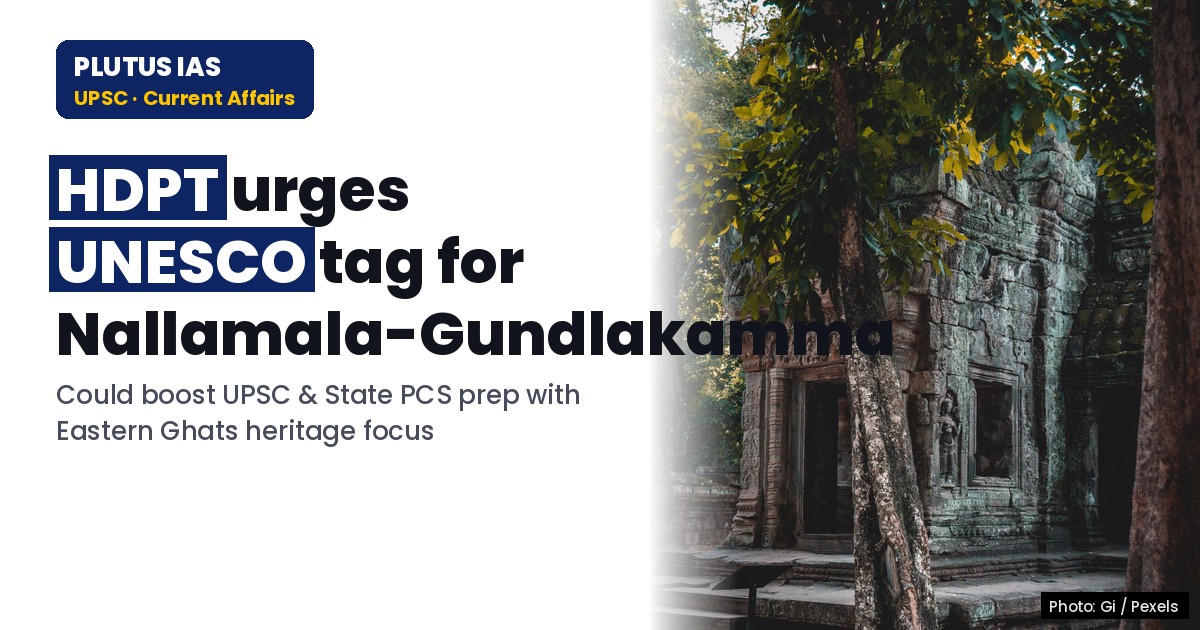
15 Oct HDPT Pushes UNESCO Tag for Nallamala-Gundlakamma for UPSC & State PCS
✎ The Nallamala Sanctuary – River Gundlakamma proposal seeks UNESCO World Heritage recognition under the 'mixed' category, combining natural biodiversity and cultural heritage, to address the underrepresentation of the Eastern…
Subject Relevance — Where This Topic Fits
- GS Paper II — International Relations (UNESCO and global heritage governance) | GS Paper III — Environment, Ecology, Biodiversity and Climate Change (conservation of biodiversity, protected areas, and global heritage recognition)
- Prelims: Nallamala Sanctuary, UNESCO World Heritage Sites, Eastern Ghats biodiversity, Mixed World Heritage Sites, River Gundlakamma, Khangchendzonga National Park, UNESCO Operational Guidelines, Cultural Landscape, Biodiversity Hotspot, Convention Concerning the Protection of the World Cultural and Natural Heritage (1972)
- Essay: The interplay between cultural heritage and environmental conservation in the 21st century, Global governance mechanisms for preserving biodiversity and indigenous traditions
Quick Revision: The Nallamala Sanctuary – River Gundlakamma proposal seeks UNESCO World Heritage recognition under the ‘mixed’ category, combining natural biodiversity and cultural heritage, to address the underrepresentation of the Eastern Ghats in global conservation frameworks.
Why is this in the news?
The Hindu Dharma Parirakshana Trust (HDPT) has proposed the inclusion of the Nallamala Sanctuary and River Gundlakamma in Andhra Pradesh under the UNESCO World Heritage List, citing its dual significance as a natural and cultural landscape. This proposal, advanced through a nine-day padayatra and advocacy efforts, underscores the need for global recognition of the Eastern Ghats’ ecological and heritage value, which remains underrepresented in international conservation frameworks.
Background
- The Eastern Ghats, a discontinuous range of mountains along India’s eastern coast, constitute one of the world’s biodiversity hotspots but are critically underrepresented in global conservation initiatives such as the UNESCO World Heritage List.
- The Nallamala Sanctuary, part of the Eastern Ghats, is a protected area known for its dense forests, endemic flora and fauna, and cultural heritage sites like the Chandavaram Buddhist Stupa.
- UNESCO’s World Heritage Convention (1972) provides a framework for identifying and protecting sites of outstanding universal value, with criteria encompassing natural, cultural, and mixed heritage.
- The proposal aligns with global efforts to address the conservation of biodiversity-rich yet underrepresented regions, particularly in the context of climate change and anthropogenic pressures.
- The HDPT’s initiative follows a structured advocacy process, including a padayatra to raise awareness and direct engagement with state and central government authorities.
What is the Nallamala Sanctuary – River Gundlakamma Proposal?
- The proposal seeks UNESCO World Heritage recognition for the Nallamala Sanctuary and River Gundlakamma as a ‘mixed’ site, combining natural and cultural significance under the UNESCO Operational Guidelines.
- Nallamala Sanctuary is a protected forest area in the Eastern Ghats, known for its biodiversity, including species like the red sanders, sloth bear, and leopard, as well as its role in watershed conservation for the Gundlakamma River basin.
- River Gundlakamma flows through the sanctuary and is integral to the region’s ecological and cultural heritage, supporting agriculture, traditional livelihoods, and historic settlements.
- The proposal highlights the presence of ancient temples, Buddhist stupas (e.g., Chandavaram), and other archaeological sites that reflect the region’s historical and cultural continuity.
- UNESCO’s ‘mixed’ category recognises sites that exhibit both natural and cultural significance, such as Khangchendzonga National Park, which combines glacial landscapes with indigenous traditions and Buddhist heritage.
- The inclusion of the Nallamala Sanctuary – River Gundlakamma would address the geographical imbalance in India’s World Heritage Sites, which are concentrated in the Himalayas, Western Ghats, and the Indo-Gangetic Plain.
- The proposal emphasises the need for conservation measures to mitigate threats such as deforestation, mining, and climate change impacts on the Eastern Ghats’ fragile ecosystem.
- The HDPT’s advocacy includes a nine-day padayatra along the Gundlakamma River to mobilise local communities and highlight the region’s heritage value, followed by formal submissions to state and central authorities.
Key Features
| Feature | Significance |
|---|---|
| Nallamala Sanctuary | A critical Eastern Ghats biodiversity hotspot housing endemic flora and fauna, including the red sanders (Pterocarpus santalinus) and several endangered species such as the Indian leopard and the yellow-throated bulbul. |
| River Gundlakamma | A vital perennial river sustaining the sanctuary’s ecosystem, supporting agricultural communities downstream and serving as a cultural lifeline with historical settlements along its banks. |
| Chandavaram Buddhist Stupa | An ancient archaeological site dating to the 3rd century BCE, representing the syncretic cultural heritage of the region and its historical significance in the spread of Buddhism. |
| Mixed World Heritage Site Criteria | UNESCO’s dual classification system that recognises sites of outstanding universal value combining natural and cultural attributes, exemplified by Khangchendzonga National Park. |
| Eastern Ghats Biodiversity | One of India’s least studied and under-represented ecological regions, with high levels of endemism and ecological services such as water regulation and carbon sequestration. |
Why it Matters
Ecological Significance
- The Nallamala Sanctuary is part of the Eastern Ghats, a globally significant biodiversity area with high levels of endemism, particularly in flora and avifauna.
- The sanctuary serves as a critical corridor for wildlife movement between the Eastern and Western Ghats, maintaining genetic diversity.
- River Gundlakamma’s perennial flow supports riparian ecosystems, which are among the most threatened habitats in India due to anthropogenic pressures.
- The region’s ecological services, including watershed protection and carbon sequestration, are vital for climate resilience in peninsular India.
Cultural and Historical Significance
- The Chandavaram Buddhist Stupa is a key archaeological site from the Satavahana period, reflecting the region’s role in the spread of Buddhism and trade routes.
- The sanctuary is interspersed with ancient temples and historic sites, indicating continuous human habitation and cultural evolution over millennia.
- The syncretic heritage of the region, blending indigenous traditions with historical influences, provides a unique narrative for UNESCO recognition.
- The river Gundlakamma has been a cultural lifeline, with settlements along its banks preserving traditional knowledge systems and livelihood practices.
Strategic and Policy Significance
- UNESCO World Heritage status would provide international legal protection, enhancing conservation efforts and attracting global funding for the region.
- The recognition would address the under-representation of the Eastern Ghats in global conservation frameworks, balancing India’s World Heritage portfolio.
- It would catalyse inter-state and inter-ministerial coordination for integrated conservation, aligning with India’s commitments under the Convention Concerning the Protection of the World Cultural and Natural Heritage (1972).
- The proposal aligns with India’s broader strategy to leverage cultural and natural heritage for sustainable tourism and community livelihoods.
Legal and Governance Significance
- The proposal underscores the role of civil society organisations (e.g., HDPT) in advocating for heritage conservation, complementing government-led initiatives.
- It highlights the need for a robust legal framework to protect mixed heritage sites, integrating provisions under the Wildlife Protection Act, 1972, and the Ancient Monuments and Archaeological Sites and Remains Act, 1958.
- The initiative demonstrates the potential of community-driven conservation models in achieving national and international heritage goals.
Challenges
1. Anthropogenic Pressures and Habitat Fragmentation
- Encroachment for agriculture, mining (e.g., granite and bauxite), and infrastructure projects (roads, dams) threatens the sanctuary’s ecological integrity.
- Unregulated tourism and pilgrimage activities (e.g., to temples within the sanctuary) exert pressure on fragile ecosystems.
- Climate change-induced events (e.g., droughts, forest fires) exacerbate habitat degradation and species vulnerability.
UPSC Link: Environmental degradation and conservation challenges
2. Institutional and Governance Gaps
- Limited coordination between forest, culture, and tourism departments hampers integrated conservation planning.
- Inadequate funding and technical capacity for heritage documentation and conservation in state agencies.
- Weak enforcement of environmental laws due to resource constraints and competing developmental priorities.
UPSC Link: Governance and policy implementation challenges
3. Cultural Heritage Management Challenges
- Lack of systematic archaeological surveys and documentation for many historic sites within the sanctuary.
- Insufficient community involvement in heritage conservation, leading to neglect of traditional knowledge systems.
- Balancing conservation with the needs of local communities dependent on forest resources for livelihoods.
UPSC Link: Cultural heritage preservation and community engagement
4. UNESCO Nomination Process Complexities
- Meeting UNESCO’s stringent criteria for mixed sites requires comprehensive documentation of natural and cultural attributes.
- Competition with other Indian sites for limited slots in UNESCO’s tentative list and eventual inscription.
- Ensuring long-term monitoring and management plans post-recognition to maintain World Heritage status.
UPSC Link: International conventions and heritage management
5. Awareness and Advocacy Gaps
- Limited public awareness about the ecological and cultural significance of the Eastern Ghats.
- Need for sustained advocacy by civil society, academia, and media to build consensus for heritage recognition.
- Addressing misconceptions about World Heritage status potentially restricting local development.
UPSC Link: Public participation in environmental governance
Challenges — UPSC Perspective
| Issue | Concern |
|---|---|
| Mining and Quarrying | Unregulated extraction of minerals degrades habitats and disrupts ecological connectivity. |
| Agricultural Expansion | Shifting cultivation and monoculture plantations reduce forest cover and biodiversity. |
| Tourism and Pilgrimage | Unplanned tourism infrastructure and footfall damage sensitive ecosystems. |
| Climate Change | Increased frequency of droughts and forest fires threatens species survival. |
| Archaeological Neglect | Lack of systematic surveys and conservation of ancient sites. |
| Inter-Departmental Coordination | Fragmented governance impedes integrated conservation efforts. |
Way Forward
- Conduct a comprehensive ecological and cultural assessment of the Nallamala Sanctuary–River Gundlakamma to document its outstanding universal value for UNESCO nomination.
- Strengthen inter-departmental coordination between the State Forest Department, Archaeological Survey of India (ASI), and Ministry of Culture to align conservation priorities.
- Develop a robust management plan with clear roles for local communities, civil society, and government agencies to ensure sustainable conservation post-recognition.
- Enhance public awareness campaigns to highlight the ecological and cultural significance of the Eastern Ghats, fostering community stewardship.
- Leverage India’s tentative list submissions to UNESCO to prioritise the Nallamala Sanctuary–River Gundlakamma for nomination, aligning with global conservation goals.
- Integrate climate resilience strategies into conservation plans to address vulnerabilities posed by climate change.
- Establish a dedicated fund for heritage conservation, combining state, central, and international resources (e.g., UNESCO’s World Heritage Fund).
- Promote eco-tourism models that balance conservation with livelihood generation, ensuring benefits accrue to local communities.
UPSC Value Addition
Keywords for Mains Answer-Writing
UNESCO World Heritage Sites · Nallamala Sanctuary · Eastern Ghats biodiversity · cultural landscape · mixed World Heritage Sites · UNESCO 1972 Convention · biodiversity conservation · indigenous heritage · Andhra Pradesh conservation · UNESCO World Heritage Committee · Khangchendzonga National Park · River Gundlakamma · Chandavaram Buddhist Stupa · environmental governance · ecological significance of Eastern Ghats
Concept Flow
Civil society advocacy (HDPT’s Padayatra) → Documentation of ecological and cultural significance → Proposal for UNESCO recognition → State and central government engagement → UNESCO tentative list submission → International evaluation → World Heritage inscription → Integrated conservation and management plan → Sustainable development and community engagement.
Prelims Practice Questions
Q1. Consider the following statements regarding UNESCO World Heritage Sites in India:
1. Khangchendzonga National Park is India’s first ‘Mixed’ World Heritage Site recognised by UNESCO.
2. The UNESCO World Heritage Convention was adopted in 1972.
3. The Nallamala Sanctuary is located entirely within the Western Ghats.
4. The UNESCO World Heritage Committee is responsible for the implementation of the World Heritage Convention.
How many of the above statements are correct?
- Only one
- Only two
- Only three
- All
Answer: Only three — Statements 1, 2, and 4 are correct. Statement 3 is incorrect because the Nallamala Sanctuary is located in the Eastern Ghats, not the Western Ghats.
Q2. Assertion (A): The UNESCO World Heritage Convention of 1972 aims to protect both cultural and natural heritage.
Reason (R): The Convention establishes a framework for international cooperation to identify and conserve sites of outstanding universal value.
Options:
A. Both A and R are true, and R is the correct explanation of A.
B. Both A and R are true, but R is not the correct explanation of A.
C. A is true, but R is false.
D. A is false, but R is true.
Answer: ? — Both Assertion (A) and Reason (R) are true, and Reason (R) correctly explains Assertion (A). The 1972 Convention explicitly recognises both cultural and natural heritage as part of its mandate.
Q3. Match the following pairs related to UNESCO World Heritage Sites in India:
Column I (Site) | Column II (State)
——————————————|——————————————
A. Khangchendzonga National Park | 1. Sikkim
B. Western Ghats | 2. Maharashtra
C. Elephanta Caves | 3. Kerala
D. Sundarbans | 4. West Bengal
Options:
A. A-1, B-3, C-2, D-4
B. A-2, B-1, C-4, D-3
C. A-1, B-2, C-3, D-4
D. A-4, B-3, C-2, D-1
Answer: ? — Correct matches are: A-1 (Khangchendzonga National Park is in Sikkim), B-3 (Western Ghats span multiple states including Kerala), C-2 (Elephanta Caves are in Maharashtra), D-4 (Sundarbans are in West Bengal).
Mains Practice Question
✍ The proposal to seek UNESCO World Heritage Site status for the ‘Nallamala Sanctuary – River Gundlakamma’ underscores the need to protect India’s Eastern Ghats biodiversity and cultural heritage. Critically examine the significance of such recognition for India’s conservation efforts and the procedural pathway for achieving it. (15 Marks)
Approach: MODEL-ANSWER SKELETON:
1. **Introduction (2 marks)**: Define UNESCO World Heritage Sites and the dual criteria of ‘Outstanding Universal Value’ (OUV) under the 1972 Convention, citing the ‘cultural’ and ‘natural’ categories. Reference the Khangchendzonga National Park as India’s first ‘Mixed’ site.
2. **Significance for Nallamala Sanctuary (5 marks)**:
– **Biodiversity**: Highlight the ecological uniqueness of the Eastern Ghats, including endemic flora/fauna, and its role in the Eastern Ghats biodiversity hotspot.
– **Cultural Heritage**: Link the Chandavaram Buddhist Stupa and other ancient temples to India’s cultural continuum, emphasising the ‘cultural landscape’ concept under UNESCO guidelines.
– **Conservation Imperative**: Discuss threats such as deforestation, mining, and climate change, and how UNESCO status could provide legal and financial safeguards.
3. **Procedural Pathway (5 marks)**:
– **Nomination Process**: Outline the steps under UNESCO’s Operational Guidelines: tentative list submission by India, preparation of a nomination dossier, and evaluation by IUCN/ICOMOS.
– **Role of Central and State Governments**: Explain the constitutional division of powers (Entry 13 in the Union List for ‘Ancient and Historical Monuments’), and the need for inter-state coordination.
– **Stakeholder Engagement**: Highlight the role of local communities, NGOs, and the HDPT in raising awareness and mobilising support.
4. **Challenges and Way Forward (3 marks)**:
– **Under-representation**: Note that the Eastern Ghats lack UNESCO representation, unlike the Himalayas or Western Ghats.
– **Balancing Development and Conservation**: Discuss potential conflicts with infrastructure projects (e.g., Polavaram Dam) and the need for sustainable tourism policies.
– **Conclusion**: Argue that UNESCO recognition would elevate India’s global conservation profile while ensuring long-term ecological and cultural preservation.
Source: The Hindu
Generated by AanyaAi for educational purpose.
Related guides on our sites
- How to prepare for GS paper 1 for UPSC CSE mains exam
- Best UPSC coaching for IFOS exam
- Best mentorship programme for upsc
- UPSC+BA degree

- NAMASTE Scheme: Enhancing Sanitation Workers’ Livelihoods & Safety - November 14, 2026
- एमएसएमई का विशेष अभियान 6.0: स्वच्छता और लंबित मामलों का निपटारा - November 14, 2026
- Sea Vigil-26: Coastal Defence Drills Off Visakhapatnam - November 14, 2026

No Comments