


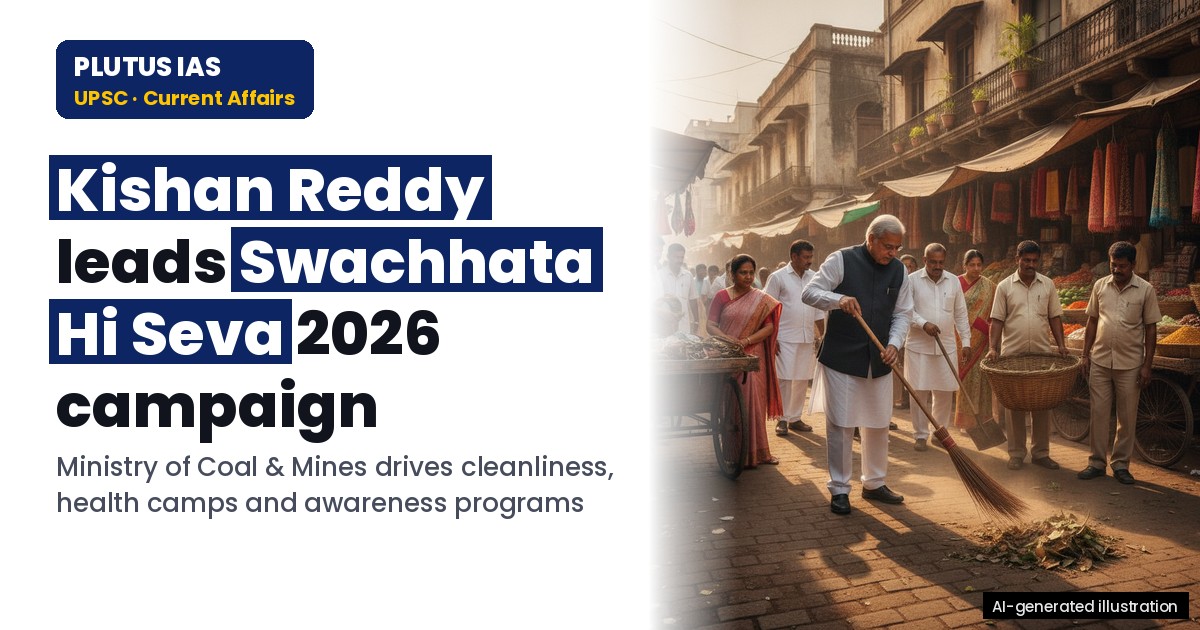
17 Oct Ministry of Coal Joins Swachhata Hi Seva 2026: Key Initiatives & Impact
✎ Swachhata Hi Seva (SHS) 2026 institutionalises cleanliness as a governance practice by mandating public participation, institutional accountability, and sustainable waste management, with the Ministry of Coal and Mines…
Subject Relevance — Where This Topic Fits
- GS Paper II — Governance, Constitution, Polity, Social Justice and International Relations (Role of Ministries in Public Service Delivery) | GS Paper III — Environment, Disaster Management and Sustainable Development (Swachh Bharat Mission, Solid Waste Management)
- Prelims: Swachhata Hi Seva (SHS) campaign, Swachh Bharat Mission, Cleanliness Targeted Units (CTUs), Safai Mitras, Solid Waste Management Rules 2016, Plastic Waste Management Rules 2022, Mission LiFE, Public Participation in Governance
- Essay: The Role of Institutions in Promoting Sustainable Development: A Case Study of Swachhata Hi Seva 2026, Public Participation as the Bedrock of National Progress
Quick Revision: Swachhata Hi Seva (SHS) 2026 institutionalises cleanliness as a governance practice by mandating public participation, institutional accountability, and sustainable waste management, with the Ministry of Coal and Mines demonstrating leadership through targeted cleanliness drives and welfare initiatives for sanitation workers.
Why is this in the news?
The Ministry of Coal and Mines, along with its regional offices, actively participated in the Swachhata Hi Seva (SHS) 2026 campaign, demonstrating institutional commitment to cleanliness, environmental responsibility, and public participation. The campaign underscored the ministry’s role in transforming Swachh Bharat Mission principles into tangible governance outcomes through targeted interventions such as the rejuvenation of Cleanliness Targeted Units (CTUs), cleaning of public spaces, and welfare initiatives for sanitation workers. This participation aligns with the broader national agenda of institutionalising cleanliness as a daily governance practice rather than a periodic campaign.
Background
- The Swachh Bharat Mission (SBM), launched in 2014, is India’s flagship programme for achieving universal sanitation and cleanliness, with a target of making the country Open Defecation Free (ODF) and ensuring sustainable solid waste management.
- Swachhata Hi Seva (SHS) is an annual, time-bound campaign launched in 2017 to mobilise public participation in cleanliness drives, with a focus on behavioural change and institutional engagement.
- The Ministry of Coal and Mines oversees the coal and mining sectors, which are critical to India’s energy security but also generate significant environmental challenges, including waste management and land degradation.
- The Solid Waste Management Rules, 2016, and Plastic Waste Management Rules, 2022, mandate the segregation, collection, and scientific disposal of waste, placing legal obligations on urban local bodies and institutions.
- Mission LiFE (Lifestyle for Environment), launched in 2022, promotes sustainable living practices, including waste reduction and circular economy principles, complementing SHS efforts.
What is Swachhata Hi Seva (SHS) 2026 and the Ministry of Coal and Mines’ Role?
- Swachhata Hi Seva (SHS) 2026 is the annual cleanliness campaign, designed to foster public participation and institutional accountability in achieving a cleaner, healthier, and more sustainable India.
- The campaign operates on the principle of ‘Jan Bhagidari’ (public participation), encouraging citizens, institutions, and communities to contribute to cleanliness through shramdaan (voluntary labour), awareness drives, and waste management initiatives.
- The Ministry of Coal and Mines participated in SHS 2026 through a multi-pronged approach, including the rejuvenation of Cleanliness Targeted Units (CTUs), cleaning of public spaces (e.g., markets, temples, lakes), and health camps for sanitation workers (‘Safai Mitras’).
- Cleanliness Targeted Units (CTUs) are designated spaces within institutions or public areas that are prioritised for regular cleaning, maintenance, and behavioural change interventions to ensure sustained cleanliness.
- The ministry’s involvement included the cleaning of 59 public spaces with 5,498 participants and the rejuvenation of 136 CTUs with 10,723 contributors, demonstrating measurable institutional engagement.
- Health camps for Safai Mitras were organised to address occupational health risks, underscoring the ministry’s commitment to the welfare and dignity of sanitation workers, who are often marginalised despite their critical role in public health.
- The campaign also promoted creative waste management through competitions such as essay writing and art made from waste, aligning with the principles of circular economy and sustainable consumption.
- SHS 2026 aligns with the broader objectives of Mission LiFE, which advocates for sustainable lifestyles and institutional practices that reduce environmental footprint while enhancing public well-being.
Key Features
| Feature | Significance |
|---|---|
| Participation by Ministry and Regional Offices | Demonstrates inter-institutional coordination and decentralised implementation of national sanitation goals under Swachh Bharat Mission. |
| Rejuvenation of Cleanliness Targeted Units (CTUs) | Ensures sustained cleanliness in institutional premises, reflecting long-term infrastructure and behavioural change. |
| Public Site Cleaning Initiatives | Addresses civic cleanliness in high-footfall areas, enhancing urban environmental governance. |
| Welfare Camps for Sanitation Workers | Upholds dignity of labour by providing health services, aligning with constitutional directive principles of Article 42. |
| Awareness and Competitions in Schools | Fosters environmental consciousness among youth, embedding sustainability as a cultural value from an early age. |
Why it Matters
Governance and Institutional Efficiency
- Highlights the role of line ministries in operationalising national missions through field-level action, reinforcing the principle of cooperative federalism.
- Showcases the integration of sanitation with health, labour welfare, and education—key pillars of sustainable development.
- Illustrates the use of symbolic acts (oath-taking) to institutionalise behavioural change, a technique rooted in behavioural public policy.
Environmental Sustainability
- Reinforces the link between cleanliness and ecological health, particularly through waterbody cleaning and waste management.
- Promotes circular economy principles via waste-to-art competitions, aligning with SDG 12 (Responsible Consumption and Production).
Social Equity and Inclusion
- Recognises the contribution of sanitation workers through health camps, addressing occupational health disparities.
- Encourages public participation across socio-economic strata, ensuring inclusive ownership of sanitation goals.
Challenges
1. Sustaining Behavioural Change Post-Campaign
- Risk of campaign fatigue leading to relapse into pre-intervention practices.
- Need for continuous reinforcement mechanisms such as monitoring, incentives, and community feedback loops.
UPSC Link: GS-II: Governance
2. Resource Allocation for Long-Term Maintenance
- Limited budgetary provisions for post-campaign upkeep of cleaned sites and infrastructure.
- Dependence on voluntary labour (e.g., shramdaan) may not suffice for large-scale, year-round operations.
UPSC Link: GS-III: Resource Mobilisation
3. Inclusivity in Participation
- Ensuring marginalised groups (e.g., sanitation workers, informal sector) are not merely beneficiaries but active decision-makers.
- Language barriers and digital divide may limit outreach in diverse linguistic and socio-economic contexts.
UPSC Link: GS-II: Social Justice
4. Monitoring and Accountability Gaps
- Absence of real-time data systems to track progress and address lapses in cleanliness standards.
- Need for third-party audits to prevent tokenism and ensure genuine impact assessment.
UPSC Link: GS-IV: Ethics and Integrity
Challenges — UPSC Perspective
| Issue | Concern |
|---|---|
| Post-Campaign Behavioural Relapse | Risk of reverting to pre-intervention hygiene practices due to lack of reinforcement. |
| Infrastructure Maintenance Costs | High recurring expenditure for upkeep of cleaned public spaces and facilities. |
| Participation Disparities | Unequal engagement across urban-rural and socio-economic divides. |
| Data Gaps in Impact Assessment | Inadequate mechanisms to measure long-term outcomes of sanitation initiatives. |
| Occupational Health Risks for Sanitation Workers | Persistent exposure to hazardous conditions despite welfare measures. |
Way Forward
- Establish a multi-stakeholder monitoring committee to oversee post-campaign cleanliness standards and address lapses.
- Integrate sanitation metrics into existing urban governance frameworks (e.g., Smart Cities Mission) for sustained accountability.
- Expand digital platforms for real-time reporting of cleanliness issues by citizens, ensuring transparency.
- Institutionalise health camps for sanitation workers as an annual feature, with linkages to national health schemes.
- Design modular training programmes for municipal staff and community leaders to sustain behavioural change.
- Promote public-private partnerships for waste management in high-footfall areas to reduce municipal burden.
- Conduct periodic audits by independent agencies to validate the impact of rejuvenated CTUs and cleaned sites.
UPSC Value Addition
Keywords for Mains Answer-Writing
Swachh Bharat Mission · Swachhata Hi Seva Campaign 2026 · Cleanliness Targeted Units (CTUs) · Safai Mitras welfare · public participation in sanitation · Ministry of Coal and Mines · environmental responsibility · collective action for cleanliness · sustainable India · public health and sanitation · Swachhata Shapath · waste management and recycling · health camps for sanitation workers · rejuvenation of public spaces · Jan Bhagidari in governance
Constitutional & Policy Linkages
- Article 48A: Directive Principle of State Policy on protection and improvement of environment.
- Article 51A(g): Fundamental Duty to protect and improve the natural environment.
Concept Flow
National sanitation mission (Swachh Bharat Mission) → Ministry-led decentralised implementation → Regional office participation → Field-level activities (CTU rejuvenation, public site cleaning) → Behavioural reinforcement (oath-taking, competitions) → Environmental and social outcomes (cleanliness, health, equity). → Public site cleaning → Enhanced civic governance → Reduced disease burden → Improved quality of life. → Welfare camps for sanitation workers → Recognition of labour dignity → Compliance with Article 42 (just and humane conditions of work). → School-based awareness programmes → Youth engagement → Cultural shift towards sustainability. → Post-campaign maintenance → Institutionalisation of cleanliness → Long-term environmental sustainability.
Prelims Practice Questions
Q1. Consider the following statements about the Swachhata Hi Seva (SHS) Campaign 2026:
1. The campaign was launched under the aegis of the Ministry of Coal and Mines.
2. It included the rejuvenation of Cleanliness Targeted Units (CTUs) and public spaces.
3. The campaign mandated the participation of only government officials, excluding public involvement.
4. Health camps were organized exclusively for senior administrative officers.
How many of the above statements are correct?
- Only one
- Only two
- Only three
- All
Answer: Only three — Statements 1 and 2 are correct as the campaign was initiated by the Ministry of Coal and Mines and involved rejuvenation of CTUs and public spaces. Statement 3 is incorrect because the campaign emphasized public participation. Statement 4 is incorrect as health camps were organized for Safai Mitras and sanitation workers.
Q2. Assertion (A): The Swachhata Hi Seva Campaign 2026 included initiatives for the welfare of Safai Mitras.
Reason (R): The campaign aimed to integrate cleanliness into daily life and recognize the contributions of sanitation workers.
In the context of the above two statements, which one of the following is correct?
- Both A and R are true, and R is the correct explanation of A
- Both A and R are true, but R is not the correct explanation of A
- A is true, but R is false
- A is false, but R is true
Answer: Both A and R are true, and R is the correct explanation of A — Both the Assertion (A) and Reason (R) are true, and R correctly explains A. The campaign explicitly included welfare measures for Safai Mitras as part of its broader objectives.
Q3. Match the following initiatives under the Swachhata Hi Seva Campaign 2026 with their respective objectives:
Column I (Initiative) | Column II (Objective)
———————————————–|———————————————–
A. Rejuvenation of Cleanliness Targeted Units | 1. Promoting public participation in cleanliness
B. Health camps for Safai Mitras | 2. Recognizing and supporting sanitation workers
C. Essay writing competitions in schools | 3. Enhancing environmental awareness
D. Cleaning of public lakes and water bodies | 4. Rejuvenating designated cleanliness units
Select the correct match:
- A-4, B-2, C-3, D-1
- A-1, B-2, C-3, D-4
- A-4, B-3, C-2, D-1
- A-2, B-4, C-1, D-3
Answer: A-4, B-2, C-3, D-1 — A matches with 4 (Rejuvenation of CTUs), B with 2 (Health camps for Safai Mitras), C with 3 (Essay writing competitions for awareness), and D with 1 (Cleaning of public lakes and water bodies).
Mains Practice Question
✍ The Swachhata Hi Seva Campaign 2026, spearheaded by the Ministry of Coal and Mines, exemplifies the integration of environmental responsibility, public participation, and institutional commitment in achieving the goals of the Swachhata Bharat Mission. Critically examine the significance of such campaigns in fostering a sustainable and healthy society. Also, assess the role of government-led initiatives in ensuring long-term behavioral change towards cleanliness and environmental stewardship. (15 Marks)
Approach: MODEL-ANSWER SKELETON:
1. **Introduction**: Define the Swachhata Hi Seva Campaign 2026 and its alignment with the Swachh Bharat Mission. Highlight its objectives: rejuvenation of Cleanliness Targeted Units (CTUs), public space sanitation, Safai Mitras welfare, and environmental awareness.
2. **Significance of Campaigns like SHS**:
– **Collective Action**: Emphasize the role of collective responsibility (Jan Bhagidari) in achieving sustainable cleanliness, citing examples from the campaign (e.g., participation of 10,723 individuals in CTU rejuvenation).
– **Behavioral Change**: Discuss how such campaigns can instill long-term habits of cleanliness, supported by behavioral science principles (e.g., nudges, social norms).
– **Environmental Stewardship**: Link cleanliness to broader environmental goals, such as waste management, recycling, and public health outcomes.
3. **Role of Government-Led Initiatives**:
– **Institutional Commitment**: Highlight the Ministry’s leadership (e.g., Swachhata Shapath, health camps for Safai Mitras) in setting standards and mobilizing resources.
– **Policy Frameworks**: Reference the Swachh Bharat Mission (SBM) 2.0 and its focus on ODF+ and ODF++ protocols, which SHS aligns with.
– **Public-Private Partnerships**: Discuss how such campaigns can leverage partnerships with NGOs, schools, and local bodies to amplify impact.
4. **Challenges and Limitations**:
– **Sustainability**: Address concerns about the durability of campaign-driven cleanliness (e.g., post-campaign maintenance, community fatigue).
– **Inclusivity**: Critique whether such initiatives reach marginalized groups (e.g., Safai Mitras, rural areas) equitably.
– **Data and Monitoring**: Highlight the need for robust monitoring mechanisms to track long-term outcomes.
5. **Comparative Perspective**:
– Compare SHS with other national campaigns (e.g., Namami Gange, Swachh Vidyalaya Abhiyan) to draw lessons on scalability and effectiveness.
6. **Conclusion**: Summarize the transformative potential of SHS in embedding cleanliness as a societal value, while acknowledging the need for sustained institutional and community efforts. Conclude with a forward-looking statement on integrating cleanliness into India’s development paradigm.
Source: PIB (Press Information Bureau)
Generated by AanyaAi for educational purpose.
Related guides on our sites
- Best PSIR optional coaching for upsc
- Best PSIR optional teacher for upsc
- Best teacher of PSIR optional for upsc
- Best PSIR optional coaching in delhi for UPSC

- UNEP Report 2026 Warns: Paris 1.5°C Target Slipping Away - October 23, 2026
- पूर्व आईएएस अधिकारी हत्या मामले में आईएएस एसोसिएशन की मुख्यमंत्री से मुलाकात - October 23, 2026
- UPSC Exam: Rare Glimpse of Ritwik Ghatak’s Cinematic Legacy at 4-Day Festival - October 23, 2026

No Comments