


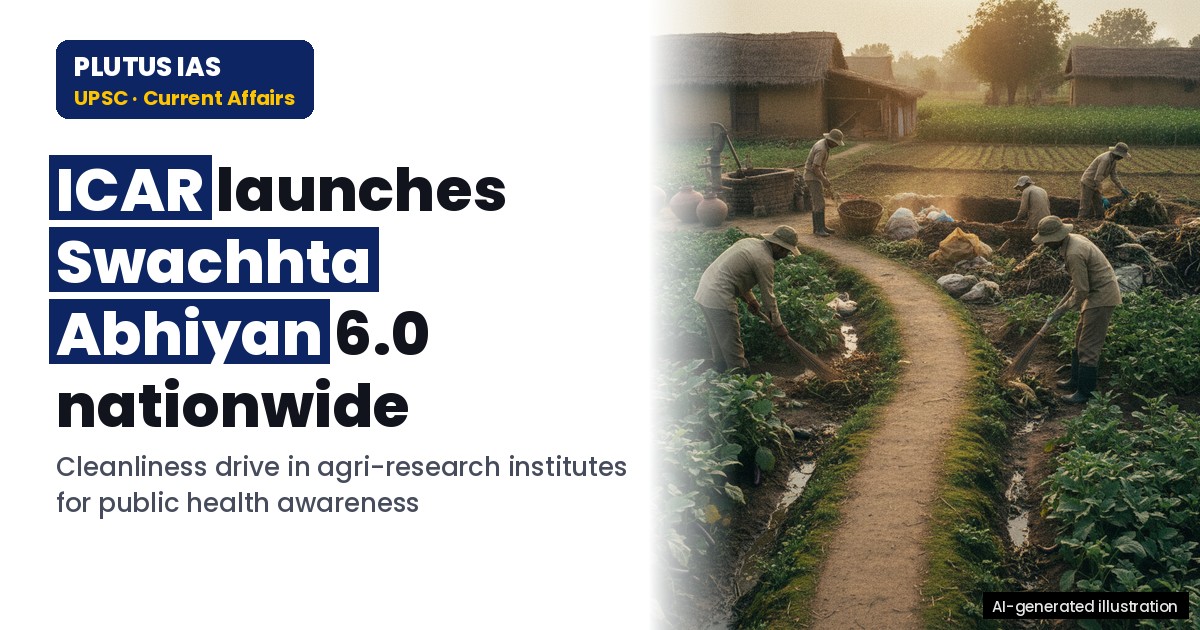
17 Oct Swachhta Abhiyan 6: ICAR’s Cleanliness Drive for Health & Governance
✎ Swachhta Special Campaign 6 in ICAR-DARE campuses focuses on institutional cleanliness, waste segregation, and eco-friendly practices to enhance research quality, safety, and sustainability.
Subject Relevance — Where This Topic Fits
- GS Paper II — Governance, Transparency and Accountability | GS Paper III — Environment, Sustainable Agriculture and Waste Management
- Prelims: Swachhta Special Campaign 6, ICAR-DARE, Agri-research campus sanitation, Scrap material disposal, Waste segregation protocols, Kisan Sabha Portal (contextual link)
- Essay: Role of institutional cleanliness in national development, Sustainable agricultural practices and public health interface
Quick Revision: Swachhta Special Campaign 6 in ICAR-DARE campuses focuses on institutional cleanliness, waste segregation, and eco-friendly practices to enhance research quality, safety, and sustainability.
Why is this in the news?
The Department of Agricultural Research and Education (DARE) under the Ministry of Agriculture and Farmers’ Welfare, through the Indian Council of Agricultural Research (ICAR), has intensified sanitation initiatives under Swachhta Special Campaign 6 across its research campuses in Patna, Goa, and Motihari. The campaign focuses on institutionalising cleanliness, waste segregation, and eco-friendly practices in agricultural research facilities to enhance public health, operational efficiency, and environmental sustainability.
Background
- Swachhta Special Campaigns are time-bound, mission-mode initiatives launched by the Government of India to promote cleanliness, transparency, and efficiency in public institutions.
- The Department of Agricultural Research and Education (DARE) is the nodal agency under the Ministry of Agriculture and Farmers’ Welfare responsible for coordinating agricultural research and education in India.
- The Indian Council of Agricultural Research (ICAR) is an autonomous body under DARE, mandated to conduct research, education, and extension in agriculture and allied sciences.
- Agricultural research campuses house laboratories, experimental farms, guest houses, and administrative blocks, necessitating stringent sanitation protocols to prevent contamination and ensure safety.
- The campaign aligns with the broader objectives of the Swachh Bharat Mission (Gramin and Urban) and the National Mission for Sustainable Agriculture (NMSA).
- Institutional sanitation in research campuses directly impacts the quality of agricultural research, food safety, and public health outcomes.
What is Swachhta Special Campaign 6 and its relevance to ICAR-DARE?
- Swachhta Special Campaign 6 is a government-led initiative to institutionalise cleanliness, waste management, and transparency in public institutions, including agricultural research campuses.
- The campaign is part of a series of time-bound drives (e.g., Swachhta Pakhwada, Swachhta Abhiyan) aimed at creating awareness, segregating waste, and disposing of scrap material in compliance with environmental norms.
- ICAR-DARE has undertaken multi-pronged activities under the campaign, including: (a) cleaning of campuses and experimental farms; (b) segregation and disposal of scrap materials such as metal objects, electrical panels, wires, and plastics; (c) removal of unwanted vegetation and weeds; and (d) maintenance of internal roads and public spaces.
- The campaign emphasises the role of sanitation in enhancing workplace efficiency, ensuring the safety of farm personnel, and maintaining a healthy environment for researchers and visitors.
- The audit and section staff of ICAR-CCARI (Goa) have conducted audits of physical records and identified and listed scrap materials.
- The initiative also includes awareness programmes to educate students, researchers, and staff on the importance of sanitation, hygiene, and eco-friendly practices in agricultural research.
- The campaign underscores the need for regular maintenance of plantation areas, weed management, and proper disposal of agricultural waste to prevent pest infestations and environmental degradation.
- These efforts contribute to the broader goals of sustainable agriculture, food safety, and public health by minimising contamination risks in agricultural research and production systems.
Key Features
| Feature | Significance |
|---|---|
| Institutional waste audits and scrap disposal | Ensures compliance with record-keeping norms, optimises storage space, and reduces environmental hazards from obsolete materials in agricultural research institutions. |
| Campus-wide sanitation drives (Patna, Bihar) | Creates a hygienic, pest-free environment in ICAR research campuses, protecting farm workers and promoting public health awareness among stakeholders. |
| Banana plantation maintenance (Motihari, Bihar) | Prevents pest proliferation, enhances farm accessibility, and maintains institutional green cover through systematic weed removal and waste management. |
| Guest-house scrap identification (Goa) | Streamlines material inventory, recovers reusable resources, and aligns with circular economy principles by segregating scrap for authorised disposal. |
| Pest management in farm pathways | Mitigates zoonotic and agricultural risks by eliminating breeding grounds for disease vectors in high-traffic farm areas. |
Why it Matters
Public Health & Safety
- Reduces exposure to vector-borne diseases (e.g., dengue, malaria) in agricultural research campuses and surrounding rural communities.
- Promotes hygiene practices among farm workers, students, and researchers, lowering occupational health risks.
- Ensures compliance with the National Rural Health Mission (NRHM) objectives of disease prevention through environmental sanitation.
Institutional Efficiency
- Enhances operational efficiency by optimising storage, record-keeping, and material utilisation in ICAR institutions.
- Improves farm accessibility and safety through systematic weed control and debris removal.
- Supports the ICAR’s mandate of sustainable agricultural research by maintaining clean, organised research environments.
Environmental Sustainability
- Reduces landfill burden by segregating and disposing of scrap materials through authorised channels.
- Prevents soil and water contamination from agricultural and electronic waste in campus ecosystems.
- Contributes to India’s commitments under the Swachh Bharat Mission and the National Green Tribunal guidelines.
Policy & Governance
- Demonstrates the implementation of the Swachhata Hi Seva (SHS) campaign, a government-led initiative for mass sanitation awareness.
- Aligns with the ICAR’s institutional policies on waste management and occupational safety.
- Serves as a model for other research institutions to adopt structured sanitation protocols.
Challenges
1. Behavioural Resistance to Sanitation Practices
- Low awareness among temporary farm workers about hygiene protocols and waste segregation.
- Cultural reluctance to adopt systematic weed control and debris removal in agricultural settings.
- Need for continuous reinforcement through training and awareness campaigns.
UPSC Link: GS3: Environmental pollution & degradation
2. Logistical Constraints in Waste Disposal
- Limited availability of authorised scrap disposal facilities in rural areas near research campuses.
- High transportation costs for off-site disposal of bulky agricultural and electronic waste.
- Coordination gaps between institutional authorities and municipal waste management systems.
UPSC Link: GS3: Solid waste management
3. Resource Allocation for Large-Scale Drives
- Requires sustained funding for periodic sanitation drives, especially in resource-constrained institutions.
- Need for skilled manpower to conduct waste audits, pest control, and plantation maintenance.
- Balancing operational priorities with sanitation goals amid competing institutional demands.
UPSC Link: GS2: Government budgets & financial management
4. Monitoring and Compliance Gaps
- Lack of standardised metrics to assess the impact of sanitation drives on public health outcomes.
- Inconsistent enforcement of waste management protocols across ICAR institutions.
- Need for third-party audits to ensure adherence to environmental and occupational safety norms.
UPSC Link: GS4: Governance & accountability
Challenges — UPSC Perspective
| Issue | Concern |
|---|---|
| Temporary workforce engagement | Low participation in hygiene training due to high turnover and lack of incentives. |
| Rural waste infrastructure gaps | Absence of formal scrap collection systems in peri-urban areas near research campuses. |
| Seasonal agricultural waste | Peak waste generation during harvest seasons overwhelms institutional disposal mechanisms. |
| Regulatory overlaps | Divergent guidelines from central, state, and municipal authorities complicate compliance. |
| Data management | Inadequate digital tracking of waste disposal chains leads to accountability gaps. |
Government Initiatives — Must-Memorise for Prelims
- Swachhata Hi Seva (SHS) Campaign
Way Forward
- Conduct periodic hygiene training sessions for farm workers, researchers, and students to institutionalise sanitation practices.
- Establish partnerships with local municipal bodies to set up decentralised scrap collection and disposal units near ICAR campuses.
- Develop a standardised waste audit framework to track progress and identify gaps in sanitation drives.
- Integrate pest management protocols with seasonal agricultural cycles to ensure year-round farm safety.
- Leverage digital tools (e.g., GIS mapping) to monitor waste generation hotspots and optimise disposal routes.
- Allocate dedicated budgets for sanitation drives, ensuring continuity beyond ad-hoc campaigns.
- Promote research on low-cost, eco-friendly waste management solutions tailored to rural agricultural settings.
UPSC Value Addition
Keywords for Mains Answer-Writing
Swachhta Special Campaign 6.0 · Indian Council of Agricultural Research (ICAR) · Department of Agricultural Research and Education (DARE) · Institutional sanitation · Waste management in agricultural research institutions · Scientific temper in governance · Sustainable agriculture practices · Public health and sanitation · Green campus initiatives · Circular economy in institutional governance
Concept Flow
Swachhata Hi Seva (SHS) campaign → Institutional sanitation drives in ICAR campuses → Waste audits and scrap disposal → Environmental and public health benefits → Compliance with NRHM and Swachh Bharat Mission goals → Sanitation drive initiation → Campus-wide cleanliness and pest control → Improved farm worker safety → Reduced disease vectors → Enhanced agricultural productivity → Scrap identification and disposal → Authorised waste processing → Circular economy integration → Reduced landfill burden → Environmental sustainability → Institutional policies on sanitation → Resource allocation for drives → Training and awareness campaigns → Behavioural change among stakeholders → Long-term hygiene culture → Logistical challenges in waste disposal → Need for municipal partnerships → Decentralised waste management systems → Improved compliance and efficiency
Prelims Practice Questions
Q1. Consider the following statements regarding the Swachhta Special Campaign 6.0:
1. It is an initiative of the Ministry of Agriculture and Farmers’ Welfare.
2. The campaign focuses exclusively on urban sanitation infrastructure.
3. ICAR and DARE are key implementing agencies under this campaign.
4. The campaign includes the identification and disposal of scrap materials in agricultural research institutions.
How many of the above statements are correct?
- Only one
- Only two
- Only three
- All four
Answer: All four — Statements 1, 3, and 4 are correct. Statement 2 is incorrect as the campaign targets both urban and rural areas, including agricultural research institutions.
Q2. Assertion (A): The Swachhta Special Campaign 6.0 emphasizes the role of institutional sanitation in enhancing workplace efficiency and environmental sustainability.
Reason (R): The campaign mandates the disposal of scrap materials through approved waste management systems in agricultural research institutions.
In the context of the above two statements, which one of the following is correct?
- Both A and R are true, and R is the correct explanation of A
- Both A and R are true, but R is not the correct explanation of A
- A is true, but R is false
- A is false, but R is true
Answer: Both A and R are true, but R is not the correct explanation of A — Both statements are true. The campaign indeed emphasizes institutional sanitation (A) and mandates proper disposal of scrap materials (R), with R providing a valid explanation for A.
Q3. Match the following pairs related to the Swachhta Special Campaign 6.0:
Column I (Institution) Column II (Activity)
A. ICAR Research Complex, Patna 1. Banana plantation maintenance and weed removal
B. ICAR-CCARI, Goa 2. Sorting of physical vouchers as per audit guidelines
C. ICAR-MGIFRI, Motihari 3. Identification and disposal of scrap metal and plastic
D. ICAR-CIFA, Bhubaneswar 4. Cleaning of farm pathways and removal of unwanted vegetation
Select the correct match:
- A-4, B-2, C-1, D-3
- A-3, B-1, C-4, D-2
- A-1, B-3, C-2, D-4
- A-4, B-3, C-1, D-2
Answer: A-4, B-2, C-1, D-3 — The correct matches are: A-4 (Patna focuses on farm pathways and vegetation removal), B-2 (CCARI, Goa sorts vouchers), C-1 (MGIFRI, Motihari maintains banana plantations), D-3 (CIFA, Bhubaneswar handles scrap disposal).
Mains Practice Question
✍ The Swachhta Special Campaign 6.0, led by DARE/ICAR, underscores the criticality of institutional sanitation in agricultural research institutions. Critically examine the role of such campaigns in promoting sustainable agriculture and public health in India. (15 Marks)
Approach: MODEL-ANSWER SKELETON:
1. **Introduction**: Define Swachhta Special Campaign 6.0 and its objectives (e.g., waste management, cleanliness in research institutions).
2. **Institutional Sanitation and Sustainable Agriculture**:
– Link sanitation to Good Agricultural Practices (GAP) and Integrated Pest Management (IPM).
– Cite ICAR’s role in promoting eco-friendly farming through clean campuses (e.g., removal of unwanted vegetation, waste segregation).
3. **Public Health Implications**:
– Discuss how clean research campuses reduce zoonotic risks and vector-borne diseases (e.g., harmful insects in farms).
– Reference the One Health approach and its alignment with WHO/FAO guidelines.
4. **Governance and Institutional Mechanisms**:
– Highlight DARE/ICAR’s administrative role in enforcing sanitation protocols (e.g., scrap disposal, record-keeping).
– Mention the Swachh Bharat Mission (Gramin/Urban) as a complementary framework.
5. **Challenges and Limitations**:
– Resource constraints in rural institutions (e.g., lack of waste processing facilities).
– Behavioral resistance to change among staff and researchers.
6. **Way Forward**:
– Propose institutional capacity-building (e.g., training programs, PPP models for waste management).
– Emphasize the role of scientific temper in fostering long-term sustainability.
7. **Conclusion**: Summarize the campaign’s contribution to India’s SDG 3 (Good Health) and SDG 12 (Responsible Consumption).
**Key Terms to Include**: DARE, ICAR, Swachhta Special Campaign, Good Agricultural Practices (GAP), Integrated Pest Management (IPM), One Health, Swachh Bharat Mission, SDGs.
Source: PIB (Press Information Bureau)
Generated by AanyaAi for educational purpose.
Related guides on our sites
- Best PSIR optional coaching for upsc
- Best PSIR optional teacher for upsc
- Best teacher of PSIR optional for upsc
- Best PSIR optional coaching in delhi for UPSC

- NAMASTE Scheme: Enhancing Sanitation Workers’ Livelihoods & Safety - November 14, 2026
- एमएसएमई का विशेष अभियान 6.0: स्वच्छता और लंबित मामलों का निपटारा - November 14, 2026
- Sea Vigil-26: Coastal Defence Drills Off Visakhapatnam - November 14, 2026

No Comments