


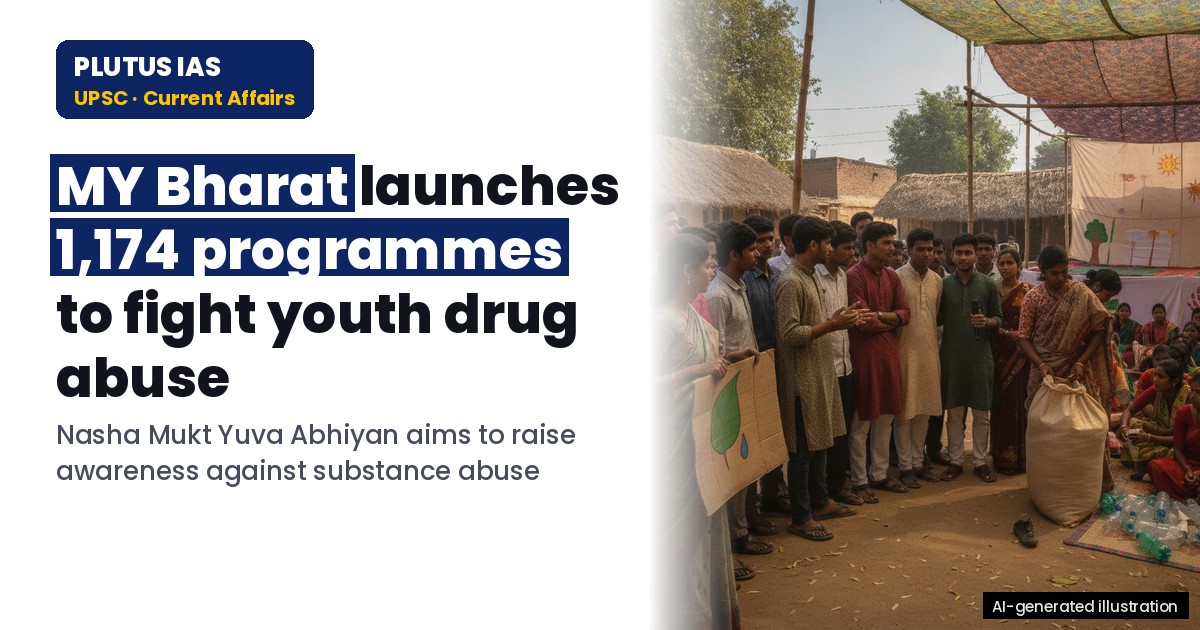
19 Oct MY Bharat Launches 1,174 Programmes Under Nasha Mukt Yuva Abhiyan
✎ NMYA is a national campaign, implemented through MY Bharat, to prevent substance abuse among youth by leveraging awareness, rehabilitation, and multi-stakeholder engagement.
Subject Relevance — Where This Topic Fits
- GS Paper II — Governance, Government Policies and Interventions for Development in various sectors | GS Paper III — Issues relating to Development and Management of Social Sector/Services relating to Health, Human Resources | GS Paper IV — Ethics and Human Interface: Role of Family, Society and Educational Institutions in Inculcating Values
- Prelims: Nasha Mukt Yuva Abhiyan, MY Bharat, Substance abuse prevention, National Youth Policy 2021, Sankalp Se Siddhi, Yuva Sangam, Youth Empowerment
- Essay: The role of youth in nation-building: Challenges and opportunities, Public health interventions and social transformation: A case study of substance abuse prevention
Quick Revision: NMYA is a national campaign, implemented through MY Bharat, to prevent substance abuse among youth by leveraging awareness, rehabilitation, and multi-stakeholder engagement.
Why is this in the news?
The MY Bharat platform, under the aegis of the Ministry of Youth Affairs and Sports, has organised 1,174 programmes across 36 States and Union Territories during the fifth week of the Nasha Mukt Yuva Abhiyan (NMYA), a national campaign aimed at preventing substance abuse among youth. This initiative underscores the government’s commitment to leveraging youth-centric platforms for public health interventions and aligns with broader national priorities of youth empowerment and social development.
Background
- The Nasha Mukt Yuva Abhiyan (NMYA) was launched as a pan-India campaign to create awareness about the perils of substance abuse among youth and to promote healthy lifestyles.
- The campaign is a multi-ministerial effort, involving the Ministry of Youth Affairs and Sports, Ministry of Social Justice and Empowerment, Ministry of Health and Family Welfare, and Ministry of Education, among others.
- MY Bharat, a revamped version of the Nehru Yuva Kendra Sangathan (NYKS) and National Service Scheme (NSS), was launched in October 2023 to provide a digital-first platform for youth engagement, volunteerism, and community service.
- The NMYA is aligned with the National Youth Policy 2021, which emphasises the holistic development of youth, including their physical, mental, and social well-being.
- The campaign also draws from the Sustainable Development Goals (SDG 3: Good Health and Well-being) and the National Drug Dependence Treatment Centre (NDDTC) guidelines for substance abuse prevention.
- The initiative is part of the broader ‘Sankalp Se Siddhi’ vision, which aims to transform India into a developed nation by 2047 through inclusive and participatory governance.
What is the Nasha Mukt Yuva Abhiyan (NMYA)?
- NMYA is a national campaign launched to raise awareness about the harmful effects of substance abuse, including drugs, alcohol, and tobacco, among youth.
- The campaign employs a multi-pronged approach, including awareness drives, community engagement, skill development, and rehabilitation support for affected individuals.
- NMYA is implemented through a network of youth clubs, educational institutions, and community organisations, leveraging platforms like MY Bharat for outreach and mobilisation.
- The campaign includes the establishment of ‘Nasha Mukt Kendras’ (Drug-Free Centres) in districts to provide counselling, de-addiction, and rehabilitation services.
- NMYA aligns with the ‘National Action Plan for Drug Demand Reduction (NAPDDR)’ and the ‘Narcotic Drugs and Psychotropic Substances (NDPS) Act, 1985’, which criminalises the production, sale, and consumption of illegal substances.
- The campaign also promotes the use of digital tools and social media to disseminate information, conduct surveys, and monitor progress.
- NMYA is complemented by the ‘National Youth Policy 2021’, which prioritises the mental health and well-being of youth, including prevention of substance abuse.
Key Features
| Feature | Significance |
|---|---|
| Nasha Mukt Yuva Abhiyan (NMYA) | A national youth-focused campaign aimed at creating awareness about substance abuse and promoting a drug-free lifestyle among young citizens. |
| MY Bharat Platform | The nodal agency coordinating the NMYA programmes, leveraging youth volunteer networks for grassroots outreach. |
| Week-wise Implementation Structure | The campaign is executed in structured phases, with the fifth week marking a milestone in sustained engagement across geographies. |
| Multi-stakeholder Participation | Involvement of state governments, UTs, educational institutions, NGOs, and local communities to ensure holistic coverage. |
| Awareness Generation Activities | Programmes include workshops, rallies, street plays, and digital campaigns to educate youth on the dangers of substance abuse. |
Why it Matters
Public Health and Youth Development
- Substance abuse among youth poses a significant public health challenge, contributing to mental health disorders, reduced productivity, and social disruptions.
- Preventive measures through awareness campaigns can mitigate long-term health and socio-economic costs associated with addiction.
- The NMYA aligns with the Sustainable Development Goal 3 (Good Health and Well-being) by promoting healthy lifestyles among the youth population.
Governance and Institutional Capacity
- The MY Bharat platform demonstrates the government’s ability to mobilise institutional resources for large-scale social campaigns.
- Decentralised implementation across 36 states and UTs highlights the federal structure’s effectiveness in executing national programmes.
- Volunteer-driven models enhance community engagement and ensure sustained grassroots participation.
Social and Behavioural Impact
- Awareness programmes target behavioural change by addressing misconceptions about substance use and promoting peer-led advocacy.
- Engagement with educational institutions fosters early intervention and resilience-building among students.
- Cultural and regional adaptations in programme delivery ensure relevance and higher acceptance in diverse socio-economic settings.
Challenges
1. Stigma and Social Barriers
- Substance abuse remains a stigmatised issue, deterring open discussions and reducing participation in awareness programmes.
- Cultural taboos and lack of family support can hinder the effectiveness of outreach efforts.
UPSC Link: GS2: Social Justice
2. Resource Allocation and Sustainability
- Ensuring consistent funding and volunteer participation across all states and UTs is a logistical challenge.
- Sustaining long-term impact requires periodic evaluation and adaptive strategies to address evolving trends in substance abuse.
UPSC Link: GS3: Resource Management
3. Monitoring and Evaluation Gaps
- Tracking the reach and impact of programmes across diverse regions necessitates robust data collection mechanisms.
- Lack of standardised metrics for measuring behavioural change complicates assessment of campaign effectiveness.
UPSC Link: GS4: Governance
4. Digital Divide and Accessibility
- Urban-rural disparities in digital literacy and internet access may limit the reach of online awareness campaigns.
- Ensuring inclusivity for marginalised groups, including tribal and remote communities, remains a challenge.
UPSC Link: GS1: Social Issues
5. Inter-ministerial Coordination
- Effective implementation requires seamless coordination between the Ministry of Youth Affairs, Health, Education, and Social Justice.
- Delays in approvals, fund disbursement, or policy alignment can disrupt programme timelines.
UPSC Link: GS2: Centre-State Relations
Challenges — UPSC Perspective
| Issue | Concern |
|---|---|
| Stigma and Social Barriers | Limits open dialogue and reduces participation in awareness programmes. |
| Resource Allocation | Inconsistent funding and volunteer participation across regions. |
| Monitoring and Evaluation | Lack of standardised metrics for measuring behavioural change. |
| Digital Divide | Urban-rural disparities limit reach of online campaigns. |
| Inter-ministerial Coordination | Delays in approvals or fund disbursement disrupt programme timelines. |
| Cultural Sensitivity | Programmes may not resonate equally across diverse socio-cultural contexts. |
Government Initiatives — Must-Memorise for Prelims
- Nasha Mukt Bharat Abhiyaan (NMBA)
- MY Bharat (formerly Nehru Yuva Kendra Sangathan)
Way Forward
- Constitute a multi-stakeholder task force comprising health experts, educators, and youth leaders to design region-specific awareness modules.
- Develop a digital dashboard for real-time monitoring of programme reach, participation, and impact across states and UTs.
- Integrate NMYA with existing health and education schemes (e.g., Ayushman Bharat, PMKVY) to leverage infrastructure and resources.
- Launch a national helpline and mobile app for anonymous reporting and counselling on substance abuse.
- Conduct periodic impact assessments using standardised metrics to evaluate behavioural changes and programme effectiveness.
- Strengthen partnerships with NGOs, civil society organisations, and corporate entities for sustained funding and outreach.
- Incorporate life-skills education in school curricula to build resilience against substance abuse from an early age.
- Promote peer-led advocacy through youth clubs and volunteer networks to sustain grassroots engagement.
UPSC Value Addition
Keywords for Mains Answer-Writing
Nasha Mukt Bharat Abhiyaan · National Youth Policy · Substance Abuse Prevention · Youth Empowerment · Social Justice · Public Health · Governance Mechanisms · Community Participation · Skill Development · Mental Health · National Institute of Social Defence · Ministry of Social Justice and Empowerment · Prevention of Illicit Trafficking in Narcotic Drugs and Psychotropic Substances Act, 1988 · Sustainable Development Goals (SDG) 3.5 · National Action Plan for Drug Demand Reduction
Concept Flow
Inception of Nasha Mukt Yuva Abhiyan (NMYA) → Structured implementation via MY Bharat platform → Multi-stakeholder engagement (states, UTs, NGOs) → Awareness generation activities (workshops, rallies, digital campaigns) → Behavioural change among youth → Long-term public health and socio-economic benefits
Prelims Practice Questions
Q1. Consider the following statements regarding the Nasha Mukt Yuva Abhiyan (NMYA):
1. It is a central sector scheme implemented by the Ministry of Social Justice and Empowerment.
2. The scheme aims to create awareness about the ill effects of substance abuse among youth.
3. The scheme includes provisions for skill development and employment generation for rehabilitated individuals.
4. The scheme mandates the establishment of District Nodal Officers in every district for its implementation.
How many of the above statements are correct?
- Only one
- Only two
- Only three
- All four
Answer: All four — Statements 1, 2, and 3 are correct. Statement 4 is incorrect as the scheme does not mandate the establishment of District Nodal Officers; implementation is overseen by state governments in coordination with central agencies.
Q2. Assertion (A): The National Institute of Social Defence (NISD) plays a pivotal role in the implementation of the Nasha Mukt Yuva Abhiyan.
Reason (R): The NISD is the nodal agency for research, training, and capacity-building in the field of substance abuse prevention and rehabilitation under the Ministry of Social Justice and Empowerment.
In the context of the above two statements, which one of the following is correct?
- Both A and R are true, and R is the correct explanation of A
- Both A and R are true, but R is not the correct explanation of A
- A is true but R is false
- A is false but R is true
Answer: Both A and R are true, but R is not the correct explanation of A — Both the Assertion and Reason are true, and the Reason correctly explains the Assertion. The NISD is indeed the nodal agency for substance abuse prevention and rehabilitation, and it supports the NMYA through research, training, and capacity-building.
Q3. Match the following initiatives with their respective ministries/departments:
Column I (Initiative) | Column II (Ministry/Department)
———————————————–|————————————
1. Nasha Mukt Yuva Abhiyan | A. Ministry of Health and Family Welfare
2. Ayushman Bharat | B. Ministry of Social Justice and Empowerment
3. National Mental Health Programme | C. Ministry of Women and Child Development
4. Beti Bachao Beti Padhao | D. NITI Aayog
Select the correct match:
- 1-B, 2-A, 3-D, 4-C
- 1-B, 2-D, 3-A, 4-C
- 1-C, 2-A, 3-B, 4-D
- 1-A, 2-B, 3-C, 4-D
Answer: 1-B, 2-D, 3-A, 4-C — The Nasha Mukt Yuva Abhiyan is implemented by the Ministry of Social Justice and Empowerment (1-B). Ayushman Bharat is a health initiative under the Ministry of Health and Family Welfare (2-A). The National Mental Health Programme is under the Ministry of Health and Family Welfare (3-A), and Beti Bachao Beti Padhao is under the Ministry of Women and Child Development (4-C).
Mains Practice Question
✍ The Nasha Mukt Yuva Abhiyan (NMYA) represents a multi-pronged approach to address substance abuse among youth in India. Critically examine the institutional and governance mechanisms underpinning the scheme, with reference to the roles of the Ministry of Social Justice and Empowerment, the National Institute of Social Defence (NISD), and state governments. Also, assess the scheme’s alignment with the Sustainable Development Goals (SDGs), particularly SDG 3.5. (15 Marks)
Approach: MODEL-ANSWER SKELETON:
1. **Introduction (2 marks)**
– Define Nasha Mukt Yuva Abhiyan (NMYA) and its objectives: awareness creation, prevention, rehabilitation, and skill development among youth.
– Contextualise within the broader framework of India’s drug demand reduction strategy, including the National Action Plan for Drug Demand Reduction (NAPDDR) and the Prevention of Illicit Trafficking in Narcotic Drugs and Psychotropic Substances Act, 1988.
2. **Institutional Mechanisms (5 marks)**
– **Ministry of Social Justice and Empowerment (MoSJE)**: Role as the nodal ministry for policy formulation, funding, and oversight. Highlight its mandate under the NAPDDR.
– **National Institute of Social Defence (NISD)**: Functions as the technical arm—research, training, capacity-building, and monitoring of NMYA. Cite specific programmes like the ‘National Centre for Drug Abuse Prevention’.
– **State Governments**: Responsibility for ground-level implementation, including district-level coordination, resource allocation, and stakeholder engagement. Mention the role of State Nodal Agencies and District Nodal Officers where applicable.
– **Inter-Ministerial Coordination**: Reference to the Narcotics Control Bureau (NCB) and Ministry of Health and Family Welfare for health interventions and data sharing.
3. **Governance Challenges (4 marks)**
– **Fragmentation**: Overlapping mandates between central and state agencies; need for integrated monitoring mechanisms.
– **Resource Constraints**: Limited funding for rehabilitation centres and awareness campaigns; reliance on CSR and NGOs.
– **Stigma and Social Barriers**: Cultural and societal resistance to addressing substance abuse openly.
– **Data Gaps**: Lack of real-time, granular data on substance abuse prevalence and rehabilitation outcomes.
4. **Alignment with SDG 3.5 (3 marks)**
– **SDG Target 3.5**: Strengthen the prevention and treatment of substance abuse, including narcotic drug abuse and harmful use of alcohol.
– **NMYA’s Contribution**:
– Awareness campaigns align with SDG 3.5’s emphasis on education and prevention.
– Rehabilitation and skill development components address treatment and social reintegration.
– Partnerships with NGOs and community organisations support SDG 3.5’s call for multi-stakeholder collaboration.
– **Gaps**: SDG 3.5 also includes reducing the burden of substance abuse on health systems; NMYA’s health linkages (e.g., with Ayushman Bharat) could be strengthened.
5. **Conclusion (1 mark)**
– Summarise the scheme’s strengths in adopting a holistic approach while acknowledging the need for enhanced inter-sectoral coordination, data-driven policymaking, and sustained funding to achieve SDG 3.5 targets.
Source: PIB (Press Information Bureau)
Generated by AanyaAi for educational purpose.
Related guides on our sites
- Anthropology VS PSIR
- Best PSIR optional coaching
- Best PSIR optional coaching online
- Best PSIR optional teacher

- भारत ने बताया UN रिपोर्ट में दाऊद इब्राहिम को ‘भारत-आधारित’ बताना ‘गलत’ - October 22, 2026
- GRAP Stage I activated in Delhi-NCR amid rising AQI: Key actions for aspirants - October 22, 2026
- सीएक्यूएम ने दिल्ली में धूल प्रदूषण नियंत्रण के लिए उठाए कदम, एमसीडी को मिले निर्देश - October 22, 2026

No Comments