


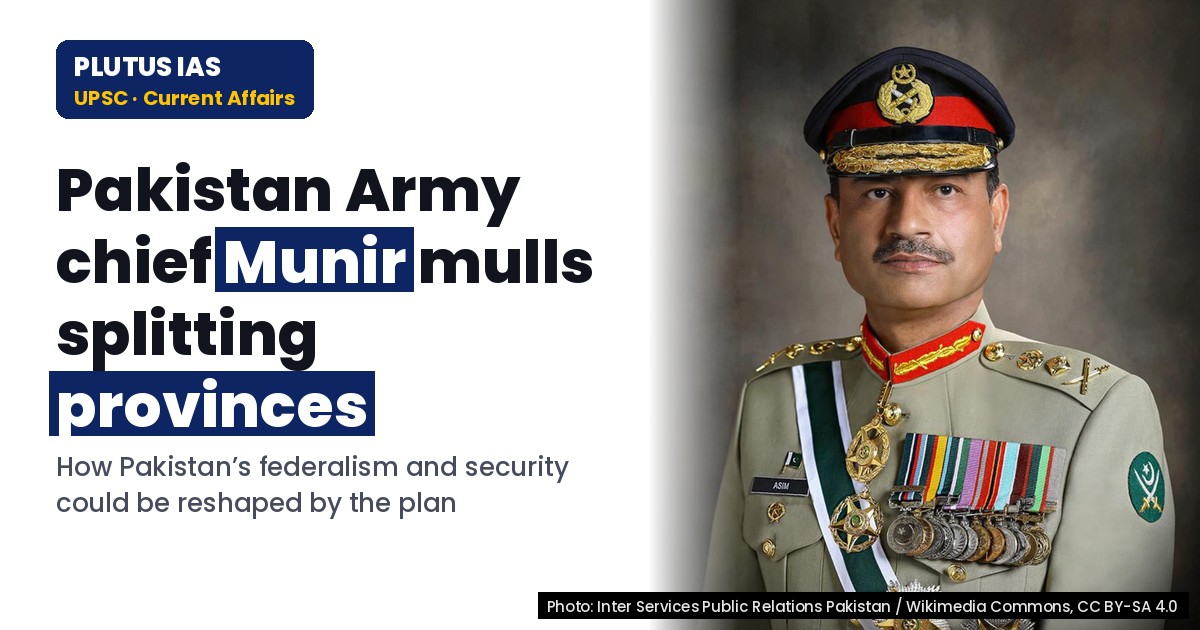
21 Oct Pakistan Army’s Plan to Redraw Provincial Map: UPSC Security Analysis
✎ Any proposal to redraw provincial boundaries in Pakistan must comply with the constitutional amendment process under Articles 239 and 240 of the 1973 Constitution, requiring a two-thirds majority in Parliament and provincial…
Subject Relevance — Where This Topic Fits
- GS Paper II — Comparative Government and Politics (Federalism, Centre-State Relations)
- Prelims: Federalism, Provincial Autonomy, Constitutional Amendment Process, Centre-State Relations, 1973 Constitution of Pakistan, Article 1, Article 239, Article 240
- Essay: Federalism and the Challenges of Governance in Multi-Ethnic States, The Role of Military in Civilian Governance: A Comparative Perspective
Quick Revision: Any proposal to redraw provincial boundaries in Pakistan must comply with the constitutional amendment process under Articles 239 and 240 of the 1973 Constitution, requiring a two-thirds majority in Parliament and provincial approvals, which makes the plan politically contentious and legally complex.
Why is this in the news?
The proposal by Pakistan’s Army Chief, General Asim Munir, to divide Pakistan’s four existing provinces into 12–15 smaller administrative units has reignited debates on federalism, provincial autonomy, and the military’s role in governance. This initiative, framed as an administrative reform, raises critical questions about constitutional feasibility, political legitimacy, and the potential consequences for Pakistan’s fragile federal structure, particularly in the context of historical grievances and separatist movements.
Background
- Pakistan’s federal structure, established under the 1973 Constitution, divides the country into four provinces: Punjab, Sindh, Khyber Pakhtunkhwa (KP), and Balochistan, alongside federally administered territories such as Islamabad and the disputed region of Gilgit-Baltistan.
- The 1973 Constitution vests residual powers with the provinces under the principle of provincial autonomy, though the federal government retains significant authority, particularly in matters of law and order, finance, and inter-provincial disputes.
- Historical tensions over provincial autonomy have been a persistent feature of Pakistan’s governance, with grievances in Balochistan and KP rooted in perceived marginalisation, resource exploitation, and military operations.
- The 1971 secession of Bangladesh (then East Pakistan) remains a cautionary precedent, highlighting the risks of federal mismanagement, military repression, and unresolved political grievances.
- Recent political developments, including the imposition of emergency rule in KP in October 2026, underscore the federal government’s use of security prerogatives to override provincial authority, raising concerns about democratic backsliding.
- The proposed restructuring plan is not the first attempt at provincial reorganisation in Pakistan; past proposals, such as the 2010 ‘One Unit’ dissolution, have faced legal and political challenges.
What is the Proposed Provincial Restructuring Plan in Pakistan?
- The plan envisages the division of Pakistan’s four existing provinces—Punjab, Sindh, KP, and Balochistan—into 12 to 15 smaller administrative units, ostensibly to improve governance, enhance service delivery, and address regional disparities.
- The proposal is framed as an administrative reform aimed at decentralisation, though critics argue it could centralise power by diluting the influence of larger provinces like Punjab and Sindh, which are strongholds of major political parties.
- Constitutional feasibility remains a major hurdle, as any redrawing of provincial boundaries would require amendments to the 1973 Constitution, necessitating a two-thirds majority in Parliament and approval from provincial assemblies.
- The plan has sparked political controversy, with Sindh and other provinces likely to oppose it due to fears of losing political clout, economic resources, or cultural identity.
- Security concerns in KP and Balochistan, including militancy and separatist movements, are often cited as justifications for administrative restructuring, though such measures have historically failed to address root causes of instability.
- The military’s involvement in proposing the plan raises questions about civilian-military relations and the potential for further erosion of democratic institutions, given the armed forces’ historical role in governance.
- The plan’s timing, amid political instability and opposition to federal interventions, has led to comparisons with past crises, including the 1971 breakup of Pakistan, though the current context differs significantly.
Key Features
| Feature | Significance |
|---|---|
| Proposed provincial restructuring | Potential redrawing of Pakistan’s four provinces into 12-15 smaller units, altering the federal administrative structure and altering political power balances. |
| Military’s expanding political role | The Pakistan Army Chief’s consideration of structural changes underscores the military’s growing influence in civilian governance, raising questions about democratic accountability. |
| Provincial autonomy concerns | The proposed changes may weaken provincial governments, particularly those led by opposition parties, thereby reducing their capacity to act as counterweights to the federal centre. |
| Constitutional and parliamentary hurdles | Redrawing provincial boundaries requires constitutional amendments, parliamentary approval, and consent from provincial assemblies, making the process politically contentious. |
| Security and separatist tensions | The restructuring is proposed amid ongoing insurgencies in Khyber Pakhtunkhwa and Balochistan, where grievances over autonomy, resource control, and military operations persist. |
Why it Matters
Federalism and Governance
- The proposal challenges Pakistan’s existing federal structure, which has historically been a point of contention between the centre and provinces, particularly in Balochistan and Khyber Pakhtunkhwa.
- Redrawing provincial boundaries could exacerbate existing grievances, particularly in regions with historical demands for greater autonomy or independence.
- The military’s role in proposing such structural changes raises concerns about the erosion of civilian supremacy and democratic norms in Pakistan.
- Provincial governments, especially those led by opposition parties, may lose political influence, further centralising power in Islamabad.
- The move could destabilise the delicate balance between federal and provincial powers, potentially leading to greater political instability.
Security and Stability
- The proposal is framed against a backdrop of persistent insurgencies in Khyber Pakhtunkhwa and Balochistan, where militant violence and separatist movements remain unresolved.
- Military-led administrative restructuring may be perceived as a coercive measure to suppress dissent rather than address underlying grievances.
- Historical precedent, such as Bangladesh’s secession in 1971, suggests that military repression without addressing political grievances can exacerbate separatist tendencies.
- The imposition of emergency rule in Khyber Pakhtunkhwa highlights the federal government’s reliance on security-centric solutions, which may further alienate provincial governments and populations.
- Security operations in Balochistan, including enforced disappearances, have long been criticised by domestic and international observers, raising questions about the efficacy of military-led governance.
Political Dynamics
- The proposal could weaken the political influence of major parties like the Pakistan Muslim League-Nawaz (PML-N) in Punjab and the Pakistan Peoples Party (PPP) in Sindh, altering Pakistan’s political landscape.
- Opposition parties, particularly those in power in Khyber Pakhtunkhwa and Sindh, may view the restructuring as an attempt by the federal government to undermine their authority.
- The military’s involvement in political decision-making raises concerns about the militarisation of civilian governance, which could undermine democratic institutions.
- The proposal may deepen political polarisation, particularly if it is perceived as a tool to consolidate power in the hands of the federal centre or the military.
Challenges
1. Constitutional and Legal Hurdles
- Any redrawing of provincial boundaries requires a constitutional amendment under Article 239 of the Constitution of Pakistan, necessitating a two-thirds majority in the National Assembly and Senate, as well as approval from the provincial assemblies.
- The process is further complicated by the requirement for consent from provincial governments, particularly those led by opposition parties, which may be reluctant to support such changes.
- The Supreme Court of Pakistan may be called upon to adjudicate disputes arising from the proposed restructuring, particularly if provincial governments challenge the legality of the process.
- The lack of a clear consensus among political stakeholders on the necessity or desirability of restructuring could lead to prolonged legal and political battles.
UPSC Link: Constitutional provisions governing federalism (Indian Constitution)
2. Political Opposition and Public Sentiment
- Major political parties, such as the PPP in Sindh, have historically opposed the division of provinces, viewing it as an attempt to weaken their political base and reduce their influence.
- Opposition parties in Khyber Pakhtunkhwa and Balochistan may perceive the proposal as a federal encroachment on provincial autonomy, further straining centre-province relations.
- Public sentiment in provinces like Balochistan, where grievances over resource control and military operations are deeply entrenched, may view the restructuring as an insincere attempt to address longstanding issues.
- The proposal could fuel separatist sentiments in Balochistan, where insurgent groups have long demanded independence or greater autonomy.
UPSC Link: Federalism and Centre-State Relations
3. Security and Insurgency Challenges
- The proposal does not address the root causes of insurgencies in Khyber Pakhtunkhwa and Balochistan, such as economic marginalisation, political exclusion, and military repression, which may persist or worsen.
- Military-led administrative restructuring could be perceived as a coercive measure, further alienating local populations and exacerbating grievances.
- The imposition of emergency rule in Khyber Pakhtunkhwa demonstrates the federal government’s reliance on security-centric solutions, which may undermine trust in provincial governance.
- The lack of a political solution to separatist movements in Balochistan could lead to increased militancy, particularly if the proposed restructuring is seen as an attempt to dilute provincial autonomy.
UPSC Link: Internal Security Challenges in India
4. Economic and Administrative Disruptions
- Redrawing provincial boundaries could lead to administrative chaos, particularly in the short term, as new governance structures are established and resources are reallocated.
- The division of provinces may disrupt existing economic corridors, particularly in Punjab and Sindh, which are key drivers of Pakistan’s economy.
- The process of restructuring could divert resources and attention away from critical economic and developmental priorities, such as poverty alleviation and infrastructure development.
- The lack of a clear economic rationale for the proposal raises questions about its potential benefits, particularly given the economic challenges facing Pakistan.
UPSC Link: Economic and Social Development
5. Regional Stability and International Relations
- The proposal could exacerbate regional tensions, particularly with Afghanistan, where historical grievances and cross-border insurgencies persist.
- International observers may view the restructuring as a sign of political instability in Pakistan, potentially affecting foreign investment and diplomatic relations.
- The lack of a transparent and inclusive process for the proposal could undermine Pakistan’s credibility on the global stage, particularly in matters of governance and human rights.
- Regional powers, such as India and China, may view the proposal through the lens of their own strategic interests, potentially leading to further geopolitical complexities.
UPSC Link: India’s Relations with Neighbouring Countries
Challenges — UPSC Perspective
| Issue | Concern |
|---|---|
| Constitutional amendments | Lack of consensus in Parliament and provincial assemblies may stall the proposal, leading to prolonged legal and political uncertainty. |
| Provincial autonomy | Opposition-led provincial governments may resist restructuring, viewing it as an attempt to centralise power and weaken their influence. |
| Insurgency and separatism | Military-led restructuring may exacerbate grievances in Khyber Pakhtunkhwa and Balochistan, fueling separatist sentiments and militancy. |
| Political polarisation | The proposal could deepen divisions between federal and provincial governments, as well as between political parties, leading to greater instability. |
| Economic disruptions | Administrative chaos and resource reallocation may disrupt economic growth, particularly in key provinces like Punjab and Sindh. |
| International perceptions | The lack of a transparent process may undermine Pakistan’s credibility, affecting foreign investment and diplomatic relations. |
Way Forward
- Conduct a transparent and inclusive national dialogue involving all stakeholders, including political parties, civil society, and provincial governments, to assess the necessity and feasibility of provincial restructuring.
- Establish a constitutional commission or expert committee to evaluate the legal, administrative, and economic implications of the proposal, ensuring adherence to federal principles.
- Address underlying grievances in Khyber Pakhtunkhwa and Balochistan through political dialogue, economic development, and respect for provincial autonomy, rather than relying solely on military solutions.
- Strengthen democratic institutions and reduce the military’s role in civilian governance to ensure that structural changes are driven by constitutional processes rather than coercive measures.
- Enhance transparency in the decision-making process, including public consultations and parliamentary debates, to build trust and legitimacy for any proposed restructuring.
- Prioritise economic development and poverty alleviation in marginalised regions to address root causes of insurgency and separatism, rather than focusing solely on administrative restructuring.
- Engage with international partners to ensure that any restructuring process adheres to democratic norms and human rights standards, mitigating potential geopolitical risks.
UPSC Value Addition
Keywords for Mains Answer-Writing
Federalism · Provincial Autonomy · Administrative Restructuring · Constitutional Amendments · Military-Civilian Relations · Sub-national Governance · Centre-State Relations · Provincial Reorganisation · Political Stability · Constitutional Processes
Concept Flow
Military’s expanding political role → Proposal for provincial restructuring → Potential weakening of provincial autonomy → Constitutional and legal hurdles → Political opposition and public resistance → Security and insurgency challenges → Economic and administrative disruptions → Regional instability and international scrutiny
Prelims Practice Questions
Q1. Consider the following statements regarding the administrative restructuring of provinces in Pakistan:
1. The proposed plan to split Pakistan’s four provinces into 12-15 smaller provinces requires constitutional amendments.
2. The plan has been unanimously welcomed by all political parties in Pakistan.
3. The federal government’s imposition of emergency rule in Khyber Pakhtunkhwa was justified on security grounds.
How many of the above statements are correct?
- Only one
- Only two
- All three
- None
Answer: Only two — Statement 1 is correct as redrawing provincial boundaries in Pakistan requires constitutional amendments. Statement 2 is incorrect as the plan faces opposition from political parties like PPP in Sindh. Statement 3 is correct as the federal government cited security grounds for the emergency rule in Khyber Pakhtunkhwa.
Q2. Assertion (A): The military’s expanding role in Pakistan’s political decision-making is a recent phenomenon.
Reason (R): The proposed restructuring of provinces into smaller units aims to weaken the influence of dominant political parties.
In the context of the above statements, which of the following is correct?
- Both A and R are true, and R is the correct explanation of A.
- Both A and R are true, but R is not the correct explanation of A.
- A is true, but R is false.
- A is false, but R is true.
Answer: A is true, but R is false. — Assertion (A) is true as the military’s role in Pakistan’s politics has been a recurring feature, not a recent phenomenon. Reason (R) is also true as the restructuring plan is seen as a move to dilute the influence of dominant parties, but it does not directly explain the assertion.
Q3. Match the following provinces of Pakistan with their respective political characteristics:
Column I (Province) Column II (Political Characteristic)
1. Punjab A. Dominated by Pakistan Peoples Party (PPP)
2. Sindh B. Stronghold of Pakistan Muslim League-Nawaz (PML-N)
3. Khyber Pakhtunkhwa C. Faces militant violence and security operations
4. Balochistan D. Longstanding grievances over autonomy and resource control
Select the correct match:
- 1-B, 2-A, 3-C, 4-D
- 1-A, 2-B, 3-C, 4-D
- 1-C, 2-D, 3-A, 4-B
- 1-D, 2-C, 3-B, 4-A
Answer: 1-B, 2-A, 3-C, 4-D — Punjab is a stronghold of PML-N (1-B), Sindh is dominated by PPP (2-A), Khyber Pakhtunkhwa faces militant violence (3-C), and Balochistan has longstanding grievances over autonomy (4-D).
Mains Practice Question
✍ The proposal to restructure Pakistan’s four provinces into 12-15 smaller units raises critical questions about federalism, provincial autonomy, and the balance of power between the centre and sub-national units. Critically examine the constitutional, political, and administrative challenges inherent in such a restructuring. Also, discuss the implications for federal stability and democratic governance in the context of Pakistan’s political history. (15 Marks)
Approach: MODEL-ANSWER SKELETON:
1. **Constitutional Challenges**:
– Highlight that redrawing provincial boundaries requires constitutional amendments under Pakistan’s 1973 Constitution (Article 239).
– Emphasise the need for a two-thirds majority in Parliament and approval from provincial assemblies (Article 239(4)).
– Note that Sindh’s opposition to division (as per the report) could stall the process.
2. **Political Challenges**:
– Discuss how the plan may weaken dominant political parties (PML-N in Punjab, PPP in Sindh) and reduce their counterbalance to the federal centre.
– Link the proposal to Pakistan’s recurring military-civilian tensions and the military’s expanding role in governance.
– Reference the emergency rule in Khyber Pakhtunkhwa (October 2026) as an example of federal overreach.
3. **Administrative Challenges**:
– Analyse the feasibility of creating smaller provinces, including resource allocation, administrative capacity, and governance efficiency.
– Cite historical precedents (e.g., Bangladesh’s 1971 separation) as cautionary examples of federal fragmentation.
4. **Implications for Federal Stability and Democratic Governance**:
– Argue that such restructuring could either strengthen federalism by accommodating sub-national aspirations or exacerbate instability by centralising power.
– Compare with India’s approach to state reorganisation (States Reorganisation Act, 1956) to highlight the role of democratic processes in boundary changes.
5. **Conclusion**:
– Take a balanced position: the proposal may address grievances in Balochistan and Khyber Pakhtunkhwa but risks undermining provincial autonomy and democratic accountability if imposed unilaterally.
Source: orissapost.com
Generated by AanyaAi for educational purpose.
Related guides on our sites
- Current affairs for upsc 2026
- How to prepare for GS paper 1 for UPSC CSE mains exam
- Best UPSC coaching for IFOS exam
- Best mentorship programme for upsc

- Pakistan Army’s Plan to Redraw Provincial Map: UPSC Security Analysis - October 21, 2026
- आईसीएआर के स्वच्छता अभियान 6.0 में 4000 से अधिक अभियान, जानिए मुख्य उपलब्धियां - October 21, 2026
- Defence Ministry signs Rs 770 crore deal with BEL for air defence radars - October 21, 2026

No Comments