


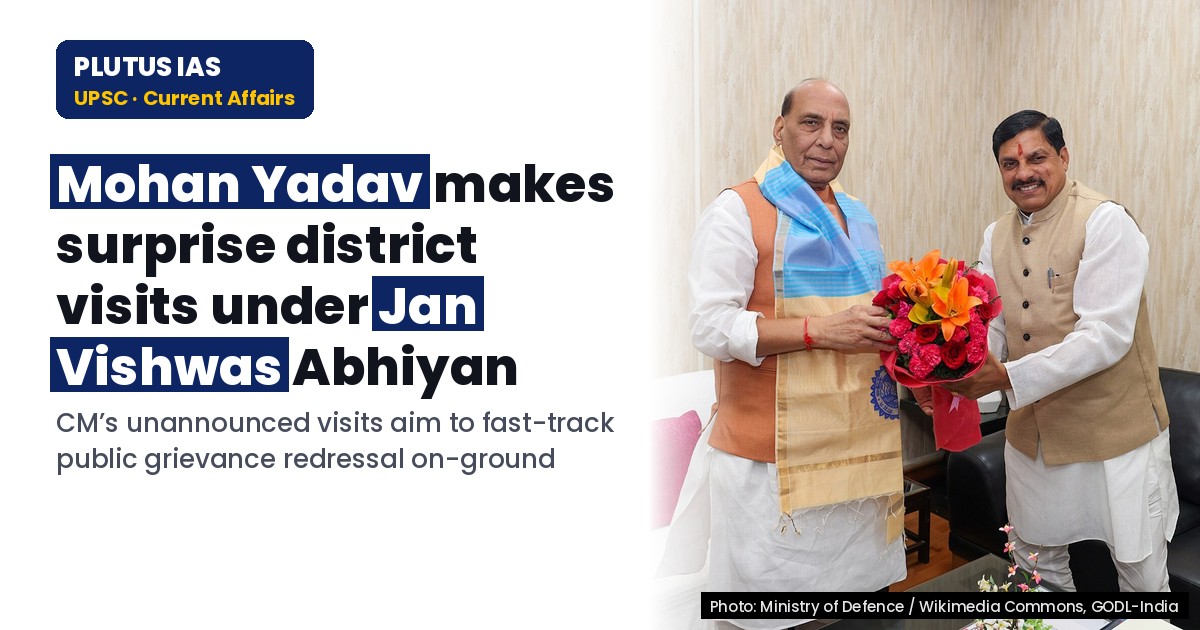
21 Oct MP CM’s surprise district visits under Jan Vishwas Abhiyan: Key governance steps
✎ Jan Vishwas Abhiyan in Madhya Pradesh emphasizes field-based administration, surprise inspections, and real-time grievance redressal to enhance governance and citizen trust.
Subject Relevance — Where This Topic Fits
- GS Paper II — Governance, Transparency and Accountability | GS Paper III — Public Administration and E-Governance
- Prelims: Jan Vishwas Abhiyan, Public Grievance Redressal Mechanisms, Field-based Administration, CM Helpline, Swamitva Yojana, Revenue Administration
- Essay: Administrative Reforms and Citizen-Centric Governance, The Role of Surprise Inspections in Public Service Delivery
Quick Revision: Jan Vishwas Abhiyan in Madhya Pradesh emphasizes field-based administration, surprise inspections, and real-time grievance redressal to enhance governance and citizen trust.
Why is this in the news?
The Madhya Pradesh government has intensified its Jan Vishwas Abhiyan by introducing unannounced surprise inspections by the Chief Minister in districts to review the redressal of public grievances. This initiative underscores the state’s commitment to enhancing governance through field-based administration, transparency, and accountability in public service delivery. The directives issued to officials to remain in the field and address grievances promptly reflect a shift towards citizen-centric governance and real-time problem-solving.
Background
- The Jan Vishwas Abhiyan is a flagship governance initiative launched by the Government of Madhya Pradesh to ensure timely redressal of public grievances and improve administrative efficiency.
- Madhya Pradesh has historically faced challenges in effective grievance redressal due to bureaucratic delays, lack of field presence of officials, and systemic inefficiencies.
- The state has been implementing the Swamitva Yojana (2026) to digitize land records and provide free property registration to eligible beneficiaries, aiming to reduce disputes and enhance transparency.
- The initiative follows a pattern of surprise inspections by senior officials in other states to assess ground realities and ensure accountability in public service delivery.
- The Chief Minister’s directives emphasize the need for officials to prioritize field-based work over desk-bound administration to address citizen grievances effectively.
What is the Jan Vishwas Abhiyan?
- Launched by the Government of Madhya Pradesh, the Jan Vishwas Abhiyan is a governance campaign aimed at ensuring timely and transparent redressal of public grievances across all departments.
- The campaign operates under the principle of field-based administration, mandating officials to remain in the field to address citizen issues directly rather than relying solely on office-based processes.
- The initiative leverages the CM Helpline as a central platform for citizens to register complaints, which are then monitored for timely resolution by respective departments.
- Key focus areas include revenue administration, women and child development, food and civil supplies, public health, and public health engineering, where grievances are often high.
- The campaign includes unannounced surprise inspections by the Chief Minister and senior officials to assess the ground reality and ensure that directives are being implemented effectively.
- The initiative is part of a broader effort to improve the ease of doing business and enhance citizen trust in government institutions through transparent and accountable governance.
- The Swamitva Yojana (2026) is integrated into the campaign to digitize land records and streamline property registration, reducing disputes and enhancing transparency in land administration.
- The campaign also includes performance reviews of district collectors and other officials, with recognition for high performers and corrective measures for laggards.
Key Features
| Feature | Significance |
|---|---|
| Surprise district visits by the Chief Minister | Ensures real-time, unfiltered assessment of ground-level implementation of the Jan Vishwas Abhiyan, reducing bureaucratic delays and enhancing accountability. |
| Field-based grievance redressal by officials | Shifts focus from desk-bound administration to direct public interaction, improving responsiveness and trust in governance mechanisms. |
| Targeted focus on 12 low-rainfall districts | Addresses regional disparities in drought-prone areas by mandating tailored action plans for water scarcity and agricultural distress. |
| CM Helpline performance review | Highlights systemic bottlenecks in key departments (Revenue, Women & Child Development, Food & Civil Supplies, etc.) and prioritizes resolution of pending complaints. |
| Monitoring of Swamitva Yojana progress | Tracks land record digitization and free plot registration targets, ensuring transparency in property rights and reducing litigation. |
Why it Matters
Administrative Reforms
- Demonstrates a shift from symbolic governance to outcome-driven administration through unannounced inspections and field-based monitoring.
- Strengthens the principle of ‘minimum government, maximum governance’ by decentralizing decision-making to the district level.
- Enhances inter-departmental coordination by identifying silos in grievance redressal systems.
Public Service Delivery
- Accelerates resolution of pending complaints by placing officials in direct contact with affected citizens, reducing bureaucratic inertia.
- Prioritizes marginalized groups (e.g., farmers in drought-prone districts) by addressing region-specific challenges.
- Improves transparency in land records (Swamitva Yojana) to prevent disputes and streamline property transactions.
Institutional Accountability
- Institutes a culture of performance-based evaluation for district collectors and field officers, with public recognition for high achievers.
- Exposes systemic inefficiencies in departments handling core citizen services (e.g., Revenue, Public Health), enabling targeted reforms.
- Uses data-driven reviews (e.g., CM Helpline metrics) to identify and rectify governance gaps.
Challenges
1. Bureaucratic Resistance to Field Engagement
- Historical tendency of officials to prioritize desk-bound work over ground-level engagement, leading to delayed grievance redressal.
- Risk of superficial compliance where officers merely ‘visit’ districts without addressing root causes of public grievances.
UPSC Link: NCERT Sociology: Bureaucracy and Development
2. Regional Disparities in Resource Allocation
- Uneven distribution of administrative attention and resources across districts, exacerbating development gaps.
- Low-rainfall districts face compounded challenges (e.g., water scarcity, agricultural distress) requiring sustained, multi-departmental interventions.
UPSC Link: Geography: Regional Imbalances and Development
3. Data Gaps in Public Service Delivery
- Incomplete or inaccurate tracking of grievances (e.g., CM Helpline) hampers evidence-based policymaking.
- Lack of real-time monitoring tools for land records (Swamitva Yojana) risks duplication of efforts and legal ambiguities.
UPSC Link: E-Governance: Challenges in Digital Public Service Delivery
4. Performance Incentives and Deterrents
- Current reward systems (e.g., public recognition) may not sufficiently incentivize sustained field engagement by officials.
- Absence of punitive measures for non-compliance (e.g., zero-progress districts) could undermine the initiative’s credibility.
UPSC Link: Public Administration: Motivation and Accountability
5. Inter-Departmental Coordination Bottlenecks
- Grievances often span multiple departments (e.g., land disputes involving Revenue and Public Health), requiring seamless coordination.
- Siloed functioning of departments (e.g., Revenue vs. Women & Child Development) delays holistic solutions to citizen issues.
UPSC Link: Public Administration: Coordination Mechanisms
Challenges — UPSC Perspective
| Issue | Concern |
|---|---|
| Desk-bound administration | Delays in grievance redressal due to over-reliance on bureaucratic processes rather than field engagement. |
| Data opacity in Swamitva Yojana | Incomplete land records hinder property rights and increase litigation risks. |
| Regional resource disparities | Drought-prone districts lack tailored interventions to address water scarcity and agricultural distress. |
| Performance measurement gaps | Lack of standardized metrics to evaluate field engagement and grievance resolution outcomes. |
| Departmental silos | Citizen issues often require multi-departmental coordination, which is currently lacking. |
| Public trust deficit | Historical delays in grievance redressal have eroded citizen confidence in governance mechanisms. |
Government Initiatives — Must-Memorise for Prelims
- Jan Vishwas Abhiyan
- Swamitva Yojana (Swamitva Adhikar Abhilakh Evam Panjiyan-2026)
Way Forward
- Institute a real-time dashboard for tracking grievances and field visits to ensure transparency and accountability.
- Develop region-specific action plans for low-rainfall districts, integrating inputs from agricultural, water resources, and revenue departments.
- Strengthen the Swamitva Yojana by digitizing land records and conducting periodic audits to eliminate discrepancies.
- Introduce performance-linked incentives for district collectors and field officers, with clear metrics for field engagement and grievance resolution.
- Establish cross-departmental task forces to address multi-faceted citizen grievances (e.g., land disputes involving Revenue and Public Health).
- Conduct quarterly reviews of the CM Helpline data to identify systemic bottlenecks and prioritize high-impact departments.
- Enhance public awareness campaigns to educate citizens on grievance redressal mechanisms and their rights under Swamitva Yojana.
- Mandate mandatory field postings for junior officers to build a culture of grassroots governance from the ground up.
UPSC Value Addition
Keywords for Mains Answer-Writing
Public Grievance Redressal Mechanism · District Administration · Jan Vishwas Abhiyan · Field Administration · Chief Minister’s Surprise Visits · Revenue Administration · Swamitva Yojana · Public Trust in Governance · Administrative Accountability · Grama Sabha and Public Participation · Right to Service Delivery · E-governance and Transparency · District Collector’s Role · Citizen-Centric Governance
Concept Flow
Citizen grievances → Bureaucratic delays in redressal → CM announces Jan Vishwas Abhiyan → Surprise district visits and field-based monitoring → Identification of systemic bottlenecks → Targeted interventions (e.g., low-rainfall districts, CM Helpline departments) → Performance-based accountability → Improved public service delivery.
Prelims Practice Questions
Q1. Consider the following statements regarding the ‘Jan Vishwas Abhiyan’ in Madhya Pradesh:
1. It is a citizen-centric campaign aimed at addressing public grievances at the grassroots level.
2. The campaign mandates field-level officials to resolve complaints instead of remaining confined to offices.
3. The campaign is exclusively focused on revenue and land record-related grievances.
4. The Chief Minister may conduct surprise visits to districts to review the campaign’s progress.
How many of the above statements are correct?
- Only one
- Only two
- Only three
- All four
Answer: All four — Statements 1, 2, and 4 are correct. Statement 3 is incorrect as the campaign addresses grievances across multiple departments (e.g., revenue, women & child development, food & civil supplies, public health).
Q2. Assertion (A): The ‘Swamitva Yojana’ aims to provide free land record registration to eligible beneficiaries.
Reason (R): The scheme is designed to enhance transparency and reduce pendency in land record registration processes.
In the context of the above statements, select the correct option:
- Both A and R are true, and R is the correct explanation of A
- Both A and R are true, but R is NOT the correct explanation of A
- A is true, but R is false
- A is false, but R is true
Answer: A is true, but R is false — Assertion (A) is true as the Swamitva Yojana provides free land record registration. Reason (R) is also true but does not directly explain the assertion, as the scheme’s broader objective includes digitization and dispute resolution, not solely pendency reduction.
Q3. Match the following pairs related to administrative reforms in Madhya Pradesh:
Column I (Initiative) | Column II (Objective)
————————————————–|————————————————–
1. Jan Vishwas Abhiyan | A. Free land record registration for eligible beneficiaries
2. Swamitva Yojana | B. Addressing public grievances through field-level officials
3. Grievance Redressal Mechanism | C. Digitization of land records and dispute resolution
4. District Collector’s Role | D. Ensuring accountability and responsiveness in administration
Select the correct match:
- 1-B, 2-A, 3-D, 4-C
- 1-B, 2-C, 3-A, 4-D
- 1-D, 2-A, 3-B, 4-C
- 1-C, 2-A, 3-B, 4-D
Answer: 1-B, 2-C, 3-A, 4-D — The correct matches are: 1-B (Jan Vishwas Abhiyan aims to address public grievances through field-level officials), 2-A (Swamitva Yojana provides free land record registration), 3-D (Grievance Redressal Mechanism ensures accountability and responsiveness), and 4-C (District Collector’s Role includes digitization of land records and dispute resolution).
Mains Practice Question
✍ The Chief Minister of Madhya Pradesh has directed officials to prioritize field-level administration and address public grievances under the ‘Jan Vishwas Abhiyan’. Critically examine the significance of this directive in the context of India’s administrative architecture. Also, assess the potential challenges in its effective implementation. (15 Marks)
Approach: MODEL-ANSWER SKELETON:
1. **Introduction (2 marks)**
– Briefly define ‘field-level administration’ and ‘public grievance redressal’ in the Indian administrative context.
– Mention the constitutional and statutory provisions underpinning citizen-centric governance (e.g., Article 41, Directive Principles of State Policy; Right to Service Delivery Acts in states).
2. **Significance of the Directive (5 marks)**
– **Accountability and Responsiveness**: Field-level administration reduces bureaucratic delays and enhances transparency (citing examples like the ‘Antyodaya’ initiative or ‘Jansunwai’ portals in other states).
– **Trust in Governance**: Direct interaction with citizens builds trust and legitimacy (reference to studies on citizen-government interface, e.g., World Bank’s ‘Citizen Engagement’ reports).
– **Decentralization**: Aligns with the 73rd and 74th Constitutional Amendments, empowering local bodies (Panchayati Raj Institutions and Urban Local Bodies).
– **Data-Driven Governance**: Surprise visits enable real-time monitoring of administrative performance (link to ‘Mission Karmayogi’ and capacity-building initiatives).
3. **Potential Challenges (5 marks)**
– **Bureaucratic Resistance**: Inertia in administrative culture, risk aversion, and lack of incentives for field-level work (cite the ‘Lal Bahadur Shastri National Academy of Administration’ reports on civil service reforms).
– **Resource Constraints**: Inadequate staffing, infrastructure, and digital tools in rural areas (reference to the ‘Digital India Land Records Modernization Programme’ challenges).
– **Political Interference**: Potential misuse of surprise visits for electoral gains rather than governance improvement (discuss the role of the Election Commission’s Model Code of Conduct).
– **Grievance Redressal Bottlenecks**: Pendency in departments like revenue and public health due to systemic inefficiencies (cite the ‘National Judicial Data Grid’ for pendency trends).
4. **Way Forward (3 marks)**
– **Institutional Reforms**: Strengthening ‘Grievance Redressal Cells’ with dedicated staff and timelines (reference the ‘Citizen’s Charter’ framework).
– **Technology Integration**: Leveraging AI and data analytics for predictive grievance resolution (e.g., Madhya Pradesh’s ‘MP e-Seva’ portal).
– **Capacity Building**: Training officials in soft skills and citizen engagement (link to ‘Mission Karmayogi’ and ‘Capacity Building Commission’).
– **Monitoring Mechanisms**: Regular audits and third-party evaluations to ensure objectivity.
Source: amarujala.com
Generated by AanyaAi for educational purpose.
Related guides on our sites
- Anthropology VS PSIR
- Best PSIR optional coaching
- Best PSIR optional coaching online
- Best PSIR optional teacher

- DFPD extends Special Campaign 6 to achieve governance targets - October 24, 2026
- डीडीडब्ल्यूएस ने जल जीवन मिशन 2.0 के तहत सामुदायिक जल प्रबंधन को मजबूत किया - October 24, 2026
- J&K’s Drug-Free Model & Welfare Schemes: A Blueprint for UPSC Exam - October 24, 2026

No Comments