


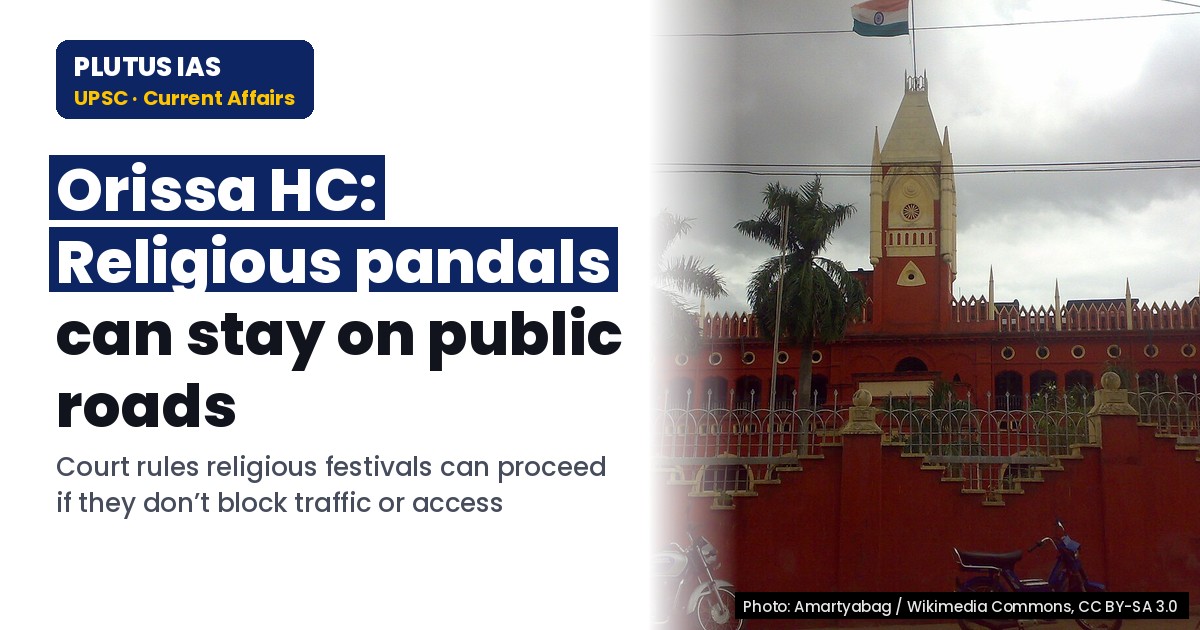
21 Oct Orissa HC on Religious Pandals: Balancing Faith & Public Interest in Polity
✎ Article 25(1) of the Constitution guarantees the right to religious freedom but subjects it to reasonable restrictions in the interest of public order, morality, and health, as affirmed by the Orissa High Court in its recent…
Subject Relevance — Where This Topic Fits
- GS Paper II — Fundamental Rights (Article 25, 26, 27, 28) | GS Paper III — Urban Governance and Public Order
- Prelims: Article 25 of the Constitution, Reasonable restrictions on religious freedom, Public order, morality, and health, Urban local body regulations, Traffic management in public spaces, Mandamus, PIL (Public Interest Litigation)
- Essay: Balancing cultural rights with public utility: A study of constitutional adjudication
Quick Revision: Article 25(1) of the Constitution guarantees the right to religious freedom but subjects it to reasonable restrictions in the interest of public order, morality, and health, as affirmed by the Orissa High Court in its recent ruling on religious pandals.
Why is this in the news?
The Orissa High Court, in a recent judgment, declined to impose a blanket ban on temporary religious pandals on public roads, affirming that community religious festivals may proceed provided they do not obstruct traffic, restrict residential access, or impede emergency services. The ruling underscores the constitutional principle that the right to religious practice under Article 25 is subject to reasonable restrictions in the interest of public order, morality, and health, while also highlighting the judiciary’s role in balancing individual inconvenience with collective cultural practices.
Background
- The Constitution of India guarantees the right to freedom of religion under Articles 25–28, subject to public order, morality, and health.
- Temporary religious pandals are a common feature of festivals in India, often erected on public roads or open spaces due to space constraints in urban and semi-urban areas.
- Urban local bodies and municipal authorities regulate the use of public spaces through permits, traffic management plans, and zoning regulations to balance religious practices with public utility.
- Public Interest Litigations (PILs) have increasingly been filed to address conflicts arising from the use of public spaces for religious activities, particularly where such activities allegedly obstruct traffic or violate safety norms.
- The doctrine of reasonable restrictions, as enshrined in Article 25(1), empowers the state to impose limitations on religious practices to ensure public order and safety, provided such restrictions are proportionate and non-discriminatory.
- The Orissa High Court’s ruling aligns with previous judicial precedents, such as *Commissioner, Hindu Religious Endowments, Madras v. Lakshmindra Thirtha Swamiar* (1954) and *State of Madras v. V.G. Row* (1952), which emphasize the balance between religious freedom and public interest.
What is the legal framework governing religious pandals on public roads?
- **Article 25 of the Constitution**: Guarantees the right to freedom of conscience and the right to freely profess, practice, and propagate religion, subject to public order, morality, and health.
- **Article 26**: Ensures the right of religious denominations to manage their own affairs in matters of religion, subject to public order, morality, and health.
- **Article 27**: Prohibits the state from compelling any person to pay taxes for the promotion or maintenance of any particular religion.
- **Article 28**: Prohibits religious instruction in educational institutions wholly maintained out of State funds, though religious instruction is permitted in institutions administered by the State but established under an endowment or trust, subject to conditions.
- **Reasonable Restrictions**: The state may impose restrictions on religious practices if they are necessary to maintain public order, morality, or health, and such restrictions must be reasonable, non-arbitrary, and proportionate.
- **Public Order**: A ground for reasonable restrictions under Article 25(1), interpreted to include the smooth functioning of public spaces, traffic regulation, and emergency services.
- **Urban Local Body Regulations**: Municipal authorities issue permits for temporary structures on public roads, ensuring compliance with traffic, safety, and environmental norms.
- **Judicial Precedents**: Courts have consistently held that while religious freedom is a fundamental right, it is not absolute and must yield to public interest where conflicts arise (e.g., *Ramesh Yeshwant Prabhoo v. P.K. Kunte*, 1996).
Key Features
| Feature | Significance |
|---|---|
| Constitutional balance between religious freedom and public order | Highlights the judicial interpretation of Article 25(1) of the Constitution, which guarantees the right to freely profess, practise, and propagate religion, subject to reasonable restrictions for public order, morality, and health. |
| Judicial restraint in PIL disposal | Demonstrates the judiciary’s reluctance to impose blanket bans unless public safety and accessibility are severely compromised, preferring to direct executive authorities for regulation. |
| Public interest vs individual inconvenience | Establishes that community religious festivals, integral to cultural traditions, may proceed if they do not completely obstruct traffic or deny residents access, balancing collective and individual rights. |
| Executive accountability in permitting process | Mandates that state authorities ensure adequate space for vehicular movement, uninterrupted access for residents, and clearance for emergency vehicles during temporary pandal setups. |
| Regulatory framework for sound and time restrictions | Directs enforcement of prescribed norms to mitigate noise pollution and ensure adherence to timelines, preventing undue disruption to public life. |
Why it Matters
Constitutional and Legal
- Reaffirms the constitutional principle that religious freedom is not absolute and must yield to public order and safety, as enshrined in Article 25(1) and upheld in judicial precedents like *Commissioner, Hindu Religious Endowments, Madras v. Lakshmindra Thirtha Swamiar* (1954).
- Clarifies the judicial approach to Public Interest Litigations (PILs) involving religious practices, emphasizing proportionality and the need for evidence of severe disruption rather than mere inconvenience.
- Sets a precedent for future cases involving temporary religious structures on public roads, guiding lower courts and administrative authorities in balancing rights and restrictions.
Administrative and Governance
- Strengthens the role of district and municipal authorities in regulating public spaces during religious festivals, ensuring compliance with safety and accessibility norms.
- Highlights the importance of pre-emptive planning by local bodies to allocate space for pandals while maintaining essential public infrastructure, such as roads and emergency routes.
- Underscores the need for inter-departmental coordination between police, municipal corporations, and public health authorities to enforce sound limits and time restrictions.
Societal and Cultural
- Preserves the cultural and social fabric of communities by allowing religious festivals to proceed, provided they do not infringe upon the rights of others or public order.
- Encourages a culture of mutual accommodation and respect among diverse religious groups, where festivals can coexist without systemic exclusion.
- Promotes awareness among citizens about the necessity of adhering to regulatory norms during public celebrations to avoid conflicts and ensure inclusivity.
Challenges
1. Balancing religious freedom with public order
- The judiciary must navigate the fine line between protecting religious freedoms and preventing public disorder, especially during large-scale festivals with significant footfall.
- Local authorities face the challenge of granting permissions without appearing to favour or discriminate against any religious group, necessitating transparent and objective criteria.
- Citizens may perceive regulatory measures as infringements on their religious rights, leading to resistance or non-compliance with prescribed norms.
UPSC Link: GS-II: Fundamental Rights (Article 25)
2. Ensuring accessibility and safety during festivals
- Maintaining clear pathways for emergency vehicles and residents requires meticulous planning, particularly in densely populated urban areas where space is limited.
- Enforcing sound and time restrictions often faces pushback from organisers and participants, necessitating robust monitoring mechanisms and community engagement.
- The risk of accidents or stampedes increases during large gatherings, demanding strict adherence to structural safety standards for pandals and crowd control measures.
UPSC Link: GS-III: Disaster Management
3. Regulatory enforcement and compliance
- Local authorities may lack the resources or capacity to monitor and enforce regulations effectively, particularly in rural or semi-urban areas.
- Political or social pressures can influence the granting of permissions, undermining the neutrality of the regulatory process.
- Lack of awareness among citizens about the legal framework governing public religious activities can lead to unintentional violations of norms.
UPSC Link: GS-II: Role of Civil Services in Governance
4. Cultural sensitivity and inclusivity
- Religious festivals often intersect with local traditions, making it challenging to impose uniform regulations without alienating certain communities.
- The perception of unequal treatment by authorities can exacerbate social tensions, particularly in pluralistic societies with diverse religious practices.
- Balancing the interests of different religious groups during festival seasons requires proactive dialogue and consensus-building.
UPSC Link: GS-II: Secularism
Challenges — UPSC Perspective
| Issue | Concern |
|---|---|
| Subjectivity in defining ‘reasonable restrictions’ | Determining what constitutes a ‘complete obstruction’ or ‘undue inconvenience’ can vary based on individual perspectives, leading to disputes. |
| Resource constraints in monitoring and enforcement | Local authorities may lack the personnel, technology, or funds to effectively regulate large-scale festivals. |
| Community resistance to regulatory norms | Citizens may view restrictions as discriminatory or unnecessary, leading to non-compliance or protests. |
| Inter-departmental coordination gaps | Poor coordination between police, municipal bodies, and health departments can result in lapses in enforcement. |
| Cultural and religious sensitivities | Regulations must be framed with cultural nuances in mind to avoid perceived bias or marginalisation. |
Way Forward
- State governments and municipal corporations should develop standardised guidelines for granting permissions for temporary religious pandals, incorporating clear criteria for space allocation, sound limits, and time restrictions.
- Local authorities must conduct pre-festival audits of proposed pandal sites to ensure compliance with safety and accessibility norms, including emergency route clearances.
- Enhanced inter-departmental coordination should be institutionalised, with designated nodal officers for each festival to oversee enforcement and address grievances.
- Public awareness campaigns should be launched to educate citizens about the legal framework governing public religious activities, emphasising the importance of mutual respect and safety.
- Judicial training programmes should include modules on balancing religious freedoms with public order, ensuring consistent interpretation of constitutional provisions across courts.
- Pilot projects for smart monitoring systems (e.g., drones, IoT sensors) can be explored in high-risk areas to improve real-time enforcement of regulations.
- Community leaders and religious organisations should be engaged in dialogue to foster voluntary compliance with norms, reducing the need for coercive measures.
UPSC Value Addition
Keywords for Mains Answer-Writing
Fundamental Rights · Article 25 of the Constitution · Reasonable restrictions on religious freedom · Public order · Morality and health · Right to religious practice · Reasonable accommodation · Constitutional balance · Public interest vs individual rights · Judicial review of religious practices · Temporary religious structures · Traffic management · Emergency vehicle access · Orissa High Court judgment · Constitutional morality · Freedom of religion in India
Constitutional & Policy Linkages
- Article 25(1): Freedom of conscience and religion, subject to public order, morality, and health.
- Article 14: Equality before law and equal protection of laws, ensuring non-discriminatory application of regulations.
- Article 21: Right to life and personal liberty, interpreted to include the right to safe and accessible public spaces.
Concept Flow
Religious festivals → Temporary pandals on public roads → Potential obstruction to traffic and access → PIL filed alleging denial of rights → Judicial review under Article 25(1) → Balancing test: community interest vs individual inconvenience → Judgment permits festivals with conditions → Executive authorities enforce regulatory norms → Public order and safety maintained.
Prelims Practice Questions
Q1. Consider the following statements regarding the right to freedom of religion under the Constitution of India:
1. Article 25 guarantees the right to freely profess, practise and propagate religion.
2. The right under Article 25 is subject to public order, morality and health.
3. Religious practices that are not essential to a religion can be regulated by the state.
4. The state can impose a blanket ban on all religious processions on public roads.
How many of the above statements are correct?
- Only one
- Only two
- Only three
- All four
Answer: Only three — Statements 1, 2 and 3 are correct. Statement 4 is incorrect as the state cannot impose a blanket ban; restrictions must be reasonable and must not violate the essential religious practices.
Q2. Assertion (A): The Orissa High Court, in its recent judgment, held that the right to practise religion under Article 25 is subject to reasonable restrictions.
Reason (R): The Constitution of India permits the state to regulate religious practices in the interest of public order, morality and health.
In the context of the above two statements, which one of the following is correct?
- Both A and R are true, and R is the correct explanation of A.
- Both A and R are true, but R is not the correct explanation of A.
- A is true, but R is false.
- A is false, but R is true.
Answer: Both A and R are true, but R is not the correct explanation of A. — Both A and R are true. The Orissa High Court explicitly relied on Article 25(1) and the doctrine of reasonable restrictions. R correctly explains the constitutional basis for A.
Q3. Match the following constitutional provisions with their respective articles:
Column I (Provision)
A. Right to freedom of conscience and free profession, practice and propagation of religion
B. Right to freedom of speech and expression
C. Right to equality before law
D. Right to constitutional remedies
Column II (Article Number)
1. Article 19
2. Article 25
3. Article 14
4. Article 32
- {‘A’: 2, ‘B’: 1, ‘C’: 3, ‘D’: 4}
- {‘A’: 1, ‘B’: 2, ‘C’: 3, ‘D’: 4}
- {‘A’: 3, ‘B’: 1, ‘C’: 2, ‘D’: 4}
- {‘A’: 4, ‘B’: 3, ‘C’: 1, ‘D’: 2}
Answer: {‘A’: 2, ‘B’: 1, ‘C’: 3, ‘D’: 4} — A matches Article 25, B matches Article 19, C matches Article 14, and D matches Article 32.
Mains Practice Question
✍ The Orissa High Court, in a recent judgment, refused to impose a blanket ban on religious pandals on public roads, balancing the right to religious practice under Article 25 with public order and safety. Critically examine the constitutional framework governing the right to freedom of religion in India, with particular reference to the doctrine of reasonable restrictions. Also, analyse how the judiciary ensures that individual religious freedoms do not impinge upon the collective public interest. (15 Marks)
Approach: MODEL-ANSWER SKELETON:
1. **Constitutional Basis of Religious Freedom (Article 25)**:
– Article 25(1): Right to freely profess, practise and propagate religion.
– Article 25(2): State’s power to regulate religious practices in the interest of public order, morality and health.
– Essential religious practices doctrine (S.R. Bommai v. Union of India, 1994).
2. **Doctrine of Reasonable Restrictions**:
– Reasonable restrictions under Article 25(1): Public order, morality, health.
– Test of reasonableness: Proportionality, least restrictive means, balancing individual rights with community interests.
– Judicial review: Courts examine whether restrictions are reasonable and not arbitrary (State of Madras v. V.V. Gopalaswami, 1954; T.M.A. Pai Foundation v. State of Karnataka, 2002).
3. **Judicial Balancing of Rights and Public Interest**:
– Community celebrations vs. individual inconvenience: Courts weigh cultural and social significance against practical disruptions.
– Case law: Orissa High Court’s approach aligns with the principle that religious practices must not completely obstruct traffic or deny access to residents (e.g., Ganesh Puja/Durga Puja pandals).
– Role of authorities: Ensuring adequate space for vehicular movement, emergency vehicle access, and sound/time restrictions.
4. **Constitutional Morality and Public Order**:
– Constitutional morality (as interpreted in Navtej Singh Johar v. Union of India, 2018) requires balancing religious freedoms with societal harmony.
– Public order as a ground for restriction: Must be narrowly construed to avoid misuse (Ram Manohar Lohia v. State of Bihar, 1966).
5. **Conclusion**:
– The Orissa High Court’s judgment reflects a nuanced application of constitutional principles, ensuring that religious freedoms are not curtailed disproportionately while safeguarding public interest.
– Emphasise the role of the judiciary in upholding the balance between fundamental rights and societal needs.
Source: orissapost.com
Generated by AanyaAi for educational purpose.
Related guides on our sites
- Current affairs for upsc 2026
- Best PSIR optional coaching for upsc
- Best PSIR optional teacher for upsc
- Best teacher of PSIR optional for upsc

- एससीओ बैठक में भारत का आतंकवाद विरोध: क्षेत्रीय सहयोग पर जोर - October 22, 2026
- SEC Directs Strict SC Order Compliance for Andhra ULB Polls - October 22, 2026
- आंध्र प्रदेश: 100 नगर निकाय चुनाव प्रक्रिया पर रोक, सर्वोच्च न्यायालय के आदेश के बाद SEC ने रोकी प्रक्रिया - October 22, 2026

No Comments