


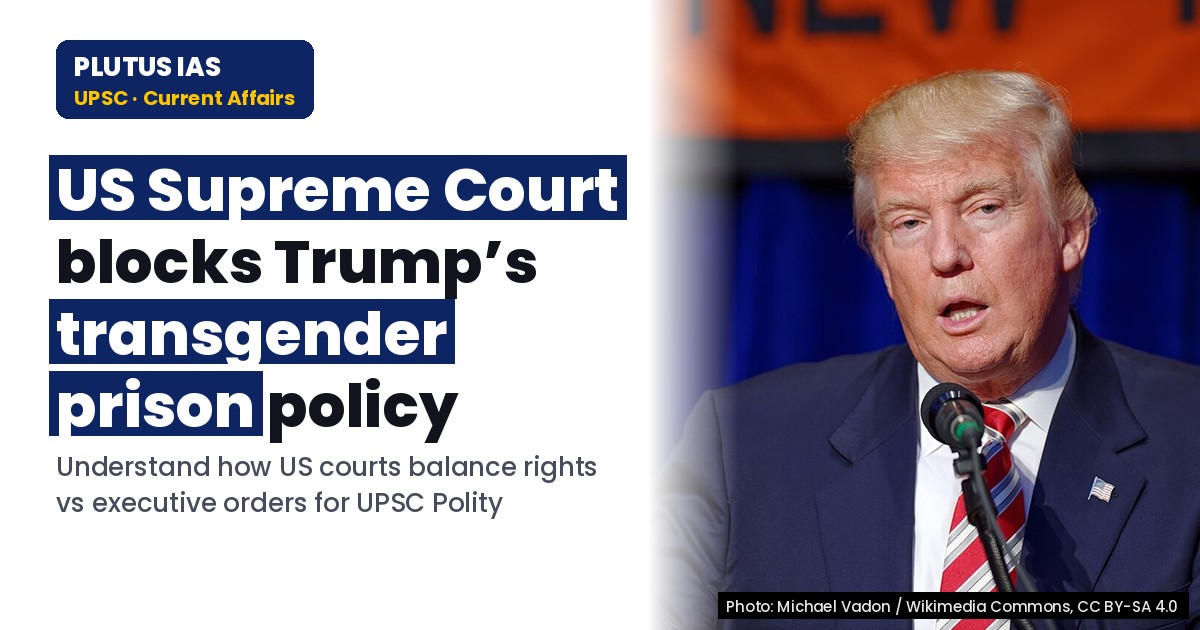
21 Oct US Supreme Court Blocks Trump’s Transgender Prison Policy: UPSC Polity Analysis
✎ The US Supreme Court’s refusal to stay a lower-court injunction blocking restrictions on transgender prisoner healthcare reaffirms the judiciary’s role in safeguarding constitutional rights, particularly where medical necessity…
Subject Relevance — Where This Topic Fits
- GS Paper II — Fundamental Rights (Article 14, 15, 21) | GS Paper II — Judiciary and Judicial Review | GS Paper III — Human Rights and Social Justice
- Prelims: Transgender Persons (Protection of Rights) Act, 2019, Article 21 (Right to Health), Judicial Review, Executive Orders, Bureau of Prisons, Gender Dysphoria, Hormone Therapy, Gender Affirming Care
- Essay: The Role of Judiciary in Protecting Fundamental Rights: A Comparative Analysis, Balancing Security Concerns with Human Rights in Correctional Institutions
Quick Revision: The US Supreme Court’s refusal to stay a lower-court injunction blocking restrictions on transgender prisoner healthcare reaffirms the judiciary’s role in safeguarding constitutional rights, particularly where medical necessity and mental health risks are established.
Why is this in the news?
The United States Supreme Court’s refusal to stay a lower-court injunction blocking the Trump administration’s policy restricting medical care for transgender prisoners marks a significant judicial intervention in the intersection of correctional governance, healthcare rights, and transgender rights. The decision underscores the judiciary’s role in scrutinising executive actions that may infringe upon constitutional guarantees, particularly in the context of incarcerated individuals who are a vulnerable population. The case also highlights the ongoing global discourse on the rights of transgender persons within state institutions, including prisons, and the legal mechanisms available to challenge policies that may exacerbate discrimination or harm.
Background
- The policy in question was introduced via an executive order by the US President, directing the Bureau of Prisons to revise its medical care protocols for transgender inmates, specifically halting surgeries, tapering hormone therapy, and discontinuing social accommodations such as access to makeup or wigs.
- The Bureau of Prisons had previously provided hormone therapy to approximately 600 transgender inmates as of 2025, a practice that had been in place for over three decades without documented security incidents linked to such care.
- A federal district court, presided over by a judge appointed by a former Republican president, granted a preliminary injunction to maintain existing medical care, citing severe mental health risks, including depression, anxiety, and suicidal tendencies, associated with untreated gender dysphoria.
- The Trump administration appealed the injunction, arguing that the policy was necessary to address unspecified security concerns, despite the lack of empirical evidence supporting such claims.
- The case reflects broader trends in US jurisprudence where conservative-majority courts have, in some instances, upheld state-level restrictions on gender-affirming care for minors and participation in sports, raising questions about the consistency of judicial approaches to transgender rights.
- The Supreme Court’s decision to deny the stay application aligns with its prior rulings that have, in certain contexts, permitted lower-court injunctions to remain in effect pending full judicial review, particularly where constitutional rights are implicated.
What are the legal and policy dimensions of transgender rights in correctional facilities?
- **Constitutional Guarantees**: Incarcerated individuals retain fundamental rights under the US Constitution, including the right to medical care under the Eighth Amendment (prohibition of cruel and unusual punishment) and the Fourteenth Amendment (equal protection and due process). Courts have recognised that denial of necessary medical treatment to prisoners may constitute a violation of constitutional rights.
- **Gender Dysphoria and Healthcare**: Gender dysphoria is a recognised medical condition under the Diagnostic and Statistical Manual of Mental Disorders (DSM-5). The World Professional Association for Transgender Health (WPATH) standards of care recommend gender-affirming treatments, including hormone therapy, as part of comprehensive mental health care for affected individuals.
- **Correctional Healthcare Policies**: Policies governing healthcare in prisons must balance security imperatives with the medical needs of inmates. Courts often intervene when policies disproportionately deny care or fail to provide alternatives that address legitimate health concerns.
- **Judicial Review of Executive Orders**: Executive orders, while a tool of governance, are subject to judicial review if they conflict with constitutional or statutory provisions. The judiciary may stay or invalidate such orders if they lack legal basis or cause irreparable harm.
- **Precedent and Consistency**: The Supreme Court’s decision to deny the stay application reflects a pattern where courts prioritise the preservation of status quo in cases involving irreversible medical interventions or where the harm of denial outweighs speculative security concerns.
- **International Human Rights Frameworks**: The case resonates with international human rights instruments, such as the UN Standard Minimum Rules for the Treatment of Prisoners (the Nelson Mandela Rules), which emphasise the right to healthcare for prisoners without discrimination.
- **Vulnerable Populations in Custody**: Transgender prisoners are a particularly vulnerable group within correctional systems, often facing higher risks of violence, isolation, and mental health crises. Policies that exacerbate these risks without justification may invite heightened judicial scrutiny.
- **Role of Expert Testimony**: Courts frequently rely on expert medical testimony to assess the necessity of treatments for gender dysphoria. In this case, the district court’s reliance on psychiatric evidence underscored the severity of risks associated with withdrawal of hormone therapy.
Key Features
| Feature | Significance |
|---|---|
| Supreme Court’s refusal to stay lower-court injunction | Upholds judicial review of executive orders on prisoner healthcare, reinforcing separation of powers. |
| Executive Order on medical care for transgender inmates | Directs Bureau of Prisons to restrict gender-affirming treatments, citing fiscal and security concerns. |
| Lower-court injunction (Judge Lamberth, Reagan appointee) | Halts enforcement pending litigation, citing risks of severe mental health consequences for inmates. |
| Transgender inmates’ legal challenge | Argues withdrawal of care violates constitutional protections against cruel and unusual punishment (8th Amendment). |
| Bureau of Prisons’ existing hormone therapy provision | Documents 600+ inmates receiving treatment in 2025, highlighting systemic reliance on such care. |
Why it Matters
Judicial & Constitutional
- Affirms courts’ role in scrutinising executive actions affecting fundamental rights, including healthcare access for marginalised groups.
- Reinforces the principle that administrative policies must be evidence-based, particularly when restricting medical treatments.
- Highlights the tension between executive discretion in prisons and constitutional protections against discrimination.
Human Rights & Social Justice
- Underscores the vulnerability of incarcerated transgender individuals and the state’s duty of care under international human rights norms.
- Raises questions about the ethical implications of denying gender-affirming care, which is linked to reduced suicide risk and improved mental health.
- Demonstrates the intersectionality of incarceration, healthcare rights, and gender identity in policy debates.
Administrative & Policy
- Illustrates the procedural challenges in implementing rapid policy reversals in sensitive domains like prisoner healthcare.
- Shows the need for empirical evidence in justifying restrictions on established medical practices within correctional systems.
- Exposes gaps in federal coordination between executive orders, agency implementation, and judicial oversight.
Global Comparative Perspective
- Aligns with international trends where courts have blocked or delayed similar restrictions on transgender healthcare in prisons (e.g., UK, Canada).
- Contrasts with jurisdictions where legislative bans on gender-affirming care have been upheld, highlighting divergent legal approaches.
Challenges
1. Balancing Security Concerns with Healthcare Rights
- Prisons argue that gender-affirming treatments may pose security risks, but lack documented evidence linking such care to incidents.
- Denial of care risks exacerbating mental health crises, creating additional institutional burdens (e.g., increased suicide attempts).
- Developing non-discriminatory security protocols that accommodate gender identity without compromising safety remains unresolved.
UPSC Link: GS2: Fundamental Rights (Article 21)
2. Executive Overreach vs. Judicial Review
- Rapid policy shifts via executive orders risk bypassing legislative and judicial scrutiny, undermining democratic accountability.
- Courts face the challenge of balancing deference to executive authority in prisons with protection of constitutional rights.
- The case exemplifies the need for clear statutory frameworks governing prisoner healthcare, especially for marginalised groups.
UPSC Link: GS2: Separation of Powers
3. Data Gaps in Policy Justification
- Government failed to provide empirical data linking hormone therapy to security threats, relying instead on speculative claims.
- Long-term studies on the impact of gender-affirming care in prisons are limited, complicating evidence-based policymaking.
- The absence of a federal registry or standardised data collection on transgender inmates hampers informed decision-making.
UPSC Link: GS2: Governance & Transparency
4. Intersectionality of Incarceration and Identity
- Transgender inmates face compounded discrimination, including higher rates of violence and inadequate access to identity-affirming resources.
- Prison policies often reflect cisnormative assumptions, failing to account for the specific needs of gender-diverse populations.
- Addressing these challenges requires intersectional approaches combining healthcare, legal protections, and staff training.
UPSC Link: GS1: Social Justice & Inclusion
5. Implementation Challenges for Correctional Systems
- Prisons lack standardised protocols for managing transgender inmates, leading to ad-hoc and potentially harmful practices.
- Staff training on gender identity and healthcare needs is often inadequate, exacerbating risks of discrimination or neglect.
- Budgetary constraints may deter prisons from adopting inclusive policies, despite long-term cost benefits of mental health interventions.
UPSC Link: GS2: Public Administration
Challenges — UPSC Perspective
| Issue | Concern |
|---|---|
| Lack of empirical evidence for security risks | Policy justification relies on assumptions rather than data, undermining legal defensibility. |
| Mental health crises among inmates | Withdrawal of care may lead to severe psychological distress, increasing institutional liabilities. |
| Inadequate staff training on gender identity | Correctional officers may misapply policies, leading to discrimination or safety risks. |
| Federal-state coordination gaps | Inconsistent application of healthcare standards across jurisdictions complicates implementation. |
| Long-term healthcare costs | Denial of preventive care may result in higher emergency treatment expenses for prisons. |
| Legal precedents on prisoner rights | Courts may increasingly scrutinise restrictive policies, setting binding standards for future cases. |
Way Forward
- Develop federal guidelines for transgender inmate healthcare, incorporating input from medical experts, legal scholars, and advocacy groups.
- Conduct empirical studies on the impact of gender-affirming care in prisons to inform evidence-based policymaking.
- Mandate comprehensive training for prison staff on gender identity, mental health, and non-discriminatory practices.
- Establish a federal registry to track healthcare outcomes for transgender inmates, ensuring transparency and accountability.
- Encourage collaboration between correctional systems and LGBTQ+ organisations to design inclusive policies and grievance mechanisms.
- Review existing prison healthcare budgets to identify cost-effective interventions that balance security and rights.
- Clarify the role of executive orders in prisoner healthcare, ensuring alignment with constitutional protections and judicial oversight.
- Promote research on the intersection of incarceration, gender identity, and mental health to guide future reforms.
UPSC Value Addition
Keywords for Mains Answer-Writing
Transgender rights · Prisoner healthcare · Judicial review of executive orders · Gender dysphoria management · Bureau of Prisons policy · Constitutional rights of incarcerated persons · Judicial intervention in administrative decisions · Executive vs judicial balance · Medical autonomy · Human rights in prisons
Constitutional & Policy Linkages
- 8th Amendment (Cruel and Unusual Punishment) – Protection against denial of essential medical care.
- 14th Amendment (Equal Protection Clause) – Ensuring non-discriminatory treatment for transgender inmates.
- Article 21 (Right to Life and Personal Liberty) – Guaranteeing access to healthcare as part of dignity.
Concept Flow
Executive Order restricting gender-affirming care in prisons → Legal challenge by transgender inmates → Lower-court injunction citing mental health risks → Supreme Court’s refusal to stay injunction → Debate on separation of powers and evidence-based policymaking → Broader implications for prisoner rights and administrative justice.
Prelims Practice Questions
Q1. Consider the following statements regarding transgender rights and prison healthcare policies:
1. The US Supreme Court’s decision in the given case pertains to the immediate enforcement of new medical restrictions for transgender prisoners.
2. The Bureau of Prisons’ policy aimed to halt surgeries, taper off hormones, and end social accommodations for transgender inmates.
3. The lower court’s order mandated the continuation of treatments, citing severe mental health risks of untreated gender dysphoria.
How many of the above statements are correct?
- Only one
- Only two
- All three
- None
Answer: All three — Statements 1 and 2 are correct as they accurately reflect the Supreme Court’s refusal to enforce the new policy and the Bureau of Prisons’ proposed restrictions. Statement 3 is also correct, as the lower court explicitly cited mental health risks like depression and suicidal thoughts as reasons to continue treatments.
Q2. Assertion (A): The US Supreme Court’s decision in the given case reflects a judicial check on executive overreach in matters of prisoner healthcare.
Reason (R): The Court upheld a lower court’s order blocking the Bureau of Prisons’ policy, citing constitutional concerns over mental health risks.
Options:
A. Both A and R are true, and R is the correct explanation of A.
B. Both A and R are true, but R is not the correct explanation of A.
C. A is true, but R is false.
D. A is false, but R is true.
Answer: ? — Both the assertion and reason are true. The Supreme Court’s refusal to enforce the policy demonstrates judicial oversight of executive actions, and the reason correctly explains this by citing the lower court’s constitutional concerns over mental health risks.
Mains Practice Question
✍ The judicial branch’s role in reviewing executive policies concerning the healthcare rights of incarcerated transgender persons is pivotal in upholding constitutional guarantees. Critically examine this statement with reference to the recent US Supreme Court decision on transgender prisoners’ healthcare. (15 Marks)
Approach: MODEL-ANSWER SKELETON:
1. **Judicial Review and Executive Policies**: Define judicial review as a mechanism for checking executive overreach, citing Marbury v. Madison (1803) and its application in administrative law.
2. **Constitutional Rights of Incarcerated Persons**: Discuss the Eighth Amendment (US) prohibiting ‘cruel and unusual punishment’ and its relevance to healthcare rights, including mental health provisions.
3. **Gender Dysphoria and Medical Autonomy**: Explain gender dysphoria as a recognised medical condition (DSM-5) and the ethical obligations of prison authorities to provide necessary treatments, citing the lower court’s reasoning in the case.
4. **Balance of Security and Rights**: Analyse the government’s argument of ‘security concerns’ versus the inmates’ right to healthcare, referencing the lack of empirical evidence linking hormone therapy to security risks.
5. **Judicial Precedents**: Compare with other Supreme Court rulings on transgender rights (e.g., restrictions on military service and passport sex markers) to highlight consistency or divergence in judicial reasoning.
6. **Global Perspective**: Briefly contrast with India’s approach, such as the Supreme Court’s recognition of transgender rights in *NALSA v. Union of India* (2014) and subsequent policies like the Transgender Persons (Protection of Rights) Act, 2019.
7. **Conclusion**: Weigh the judicial role in protecting marginalised groups against executive discretion, emphasising the need for evidence-based policymaking and constitutional adherence.
Source: orissapost.com
Generated by AanyaAi for educational purpose.
Related guides on our sites
- Best PSIR optional coaching for upsc
- Best PSIR optional teacher for upsc
- Best teacher of PSIR optional for upsc
- Best PSIR optional coaching in delhi for UPSC

- एससीओ बैठक में भारत का आतंकवाद विरोध: क्षेत्रीय सहयोग पर जोर - October 22, 2026
- SEC Directs Strict SC Order Compliance for Andhra ULB Polls - October 22, 2026
- आंध्र प्रदेश: 100 नगर निकाय चुनाव प्रक्रिया पर रोक, सर्वोच्च न्यायालय के आदेश के बाद SEC ने रोकी प्रक्रिया - October 22, 2026

No Comments