


22 Oct PM-DAKSH Scheme: Key Features for UPSC & State PCS Aspirants
✎ PM-DAKSH is a central sector scheme under the Ministry of Social Justice and Empowerment, launched in 2020, to provide skill development, upskilling, and reskilling to marginalised communities, with a focus on industry-relevant…
Subject Relevance — Where This Topic Fits
- GS Paper II — Social Justice and Governance | GS Paper III — Human Resource Development and Skill Development
- Prelims: PM-DAKSH Yojana, Deendayal Antyodaya Yojana – National Urban Livelihoods Mission (DAY-NULM), National Skill Development Mission (NSDM), Scheduled Castes and Scheduled Tribes (Prevention of Atrocities) Act, 1989, National Commission for Scheduled Castes
- Essay: The Role of Skill Development in Achieving Inclusive Growth, Empowerment of Marginalised Sections: A Governance Imperative
Quick Revision: PM-DAKSH is a central sector scheme under the Ministry of Social Justice and Empowerment, launched in 2020, to provide skill development, upskilling, and reskilling to marginalised communities, with a focus on industry-relevant training and placement assistance.
Why is this in the news?
The PM-DAKSH (Pradhan Mantri Dakshta Aur Kushalta Sampann Hitgrahi) scheme has been highlighted in recent policy communications for its role in enhancing the employability of marginalised communities through targeted skilling, upskilling, and reskilling interventions. Its renewed focus aligns with the government’s commitment to reducing socio-economic disparities and aligning the workforce with industry demands, particularly in the context of India’s demographic dividend.
Background
- The PM-DAKSH scheme was launched in 2020 as a central sector scheme under the Ministry of Social Justice and Empowerment to provide skill development opportunities to Scheduled Castes (SCs), Scheduled Tribes (STs), Other Backward Classes (OBCs), Economically Backward Classes (EBCs), De-notified Nomadic and Semi-Nomadic Tribes (DNTs), Safai Karamcharis, and other marginalised groups.
- The scheme is a convergence of existing skill development initiatives such as the Deendayal Antyodaya Yojana – National Urban Livelihoods Mission (DAY-NULM), National Rural Livelihoods Mission (NRLM), and the National Apprenticeship Promotion Scheme (NAPS) to ensure holistic coverage.
- India’s workforce faces significant skill gaps, with a large proportion of workers employed in the informal sector lacking formal training. The PM-DAKSH scheme aims to address this by offering industry-relevant training aligned with the National Skill Qualification Framework (NSQF).
- The scheme operates under the broader framework of the National Skill Development Mission (NSDM), which seeks to create a skilled workforce capable of meeting the demands of a $5 trillion economy by 2025.
- Marginalised communities, particularly SCs, STs, and DNTs, have historically faced barriers to skill acquisition due to socio-economic constraints, discrimination, and limited access to training infrastructure. PM-DAKSH seeks to mitigate these disparities through targeted interventions.
- The scheme’s implementation is monitored through a robust digital platform, ensuring transparency, accountability, and real-time tracking of beneficiaries and outcomes.
What is PM-DAKSH?
- PM-DAKSH is a central sector scheme under the Ministry of Social Justice and Empowerment, launched in 2020, to provide skill development, upskilling, and reskilling opportunities to marginalised communities.
- The scheme targets Scheduled Castes (SCs), Scheduled Tribes (STs), Other Backward Classes (OBCs), Economically Backward Classes (EBCs), De-notified Nomadic and Semi-Nomadic Tribes (DNTs), Safai Karamcharis, and other vulnerable groups.
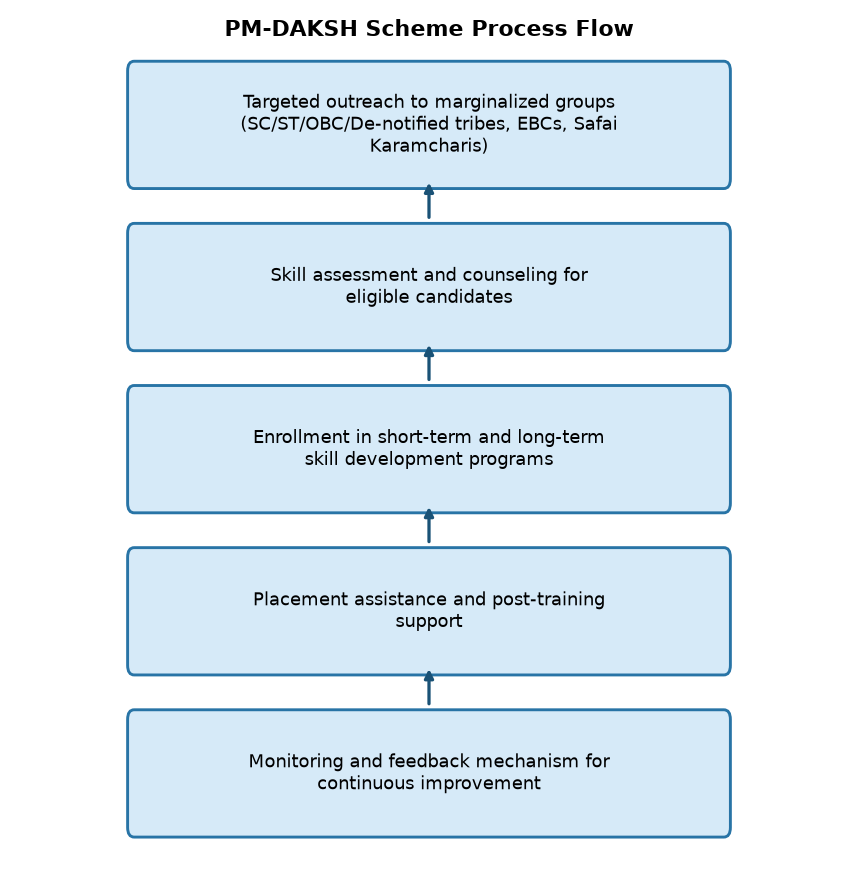
- Training is provided under four verticals: Up-skilling/Reskilling, Short-Term Training, Long-Term Training, and Entrepreneurship Development, with a focus on industry-relevant skills aligned to the National Skill Qualification Framework (NSQF).
- The scheme operates through a convergence approach, integrating existing initiatives such as DAY-NULM, NRLM, and NAPS to ensure comprehensive coverage and avoid duplication of efforts.
- Training partners include Industrial Training Institutes (ITIs), Sector Skill Councils (SSCs), and reputed training providers empanelled by the National Skill Development Corporation (NSDC).
- Financial assistance is provided to beneficiaries for training costs, including course fees, toolkits, and stipends, with a cap of ₹15,000 per beneficiary for short-term courses and ₹30,000 for long-term courses.
- The scheme includes a placement assistance component, with a target of placing at least 70% of trained beneficiaries in wage employment or self-employment within six months of completion.
- Monitoring and evaluation are conducted through a digital dashboard, tracking key metrics such as number of beneficiaries trained, placement rates, and skill attainment levels.
UPSC Value Addition
Keywords for Mains Answer-Writing
PM-DAKSH Yojana · Skill Development · Marginalised Communities · Scheduled Castes · Scheduled Tribes · Other Backward Classes · Deendayal Antyodaya Yojana-National Urban Livelihoods Mission (DAY-NULM) · Pradhan Mantri Kaushal Vikas Yojana (PMKVY) · National Skill Development Corporation (NSDC) · Inclusive Growth · Vocational Training · Livelihood Enhancement · Government Schemes for Upliftment · Constitutional Provisions for Social Justice · Article 46 · Directive Principles of State Policy · Skill India Mission · Poverty Alleviation · Economic Empowerment
Prelims Practice Questions
Q1. Consider the following statements regarding the PM-DAKSH Yojana:
1. It is a central sector scheme exclusively for the welfare of Scheduled Tribes.
2. The scheme aims to provide skill development and livelihood enhancement opportunities to marginalised communities.
3. The scheme is implemented under the aegis of the Ministry of Social Justice and Empowerment.
4. The scheme includes provisions for both short-term and long-term skill training programmes.
How many of the above statements are correct?
- Only one
- Only two
- Only three
- All four
Answer: All four — Statements 1 is incorrect as PM-DAKSH is not exclusively for Scheduled Tribes but targets SCs, STs, OBCs, and other marginalised groups. Statements 2, 3, and 4 are correct as per the scheme’s objectives and implementation framework.
Q2. Assertion (A): The PM-DAKSH Yojana is designed to bridge the digital divide by providing ICT-based skill training.
Reason (R): The scheme includes components for upskilling in emerging technologies such as artificial intelligence and blockchain.
In the context of the above two statements, which one of the following is correct?
- Both A and R are true, and R is the correct explanation of A
- Both A and R are true, but R is not the correct explanation of A
- A is true, but R is false
- A is false, but R is true
Answer: A is true, but R is false — The PM-DAKSH Yojana does aim to bridge skill gaps, but its primary focus is on traditional and emerging vocational skills, not exclusively on ICT or digital divide mitigation. The Reason (R) is true but does not directly explain the Assertion (A).
Q3. Match the following schemes with their respective ministries/implementing agencies:
Column I (Scheme) | Column II (Ministry/Implementing Agency)
——————|—————————————-
A. PM-DAKSH Yojana | 1. Ministry of Skill Development and Entrepreneurship
B. DAY-NULM | 2. Ministry of Social Justice and Empowerment
C. PMKVY | 3. Ministry of Housing and Urban Affairs
D. Stand-Up India | 4. Ministry of Micro, Small and Medium Enterprises
Select the correct match:
- A-2, B-3, C-1, D-4
- A-1, B-2, C-3, D-4
- A-3, B-1, C-2, D-4
- A-4, B-3, C-1, D-2
Answer: A-2, B-3, C-1, D-4 — PM-DAKSH is implemented by the Ministry of Social Justice and Empowerment (A-2). DAY-NULM is under the Ministry of Housing and Urban Affairs (B-3). PMKVY is under the Ministry of Skill Development and Entrepreneurship (C-1). Stand-Up India is under the Ministry of Micro, Small and Medium Enterprises (D-4).
Mains Practice Question
✍ The PM-DAKSH Yojana represents a significant policy intervention aimed at enhancing the livelihoods of marginalised communities through targeted skill development. Critically examine the scheme’s objectives, implementation framework, and its alignment with constitutional provisions for social justice. Also, analyse the challenges in achieving its intended outcomes. (15 Marks)
Approach: MODEL-ANSWER SKELETON:
1. **Introduction (2 Marks)**
– Define PM-DAKSH (Pradhan Mantri Dakshta Aur Kushalta Sampann Hitgrahi) Yojana: A central sector scheme under the Ministry of Social Justice and Empowerment.
– Objective: To provide skill development and livelihood enhancement to SCs, STs, OBCs, EBCs, Denotified Nomads, and other marginalised groups.
– Constitutional anchor: Article 46 (Directive Principle of State Policy) and Article 38 (promotion of welfare of the people).
2. **Key Features and Implementation Framework (4 Marks)**
– Target groups: SCs (20%), STs (10%), OBCs (40%), EBCs (10%), and others (20%).
– Components: Short-term training (3 months), long-term training (6-12 months), upskilling/reskilling, and entrepreneurship development.
– Implementation partners: National Skill Development Corporation (NSDC), State Skill Development Missions, and industry stakeholders.
– Funding: Central sector scheme with 100% funding from the central government.
3. **Alignment with Constitutional Provisions (4 Marks)**
– **Article 46**: Directs the State to promote the educational and economic interests of weaker sections, particularly SCs and STs.
– **Article 38(2)**: Mandates the State to minimise inequalities in income and status.
– **Article 29(2)**: Ensures no discrimination in admission to educational institutions.
– **Article 15(4)**: Allows special provisions for the advancement of socially and educationally backward classes.
– **Judicial Precedents**: Cite landmark cases like *Indra Sawhney v. Union of India* (1992) on reservation and *Ashoka Kumar Thakur v. Union of India* (2008) on creamy layer.
4. **Challenges in Implementation (4 Marks)**
– **Awareness and Outreach**: Limited awareness among target groups due to socio-economic barriers.
– **Quality of Training**: Variability in training quality across states and sectors.
– **Industry Linkages**: Weak industry-academia partnerships leading to skill mismatches.
– **Monitoring and Evaluation**: Lack of robust monitoring mechanisms to track outcomes.
– **Geographical Disparities**: Uneven distribution of training centres across urban and rural areas.
– **Digital Divide**: Limited access to ICT-based training in remote areas.
5. **Way Forward (1 Mark)**
– Strengthen multi-stakeholder partnerships (government, industry, civil society).
– Enhance digital infrastructure for remote training delivery.
– Introduce outcome-based funding models to improve accountability.
– Leverage technology for real-time monitoring and grievance redressal.
Source: PIB (Press Information Bureau)
Generated by AanyaAi for educational purpose.
Related guides on our sites
- UPSC EPFO syllabus
- Best PSIR optional coaching for upsc
- Best sociology optional coaching for upsc
- Which is best sociology optional coaching for upsc

- PM-DAKSH Scheme: Key Features for UPSC & State PCS Aspirants - October 22, 2026
- जयशंकर और टस्क की बैठक: मोदी-टस्क वार्ता से पहले भारत-पोलैंड संबंधों की दिशा तय - October 22, 2026
- UPSC Alert: 40-Day ‘Khet Bachao Abhiyan’ Launch by Union Minister - October 22, 2026

No Comments