


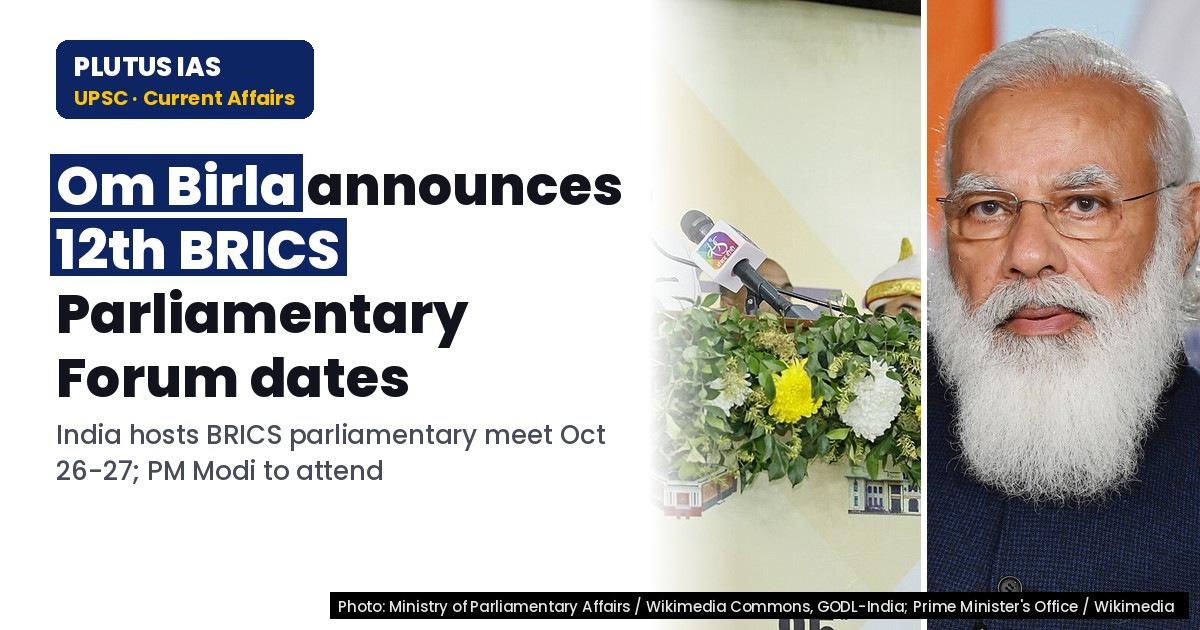
22 Oct BRICS Parliamentary Forum 2026: Key Highlights for UPSC & State PCS
✎ The BRICS Parliamentary Forum is a multilateral platform for parliamentarians to exchange best practices, foster consensus, and promote people-centric development through dialogue on resilience, innovation, cooperation, and…
Subject Relevance — Where This Topic Fits
- GS Paper II — International Relations — Bilateral, Regional and Global Groupings and Agreements involving India and/or affecting India’s interests | GS Paper II — International Relations — India’s Foreign Policy: Objectives, Tools, and Recent Initiatives | GS Paper II — International Relations — Role of Parliament in Diplomacy and Global Governance
- Prelims: BRICS, Parliamentary Diplomacy, Samvidhan Sadan, Lok Sabha Speaker, Joint Declaration, People-Centric Development, AI in Legislatures, Parliamentary Friendship Groups
- Essay: The Role of Parliamentary Diplomacy in Shaping Global Governance, Multilateralism in the 21st Century: Challenges and Opportunities for Developing Nations
Quick Revision: The BRICS Parliamentary Forum is a multilateral platform for parliamentarians to exchange best practices, foster consensus, and promote people-centric development through dialogue on resilience, innovation, cooperation, and sustainability.
Why is this in the news?
The announcement by Lok Sabha Speaker Om Birla regarding the 12th BRICS Parliamentary Forum, scheduled for October 26–27, 2026, at the Samvidhan Sadan in New Delhi, underscores India’s growing emphasis on parliamentary diplomacy within multilateral forums. This initiative aligns with India’s broader foreign policy objectives of fostering consensus-based dialogue, leveraging technological advancements in governance, and promoting sustainable development through parliamentary cooperation. The Forum’s thematic focus on ‘Strengthening Parliaments for People-Centric Development’ reflects India’s commitment to institutionalising best practices in legislative governance and multilateral engagement.
Background
- The BRICS bloc, comprising Brazil, Russia, India, China, and South Africa, was established in 2006 to promote economic cooperation and political dialogue among emerging economies.
- The BRICS Parliamentary Forum was initiated in 2015 as a platform for parliamentarians from member and partner countries to exchange ideas, share best practices, and foster collaboration on issues of mutual interest.
- India has been an active participant in the BRICS framework, utilising parliamentary diplomacy to enhance its global standing and promote its developmental priorities.
- The Samvidhan Sadan in New Delhi, inaugurated in 2023, serves as a venue for high-level parliamentary engagements, symbolising India’s commitment to constitutional governance and democratic institutions.
- Parliamentary diplomacy refers to the use of parliamentary institutions and processes to conduct foreign policy, build consensus, and address global challenges through dialogue and cooperation.
- India has been expanding its network of Parliamentary Friendship Groups, which facilitate bilateral engagement with legislatures of partner countries on issues of mutual interest.
What is the BRICS Parliamentary Forum?
- The BRICS Parliamentary Forum is a multilateral platform established to foster dialogue among parliamentarians from BRICS member countries and invited partner nations.
- The Forum aims to strengthen parliamentary cooperation, share legislative best practices, and promote consensus on issues such as sustainable development, innovation, and resilience.
- The 12th edition of the Forum, scheduled for October 26–27, 2026, will be held at the Samvidhan Sadan in New Delhi.
- The Forum’s thematic focus for 2026 is ‘Strengthening Parliaments for People-Centric Development,’ with four high-level sessions dedicated to Resilience, Innovation, Cooperation, and Sustainability.
- The Forum will bring together Presiding Officers, parliamentary leaders, Union Ministers, Members of Parliament, and dignitaries from BRICS member and partner countries to deliberate on shared challenges and opportunities.
- A key outcome of the Forum is the adoption of a Joint Declaration, which reflects the consensus reached on critical issues and serves as a roadmap for future parliamentary cooperation.
- The Forum also provides an opportunity for bilateral and multilateral interactions, including meetings of parliamentary friendship groups and delegations from participating countries.
- India’s initiative to establish Parliamentary Friendship Groups with 64 countries underscores its commitment to deepening parliamentary diplomacy and fostering long-term partnerships.
Key Features
| Feature | Significance |
|---|---|
| Hosting of the 12th BRICS Parliamentary Forum | Demonstrates India’s enhanced role in parliamentary diplomacy within BRICS, positioning the Parliament as a platform for multilateral consensus-building on developmental themes. |
| Theme: ‘Strengthening Parliaments for People-Centric Development’ | Aligns parliamentary functions with citizen-centric governance, emphasizing resilience, innovation, cooperation, and sustainability in legislative processes. |
| Establishment of Parliamentary Friendship Groups with 64 countries | Expands India’s diplomatic outreach through structured parliamentary engagement, facilitating knowledge exchange and bilateral cooperation beyond BRICS. |
| Paperless Legislatures in India | Showcases India’s adoption of digital governance, reducing administrative costs and improving legislative efficiency through technology integration. |
| Use of AI for multilingual parliamentary communication | Highlights India’s technological leadership in legislative processes, enabling inclusive participation and reducing language barriers in parliamentary proceedings. |
Why it Matters
Diplomatic and Multilateral Relations
- The BRICS Parliamentary Forum serves as a structured platform for parliamentary leaders from BRICS and partner nations to deliberate on shared developmental priorities, reinforcing India’s role in shaping global parliamentary discourse.
- The participation of 11 BRICS member countries and 10 partner nations underscores the forum’s role in fostering consensus on issues of mutual interest, including governance, innovation, and sustainability.
- Bilateral and multilateral interactions during the forum enable India to strengthen diplomatic ties through parliamentary channels, complementing traditional state-level diplomacy.
Legislative Governance and Innovation
- The forum’s focus on ‘Strengthening Parliaments for People-Centric Development’ reflects a global shift toward parliamentary accountability and responsiveness to citizen needs.
- India’s initiative to establish Parliamentary Friendship Groups with 64 countries demonstrates a structured approach to parliamentary diplomacy, facilitating long-term knowledge exchange and policy learning.
- The adoption of paperless legislatures and AI-driven multilingual communication in Indian parliaments highlights the integration of technology in legislative processes, setting a benchmark for other nations.
Economic and Technological Cooperation
- The forum’s emphasis on ‘Innovation’ and ‘Sustainability’ aligns with global efforts to leverage technology for inclusive development, particularly in areas like AI and digital governance.
- Knowledge-sharing on best practices in parliamentary communication and committee procedures enables participating nations to adopt efficient models, potentially enhancing their legislative frameworks.
Institutional Capacity Building
- The forum’s structure, including high-level sessions on resilience, innovation, cooperation, and sustainability, provides a framework for institutional learning and capacity building among parliamentary bodies.
- The meeting of Secretaries of delegations prior to the forum ensures preemptive consensus-building, enhancing the efficiency of deliberations and outcomes.
Challenges
1. Heterogeneity in Parliamentary Systems
- Diverse parliamentary systems across BRICS and partner nations may impede consensus-building, particularly on contentious issues like governance models or technological adoption.
- Variations in legislative capacity and technological infrastructure among participating nations could limit the effectiveness of knowledge-sharing initiatives.
UPSC Link: GS-II: International Organisations
2. Balancing Multilateral and Bilateral Priorities
- The forum’s dual focus on multilateral consensus and bilateral interactions may create challenges in prioritizing shared goals versus individual national interests.
- Ensuring equitable participation and representation among 21 nations (11 BRICS + 10 partners) requires meticulous logistical and diplomatic coordination.
UPSC Link: GS-II: Bilateral Groupings
3. Technological Adoption and Digital Divide
- While India showcases advanced digital governance, other nations may lack the infrastructure or capacity to adopt similar technologies, creating a digital divide in parliamentary practices.
- Ensuring inclusivity in multilingual communication, particularly for lesser-spoken languages, remains a technical and logistical challenge.
UPSC Link: GS-III: Science and Technology
4. Sustainability of Parliamentary Friendship Groups
- Maintaining long-term engagement and tangible outcomes from the newly established Parliamentary Friendship Groups requires sustained diplomatic and institutional efforts.
- Ensuring that these groups translate into concrete policy or legislative collaborations remains a challenge.
UPSC Link: GS-II: International Relations
5. Consensus on Joint Declarations
- Achieving a unanimous joint declaration at the forum may be challenging due to differing national priorities, particularly on issues like governance, innovation, or sustainability.
- Divergent views on the role of parliaments in development could hinder consensus-building.
UPSC Link: GS-II: International Treaties
Challenges — UPSC Perspective
| Issue | Concern |
|---|---|
| Diverse Parliamentary Systems | Risk of fragmented consensus due to varied governance models and legislative capacities. |
| Logistical Coordination | Challenges in accommodating 21 nations with equitable representation and participation. |
| Technological Disparities | Digital divide may limit the applicability of India’s best practices for other nations. |
| Sustainability of Initiatives | Ensuring long-term engagement and outcomes from Parliamentary Friendship Groups. |
| Consensus on Declarations | Potential disagreements on shared goals, particularly on governance and sustainability. |
Way Forward
- Enhance pre-forum consultations among Secretaries of delegations to streamline agenda-setting and consensus-building.
- Establish a dedicated knowledge-sharing platform for parliamentary best practices, including AI-driven multilingual tools.
- Promote pilot projects in partner nations to test and adapt India’s paperless and AI-driven parliamentary models.
- Strengthen the institutional framework of Parliamentary Friendship Groups through regular review and joint action plans.
- Develop a standardized framework for evaluating the impact of parliamentary innovations on governance outcomes.
- Facilitate capacity-building workshops for parliamentarians from developing nations to bridge the digital divide.
- Encourage the integration of sustainability and innovation themes into national legislative agendas.
- Leverage the forum to advocate for multilateral agreements on parliamentary transparency and citizen engagement.
UPSC Value Addition
Keywords for Mains Answer-Writing
BRICS Parliamentary Forum · parliamentary diplomacy · people-centric development · Legislative Assemblies · paperless legislatures · AI in governance · Parliamentary Friendship Groups · BRICS Joint Declaration · presiding officers · multilateral cooperation
Constitutional & Policy Linkages
- Article 80: Role of Rajya Sabha in federal representation and legislative deliberations.
- Article 81: Composition of Lok Sabha and its role in national policymaking.
Concept Flow
BRICS Parliamentary Forum announced → Host nation (India) invites delegations → Delegations prepare through bilateral/multilateral consultations → High-level sessions on resilience, innovation, cooperation, and sustainability → Joint Statement or Declaration on shared priorities → Implementation through national legislative actions → Long-term engagement via Parliamentary Friendship Groups.
Prelims Practice Questions
Q1. Consider the following statements regarding the BRICS Parliamentary Forum:
1. The 12th BRICS Parliamentary Forum will be held in New Delhi from October 26–27.
2. The theme of the Forum is ‘Strengthening Parliaments for People-Centric Development’.
3. The Forum will focus exclusively on bilateral interactions among member countries.
4. The Forum will be preceded by a meeting of the Secretaries of the delegations on October 25 to finalise the Joint Statement.
How many of the above statements are correct?
- Only one
- Only two
- Only three
- All four
Answer: All four — Statements 1, 2, and 4 are correct. Statement 3 is incorrect as the Forum will feature both bilateral and multilateral interactions.
Q2. Assertion (A): India has established Parliamentary Friendship Groups with 64 countries.
Reason (R): The BRICS Parliamentary Forum aims to facilitate consensus-based dialogue on themes such as Resilience, Innovation, Cooperation, and Sustainability.
Options:
A. Both A and R are true, and R is the correct explanation of A.
B. Both A and R are true, but R is not the correct explanation of A.
C. A is true, but R is false.
D. A is false, but R is true.
Answer: ? — Assertion (A) is true as stated by Lok Sabha Speaker Om Birla. Reason (R) is also true but does not explain the assertion, as the establishment of Parliamentary Friendship Groups is a separate initiative.
Q3. Match the following themes of the BRICS Parliamentary Forum with their descriptions:
Column I (Theme) Column II (Description)
A. Resilience 1. Enhancing collaborative efforts for sustainable development
B. Innovation 2. Building capacity to withstand shocks and crises
C. Cooperation 3. Promoting technological and procedural advancements in governance
D. Sustainability 4. Strengthening mutual support and shared governance mechanisms
Options:
A. A-2, B-3, C-4, D-1
B. A-3, B-2, C-1, D-4
C. A-1, B-4, C-2, D-3
D. A-4, B-1, C-3, D-2
Answer: ? — The correct pairing is: A-2 (Resilience: capacity to withstand shocks), B-3 (Innovation: technological advancements), C-4 (Cooperation: mutual support), D-1 (Sustainability: sustainable development).
Mains Practice Question
✍ The BRICS Parliamentary Forum represents a significant evolution in India’s parliamentary diplomacy, emphasizing ‘people-centric development’ and multilateral cooperation. Critically examine the institutional mechanisms, thematic focus, and potential outcomes of such forums in enhancing global governance. (15 Marks)
Approach: MODEL-ANSWER SKELETON:
1. **Institutional Mechanisms**:
– Role of the Lok Sabha Speaker and Presiding Officers of State Legislatures in hosting the Forum.
– Structure of the Forum: high-level sessions on Resilience, Innovation, Cooperation, and Sustainability.
– Pre-forum meeting of Secretaries to finalise the Joint Statement (25 Oct 2026).
– India’s initiative of Parliamentary Friendship Groups with 64 countries as a tool for sustained engagement.
2. **Thematic Focus**:
– ‘People-centric development’ as the overarching theme: aligning parliamentary functions with citizen welfare.
– Emphasis on AI and technology in governance (e.g., paperless Legislatures, translation into 22 languages).
– Multilateral cooperation: consensus-building through joint declarations and bilateral/multilateral interactions.
3. **Potential Outcomes and Challenges**:
– **Outcomes**: Enhanced parliamentary diplomacy, adoption of best practices (e.g., AI integration), and strengthened BRICS partnerships.
– **Challenges**: Divergent national priorities among BRICS members, ensuring equitable participation, and translating declarations into actionable policies.
4. **Comparative Perspective**:
– Contrast with other multilateral parliamentary forums (e.g., Inter-Parliamentary Union) and India’s evolving role in global governance.
5. **Conclusion**:
– The Forum’s success hinges on sustained dialogue, implementation of commitments, and India’s ability to leverage such platforms for domestic and global governance reforms.
Source: orissapost.com
Generated by AanyaAi for educational purpose.
Related guides on our sites
- Current affairs for upsc 2026
- Best PSIR optional coaching for upsc
- Best PSIR optional teacher for upsc
- Best teacher of PSIR optional for upsc

- UNEP Report 2026 Warns: Paris 1.5°C Target Slipping Away - October 23, 2026
- पूर्व आईएएस अधिकारी हत्या मामले में आईएएस एसोसिएशन की मुख्यमंत्री से मुलाकात - October 23, 2026
- UPSC Exam: Rare Glimpse of Ritwik Ghatak’s Cinematic Legacy at 4-Day Festival - October 23, 2026

No Comments