


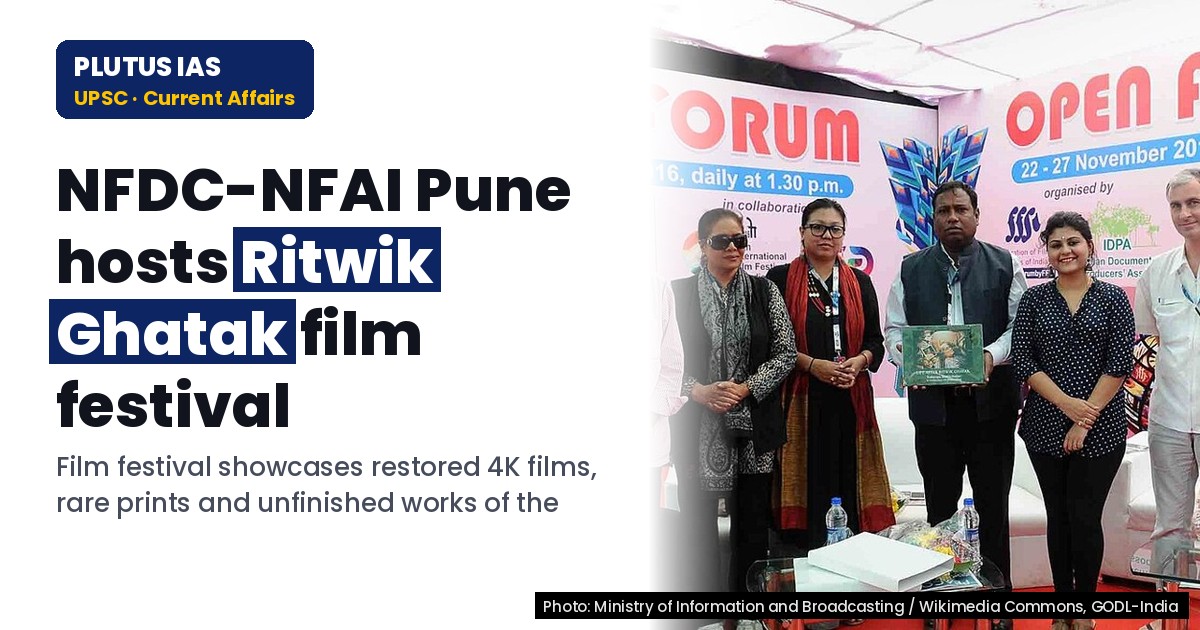
23 Oct UPSC Exam: Rare Glimpse of Ritwik Ghatak’s Cinematic Legacy at 4-Day Festival
✎ The National Film Heritage Mission (NFHM), implemented by NFDC–NFAI, is India’s flagship initiative for the restoration and digitisation of cinematic heritage, with Ritwik Ghatak’s retrospective serving as a prime example of its…
Subject Relevance — Where This Topic Fits
- GS Paper I — Indian Heritage and Culture: Visual Arts, Literature and Cinema | GS Paper II — Government Policies and Interventions for Development in various sectors
- Prelims: National Film Heritage Mission (NFHM), National Film Archive of India (NFAI), Ritwik Ghatak, Film restoration, 4K restoration, Cultural Preservation, Ministry of Information and Broadcasting, National Film Development Corporation (NFDC)
- Essay: The Role of Cultural Institutions in Preserving National Heritage, Cinema as a Mirror of Societal Transformation
Quick Revision: The National Film Heritage Mission (NFHM), implemented by NFDC–NFAI, is India’s flagship initiative for the restoration and digitisation of cinematic heritage, with Ritwik Ghatak’s retrospective serving as a prime example of its pedagogical and archival significance.
Why is this in the news?
The National Film Development Corporation–National Film Archive of India (NFDC–NFAI) is organising a four-day retrospective festival titled ‘Ghatak: A Retrospective’ from 22 to 25 October 2026 in Pune. The festival will showcase restored 4K prints of Ritwik Ghatak’s feature films, rare 35mm prints, lesser-known documentaries, educational shorts, and digitised fragments of his unfinished works, highlighting the institution’s role in preserving and disseminating India’s cinematic heritage under the National Film Heritage Mission (NFHM). This initiative underscores the importance of archival practices, technological restoration, and pedagogical engagement with cinematic legacies in India.
Background
- The National Film Archive of India (NFAI), established in 1964 under the Ministry of Information and Broadcasting, is the primary custodian of India’s cinematic heritage, tasked with the acquisition, preservation, and restoration of films and related materials.
- The National Film Development Corporation (NFDC), founded in 1975, promotes the growth of the Indian film industry through production, distribution, and preservation initiatives, including archival restoration projects.
- The National Film Heritage Mission (NFHM), launched by the Ministry of Information and Broadcasting, aims to restore, digitise, and conserve India’s audio-visual heritage, with a focus on films, documentaries, and archival materials dating from the silent era to the present.
- Ritwik Ghatak (1925–1976), a pioneering Bengali filmmaker, is celebrated for his politically charged and socially conscious cinema, which explored themes of partition, displacement, and human resilience through a distinct narrative and visual style.
- Ghatak’s works are recognised for their experimental techniques, melodramatic realism, and deep engagement with Bengali culture, making them essential to the study of post-colonial Indian cinema and its global influence.
- The preservation of Ghatak’s unfinished and lesser-known works, such as ‘Ronger Golam’ and ‘Bhagalar Banga Darshan’, exemplifies the broader challenge of archiving fragmented cinematic legacies and the role of state institutions in addressing such gaps.
What is the ‘Ghatak: A Retrospective’ festival and its significance?
- The festival is a curated showcase of Ritwik Ghatak’s cinematic oeuvre, organised by NFDC–NFAI under the National Film Heritage Mission (NFHM), to highlight the technical, artistic, and historical dimensions of his work.
- It features restored 4K prints of Ghatak’s feature films, including ‘Nagarik’ (1952), ‘Ajantrik’ (1958), ‘Meghe Dhaka Tara’ (1960), and ‘Subarnarekha’ (1962), which are emblematic of his stylistic innovations and thematic depth.
- The retrospective includes rare 35mm prints and digitised fragments of unfinished films, such as ‘Kato Ajanare’ (1959) and a biographical film on sculptor Ramkinkar Baij, demonstrating the archival mission’s commitment to preserving incomplete cinematic records.
- Documentaries and short films, such as ‘Bihar Ke Darshaniya Sthan’ (1955) and ‘Purulia Chhau’ (1970), are also featured, reflecting Ghatak’s interdisciplinary engagement with folk traditions, public life, and cultural documentation.
- The festival serves as an educational platform for film students, scholars, and enthusiasts, offering insights into Ghatak’s creative process, his contributions to screenwriting and acting, and his influence on later generations of filmmakers.
- The inclusion of films co-written or co-scripted by Ghatak, such as ‘Madhumati’ (1958) and ‘Musafir’ (1957), underscores his broader impact on Hindi cinema and the collaborative nature of filmmaking in India.
- Technical restoration in 4K format, undertaken under NFHM, ensures the longevity and accessibility of Ghatak’s works, preserving their original aesthetic and narrative integrity for future generations.
- The festival exemplifies the dual role of film archives: as repositories of cultural memory and as active participants in the revival and reinterpretation of cinematic heritage through public engagement and scholarly discourse.
Key Features
| Feature | Significance |
|---|---|
| Four-day retrospective festival ‘Ghatak: A Retrospective’ | A curated showcase of the cinematic legacy of Ritwik Ghatak, offering a rare public viewing opportunity for restored and digitised films, documentaries, and archival fragments. |
| Restoration in 4K and 2K formats | Utilises National Film Heritage Mission (NFHM) resources to digitally restore and preserve Ghatak’s films, ensuring high-fidelity access to his work for future generations. |
| Inclusion of incomplete and unreleased works | Highlights the archival role in preserving fragments of unfinished films, providing insights into Ghatak’s creative process and thematic preoccupations. |
| Screening of films with Ghatak’s contributions (e.g., Madhumati, Musafir) | Demonstrates the collaborative nature of Indian cinema, where Ghatak’s screenwriting and conceptual inputs influenced multiple filmmakers and genres. |
| Documentary and short film showcase | Reveals Ghatak’s engagement with socio-cultural themes, public life, and experimental forms beyond feature cinema. |
Why it Matters
Cultural Preservation
- The festival underscores the institutional role of the National Film Archive of India (NFAI) and NFDC in safeguarding India’s audiovisual heritage, particularly for regional and lesser-known cinematic traditions.
- Restoration and digitisation of Ghatak’s works align with global best practices in film preservation, ensuring accessibility for researchers, filmmakers, and enthusiasts.
- Exposure to Ghatak’s oeuvre—spanning realism, surrealism, and political allegory—enriches public understanding of India’s cinematic modernism and its socio-historical context.
Educational Value
- Provides a pedagogical resource for film studies, enabling students to analyse Ghatak’s narrative techniques, thematic concerns (e.g., displacement, memory, class struggle), and stylistic innovations.
- The inclusion of archival fragments and documentaries offers a holistic view of Ghatak’s artistic evolution, bridging gaps in his published filmography.
- Encourages interdisciplinary learning by linking cinema with history, literature, and political thought (e.g., Partition, Bengal’s cultural milieu).
Policy and Institutional Framework
- Demonstrates the implementation of the National Film Heritage Mission (NFHM), a government initiative to restore, digitise, and disseminate India’s film heritage, thereby fulfilling constitutional obligations towards cultural preservation (Article 51A(f)).
- Highlights the collaborative model between central institutions (NFAI, NFDC) and state archives (e.g., West Bengal State Film Archive) in preserving regional cinematic assets.
- Showcases the role of public funding in sustaining cultural institutions and ensuring equitable access to heritage materials.
Challenges
1. Preservation of Archival Material
- Degradation of original film prints due to age, improper storage, or lack of climate-controlled facilities poses risks to long-term conservation.
- Fragmentary and incomplete works require specialised restoration techniques, often involving manual reconstruction from partial footage.
- Limited awareness among stakeholders about the importance of archival preservation can lead to neglect of non-commercial or politically sensitive materials.
UPSC Link: GS Paper 1: Indian Culture – Salient aspects of Art Forms, Literature and Architecture from ancient to modern times
2. Accessibility and Digital Divide
- While digitisation enhances accessibility, it also raises concerns about digital exclusivity—those without internet or high-speed connectivity may remain underserved.
- High-resolution restorations (4K/2K) require significant storage and bandwidth, limiting real-time access for institutions with constrained resources.
- Language barriers and regional distribution of archival materials may hinder widespread engagement, particularly for non-Hindi or non-English audiences.
UPSC Link: GS Paper 2: Governance – E-governance- applications, models, successes, limitations, and potential; GS Paper 3: Challenges to internal security through communication networks
3. Balancing Restoration with Authenticity
- Restoration projects must navigate the tension between technical fidelity and artistic integrity—over-restoration can alter the original aesthetic intent.
- Decisions on which fragments to prioritise for restoration involve subjective curatorial choices, risking the loss of contextual or thematic nuances.
- Ethical considerations arise when restoring films tied to sensitive historical narratives (e.g., Partition, class struggles), requiring careful contextualisation.
UPSC Link: GS Paper 1: Indian Culture – Issues relating to the use of art forms in Indian society
4. Institutional Capacity and Funding
- Sustained funding for archival institutions is critical but often vulnerable to budgetary constraints or shifting government priorities.
- Limited human resources with expertise in film restoration and digital archiving can hinder the pace and quality of preservation efforts.
- Inter-institutional coordination between central and state archives, as well as private entities, remains a challenge in streamlining preservation workflows.
UPSC Link: GS Paper 2: Governance – Government policies and interventions for development in various sectors and issues arising out of their design and implementation
Challenges — UPSC Perspective
| Issue | Concern |
|---|---|
| Degradation of original film prints | Risk of irreversible loss of cultural heritage due to physical deterioration or improper storage conditions. |
| Digital exclusivity | High-resolution restorations may exclude audiences without access to advanced technology or internet connectivity. |
| Ethical dilemmas in restoration | Need to balance technical fidelity with preserving the original artistic and historical context of films. |
| Institutional funding gaps | Dependence on public funding makes preservation projects vulnerable to budgetary fluctuations or policy shifts. |
| Language and regional barriers | Limited accessibility for non-Hindi or non-English audiences due to linguistic and regional distribution constraints. |
| Fragmentary works and curatorial choices | Subjectivity in selecting which incomplete works to restore may lead to loss of contextual or thematic material. |
Government Initiatives — Must-Memorise for Prelims
- National Film Heritage Mission (NFHM)
Way Forward
- Expand funding and infrastructure for film archives, including climate-controlled storage facilities and state-of-the-art digitisation labs.
- Develop multilingual and regionally tailored access platforms to ensure inclusivity for diverse linguistic and cultural audiences.
- Strengthen inter-institutional collaborations between central archives (NFAI), state archives, and academic institutions for shared preservation and research initiatives.
- Incorporate film preservation and restoration into academic curricula, particularly in film studies, history, and cultural studies programmes.
- Promote public-private partnerships to augment resources for archival projects, leveraging corporate social responsibility (CSR) initiatives in the cultural sector.
- Enhance outreach programmes to raise awareness about the importance of film heritage, targeting schools, universities, and local communities.
- Establish a national digital repository for archival films, ensuring long-term sustainability and open-access policies where feasible.
- Encourage research fellowships and grants for scholars focusing on underrepresented or lesser-known cinematic traditions and filmmakers.
UPSC Value Addition
Keywords for Mains Answer-Writing
National Film Heritage Mission · National Film Development Corporation · National Film Archives of India · Ritwik Ghatak · Film restoration · 4K digitisation · Cultural preservation · Audiovisual archives · Cinematic legacy · Film festivals · Visual-audio heritage · Archival cinema · Bengali New Wave cinema · Partition narratives in cinema · Documentary filmmaking
Constitutional & Policy Linkages
- Article 51A(f): Fundamental Duties – To value and preserve the rich heritage of our composite culture
Concept Flow
Cinematic legacy of Ritwik Ghatak → Recognition of need for preservation → Implementation of National Film Heritage Mission (NFHM) → Restoration and digitisation of films → Organisation of retrospective festivals → Public engagement and educational outreach → Institutional capacity-building and policy refinement
Prelims Practice Questions
Q1. Consider the following statements about the National Film Heritage Mission (NFHM):
1. It is an initiative under the Ministry of Information and Broadcasting, Government of India.
2. It focuses exclusively on the restoration of commercially successful mainstream films.
3. It utilises 4K and 2K digitisation technologies for film preservation.
4. It is implemented solely by the National Film Development Corporation (NFDC).
How many of the above statements are correct?
- Only one
- Only two
- Only three
- All
Answer: Only three — Statements 1 and 3 are correct. Statement 2 is incorrect as NFHM preserves a wide range of films, including rare, incomplete, and lesser-known works. Statement 4 is incorrect as NFHM involves collaboration between NFDC and the National Film Archives of India (NFAI).
Q2. Assertion (A): The National Film Archives of India (NFAI) is primarily responsible for the commercial distribution of restored films.
Reason (R): The National Film Development Corporation (NFDC) handles the commercial distribution of films, while NFAI focuses on preservation and archival activities.
Options:
A. Both A and R are true, and R is the correct explanation of A.
B. Both A and R are true, but R is not the correct explanation of A.
C. A is true, but R is false.
D. A is false, but R is true.
Answer: ? — Assertion (A) is false because NFAI is not responsible for commercial distribution; it focuses on preservation and archival activities. Reason (R) is true as it correctly distinguishes the roles of NFDC and NFAI.
Q3. Match the following filmmakers with their associated films showcased in the ‘Ritwik Ghatak: A Retrospective’ festival:
Column I (Filmmaker) Column II (Film)
A. Ritwik Ghatak 1. Musafir
B. Nemai Ghosh 2. Chinnamul
C. Bimal Roy 3. Madhumati
D. Hrishikesh Mukherjee 4. Nagarik
Options:
A. A-4, B-2, C-3, D-1
B. A-2, B-4, C-1, D-3
C. A-1, B-3, C-4, D-2
D. A-3, B-1, C-2, D-4
- A
- B
- C
- D
Answer: A — Correct matches: A-4 (Nagarik), B-2 (Chinnamul), C-3 (Madhumati), D-1 (Musafir).
Mains Practice Question
✍ The National Film Heritage Mission (NFHM) exemplifies the convergence of technological advancement and cultural preservation in India. Critically examine the significance of film restoration and digitisation in safeguarding the nation’s audiovisual heritage. (15 Marks)
Approach: MODEL-ANSWER SKELETON:
1. Introduction (2 marks):
– Define NFHM as a Government of India initiative under the Ministry of Information and Broadcasting, implemented by NFDC and NFAI.
– State the objective: preservation, restoration, and digitisation of India’s film heritage using advanced technologies like 4K and 2K.
2. Significance of Film Restoration and Digitisation (5 marks):
– **Cultural Continuity**: Preserves cinematic works that reflect historical, social, and artistic contexts (e.g., Ritwik Ghatak’s films depicting Partition narratives).
– **Educational Value**: Provides access to rare and incomplete films for researchers, students, and cinephiles, enabling deeper study of filmmakers’ creative journeys.
– **Technological Integration**: Use of 4K digitisation ensures high-fidelity preservation, addressing degradation of original film prints.
– **Archival Integrity**: Highlights the role of archives in preserving not just completed films but also fragments of unfinished works, offering insights into the creative process.
– **Policy Framework**: NFHM aligns with global best practices in audiovisual archiving, ensuring India’s compliance with UNESCO’s 2003 Convention for the Safeguarding of the Intangible Cultural Heritage.
3. Challenges and Limitations (4 marks):
– **Resource Constraints**: High costs of digitisation and restoration limit the scope of preservation efforts.
– **Fragmented Archival Records**: Incomplete or lost film reels pose challenges in full restoration.
– **Technological Dependence**: Over-reliance on digital formats may risk obsolescence if not regularly updated.
– **Accessibility Barriers**: Limited public access to restored films due to copyright restrictions or lack of digital platforms.
4. Broader Implications for Cultural Policy (4 marks):
– **National Identity**: Strengthens India’s soft power by showcasing its cinematic diversity and historical narratives globally.
– **Legal and Institutional Framework**: Highlights the need for stronger legal protections for archival materials and collaboration between central and state archives.
– **Public Engagement**: Initiatives like film festivals (e.g., ‘Ritwik Ghatak: A Retrospective’) foster public appreciation and awareness of cinematic heritage.
– **Future Directions**: Emphasises the need for sustained funding, inter-institutional partnerships, and adoption of emerging technologies like AI for automated restoration.
Conclusion (1 mark):
– Reiterate the critical role of NFHM in bridging technology, culture, and policy to ensure India’s audiovisual heritage remains accessible and relevant for future generations.
Source: PIB (Press Information Bureau)
Maharashtra PCS (MPSC) — State PCS Practice
Prelims: The ‘Ritwik Ghatak Film Festival’ recently organized in Pune by NFDC-NFAI aimed to showcase the cinematic legacy of which renowned filmmaker?
- A) Satyajit Ray
- B) Ritwik Ghatak
- C) Mrinal Sen
- D) Bimal Roy
Answer: B) Ritwik Ghatak — The festival was organized by the National Film Development Corporation (NFDC) and National Film Archive of India (NFAI) in Pune to highlight the diverse cinematic heritage of Ritwik Ghatak.
Mains: Discuss the significance of the ‘Ritwik Ghatak Film Festival’ in preserving and promoting the cinematic legacy of Maharashtra’s cultural heritage. Analyze how such initiatives contribute to the state’s film industry and tourism.
Generated by AanyaAi for educational purpose.
Related guides on our sites
- How to prepare for GS paper 1 for UPSC CSE mains exam
- Best UPSC coaching for IFOS exam
- Best mentorship programme for upsc
- UPSC+BA degree

- UNEP Report 2026 Warns: Paris 1.5°C Target Slipping Away - October 23, 2026
- पूर्व आईएएस अधिकारी हत्या मामले में आईएएस एसोसिएशन की मुख्यमंत्री से मुलाकात - October 23, 2026
- UPSC Exam: Rare Glimpse of Ritwik Ghatak’s Cinematic Legacy at 4-Day Festival - October 23, 2026

No Comments