


24 Oct DFPD extends Special Campaign 6 to achieve governance targets
✎ Special Campaign 6 is a time-bound government initiative to reduce pendency, improve record management, and institutionalise cleanliness in public offices, with measurable outcomes in file disposal, digitalisation, and revenue…
Subject Relevance — Where This Topic Fits
- GS Paper II — Governance, Transparency and Accountability | GS Paper III — E-Governance, Digital India and Public Service Delivery
- Prelims: Special Campaign 6, Department of Food and Public Distribution (DFPD), E-governance, Public grievance redressal, Physical and e-file management, Revenue generation through administrative efficiency
- Essay: The role of administrative reforms in enhancing public trust and governance efficiency, Digital transformation as a catalyst for transparent and accountable governance
Quick Revision: Special Campaign 6 is a time-bound government initiative to reduce pendency, improve record management, and institutionalise cleanliness in public offices, with measurable outcomes in file disposal, digitalisation, and revenue generation.
Why is this in the news?
The Department of Food and Public Distribution (DFPD) has intensified efforts under Special Campaign 6, launched from 2 to 31 October 2026, to institutionalise cleanliness, reduce pendency of work, and improve record management across its PSUs, affiliated, and subordinate offices. The campaign, now extended, has achieved measurable progress in addressing pending grievances, digitising files, and optimising office space, reflecting the government’s sustained emphasis on administrative efficiency and citizen-centric governance.
Background
- Special Campaigns are time-bound, outcome-focused initiatives launched by the Government of India to reduce pendency, improve record management, and enhance cleanliness in government offices.
- The Department of Food and Public Distribution (DFPD), under the Ministry of Consumer Affairs, Food and Public Distribution, oversees the Public Distribution System (PDS), food security schemes, and logistics management for essential commodities.
- E-governance and digital transformation have been prioritised under the Digital India programme to streamline administrative processes and reduce manual intervention.
- The campaign aligns with the broader national agenda of ‘Minimum Government, Maximum Governance’ and the ‘Swachh Bharat Mission’ to promote cleanliness and efficiency in public institutions.
- The DFPD’s administrative reforms are critical for ensuring timely delivery of welfare schemes, reducing corruption risks, and improving citizen satisfaction.
- The campaign’s focus on physical and digital file management underscores the importance of record-keeping in governance and accountability.
What is Special Campaign 6?
- Special Campaign 6 is a government-wide initiative launched on 2 October 2026, running until 31 October 2026, aimed at reducing pendency of work, improving record management, and institutionalising cleanliness in government offices.
- The campaign is part of a series of Special Campaigns initiated by the Government of India to enhance administrative efficiency and citizen service delivery.
- Key objectives include addressing pending grievances, digitising records, optimising office space, and generating revenue through administrative efficiencies.
- The Department of Food and Public Distribution (DFPD) is implementing the campaign across its PSUs, affiliated, and subordinate offices, including the Food Corporation of India (FCI) and the Central Warehousing Corporation (CWC).
- The campaign emphasises quality disposal of pending matters, including references from Members of Parliament, state governments, and public grievances/applications.
- Progress is monitored through regular reviews by senior officials, including the Joint Secretary (Administration), to ensure timely completion of targets.
- The campaign also focuses on strengthening e-governance infrastructure, including the inspection and closure of redundant e-files to streamline digital record-keeping.
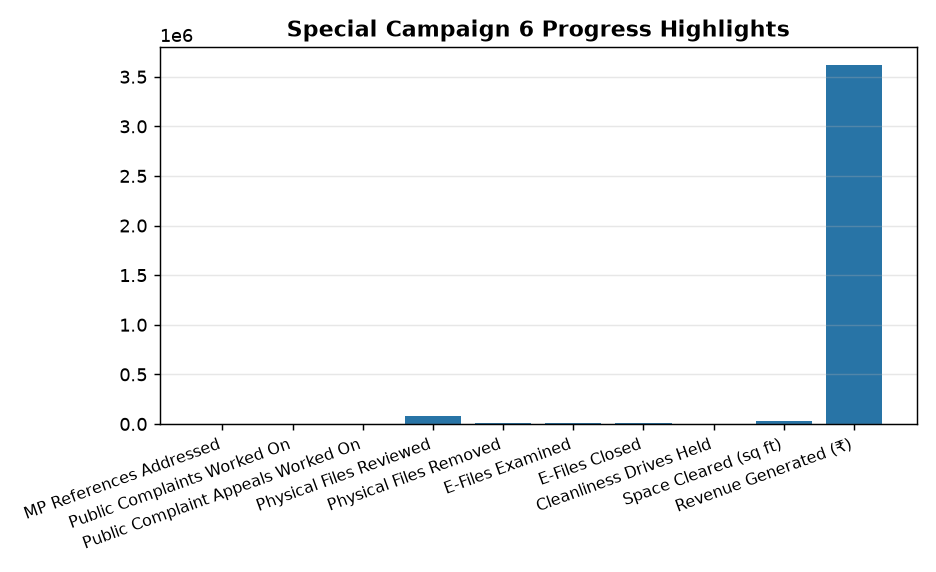
- Measurable outcomes include the physical review of over 82,000 files, disposal of 12,937 physical files, and closure of 7,331 e-files, alongside the conduct of 1,388 cleanliness drives and recovery of ₹36.16 lakh in revenue.
- The initiative reflects the government’s commitment to promoting a culture of cleanliness, efficiency, and accountability in public administration.
Key Features
| Feature | Significance |
|---|---|
| Special Campaign 6 (2–31 Oct 2026) | A focused time-bound initiative by the Department of Food and Public Distribution (DFPD) to institutionalise cleanliness, reduce pendency, and improve record management across its PSUs, affiliated and subordinate offices. |
| Physical file review (82,696 files) | Systematic audit of legacy records to eliminate redundant or obsolete documents, thereby enhancing operational efficiency and compliance with record-keeping norms. |
| Disposal of redundant files (12,937 files) | Removal of non-essential physical files to declutter office spaces, improve accessibility, and reduce storage costs. |
| Disposal of redundant e-files (7,331 files) | Digital record rationalisation to optimise storage capacity, enhance searchability, and align with e-governance objectives. |
| Space reclaimed (31,423 sq ft) | Reclaimed office space can be repurposed for functional use, improving workflow and reducing infrastructure overheads. |
| Revenue generation (₹36,15,558) | Monetisation of redundant assets or disposal of surplus materials, contributing to departmental revenue. |
| Swachhata Abhiyan (1,388 campaigns) | Institutionalisation of cleanliness drives to foster a culture of hygiene and accountability in public offices. |
Why it Matters
Administrative Efficiency
- Demonstrates the Government of India’s commitment to reducing bureaucratic red tape through time-bound, mission-mode campaigns.
- Enhances the responsiveness of public administration by addressing long-pending grievances and references in a structured manner.
- Promotes standardised record-keeping practices, aligning with the Right to Information Act, 2005, and the National Archives of India guidelines.
Transparency and Accountability
- Systematic disposal of redundant records minimises the risk of information asymmetry and improves audit trails.
- Public grievance redressal (1,030 complaints + 161 appeals addressed) strengthens citizen-centric governance.
- MP references (48 addressed) ensure legislative oversight and responsiveness to parliamentary queries.
Resource Optimisation
- Reclamation of physical and digital space reduces operational costs associated with storage and maintenance.
- Revenue generation from surplus assets contributes to fiscal discipline and efficient resource utilisation.
- Improved workflow due to decluttered office environments enhances employee productivity.
Governance Reforms
- Embeds Swachh Bharat Mission principles within routine administrative functions, institutionalising cleanliness as a governance priority.
- Serves as a model for other ministries to replicate similar campaigns, fostering a culture of continuous improvement in public offices.
- Demonstrates the integration of e-governance initiatives with physical record management for holistic administrative reform.
Challenges
1. Legacy Record Management
- Large volumes of outdated physical and digital records hinder operational efficiency and compliance.
- Lack of standardised digitisation processes across PSUs complicates record rationalisation.
- Resistance to change among staff accustomed to traditional record-keeping practices.
UPSC Link: Governance: e-Governance
2. Grievance Redressal Bottlenecks
- High pendency of public complaints and appeals due to procedural delays and inadequate staffing.
- Inadequate coordination between central and state-level offices in resolving grievances.
- Limited use of technology in tracking and resolving complaints in real time.
UPSC Link: Governance: Citizen Charter
3. Space and Infrastructure Constraints
- Limited office space in urban centres exacerbates storage challenges for physical records.
- Inadequate IT infrastructure for digitisation and e-file management in remote or under-resourced offices.
- High costs associated with maintaining and securing legacy records.
UPSC Link: Governance: Infrastructure
4. Cultural and Behavioural Barriers
- Reluctance among employees to adopt digital record-keeping due to perceived complexity or lack of training.
- Low prioritisation of cleanliness and record management in routine administrative functions.
- Insufficient incentives for staff to participate in Swachhata campaigns or record rationalisation drives.
UPSC Link: Governance: Organisational Culture
Challenges — UPSC Perspective
| Issue | Concern |
|---|---|
| Outdated record-keeping systems | High volumes of redundant physical and digital records impede efficiency and compliance. |
| Procedural delays in grievance redressal | Citizen complaints and appeals face prolonged pendency due to bureaucratic bottlenecks. |
| Inadequate digitisation infrastructure | Lack of standardised digital record-keeping across PSUs hinders modernisation efforts. |
| Space constraints in urban offices | Limited storage capacity exacerbates the challenge of managing legacy records. |
| Resistance to behavioural change | Staff accustomed to traditional practices may resist adopting new record-keeping norms. |
| Coordination gaps between central and state offices | Inconsistent implementation of record management policies across jurisdictions. |
Way Forward
- Institutionalise regular audits of physical and digital records to prevent accumulation of redundant documents.
- Accelerate digitisation initiatives with standardised protocols for e-file management across all PSUs.
- Enhance grievance redressal mechanisms through real-time tracking systems and dedicated staff training.
- Expand Swachhata campaigns to include periodic cleanliness drives and awareness programmes in all offices.
- Implement incentives for staff participation in record rationalisation and cleanliness initiatives.
- Strengthen inter-departmental coordination to ensure uniform implementation of record management policies.
- Develop a centralised dashboard for monitoring progress on record disposal, grievance redressal, and space reclamation.
- Conduct periodic reviews with nodal officers to assess compliance and address implementation challenges.
UPSC Value Addition
Keywords for Mains Answer-Writing
Special Campaign 6 · Department of Food and Public Distribution (DFPD) · Public Grievance Redressal · Digitisation of Records · Swachhata Abhiyan · E-governance in Public Administration · Institutional Cleanliness · Pending Matters Disposal · Revenue Generation through Administrative Efficiency · Public Sector Undertakings (PSUs) Governance · Administrative Reforms · Record Management in Government · MP References and State Government References · E-filing Systems · Space Optimization in Government Offices
Concept Flow
Legacy record accumulation → Inefficient governance → Special Campaign 6 launched → Systematic review and disposal of records → Reclaimed space and optimised workflow → Enhanced administrative efficiency → Improved citizen grievance redressal → Institutionalisation of cleanliness and record-keeping norms → Sustainable governance reforms
Prelims Practice Questions
Q1. Consider the following statements regarding Special Campaign 6 launched by the Department of Food and Public Distribution (DFPD):
1. The campaign focuses on digitisation of records and institutional cleanliness.
2. Under the campaign, 82,696 physical files were reviewed and 12,937 physical files were disposed of.
3. The campaign includes disposal of pending public grievances and appeals.
4. The campaign is limited to the headquarters of the DFPD and does not involve its PSUs or subordinate offices.
How many of the above statements are correct?
- Only one
- Only two
- Only three
- All four
Answer: Only three — Statements 1, 2, and 3 are correct as per the PIB release. Statement 4 is incorrect because the campaign involves DFPD, its PSUs, and subordinate offices.
Q2. Assertion (A): Special Campaign 6 aims to institutionalise cleanliness and reduce pending matters in government offices.
Reason (R): The campaign includes activities like organising Swachhata Abhiyan and disposing of physical and e-files.
In the context of the above two statements, which one of the following is correct?
- Both A and R are true, and R is the correct explanation of A.
- Both A and R are true, but R is not the correct explanation of A.
- A is true, but R is false.
- A is false, but R is true.
Answer: Both A and R are true, but R is not the correct explanation of A. — Both Assertion (A) and Reason (R) are true, and Reason (R) correctly explains Assertion (A) as the campaign’s activities directly support its stated objectives.
Q3. Match the following achievements of Special Campaign 6 with their respective quantitative targets as reported by the DFPD:
Column I (Achievement) | Column II (Quantitative Target)
————————————————–|————————————
A. Physical files reviewed | 1. 14,663
B. E-files closed | 2. 82,696
C. Public grievances addressed | 3. 7,331
D. Swachhata Abhiyan organised | 4. 1,030
Choose the correct match:
- A-2, B-3, C-4, D-1
- A-2, B-3, C-1, D-4
- A-1, B-2, C-3, D-4
- A-3, B-1, C-4, D-2
Answer: A-2, B-3, C-4, D-1 — A-2 (82,696 physical files reviewed), B-3 (7,331 e-files closed), C-4 (1,030 public grievances addressed), D-1 (14,663 e-files checked).
Mains Practice Question
✍ The Department of Food and Public Distribution (DFPD) has intensified efforts under Special Campaign 6 to institutionalise cleanliness, digitise records, and dispose of pending matters in its offices and affiliated PSUs. In this context, critically examine the significance of such administrative reforms for enhancing governance efficiency and citizen satisfaction. (15 Marks)
Approach: MODEL-ANSWER SKELETON:
1. Introduction (2 marks):
– Define administrative reforms and their objectives in public governance.
– Contextualise Special Campaign 6 as part of the Government of India’s broader Swachh Bharat Mission and E-governance initiatives.
2. Significance of Administrative Reforms (5 marks):
– Efficiency: Reduction in pendency improves service delivery and reduces bureaucratic delays.
– Transparency: Digitisation of records enhances accountability and traceability of decisions.
– Citizen-Centric Governance: Timely disposal of grievances and appeals improves public trust.
– Resource Optimisation: Space and cost savings through disposal of redundant physical files.
– Institutional Cleanliness: Promotion of a culture of discipline and professionalism in government offices.
3. Mechanisms and Achievements (4 marks):
– Data from Special Campaign 6: Review of 82,696 physical files, disposal of 12,937 files, disposal of 7,331 e-files, and addressing 1,030 public grievances.
– Role of E-governance: Transition from physical to digital records and its impact on accessibility and retrieval.
– Swachhata Abhiyan: Institutionalising cleanliness as a continuous process rather than a one-time campaign.
4. Challenges and Limitations (3 marks):
– Resistance to Change: Bureaucratic inertia and lack of digital literacy among staff.
– Data Security: Ensuring confidentiality and integrity of digitised records.
– Inter-departmental Coordination: Ensuring uniformity in implementation across PSUs and subordinate offices.
5. Conclusion (1 mark):
– Summarise the transformative potential of such reforms for public administration.
– Emphasise the need for sustained efforts, capacity building, and periodic reviews to institutionalise these practices.
Source: PIB (Press Information Bureau)
Generated by AanyaAi for educational purpose.
Related guides on our sites
- Anthropology VS PSIR
- Best PSIR optional coaching
- Best PSIR optional coaching online
- Best PSIR optional teacher

- Allahabad HC Slams UP Govt Over Shop Evictions for Ayodhya Hospital - October 24, 2026
- विदेश मंत्री जयशंकर ने संयुक्त राष्ट्र चार्टर के प्रति भारत की प्रतिबद्धता दोहराई - October 24, 2026
- GRP Chiefs Conference 2024: Intelligence-Led Policing & RPF-GRP Coordination Focus - October 24, 2026

No Comments