


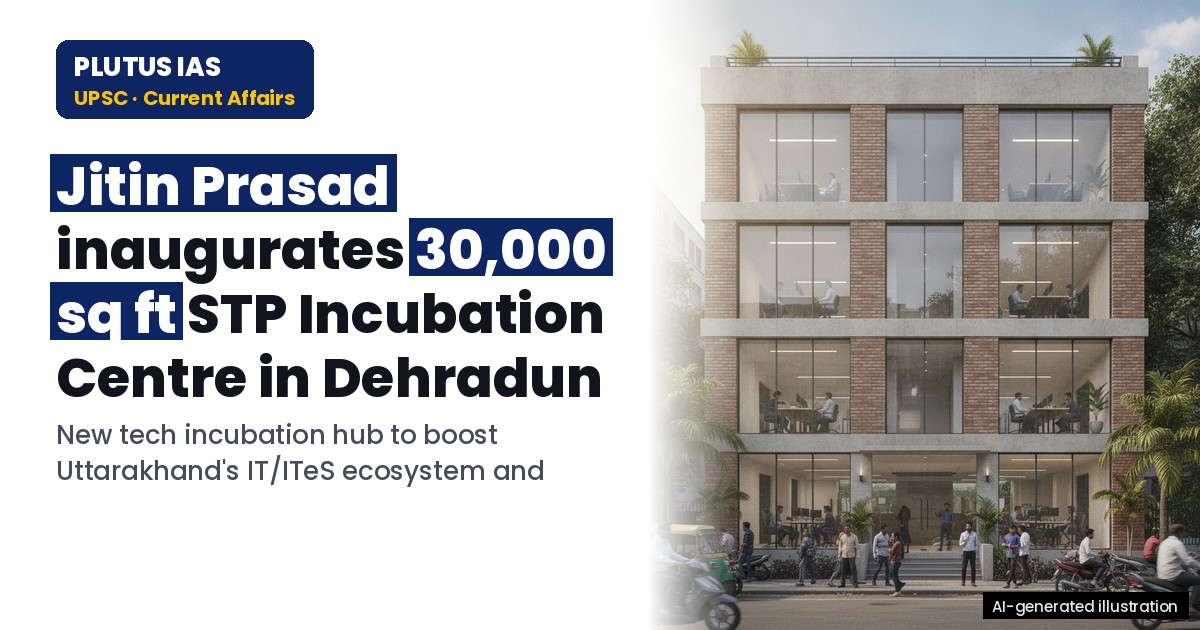
24 Oct एसटीपीआई ने देहरादून में 30,000 वर्ग फुट की नई स्टार्टअप इन्क्यूबेशन सुविधा का उद्घाटन किया
✎ The STPI NextGen Incubation Centre in Dehradun is a MeitY-backed initiative to strengthen Uttarakhand’s IT and startup ecosystem by providing modern infrastructure, fostering innovation, and accelerating job creation.
Subject Relevance — Where This Topic Fits
- GS Paper II — Government Policies and Interventions for Development in various sectors | GS Paper III — Technology, Innovation and Issues relating to Intellectual Property Rights | GS Paper III — Development, Bio-diversity, Environment, Security and Disaster Management (for regional ecosystem context)
- Prelims: Incubation Centre, Software Technology Parks of India (STPI), Electronics Manufacturing Clusters (EMC), Startup India initiative, MeitY, Atmanirbhar Bharat, Semiconductor Mission, IT/ITeS sector
- Essay: Technological self-reliance as a pillar of national development, Role of incubation centres in fostering innovation and entrepreneurship
Quick Revision: The STPI NextGen Incubation Centre in Dehradun is a MeitY-backed initiative to strengthen Uttarakhand’s IT and startup ecosystem by providing modern infrastructure, fostering innovation, and accelerating job creation.
Why is this in the news?
The inauguration of the Software Technology Parks of India’s (STPI) new 30,000 sq. ft. incubation facility in Dehradun, Uttarakhand, marks a significant intervention in strengthening the state’s IT and startup ecosystem. This development aligns with national priorities of fostering technological self-reliance, promoting electronics manufacturing, and accelerating digital transformation, particularly in hill states with emerging innovation hubs.
Background
- Uttarakhand has emerged as a growing hub for IT-enabled services (ITeS) and technology-driven enterprises, with over 1,700 recognised startups as of recent data.
- The state government has prioritised digital governance and IT infrastructure development, including the establishment of Electronics Manufacturing Clusters (EMCs) in districts like Kashipur to attract investment in electronics hardware.
- The Electronics and IT Ministry (MeitY) has been implementing the ‘Semiconductor Mission’ and ‘Production-Linked Incentive (PLI) Scheme for Electronics’ to reduce import dependence and boost domestic manufacturing.
- STPI, an autonomous society under MeitY, operates across India to promote software exports, innovation, and startup incubation through its network of parks and centres.
- Dehradun, as the state capital, serves as a strategic location for such facilities due to its existing IT park infrastructure and connectivity.
- The COVID-19 pandemic highlighted vulnerabilities in global supply chains, particularly for critical components like semiconductors, underscoring the need for domestic capacity building.
What is the STPI NextGen Incubation Centre in Dehradun?
- The STPI NextGen Incubation Centre in Dehradun is a state-of-the-art facility designed to support technology startups, IT/ITeS companies, and innovation-driven enterprises with modern infrastructure and collaborative workspaces.
- The facility spans approximately 30,000 square feet across four floors, offering semi-furnished office spaces, high-speed internet connectivity, climate-controlled and eco-friendly work environments, an auditorium, meeting rooms, conference halls, and a Network Operations Centre (NOC).
- It is specifically tailored to foster collaboration, business expansion, and technological advancement among resident enterprises, thereby accelerating product development and market readiness.
- The centre is part of STPI’s broader mandate to promote software exports, innovation, and entrepreneurship under the aegis of the Ministry of Electronics and Information Technology (MeitY).
- By providing shared amenities and a conducive ecosystem, the facility reduces overhead costs for startups and enables them to focus on core innovation and scaling.
- The initiative complements Uttarakhand’s broader strategy to position itself as a competitive destination for IT and electronics manufacturing, aligning with national goals of ‘Atmanirbhar Bharat’ (Self-Reliant India).
- The centre is expected to attract investment, generate employment, and nurture a pipeline of technologically proficient talent, particularly among the youth in the region.
- It also serves as a platform for knowledge exchange, mentorship, and access to government schemes such as Startup India and the Production-Linked Incentive (PLI) Scheme.
Key Features
| Feature | Significance |
|---|---|
| 30,000 sq. ft. built-up area across four floors | Provides scalable infrastructure to accommodate growing technology enterprises and startups in Uttarakhand. |
| Semi-furnished office spaces | Reduces capital expenditure for early-stage startups, enabling rapid deployment of business operations. |
| High-speed internet connectivity and NOC | Ensures seamless digital operations, critical for IT/ITeS and emerging tech ventures. |
| Air-conditioned, eco-friendly work environment | Enhances productivity and aligns with sustainable development goals for modern workspaces. |
| Auditorium, meeting rooms, and conference facilities | Facilitates networking, knowledge dissemination, and collaborative innovation among entrepreneurs. |
Why it Matters
Economic Growth and Employment Generation
- Stimulates local economy through increased investment in technology-driven enterprises and ancillary services.
- Creates high-skilled employment opportunities in Uttarakhand, particularly for youth and graduates in STEM fields.
- Supports the expansion of existing IT/ITeS firms and attracts new ventures to the state.
Technological Self-Reliance and Innovation
- Strengthens Uttarakhand’s role in India’s broader push for semiconductor and electronics manufacturing self-sufficiency.
- Provides a platform for startups to develop indigenous solutions in emerging tech domains (e.g., AI, IoT, and hardware innovation).
- Enhances the state’s capacity to contribute to national initiatives like ‘Atmanirbhar Bharat’ in the technology sector.
Ecosystem Development and Entrepreneurship
- Complements existing startup recognition (1,700+ startups in Uttarakhand) by offering structured incubation support.
- Fosters a collaborative environment for knowledge-sharing, mentorship, and cross-sector partnerships.
- Aligns with the state’s vision for 2047 ‘Developed India’ by integrating technology and innovation into governance and industry.
Strategic Infrastructure for Uttarakhand
- Reduces reliance on external hubs for technology incubation, retaining talent and capital within the state.
- Supports the development of electronics manufacturing clusters (e.g., Kashipur) by providing a skilled workforce pipeline.
- Enhances Uttarakhand’s appeal as a destination for IT/ITeS investments and tourism-related tech solutions.
Challenges
1. Limited Access to Venture Capital and Funding
- Startups in tier-2/3 cities often face challenges in securing early-stage funding due to risk-averse investors.
- Need for structured mentorship and investor connect programs to bridge the funding gap.
UPSC Link: GS3: Investment Models
2. Infrastructure Bottlenecks in Hilly Regions
- Geographical constraints in Uttarakhand may limit scalability of physical infrastructure despite policy support.
- Dependence on reliable power and internet connectivity in remote areas for seamless operations.
UPSC Link: GS3: Infrastructure Development
3. Skill Mismatch and Talent Retention
- Shortage of specialized talent in emerging tech domains (e.g., semiconductor design, AI) within the state.
- Risk of brain drain as skilled professionals migrate to metropolitan hubs for better opportunities.
UPSC Link: GS2: Skill Development
4. Policy Implementation and Bureaucratic Hurdles
- Delays in approvals, land acquisition, or regulatory clearances may impede the operationalization of such facilities.
- Need for streamlined single-window clearance mechanisms for startups and enterprises.
UPSC Link: GS2: Governance
5. Competition from Established Hubs
- Attracting and retaining startups may be challenging due to the dominance of established IT hubs (e.g., Bengaluru, Hyderabad).
- Requirement for differentiated incentives (e.g., tax breaks, subsidies) to offset location disadvantages.
UPSC Link: GS3: Industrial Policy
Challenges — UPSC Perspective
| Issue | Concern |
|---|---|
| Funding Access | Limited venture capital and angel investment networks in Uttarakhand. |
| Infrastructure Constraints | Geographical challenges in scaling physical and digital infrastructure. |
| Talent Shortage | Gap between industry demand and availability of specialized technical skills. |
| Regulatory Delays | Potential bottlenecks in approvals and compliance for new ventures. |
| Competition | Risk of startups and firms preferring established metropolitan IT hubs. |
Government Initiatives — Must-Memorise for Prelims
- Software Technology Parks of India (STPI) Scheme
- Atal Incubation Mission (AIM) under NITI Aayog
- Electronics Manufacturing Clusters (EMC) Scheme
Way Forward
- Establish a dedicated seed-funding corpus for Uttarakhand-based startups to address early-stage capital constraints.
- Launch skill-upgradation programs in collaboration with IITs/NITs to bridge the talent gap in emerging technologies.
- Develop a single-window portal for regulatory clearances, approvals, and compliance to reduce bureaucratic delays.
- Create a mentorship network connecting successful entrepreneurs, investors, and academia to guide startups.
- Promote public-private partnerships to expand co-working spaces and satellite incubation centers in tier-2 cities.
- Incentivize electronics manufacturing units in Uttarakhand through tax rebates, subsidies, and land allocation.
- Strengthen digital connectivity in hilly regions via BharatNet and state-led initiatives to ensure seamless operations.
UPSC Value Addition
Keywords for Mains Answer-Writing
Software Technology Parks of India (STPI) · Start-up ecosystem · Incubation facility · Dehradun · Uttarakhand · IT/ITeS policy · Electronics Manufacturing Clusters (EMC) · Digital India Mission · Atmanirbhar Bharat Abhiyan · Semiconductor manufacturing · Innovation and entrepreneurship · Science and Technology Parks · Ministry of Electronics and Information Technology (MeitY) · High-speed internet infrastructure · Startup India initiative
Concept Flow
Policy Directive: Government’s emphasis on ‘Atmanirbhar Bharat’ and ‘Developed India 2047’ drives technological self-reliance. → Institutional Role: STPI, under MeitY, operationalizes incubation facilities to support startups and IT enterprises. → Infrastructure Provision: 30,000 sq. ft. facility with modern amenities enables scalable and sustainable operations. → Ecosystem Integration: Collaboration between startups, academia, and industry fosters innovation and entrepreneurship. → Economic Impact: Enhanced employment, investment, and skill development contribute to regional and national growth. → Long-term Vision: Strengthening Uttarakhand’s IT/ITeS sector aligns with broader goals of inclusive and equitable development.
Prelims Practice Questions
Q1. Consider the following statements regarding the Software Technology Parks of India (STPI):
1. STPI is an autonomous society under the Ministry of Electronics and Information Technology (MeitY), Government of India.
2. STPI primarily focuses on promoting software exports and providing incubation facilities to startups.
3. The newly inaugurated incubation facility in Dehradun is spread over 30,000 square feet and includes a Network Operations Centre (NOC).
How many of the above statements are correct?
- Only one
- Only two
- All three
- None
Answer: All three — Statements 1 and 2 are correct as STPI is indeed an autonomous society under MeitY and focuses on software exports and incubation. Statement 3 is correct as the Dehradun facility spans 30,000 sq. ft. and includes a NOC. Thus, two statements are correct.
Q2. Assertion (A): The establishment of Electronics Manufacturing Clusters (EMCs) is a key strategy under the Atmanirbhar Bharat Abhiyan to boost domestic semiconductor and electronics manufacturing.
Reason (R): EMCs provide shared infrastructure and facilities to attract investments and promote manufacturing in the electronics sector.
Options:
A. Both A and R are true, and R is the correct explanation of A.
B. Both A and R are true, but R is not the correct explanation of A.
C. A is true but R is false.
D. A is false but R is true.
Answer: ? — Both Assertion (A) and Reason (R) are true. The Atmanirbhar Bharat Abhiyan indeed promotes EMCs to boost domestic manufacturing, and EMCs provide shared infrastructure to attract investments. R correctly explains A.
Q3. Match the following initiatives with their respective objectives:
Column I (Initiative) | Column II (Objective)
——————————————|——————————————
A. Startup India | 1. Promote electronics and semiconductor manufacturing
B. Digital India Mission | 2. Provide incubation facilities to startups
C. Electronics Manufacturing Clusters (EMC)| 3. Transform India into a digitally empowered society
D. STPI Incubation Facility, Dehradun | 4. Foster entrepreneurship and innovation ecosystem
Options:
A. A-4, B-3, C-1, D-2
B. A-2, B-1, C-3, D-4
C. A-3, B-2, C-1, D-4
D. A-4, B-1, C-2, D-3
Answer: ? — Correct matches: A-4 (Startup India fosters entrepreneurship), B-3 (Digital India Mission aims to create a digitally empowered society), C-1 (EMCs promote electronics manufacturing), D-2 (STPI incubation facility provides support to startups).
Mains Practice Question
✍ The establishment of the new incubation facility by the Software Technology Parks of India (STPI) in Dehradun represents a critical intervention in strengthening the technology and start-up ecosystem in Uttarakhand. In this context, critically evaluate the role of incubation facilities in fostering innovation, entrepreneurship, and economic growth in India. (15 Marks)
Approach: MODEL-ANSWER SKELETON:
1. **Definition and Purpose of Incubation Facilities**
– Define incubation facilities as structured programs providing shared infrastructure, mentorship, and resources to startups and early-stage enterprises.
– Cite the STPI Dehradun facility as an example of a government-backed initiative under the Ministry of Electronics and Information Technology (MeitY).
2. **Role in Fostering Innovation**
– Explain how incubation facilities provide a collaborative environment for knowledge exchange, prototyping, and product development.
– Reference the STPI facility’s modern infrastructure, including high-speed internet, NOC, and climate-controlled spaces, to illustrate this role.
– Link to the broader goal of reducing dependence on imported technologies (e.g., semiconductors) as highlighted in the Atmanirbhar Bharat Abhiyan.
3. **Role in Promoting Entrepreneurship**
– Discuss how incubation facilities reduce barriers to entry for startups by providing access to funding opportunities, mentorship, and networking.
– Reference the Startup India initiative and its synergy with STPI’s efforts to create an enabling ecosystem for entrepreneurs.
– Highlight the role of such facilities in Uttarakhand, where over 1,700 startups are already registered.
4. **Contribution to Economic Growth and Employment Generation**
– Explain the multiplier effect of startups on local economies, including job creation and attraction of investments.
– Cite examples of Electronics Manufacturing Clusters (EMCs) in Uttarakhand (e.g., Kashipur) and their role in integrating with incubation facilities to create a robust ecosystem.
5. **Challenges and Limitations**
– Acknowledge challenges such as limited access to venture capital, regulatory hurdles, and the need for continuous upskilling of the workforce.
– Discuss the role of government policies (e.g., Production-Linked Incentive Scheme for Electronics) in addressing these challenges.
6. **Conclusion**
– Summarize the critical role of incubation facilities in driving innovation, entrepreneurship, and economic growth.
– Emphasize the need for sustained public-private partnerships to scale such initiatives and align them with national goals like ‘Viksit Bharat 2047’.
Source: PIB (Press Information Bureau)
Uttarakhand PCS (UKPSC) — State PCS Practice
Prelims: Which of the following initiatives was recently launched by STPI (Software Technology Parks of India) in Dehradun to strengthen Uttarakhand’s technology and startup ecosystem?
- A. A new incubation facility under the ‘STPI Dehradun’ banner
- B. A state-wide digital literacy campaign
- C. A government-funded venture capital fund for startups
- D. A national-level hackathon for students
Answer: A. A new incubation facility under the ‘STPI Dehradun’ banner — STPI inaugurated a new incubation facility in Dehradun to foster innovation and support startups in Uttarakhand.
Mains: Discuss the significance of STPI’s new incubation facility in Dehradun for Uttarakhand’s technology and startup ecosystem. How can this initiative contribute to the state’s economic growth and employment generation? (250 words)
Generated by AanyaAi for educational purpose.

- माई भारत अभियान: ग्राम सेवा एवं खेल दिवस के तहत गांवों में Nasha Mukt Yuva Abhiyan - October 24, 2026
- Odisha’s Zero Casualty Plan as Cyclone Threatens: UPSC Geography Insights - October 24, 2026
- आरबीआई का ओडिशा डेटा सेंटर: अर्थव्यवस्था के लिए क्यों है महत्वपूर्ण? - October 24, 2026

No Comments