


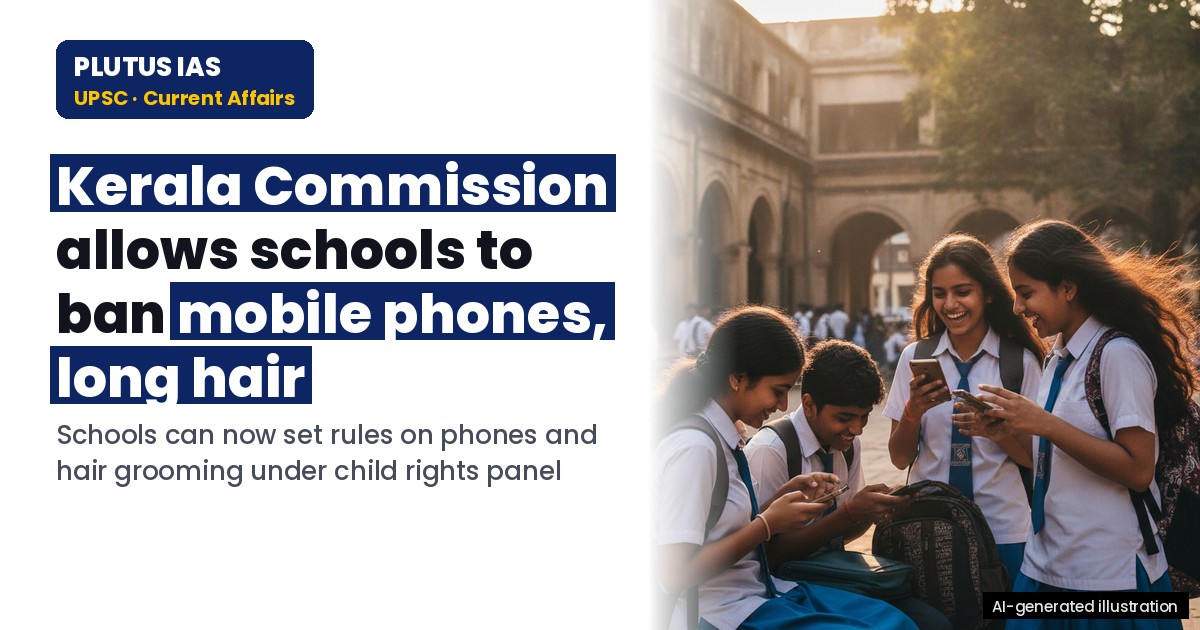
24 Oct Kerala Commission Allows Schools to Ban Mobile Phones & Long Hair
✎ Schools may regulate mobile phone use and grooming norms under disciplinary policies, but such measures must be non-discriminatory, dignity-preserving, and consistent with the Right to Education Act, 2009.
Subject Relevance — Where This Topic Fits
- GS Paper I — Society — Issues relating to children | GS Paper II — Governance — Role of Statutory Bodies | GS Paper IV — Ethics — Dilemmas in Public Administration
- Prelims: Child Rights Commission, Right to Education (RTE) Act, 2009, Disciplinary measures in schools, Parental consent for mobile phone use, School discipline policies
- Essay: The interplay between individual freedom and institutional discipline in shaping responsible citizens, Balancing child protection with the need for structured learning environments
Quick Revision: Schools may regulate mobile phone use and grooming norms under disciplinary policies, but such measures must be non-discriminatory, dignity-preserving, and consistent with the Right to Education Act, 2009.
Why is this in the news?
The Kerala State Commission for Protection of Child Rights (KSCPCR) issued an order on 23 October 2026, affirming the authority of schools to regulate mobile phone usage and grooming norms (e.g., hair length) as part of disciplinary measures, while simultaneously emphasising the protection of students’ dignity and right to education. This directive addresses a petition by students seeking relaxation of such rules and underscores the tension between institutional authority and child rights, prompting broader discussions on the scope of school discipline and the role of statutory bodies in safeguarding children’s interests.
Background
- The Right of Children to Free and Compulsory Education (RTE) Act, 2009, mandates free and compulsory education for children aged 6–14, while also recognising the need for school discipline to foster a conducive learning environment.
- The United Nations Convention on the Rights of the Child (UNCRC), ratified by India, guarantees children the right to education, protection from harm, and respect for their dignity, even within institutional settings.
- State Commissions for Protection of Child Rights (SCPCRs) are statutory bodies established under the Commissions for Protection of Child Rights Act, 2005, to monitor the implementation of child rights and address grievances related to children’s welfare.
- Kerala’s education system includes a mix of government, aided, and private schools, each with varying disciplinary policies, leading to inconsistencies in enforcement and potential conflicts with child rights.
- The petition that prompted the KSCPCR order reflects growing student activism and awareness of individual freedoms, particularly in the context of digital rights and personal autonomy.
- The order aligns with broader national debates on the balance between discipline and child-centric approaches in educational institutions, as seen in guidelines issued by the National Commission for Protection of Child Rights (NCPCR).
What is the Kerala State Commission for Protection of Child Rights (KSCPCR) Order on School Discipline?
- The KSCPCR order clarifies that schools may impose reasonable restrictions on mobile phone usage and grooming norms (e.g., hair length) as part of their disciplinary framework, provided such rules are uniformly applied and non-discriminatory.
- Mobile phones brought to school with parents’ knowledge for specific needs must be switched off and stored securely by school authorities until the end of the school day to prevent misuse during classes.
- Teachers are permitted to check students’ bags to prevent the carrying of harmful items, including intoxicating substances, but must do so with strict adherence to the child’s dignity and privacy, avoiding humiliation or mental harassment.
- The order emphasises that disciplinary actions, such as expulsion or denial of education, cannot be used as punitive measures, as they violate the child’s fundamental right to education under the RTE Act.
- Schools are encouraged to obtain written undertakings from parents and students regarding disciplinary expectations at the time of admission, similar to practices in CBSE, ICSE, and unaided schools.
- The commission calls for awareness programmes on the safe use of cosmetics and personal hygiene, as well as the provision of clean toilets and water facilities in schools, to address broader health and sanitation concerns.
- The order underscores the responsibility of teachers to guide students towards responsible citizenship while respecting their rights, thereby resolving the dilemma of intervention versus restraint in disciplinary matters.
- The KSCPCR’s directive is rooted in the principle that school discipline must be child-friendly, rights-based, and aligned with constitutional values of dignity and equality.
UPSC Value Addition
Keywords for Mains Answer-Writing
Child Rights Commission · Right to Education Act 2009 · School Discipline · Judicial Activism in Education · KSCPCR · Student Rights vs Institutional Authority · Constitutional Provisions for Child Protection · School Management Committees · Child Protection Policies · Judicial Review of School Regulations
Prelims Practice Questions
Q1. Consider the following statements regarding the Kerala State Commission for Protection of Child Rights (KSCPCR):
1. The KSCPCR has the authority to issue binding orders on school discipline, including restrictions on mobile phone use and hair grooming.
2. The KSCPCR’s orders are enforceable under the Right to Education (RTE) Act, 2009.
3. The KSCPCR can mandate that schools obtain written undertakings on discipline from parents and students.
How many of the above statements are correct?
- Only one
- Only two
- All three
- None
Answer: Only two — Statement 1 is correct as the KSCPCR has issued orders on school discipline. Statement 2 is incorrect as the RTE Act does not explicitly grant such powers to the KSCPCR. Statement 3 is correct as the KSCPCR has called for written undertakings on discipline.
Q2. Assertion (A): The Kerala State Commission for Protection of Child Rights (KSCPCR) has ruled that teachers may check students’ bags to prevent them from carrying harmful items, including intoxicating substances.
Reason (R): The Right to Education (RTE) Act, 2009, empowers schools to conduct bag checks to ensure student safety and discipline.
In the context of the above two statements, which one of the following is correct?
- Both A and R are true, and R is the correct explanation of A.
- Both A and R are true, but R is not the correct explanation of A.
- A is true, but R is false.
- A is false, but R is true.
Answer: A is true, but R is false. — Assertion (A) is true as the KSCPCR’s order permits bag checks under certain conditions. Reason (R) is true in general but does not directly explain the specific ruling of the KSCPCR.
Q3. Match the following provisions with their respective legal frameworks:
Column I (Provision) Column II (Legal Framework)
A. Right to Education Act, 2009 1. Empowers schools to enforce discipline
B. Juvenile Justice (Care and Protection of Children) Act, 2015 2. Mandates child protection measures
C. Protection of Children from Sexual Offences (POCSO) Act, 2012 3. Ensures access to free and compulsory education
D. School Management Committees 4. Addresses child abuse and exploitation
Choose the correct match:
- A-3, B-4, C-2, D-1; A-1, B-2, C-3, D-4; A-4, B-3, C-2, D-1; A-2, B-1, C-4, D-3
- answer_string_array_indexed_answer_option_index_is_0
- explain_match_pairs_are_A3_B4_C2_D1
- format_match
Answer: A-3, B-4, C-2, D-1; A-1, B-2, C-3, D-4; A-4, B-3, C-2, D-1; A-2, B-1, C-4, D-3 — A-3: The RTE Act mandates free and compulsory education. B-4: The JJ Act addresses child protection and welfare. C-2: POCSO Act focuses on child abuse and exploitation. D-1: School Management Committees are empowered to enforce discipline and ensure child protection.
Mains Practice Question
✍ The Kerala State Commission for Protection of Child Rights (KSCPCR) has issued directives to schools on discipline, including restrictions on mobile phone use and hair grooming, while balancing student rights and institutional authority. Critically examine the constitutional and legal framework governing such directives, with reference to the Right to Education (RTE) Act, 2009, and the role of child rights commissions in India. Also, discuss the implications of these directives for school management and student autonomy. (15 Marks)
Approach: MODEL-ANSWER SKELETON:
1. **Constitutional and Legal Framework**:
– **Right to Education (RTE) Act, 2009**: Highlight key provisions such as Section 12(1)(c) (admission of disadvantaged groups), Section 29 (curriculum and evaluation), and Section 30 (discipline and management). Emphasise the balance between discipline and child rights.
– **Article 21A**: Right to free and compulsory education as a fundamental right.
– **Article 15(3)**: Empowers the state to make special provisions for children.
– **Article 39(f)**: Directive Principle of State Policy for child protection and development.
– **Juvenile Justice (Care and Protection of Children) Act, 2015**: Provisions for child protection and welfare.
– **Protection of Children from Sexual Offences (POCSO) Act, 2012**: Addresses child abuse and exploitation.
2. **Role of Child Rights Commissions**:
– **Protection of Children from Sexual Offences Act, 2012 (Section 37)**: Establishes Child Welfare Committees and Commissions for Child Rights.
– **Functions of State Commissions**: Monitoring implementation of child rights, inquiring into complaints, and recommending measures for effective implementation.
– **Judicial Activism**: Role of commissions in issuing directives to ensure compliance with child rights (e.g., KSCPCR’s order).
3. **KSCPCR’s Directives**:
– **Discipline vs. Autonomy**: Examine the KSCPCR’s directives on mobile phone use and hair grooming as measures to ensure discipline while respecting student rights.
– **Bag Checks**: Discuss the balance between ensuring safety (preventing intoxicating substances) and protecting student dignity (Article 21 and 14).
– **Written Undertakings**: Highlight the need for written undertakings to formalise discipline expectations.
4. **Implications for School Management and Student Autonomy**:
– **School Management Committees (SMCs)**: Role in enforcing discipline and ensuring child protection under RTE Act.
– **Student Autonomy**: Discuss the tension between institutional authority and individual freedoms (e.g., personal grooming, use of mobile phones).
– **Teacher’s Role**: Emphasise the need for responsible intervention without humiliation or denial of education.
5. **Critical Analysis**:
– **Pros and Cons**: Evaluate the effectiveness of such directives in maintaining discipline and protecting child rights.
– **Challenges**: Discuss potential challenges such as enforcement, resistance from stakeholders, and the need for uniform guidelines.
– **Judicial Precedents**: Reference relevant Supreme Court judgments (e.g., Unnikrishnan JP v State of Andhra Pradesh, 1993) on the right to education and child protection.
6. **Conclusion**:
– Summarise the need for a balanced approach that upholds child rights while ensuring a disciplined learning environment. Highlight the role of commissions, schools, and the judiciary in achieving this balance.
Source: The Hindu
Kerala PCS (Kerala PSC (KAS)) — State PCS Practice
Prelims: According to the Kerala State Commission for Protection of Child Rights (KSCPCR), which of the following restrictions can schools impose on students to ensure discipline and safety?
- Ban on mobile phones and long hair
- Mandatory uniforms only
- Strict attendance policies
- Compulsory sports participation
Answer: Ban on mobile phones and long hair — The KSCPCR has recommended schools to restrict mobile phone usage and long hair among students as part of safety and discipline measures.
Mains: Discuss the role of the Kerala State Commission for Protection of Child Rights (KSCPCR) in safeguarding the rights of children in Kerala. How can schools implement the recent guidelines issued by KSCPCR to balance discipline with the protection of child rights?
Generated by AanyaAi for educational purpose.
Related guides on our sites
- Current affairs for upsc 2026
- Best PSIR optional coaching for upsc
- Best PSIR optional teacher for upsc
- Best teacher of PSIR optional for upsc

- Kerala Commission Allows Schools to Ban Mobile Phones & Long Hair - October 24, 2026
- अफीम नीति 2026-27: किसानों की निराशा, भाव नहीं बढ़े, नियम सख्त हुए - October 24, 2026
- Madhya Pradesh Assembly to Go Paperless: NeVA Training for MLAs from Oct 28 - October 24, 2026

No Comments