


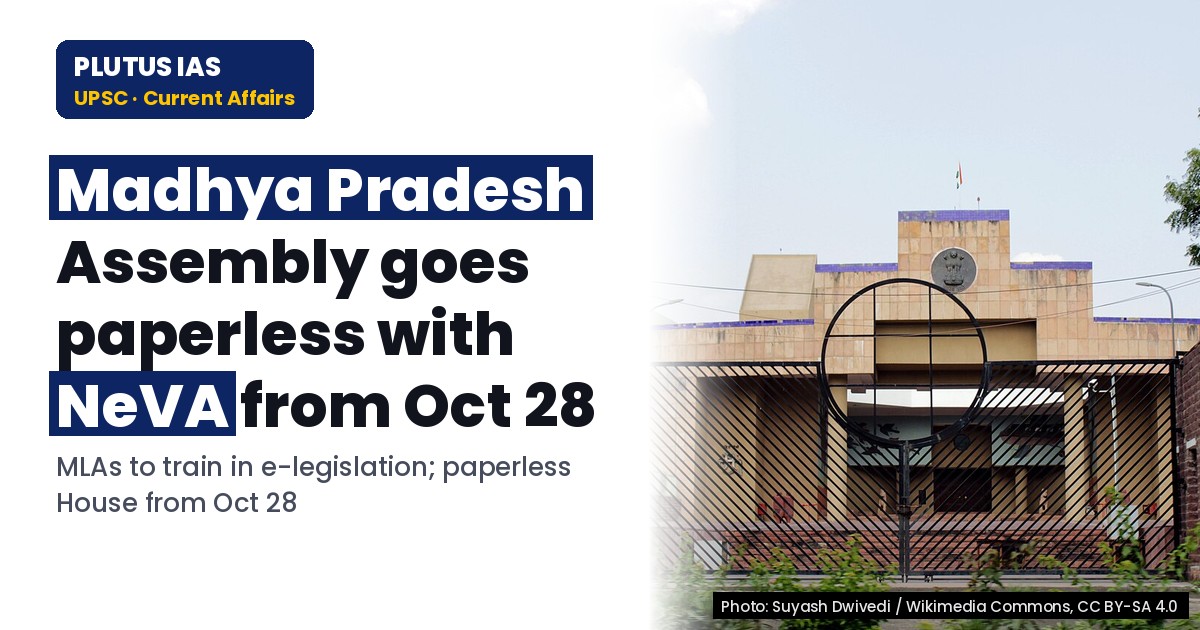
24 Oct Madhya Pradesh Assembly to Go Paperless: NeVA Training for MLAs from Oct 28
✎ NeVA is a digital governance initiative under the Digital India Programme, aimed at transforming legislative processes in India by replacing paper-based workflows with electronic systems, thereby enhancing efficiency…
Subject Relevance — Where This Topic Fits
- GS Paper II — Polity and Governance | GS Paper III — Science and Technology
- Prelims: NeVA, Digital Parliament, E-governance, Legislative Assembly, Paperless Assembly, Electronic Voting Machine, Parliamentary Procedures
- Essay: Role of Technology in Governance: Opportunities and Challenges, E-governance as a Catalyst for Democratic Accountability
Quick Revision: NeVA is a digital governance initiative under the Digital India Programme, aimed at transforming legislative processes in India by replacing paper-based workflows with electronic systems, thereby enhancing efficiency, transparency, and accessibility.
Why is this in the news?
The Madhya Pradesh Legislative Assembly is set to transition to a paperless system through the National e-Vidhan Application (NeVA), with a three-day training programme for legislators commencing on 28 October 2026. This initiative aligns with broader national efforts to digitise legislative processes, aiming to enhance efficiency, transparency, and accessibility in legislative functioning. The move reflects the integration of digital governance tools in India’s parliamentary democracy.
Background
- The National e-Vidhan Application (NeVA) is a Mission Mode Project under the Digital India Programme, launched to digitise the functioning of State Legislatures and Parliament.
- NeVA seeks to replace physical documents with digital records, enabling legislators to access legislative information, submit questions, and participate in proceedings via electronic means.
- The initiative is part of the broader e-governance framework aimed at reducing bureaucratic delays, minimising paper usage, and improving the responsiveness of legislative bodies.
- Madhya Pradesh is one of several states adopting NeVA, following the footsteps of states like Gujarat, Himachal Pradesh, and Odisha, which have already implemented or are in the process of implementing the system.
- The digitisation drive is expected to streamline legislative workflows, including the submission of questions, notices, and resolutions, thereby enhancing the efficiency of the legislative process.
- The training programme for legislators and their staff underscores the importance of capacity-building in leveraging digital tools for governance.
What is the National e-Vidhan Application (NeVA)?
- NeVA is a digital platform designed to transform the functioning of legislatures in India by replacing paper-based processes with electronic workflows.
- The application enables legislators to access legislative documents, submit questions, notices, and resolutions, and participate in proceedings through digital means.
- NeVA is part of the Digital India initiative and is being implemented under the guidance of the Ministry of Parliamentary Affairs, Government of India.
- The platform supports features such as personalised feeds, notifications, and access to historical legislative data, including past questions, debates, and bills.
- NeVA aims to enhance transparency by making legislative information publicly accessible, thereby fostering greater accountability and citizen engagement.
- The system is designed to integrate with existing parliamentary management systems, ensuring seamless adoption across legislative bodies.
- NeVA is compliant with the Digital India standards and adheres to data security and privacy norms to safeguard sensitive legislative information.
- The adoption of NeVA is expected to reduce the time and resources spent on managing physical documents, thereby improving the overall efficiency of legislative processes.
Key Features
| Feature | Significance |
|---|---|
| Digitalisation of legislative processes | Eliminates paper-based workflows in the legislative assembly, reducing administrative delays and enhancing efficiency in procedural compliance. |
| NeVA (National e-Vidhan Application) training for MLAs | Ensures uniform adoption of digital tools among legislators, enabling seamless integration with the e-Vidhan ecosystem. |
| Digital dissemination of House business (agenda, bills, Q&A) | Provides real-time access to legislative documents, improving transparency and reducing dependency on physical copies. |
| Personalised digital notifications for MLAs | Streamlines communication of procedural updates, such as notices for questions, adjournment motions, and resolutions. |
| Training for MLAs and supporting staff (OSDs, PAs) | Builds technical competency to sustain the transition to a paperless legislative environment. |
Why it Matters
Administrative Efficiency
- Reduces time lag in legislative processes by automating document handling and communication.
- Minimises logistical overheads associated with physical paperwork, such as printing, distribution, and storage.
- Enhances traceability of legislative actions through digitised records.
Transparency and Accountability
- Facilitates public access to legislative proceedings, bills, and responses to questions via digital platforms.
- Promotes standardised documentation, reducing ambiguities in procedural compliance.
- Strengthens institutional accountability through auditable digital trails.
Technological Modernisation
- Aligns with the broader e-governance initiatives under the Digital India programme.
- Demonstrates the potential for scaling digital legislative practices across state assemblies.
- Encourages adoption of emerging technologies (e.g., AI-driven analytics) for legislative workflows.
Resource Optimisation
- Lowers operational costs by reducing reliance on physical infrastructure for legislative documentation.
- Supports environmental sustainability through reduced paper consumption.
- Enables efficient utilisation of legislative staff for substantive work rather than clerical tasks.
Challenges
1. Digital Literacy and Training Gaps
- Varied levels of technological proficiency among MLAs and supporting staff may impede adoption.
- Sustained training programmes required to ensure long-term competency in digital tools.
- Risk of resistance to change due to unfamiliarity with digital workflows.
UPSC Link: GS-II: Governance, e-governance
2. Cybersecurity and Data Integrity
- Vulnerability to cyber threats, including data breaches and unauthorised access to legislative documents.
- Need for robust encryption, access controls, and disaster recovery mechanisms to safeguard digital records.
- Potential for system downtime to disrupt legislative proceedings.
UPSC Link: GS-III: Cybersecurity
3. Infrastructure and Connectivity
- Dependence on reliable internet connectivity and digital infrastructure across legislative premises.
- Risk of inequitable access due to disparities in technological infrastructure.
- Need for periodic upgrades to hardware and software to maintain system performance.
UPSC Link: GS-II: Governance
4. Interoperability with Existing Systems
- Integration challenges with legacy systems used for legislative documentation and archival.
- Ensuring compatibility with national e-Vidhan standards for seamless data exchange.
- Coordination required with other state and central government digital platforms.
UPSC Link: GS-II: Governance
5. Public Access and Digital Divide
- Limited digital literacy among citizens may restrict public participation in legislative processes.
- Need for user-friendly interfaces and multilingual support to ensure inclusivity.
- Risk of marginalising stakeholders without access to digital tools.
UPSC Link: GS-II: Inclusive Governance
Challenges — UPSC Perspective
| Issue | Concern |
|---|---|
| Digital Divide | Unequal access to technology among MLAs and citizens may hinder adoption. |
| Data Privacy | Risk of unauthorised access or misuse of legislative data in digital repositories. |
| System Reliability | Potential for technical failures to disrupt legislative workflows. |
| Training Fatigue | Sustained effort required to maintain competency among users. |
| Standardisation | Need for uniform protocols to ensure interoperability across legislative bodies. |
Way Forward
- Conduct periodic refresher training programmes for MLAs and supporting staff to reinforce digital skills.
- Establish a dedicated cybersecurity cell to monitor and mitigate risks to digital legislative infrastructure.
- Develop a phased rollout plan for public access to digital legislative records, ensuring inclusivity.
- Collaborate with the National Informatics Centre (NIC) to ensure alignment with national e-Vidhan standards.
- Introduce a feedback mechanism to identify and address operational challenges in the digital workflow.
- Allocate budgetary provisions for continuous upgrades to digital infrastructure and software.
- Promote awareness campaigns to enhance public understanding of the digital legislative process.
- Explore the integration of AI-driven tools for automated summarisation of legislative documents.
UPSC Value Addition
Keywords for Mains Answer-Writing
Digital transformation in legislatures · National e-Vidhan Application (NeVA) · paperless assembly · legislative digitisation · MP Vidhan Sabha initiative · e-governance in state legislatures · legislative efficiency · digital legislative processes · NeVA training for MLAs · e-legislative documents · legislative transparency · digitisation of legislative functions · state legislative digitisation initiatives
Constitutional & Policy Linkages
- Article 208: Rules of procedure for conduct of business in the State Legislature (framework for digital adoption).
Concept Flow
Legislative processes → Paper-based workflows → High administrative costs and delays → Adoption of digital tools (NeVA) → Training for MLAs and staff → Implementation of e-Vidhan system → Real-time access to legislative documents → Enhanced transparency and efficiency.
Prelims Practice Questions
Q1. Consider the following statements regarding the National e-Vidhan Application (NeVA):
1. NeVA is a digital platform designed to transform legislative processes into paperless workflows.
2. NeVA is mandated by the Constitution of India under Article 208 for all state legislatures.
3. NeVA enables MLAs to submit questions, notices, and petitions digitally.
4. NeVA training is currently being conducted for MLAs in Madhya Pradesh.
How many of the above statements are correct?
- Only one
- Only two
- Only three
- All four
Answer: All four — Statements 1, 3, and 4 are correct. Statement 2 is incorrect as NeVA is not constitutionally mandated but is a centrally sponsored scheme for digital transformation of legislatures.
Q2. Assertion (A): The National e-Vidhan Application (NeVA) aims to reduce the reliance on physical documents in legislative assemblies.
Reason (R): NeVA provides a digital platform for MLAs to access legislative documents, submit questions, and file petitions electronically.
Options:
A. Both A and R are true, and R is the correct explanation of A.
B. Both A and R are true, but R is not the correct explanation of A.
C. A is true, but R is false.
D. A is false, but R is true.
Answer: ? — Both A and R are true, and R correctly explains A. NeVA’s primary objective is to digitise legislative processes, thereby reducing paper usage.
Q3. Match the following initiatives with their respective objectives:
Column I (Initiative) | Column II (Objective)
—————————————————|——————————————————
1. National e-Vidhan Application (NeVA) | A. Digitising legislative processes in state assemblies
2. Digital India Programme | B. Transforming India into a digitally empowered society
3. e-Sansad | C. Digitising Parliament’s functioning
4. e-Governance in States | D. Modernising governance through ICT in states
Options:
A. 1-A, 2-B, 3-C, 4-D
B. 1-B, 2-A, 3-D, 4-C
C. 1-C, 2-D, 3-A, 4-B
D. 1-D, 2-C, 3-B, 4-A
Answer: ? — 1-A: NeVA is specifically designed for state legislatures. 2-B: Digital India Programme aims to empower society digitally. 3-C: e-Sansad digitises Parliament’s functioning. 4-D: e-Governance in states modernises governance through ICT.
Mains Practice Question
✍ The National e-Vidhan Application (NeVA) represents a transformative shift in the functioning of Indian legislatures. Critically examine the potential benefits and challenges associated with the digitisation of legislative processes, with particular reference to the Madhya Pradesh Vidhan Sabha initiative. Also, analyse how such digitisation aligns with the broader objectives of e-governance in India. (15 Marks)
Approach: MODEL-ANSWER SKELETON:
1. Introduction (2 marks):
– Define NeVA and its objective: paperless, efficient, and transparent legislative processes.
– Contextualise with Madhya Pradesh’s initiative (training of MLAs from 28-30 October 2026).
2. Benefits of NeVA (5 marks):
– Efficiency: Reduced time for document processing, faster access to legislative information.
– Transparency: Public access to legislative documents, questions, and proceedings.
– Cost-effectiveness: Reduction in printing and storage costs.
– Environmental sustainability: Lower paper consumption.
– Accessibility: MLAs can access information on-the-go via digital platforms.
– Alignment with Digital India: Supports the vision of a digitally empowered society.
3. Challenges and Concerns (5 marks):
– Digital Divide: Risk of excluding MLAs or staff unfamiliar with digital tools.
– Cybersecurity: Vulnerability to data breaches or hacking of legislative information.
– Infrastructure Dependence: Reliance on stable internet and IT infrastructure.
– Training and Capacity Building: Need for continuous upskilling of MLAs and staff.
– Legal and Procedural Adjustments: Amendments required in legislative rules to accommodate digital processes.
– Resistance to Change: Potential reluctance among traditionalists to adopt new systems.
4. Alignment with E-Governance Objectives (3 marks):
– NeVA as a subset of e-governance: Supports the broader goal of transparent, accountable, and participatory governance.
– Integration with other e-governance initiatives: e-Sansad, Digital India, and state-level e-governance portals.
– Contribution to Good Governance: Enhances responsiveness, reduces corruption, and improves service delivery.
5. Conclusion (1 mark):
– NeVA is a progressive step but requires robust implementation strategies, continuous training, and safeguards against risks to realise its full potential.
Source: amarujala.com
Generated by AanyaAi for educational purpose.
Related guides on our sites
- Current affairs for upsc 2026
- How to prepare for GS paper 1 for UPSC CSE mains exam
- Best UPSC coaching for IFOS exam
- Best mentorship programme for upsc

- Madhya Pradesh Assembly to Go Paperless: NeVA Training for MLAs from Oct 28 - October 24, 2026
- गगनयान: अंतरिक्ष यात्री अभ्यर्थी अंगद प्रताप बोले, ‘G1 परीक्षण उड़ान से रोमांचित हूँ’ - October 24, 2026
- Indigenous AIP System: Key Milestone for Indian Navy Submarines - October 24, 2026

No Comments