


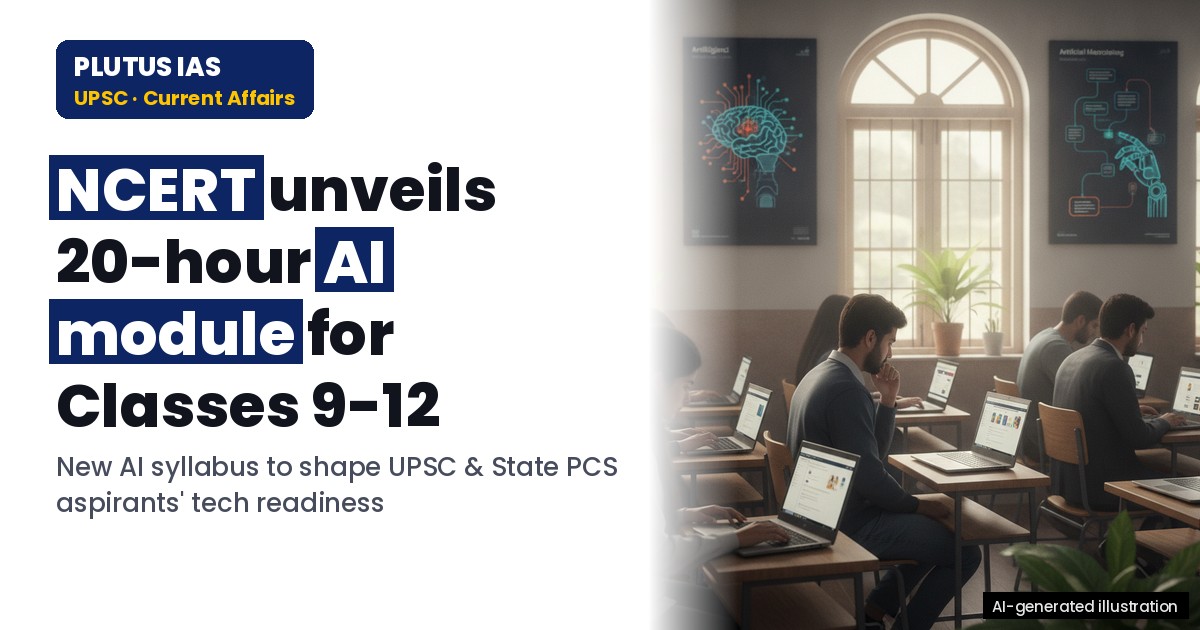
25 Oct NCERT’s AI Module for Classes 9-12: Deepfakes & Ethical AI for UPSC
✎ NCERT’s 20-hour AI module for classes 9–12 integrates computational thinking and ethical AI education, emphasizing experiential learning, data privacy, and critical evaluation of AI systems to prepare students for a…
Subject Relevance — Where This Topic Fits
- GS Paper III — Science and Technology: Developments and their Applications and Effects in Everyday Life | GS Paper II — Governance, Constitution, Polity, Social Justice and International Relations: Role of Institutions in Education and Skill Development
- Prelims: Artificial Intelligence (AI), Deepfakes, Computational Thinking (CT), National Council of Educational Research and Training (NCERT), IIT Madras, IIT Jodhpur, Misinformation, Data Privacy, Ethical AI, Experiential Learning
- Essay: The Role of Education in Shaping Responsible Citizens in the Age of Artificial Intelligence, Ethics and Innovation: Balancing Technological Advancement with Human Values
Quick Revision: NCERT’s 20-hour AI module for classes 9–12 integrates computational thinking and ethical AI education, emphasizing experiential learning, data privacy, and critical evaluation of AI systems to prepare students for a technology-driven future.
Why is this in the news?
The National Council of Educational Research and Training (NCERT) has introduced a 20-hour module on Computational Thinking (CT) and Artificial Intelligence (AI) for students in classes 9 to 12, developed in collaboration with IIT Madras and IIT Jodhpur. This initiative is a response to the growing prevalence of AI-driven technologies, including deepfakes, and aims to equip students with the knowledge and ethical frameworks necessary to critically evaluate AI systems. The module emphasizes activity-based learning, data privacy, and responsible technology use, aligning with contemporary challenges in digital literacy and misinformation.
Background
- Artificial Intelligence (AI) has transitioned from a niche academic field to a ubiquitous technology influencing education, governance, and daily life, necessitating structured learning pathways at the school level.
- Deepfakes and AI-generated misinformation pose significant threats to democratic processes, public trust, and individual privacy, highlighting the need for early education on ethical AI use.
- The National Education Policy (NEP) 2020 advocates for the integration of 21st-century skills, including computational thinking and digital literacy, into school curricula across all stages of education.
- India’s National Digital Education Architecture (NDEAR) and the Digital India initiative underscore the importance of equitable access to digital education and the development of critical technological competencies among youth.
- Collaborations between NCERT and premier technical institutions like IIT Madras and IIT Jodhpur reflect a broader trend of leveraging academic expertise to enhance school-level STEM education.
- Global initiatives, such as UNESCO’s *Guidance for Generative AI in Education and Research*, emphasize the ethical and pedagogical dimensions of AI integration in educational systems.
What is the NCERT AI Module for Classes 9–12?
- The module is a 20-hour, activity-based curriculum designed to introduce students to the fundamentals of Artificial Intelligence (AI) and Computational Thinking (CT) without requiring prior knowledge of the subject.
- It focuses on demystifying AI by explaining core concepts such as machine learning, neural networks, and data-driven decision-making through relatable examples and practical exercises.
- A key emphasis is placed on the ethical boundaries of AI, including data privacy, misinformation detection, fairness in algorithmic decision-making, and digital safety, to foster responsible technology use.
- The module employs an experiential learning approach, utilizing discussions, hands-on experiments, and reflective exercises to enhance understanding and retention of AI principles.
- Activities are designed to be inclusive, allowing participation with or without digital devices, thus ensuring accessibility across diverse school contexts and resource levels.
- Students are encouraged to develop critical thinking skills to evaluate AI-generated outputs, distinguishing between reliable and unreliable information while recognizing the limitations of AI systems.
- The curriculum aligns with the National Education Policy (NEP) 2020’s vision of integrating technology and ethical reasoning into school education.
- Collaborations with IIT Madras and IIT Jodhpur ensure academic rigor, with input from experts in AI, pedagogy, and educational technology.
Key Features
| Feature | Significance |
|---|---|
| 20-hour AI module for classes 9–12 | Introduces foundational computational thinking and AI literacy to school students, bridging the digital divide and preparing the next generation for an AI-integrated workforce. |
| Activity-based learning model | Ensures experiential understanding through discussions, practical exercises, and experimentation, making abstract AI concepts accessible without requiring digital devices. |
| Ethical boundaries and data privacy focus | Emphasises responsible AI use, critical verification of AI outputs, and safeguards against misinformation and deepfakes, aligning with global digital citizenship standards. |
| Collaboration with IITs (Madras & Jodhpur) | Leverages academic expertise to design rigorous, up-to-date content that reflects current AI advancements and limitations. |
| Inclusivity across school contexts | Designed to be implementable in diverse educational settings, including resource-constrained environments, ensuring equitable access to AI education. |
Why it Matters
Pedagogical Innovation
- Represents a paradigm shift in school education by integrating computational thinking and AI literacy into the formal curriculum, moving beyond traditional rote learning.
- Promotes higher-order cognitive skills such as critical thinking, problem-solving, and ethical reasoning in students from an early stage.
- Encourages experiential learning, fostering creativity and innovation, which are essential for India’s transition to a knowledge-based economy.
Societal Impact
- Equips students with the ability to discern AI-generated content, mitigating risks associated with deepfakes, misinformation, and synthetic media in public discourse.
- Fosters a culture of responsible digital citizenship, where students become informed, ethical users of technology rather than passive consumers.
- Reduces the digital divide by making AI education accessible to students across socio-economic backgrounds and geographical regions.
Economic and Workforce Preparation
- Aligns with India’s vision of becoming a global leader in AI by building a skilled talent pool from the school level, addressing the growing demand for AI professionals.
- Prepares students for future careers in emerging fields such as AI ethics, data science, and digital forensics, which are critical for India’s digital economy.
- Encourages entrepreneurship by familiarising students with AI applications, enabling them to ideate and develop solutions for local and global challenges.
Policy and Governance
- Demonstrates proactive governance by integrating AI literacy into the national curriculum, reflecting India’s commitment to inclusive and future-ready education.
- Sets a precedent for other countries to adopt similar initiatives, positioning India as a leader in AI education reform.
- Supports the implementation of the National Education Policy (NEP) 2020, which emphasises skill development, multidisciplinary learning, and digital empowerment.
Challenges
1. Implementation and Scalability
- Ensuring uniform quality of instruction across diverse school systems, including government and private institutions, with varying levels of infrastructure and teacher training.
- Addressing the shortage of trained educators capable of teaching AI and computational thinking effectively at the school level.
- Scaling the module to cover all 1.5 million schools in India while maintaining cost-effectiveness and resource efficiency.
UPSC Link: NEP 2020: School Education Reforms
2. Equity and Accessibility
- Bridging the digital divide to ensure that students in rural and underserved areas have equal access to AI education, including those without internet or device access.
- Preventing socio-economic disparities from translating into unequal opportunities in AI literacy and future career prospects.
- Ensuring that the module is inclusive of students with disabilities, providing adaptive learning tools and resources where necessary.
UPSC Link: Digital Divide: Policy Interventions
3. Curriculum Relevance and Updates
- Keeping the AI curriculum dynamic and responsive to rapid technological advancements, ensuring that content remains current and scientifically accurate.
- Balancing foundational concepts with emerging trends in AI, such as generative AI, reinforcement learning, and ethical AI frameworks.
- Incorporating feedback from educators, students, and industry experts to refine and improve the module over time.
UPSC Link: AI Policy: Global Best Practices
4. Ethical and Safety Concerns
- Preventing misuse of AI knowledge by students, such as creating deepfakes or engaging in unethical data practices, through robust ethical guidelines and awareness programmes.
- Ensuring that students understand the limitations of AI systems, including biases in training data and the potential for algorithmic discrimination.
- Promoting responsible AI use in line with international ethical frameworks, such as UNESCO’s Recommendation on the Ethics of AI.
UPSC Link: Ethical AI: UNESCO Guidelines
5. Assessment and Evaluation
- Developing robust assessment mechanisms to measure student learning outcomes and the effectiveness of the AI module without resorting to rote memorisation.
- Ensuring that assessments are aligned with higher-order cognitive skills, such as analysis, evaluation, and creation, rather than factual recall.
- Providing feedback mechanisms for educators to identify gaps in student understanding and adapt teaching strategies accordingly.
UPSC Link: Assessment Reforms: Competency-Based Learning
Challenges — UPSC Perspective
| Issue | Concern |
|---|---|
| Teacher Training | Insufficient number of educators trained in AI and computational thinking to deliver the module effectively across all schools. |
| Resource Constraints | Limited availability of digital devices, internet connectivity, and learning materials in government schools, particularly in rural areas. |
| Curriculum Rigidity | Existing school curricula may lack flexibility to accommodate additional hours for AI education without compromising core subjects. |
| Student Engagement | Risk of low student interest or engagement if the module is perceived as overly technical or disconnected from their immediate interests. |
| Ethical Misuse | Potential for students to experiment with AI tools in ways that violate privacy, create misinformation, or engage in unethical practices without proper safeguards. |
| Monitoring and Evaluation | Difficulty in tracking the implementation and impact of the module across diverse educational contexts, leading to uneven outcomes. |
Way Forward
- Conduct nationwide teacher training programmes in collaboration with state education departments and IITs to build a cadre of AI-literate educators.
- Develop low-cost, offline-friendly digital resources and activity kits to ensure accessibility in resource-constrained schools.
- Establish a continuous feedback loop with educators, students, and parents to refine the module and address implementation challenges.
- Integrate AI education with existing subjects such as mathematics, science, and social studies to enhance interdisciplinary learning and relevance.
- Launch public awareness campaigns to highlight the importance of AI literacy and encourage community participation in supporting students.
- Partner with industry stakeholders to provide mentorship, internships, and real-world case studies to contextualise AI learning.
- Develop standardised assessment tools to evaluate student learning outcomes and the effectiveness of the AI module.
- Promote research and innovation in AI education by funding pilot projects and studies to identify best practices and scalable models.
UPSC Value Addition
Keywords for Mains Answer-Writing
Artificial Intelligence (AI), deepfakes, computational thinking, ethical boundaries in technology, data privacy, misinformation, AI literacy in education, National Council of Educational Research and Training (NCERT), AI governance, responsible AI use, AI applications and limitations, experiential learning in AI education, AI policy framework, digital safety, critical evaluation of AI outputs
Concept Flow
Rapid advancements in AI and deepfake technology → Rising societal risks (misinformation, privacy violations) → Need for AI literacy at grassroots level → NCERT introduces AI module for school students → Activity-based learning fosters critical thinking and ethical reasoning → Students become informed, responsible digital citizens → Long-term workforce preparedness for AI-driven economy → Alignment with NEP 2020’s vision of equitable and future-ready education.
Prelims Practice Questions
Q1. Consider the following statements regarding the AI module introduced by NCERT for classes 9-12:
1. The module is designed to be activity-based and can be conducted with or without digital devices.
2. It emphasizes ethical boundaries such as data privacy, misinformation, and digital safety.
3. The module was developed in consultation with IIT Bombay and IIT Delhi.
4. It aims to make students responsible users of AI systems rather than passive consumers.
How many of the above statements are correct?
- Only one
- Only two
- Only three
- All
Answer: Only three — Statements 1, 2, and 4 are correct. Statement 3 is incorrect as the module was developed in consultation with IIT Madras and IIT Jodhpur, not IIT Bombay or IIT Delhi.
Q2. Assertion (A): The NCERT AI module for classes 9-12 includes a focus on detecting deepfakes as a critical skill for students.
Reason (R): Deepfakes are a form of AI-generated misinformation that can undermine digital safety and ethical boundaries in technology use.
Options:
A. Both A and R are true, and R is the correct explanation of A.
B. Both A and R are true, but R is not the correct explanation of A.
C. A is true, but R is false.
D. A is false, but R is true.
Answer: ? — Both Assertion (A) and Reason (R) are true, and Reason (R) correctly explains Assertion (A). The module explicitly addresses ethical boundaries, including misinformation like deepfakes, to foster responsible AI use.
Q3. Match the following terms associated with the NCERT AI module with their correct descriptions:
Term | Description
— | —
1. Computational Thinking (CT) | A. A systematic approach to solving problems using AI concepts and applications
2. Deepfakes | B. AI-generated content designed to mimic real individuals or events, often used to spread misinformation
3. Data Privacy | C. The protection of personal data from unauthorized access or misuse
4. Responsible AI Use | D. Ethical guidelines for using AI systems to ensure fairness, safety, and accountability
Options:
A. 1-A, 2-B, 3-C, 4-D
B. 1-B, 2-A, 3-D, 4-C
C. 1-C, 2-D, 3-A, 4-B
D. 1-D, 2-C, 3-B, 4-A
Answer: ? — The correct match is: 1-A, 2-B, 3-C, 4-D. Computational Thinking (CT) is a systematic problem-solving approach; deepfakes are AI-generated misinformation; data privacy involves protecting personal data; and responsible AI use includes ethical guidelines.
Mains Practice Question
✍ The integration of Artificial Intelligence (AI) into education necessitates a balance between technological advancement and ethical responsibility. Critically examine how the NCERT’s 20-hour AI module for classes 9-12 addresses the ethical boundaries of AI use, including deepfakes, misinformation, and data privacy. (15 Marks)
Approach: MODEL-ANSWER SKELETON:
1. **Contextual Introduction (2 Marks)**
– Briefly introduce AI’s growing role in education and society, highlighting challenges like deepfakes and misinformation.
– Mention NCERT’s initiative as a proactive step toward AI literacy.
2. **Ethical Boundaries Addressed by the Module (5 Marks)**
– **Deepfakes and Misinformation:** Explain how the module educates students on identifying AI-generated content, its limitations, and the risks of misinformation.
– **Data Privacy:** Discuss the emphasis on protecting personal data, aligning with frameworks like the Digital Personal Data Protection Act, 2023.
– **Fairness and Bias:** Highlight the module’s focus on ensuring AI systems are used fairly and without bias.
– **Digital Safety:** Include the module’s approach to teaching safe online practices.
3. **Pedagogical Approach (4 Marks)**
– **Activity-Based Learning:** Describe how experiential learning (discussions, practical exercises, experimentation) fosters critical thinking.
– **Inclusivity:** Explain the module’s adaptability for schools with or without digital devices, ensuring equitable access.
– **Collaborative Development:** Mention the role of IIT Madras and IIT Jodhpur in designing the module.
4. **Critical Analysis (3 Marks)**
– **Strengths:** Acknowledge the module’s comprehensive approach to ethical AI use and its alignment with global best practices.
– **Limitations:** Discuss potential challenges, such as scalability, teacher training, and the need for periodic updates to keep pace with AI advancements.
5. **Conclusion (1 Mark)**
– Summarize the significance of integrating ethical AI education in school curricula to prepare students for a technology-driven future.
Source: orissapost.com
Generated by AanyaAi for educational purpose.
Related guides on our sites
- UPSC EPFO syllabus
- Gs Paper 1 Syllabus
- How to prepare for GS paper 1 for UPSC CSE mains exam
- Best UPSC coaching for IFOS exam

- NCERT’s AI Module for Classes 9-12: Deepfakes & Ethical AI for UPSC - October 25, 2026
- अक्टूबर 28 को आएगा चक्रवात, आंध्र प्रदेश में बाढ़ और निकासी की तैयारी - October 25, 2026
- Odisha Cyclone Alert: Schools Closed, Response Teams on High Alert - October 25, 2026

No Comments