


26 Oct DAC approves Rs 2.12 lakh crore defence acquisitions for armed forces
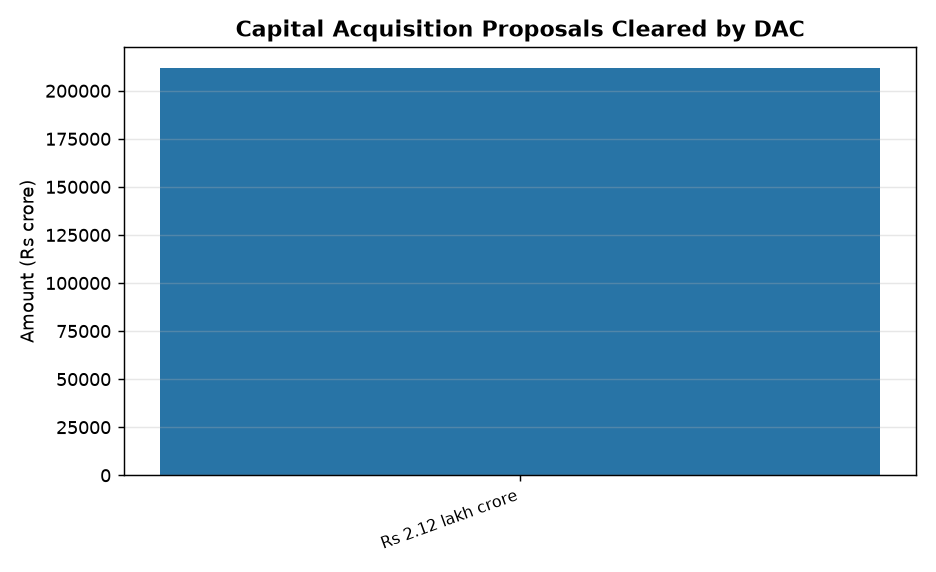
✎ The Defence Acquisition Council (DAC) is the apex body for capital procurement in the Ministry of Defence, chaired by the Union Defence Minister, and is responsible for approving procurement proposals under the Defence…
Subject Relevance — Where This Topic Fits
- GS Paper III — Security
- Prelims: Defence Acquisition Council, Defence Procurement Procedure, Capital Acquisition, Make in India in Defence, Offset Policy, Strategic Partnership Model
- Essay: India’s defence modernisation: Balancing indigenous capability and strategic autonomy
Quick Revision: The Defence Acquisition Council (DAC) is the apex body for capital procurement in the Ministry of Defence, chaired by the Union Defence Minister, and is responsible for approving procurement proposals under the Defence Procurement Procedure (DPP) to ensure timely and indigenous defence modernisation.
Why is this in the news?
The Defence Acquisition Council (DAC), the apex body for capital procurement in the Ministry of Defence, has approved capital acquisition proposals worth ₹2.12 lakh crore for the Indian Armed Forces. This development underscores the institutional mechanisms governing defence procurement in India, the evolving procurement framework under the Defence Procurement Procedure (DPP), and the strategic imperatives driving indigenous defence manufacturing.
Background
- The Defence Acquisition Council (DAC) was established in 2001 under the Ministry of Defence to streamline and expedite the capital acquisition process for the Armed Forces, ensuring timely and cost-effective procurement of defence equipment.
- The DAC operates under the Defence Procurement Procedure (DPP), which has undergone multiple revisions to align with the ‘Make in India’ initiative and promote indigenous defence manufacturing.
- India’s defence procurement landscape is shaped by geopolitical considerations, technological advancements, and the need to reduce import dependence, as outlined in the Defence Production and Export Promotion Policy (DPEPP) 2020.
- The DAC’s approvals are a critical component of the ‘Atmanirbhar Bharat’ initiative, aiming to enhance self-reliance in defence production through strategic partnerships, indigenisation, and offset mechanisms.
- Recent approvals reflect a shift towards multi-platform acquisitions, including platforms such as aircraft, artillery systems, and naval vessels, to address operational gaps and modernise the Armed Forces.
- The DAC’s decisions are vetted by the Defence Procurement Board (DPB) and the Defence Finance Committee (DFC) to ensure fiscal prudence and alignment with the Long-Term Integrated Perspective Plan (LTIPP).
What is the Defence Acquisition Council (DAC)?
- The Defence Acquisition Council (DAC) is the highest decision-making body in the Ministry of Defence for capital procurement of defence equipment, chaired by the Union Minister of Defence.
- Established in 2001, the DAC was constituted to expedite the procurement process, reduce procedural delays, and ensure timely acquisition of defence equipment for the Armed Forces.
- The DAC’s mandate includes approving long-term procurement plans, categorising procurement cases, and granting ‘Acceptance of Necessity’ (AoN) for projects under the Defence Procurement Procedure (DPP).
- The council comprises senior officials from the Ministry of Defence, including the Chiefs of the three Services (Army, Navy, Air Force), the Defence Secretary, and the Finance Secretary.
- The DAC plays a pivotal role in promoting indigenous defence manufacturing by prioritising procurement under the ‘Buy (Indian)’, ‘Buy and Make (Indian)’, and ‘Make’ categories of the DPP.
- The DAC’s decisions are guided by the principles of strategic partnership, offset obligations (where applicable), and the ‘Make in India’ initiative to reduce import dependence.
- The council also oversees the implementation of the Strategic Partnership Model (SPM), which facilitates collaboration between Indian private sector entities and global Original Equipment Manufacturers (OEMs) for high-technology defence platforms.
- The DAC’s approvals are subject to compliance with the Defence Procurement Procedure (DPP) and the Long-Term Integrated Perspective Plan (LTIPP) of the Armed Forces.
Key Features
| Feature | Significance |
|---|---|
| Capital Acquisition Proposals | Represents planned investments in defence capabilities, enhancing operational readiness and strategic autonomy. |
| Defence Acquisition Council (DAC) | Constitutes the apex body for defence procurement, ensuring inter-service coordination and adherence to defence acquisition procedures. |
| Procurement through Capital Budget | Funds allocated under the capital head of the defence budget, enabling acquisition of long-term assets like platforms, weapons, and systems. |
| Multi-Service Integration | Proposals often span requirements across the Army, Navy, and Air Force, reflecting joint operational priorities. |
Why it Matters
Strategic Autonomy
- Reduces dependence on foreign suppliers by prioritising indigenous defence manufacturing under the ‘Make in India’ initiative.
- Strengthens India’s position in global defence partnerships through calibrated acquisitions aligned with strategic interests.
- Enhances the Indian Armed Forces’ capability to respond to emerging security challenges in the Indo-Pacific and beyond.
Economic Impact
- Stimulates domestic defence industrial base, generating employment and fostering technological self-reliance.
- Contributes to the growth of MSMEs and start-ups in defence manufacturing, aligning with the ‘Aatmanirbhar Bharat’ vision.
- Long-term capital investments in defence infrastructure create multiplier effects across allied sectors such as logistics, R&D, and skill development.
Operational Readiness
- Modernises critical defence platforms, including fighter aircraft, helicopters, and missile systems, to maintain technological parity.
- Facilitates timely upgrades and replacements of obsolescent equipment, ensuring sustained operational effectiveness.
- Supports niche capabilities such as electronic warfare, cyber defence, and space-based surveillance.
Defence Procurement Procedure (DPP)
- Ensures transparency and accountability in defence acquisitions through structured processes under the DPP 2020.
- Balances urgency with procedural rigour via provisions like ‘Make-I’ and ‘Make-II’ categories for indigenous development.
- Incorporates offset mechanisms to promote technology transfer and joint ventures with domestic industry.
Challenges
1. Indigenous Manufacturing Gaps
- Limited capacity of domestic defence PSUs and private sector to meet large-scale production timelines for advanced platforms.
- Dependence on foreign Original Equipment Manufacturers (OEMs) for critical components and sub-systems.
- Skill shortages in high-technology domains such as aerospace, naval shipbuilding, and cyber systems.
UPSC Link: Defence Industrial Base
2. Procurement Delays
- Extended timelines due to multi-layered approval processes under the DPP, including trials, negotiations, and vendor selection.
- Bureaucratic and procedural bottlenecks in inter-ministerial coordination, particularly for multi-vendor projects.
- Impact of global supply chain disruptions on delivery schedules for imported defence equipment.
UPSC Link: Defence Procurement Procedure
3. Cost Overruns
- Escalation in project costs due to inflation, currency fluctuations, and unforeseen technical challenges.
- Limited fiscal space within the defence budget to accommodate unplanned expenses, necessitating re-prioritisation.
- Pressure to balance capital acquisitions with revenue expenditures for operational maintenance.
UPSC Link: Capital vs Revenue Expenditure
4. Technology Transfer Constraints
- Restrictive clauses in foreign defence contracts limiting the scope of technology transfer to domestic entities.
- Inadequate R&D investment by private sector to absorb and adapt transferred technologies.
- Regulatory hurdles in intellectual property rights and export controls imposed by technology-exporting nations.
UPSC Link: Offset Obligations
Challenges — UPSC Perspective
| Issue | Concern |
|---|---|
| Vendor Reliability | Risk of delays or defaults by foreign suppliers due to geopolitical or economic factors. |
| Regulatory Compliance | Complexity in adhering to multiple domestic and international regulatory frameworks for defence procurement. |
| Human Resource Development | Shortage of trained personnel in niche domains such as artificial intelligence, robotics, and hypersonic systems. |
| Infrastructure Bottlenecks | Inadequate testing and production facilities for indigenous development of defence platforms. |
| Budgetary Constraints | Competition for resources between capital acquisitions and social sector expenditures. |
Way Forward
- Streamline the Defence Procurement Procedure (DPP) by reducing procedural layers and expediting vendor selection for time-sensitive acquisitions.
- Enhance funding for R&D in critical areas such as drones, AI-driven surveillance, and next-generation fighter aircraft under the iDEX and Make-II schemes.
- Strengthen the defence industrial base by incentivising private sector participation through tax benefits, ease of doing business reforms, and assured orders.
- Establish dedicated skill development programmes in collaboration with IITs, NITs, and industry partners to address talent shortages in high-tech domains.
- Improve inter-ministerial coordination by creating a single-window clearance mechanism for defence procurement to minimise delays.
- Promote public-private partnerships (PPPs) for defence manufacturing hubs, leveraging India’s geographic and demographic advantages.
- Augment testing and certification infrastructure through the creation of advanced test ranges and certification centres under the DRDO and HAL.
- Adopt a phased acquisition strategy to balance immediate operational needs with long-term indigenous capability development.
UPSC Value Addition
Keywords for Mains Answer-Writing
Defence Acquisition Council · Capital Acquisition Proposals · Defence Procurement Procedure 2020 · Make in India in Defence · Self-Reliance in Defence Manufacturing · Defence Modernisation · Defence Industrial Base · Strategic Partnership Model · Defence Acquisition Process · Capital Expenditure in Defence
Concept Flow
Government identifies strategic defence gaps → DAC evaluates proposals → Cabinet Committee on Security (CCS) approves capital acquisitions → Budgetary allocations under Defence Services Estimates → Procurement via DPP 2020 → Indigenous development prioritised under ‘Make in India’ → Modernisation of Armed Forces → Enhanced operational readiness and strategic autonomy.
Prelims Practice Questions
Q1. Consider the following statements regarding the Defence Acquisition Council (DAC):
1. The DAC is chaired by the Prime Minister of India.
2. The DAC is responsible for categorisation of the capital acquisition proposals relating to new schemes for defence forces.
3. The DAC approves the long-term integrated perspective plan (LTIPP) for the defence forces.
4. The DAC is a statutory body established under the Defence Procurement Procedure (DPP) 2020.
How many of the above statements are correct?
- Only one
- Only two
- Only three
- All
Answer: Only three — Statements 2 and 3 are correct. The DAC is chaired by the Defence Minister, not the Prime Minister. The DAC is not a statutory body but functions under the administrative framework of the Ministry of Defence.
Q2. Assertion (A): The Defence Acquisition Council (DAC) plays a pivotal role in promoting self-reliance in defence manufacturing under the ‘Make in India’ initiative.
Reason (R): The DAC mandates that a minimum of 50% indigenous content is required for procurement under the ‘Make’ category of the Defence Procurement Procedure (DPP).
In the context of the above two statements, which one of the following is correct?
- Both A and R are true and R is the correct explanation of A.
- Both A and R are true but R is not the correct explanation of A.
- A is true but R is false.
- A is false but R is true.
Answer: A is false but R is true. — The DAC promotes self-reliance in defence manufacturing through various procurement categories, including ‘Make’ and ‘Buy (Indian)’, but the minimum indigenous content requirement of 50% is specified for procurement under the ‘Buy (Indian)’ category, not the ‘Make’ category.
Q3. Match the following procurement categories under the Defence Procurement Procedure (DPP) 2020 with their respective definitions:
Column I (Procurement Category)
A. Buy (Indian – IDDM)
B. Make
C. Buy and Make (Indian)
D. Strategic Partnership Model
Column II (Definition)
1. Procurement from Indian vendors with minimum 50% indigenous content.
2. Indigenous design, development, and manufacture with government funding.
3. Procurement of equipment in a phased manner, combining indigenous manufacturing with technology transfer.
4. Long-term partnership with Indian private sector firms for manufacturing high-tech defence platforms.
Select the correct match:
- A-1, B-2, C-3, D-4; A-2, B-1, C-4, D-3; A-3, B-4, C-1, D-2; A-4, B-3, C-2, D-1
- answer_index_list_for_explain_only_here_but_NOT_in_output_json_0: [0, 1, 2, 3]
- answer_index_list_for_explain_only_here_but_NOT_in_output_json_1: [0, 1, 2, 3]
- answer_index_list_for_explain_only_here_but_NOT_in_output_json_2: [0, 1, 2, 3]
- answer_index_list_for_explain_only_here_but_NOT_in_output_json_3: [0, 1, 2, 3]
- answer_index_list_for_explain_only_here_but_NOT_in_output_json_4: [0],
Answer: A-1, B-2, C-3, D-4; A-2, B-1, C-4, D-3; A-3, B-4, C-1, D-2; A-4, B-3, C-2, D-1 — The correct matching is: A-1 (Buy (Indian – IDDM): procurement from Indian vendors with minimum 50% indigenous content), B-2 (Make: indigenous design, development, and manufacture with government funding), C-3 (Buy and Make (Indian): phased procurement combining indigenous manufacturing with technology transfer), and D-4 (Strategic Partnership Model: long-term partnership with Indian private sector firms for manufacturing high-tech defence platforms).
Mains Practice Question
✍ The Defence Acquisition Council (DAC) has recently cleared capital acquisition proposals worth Rs 2.12 lakh crore for the defence forces. In this context, critically examine the role of the DAC in India’s defence procurement architecture. How does it balance the imperatives of modernisation, strategic autonomy, and fiscal prudence? (15 Marks)
Approach: A full answer must cover the following dimensions:
1. **Constitutional and Institutional Framework**:
– Role of the DAC as a high-level decision-making body under the Ministry of Defence.
– Composition: Defence Minister (Chairperson), Chiefs of Staff Committee, Secretary (Defence Production), Secretary (Defence Research and Development), and Financial Advisor (Defence Services).
– Legal basis: Defence Procurement Procedure (DPP) 2020 and its iterative updates.
2. **Functions and Processes**:
– Categorisation of acquisition proposals (Buy, Make, Buy and Make, Strategic Partnership Model).
– Approval of long-term integrated perspective plans (LTIPP) and five-year defence plans.
– Delegation of powers to the Defence Acquisition Wing (DAW) for faster processing.
– Role in promoting indigenous manufacturing under ‘Make in India’ and ‘Atmanirbhar Bharat’ initiatives.
3. **Balancing Modernisation, Strategic Autonomy, and Fiscal Prudence**:
– **Modernisation**: Acquisition of advanced platforms (e.g., fighter aircraft, submarines, artillery systems) to bridge capability gaps.
– **Strategic Autonomy**: Emphasis on indigenous design, development, and manufacture (e.g., Tejas, INS Vikrant, Arjun MBT).
– **Fiscal Prudence**: Cost-effective procurement through competitive bidding, offset mechanisms, and life-cycle cost considerations.
4. **Challenges and Criticisms**:
– Delay in decision-making due to bureaucratic and inter-ministerial coordination issues.
– Over-reliance on imports despite ‘Make in India’ push (e.g., recent Rafale deal).
– Limited participation of MSMEs and startups in defence manufacturing.
– Balancing immediate operational needs with long-term strategic goals.
5. **Recent Initiatives and Data**:
– DAC’s approvals under the ‘Make’ category and Strategic Partnership Model for platforms like Light Combat Helicopters (LCH) and Advanced Towed Artillery Gun Systems (ATAGS).
– Indigenous content requirements: 50% for ‘Buy (Indian – IDDM)’ and 40% for ‘Buy (Global – Manufacture in India)’.
– Role of Defence Research and Development Organisation (DRDO) and public sector undertakings (PSUs) in indigenisation.
6. **Comparative Perspective**:
– Contrast with procurement processes in other major defence spenders (e.g., USA’s Defense Acquisition System, Russia’s state-driven model).
– Lessons from global best practices in defence procurement.
7. **Way Forward**:
– Streamlining the acquisition process through digitalisation (e.g., Defence Acquisition Portal).
– Enhancing private sector participation through policy incentives and ease of doing business reforms.
– Strengthening the defence industrial base through cluster-based development and skill upgradation.
**Balance of Views**:
– Proponents argue that the DAC has accelerated modernisation and indigenisation, citing recent approvals and indigenous platform developments.
– Critics highlight systemic delays, bureaucratic inertia, and the need for greater transparency and accountability in procurement decisions.
Source: PIB (Press Information Bureau)
Generated by AanyaAi for educational purpose.
Related guides on our sites
- How to prepare for GS paper 1 for UPSC CSE mains exam
- Best UPSC coaching for IFOS exam
- Best mentorship programme for upsc
- UPSC+BA degree

- NAMASTE Scheme: Enhancing Sanitation Workers’ Livelihoods & Safety - November 14, 2026
- एमएसएमई का विशेष अभियान 6.0: स्वच्छता और लंबित मामलों का निपटारा - November 14, 2026
- Sea Vigil-26: Coastal Defence Drills Off Visakhapatnam - November 14, 2026

No Comments