


26 Oct MP BJP’s Rajya Sabha Panel: Key Polity Updates for UPSC & PCS Aspirants
✎ The Rajya Sabha nominations in Madhya Pradesh involve internal party consultations followed by formal election by state MLAs, while nuclear power projects require compliance with environmental laws and public consultations.
Subject Relevance — Where This Topic Fits
- GS Paper II — Polity and Governance (Parliamentary procedures, State Legislatures, Electoral processes) | GS Paper III — Environment and Disaster Management (Nuclear energy and public protests)
- Prelims: Rajya Sabha, State Legislative Assembly, Nuclear Power Plant, Environmental Impact Assessment (EIA), Parliamentary Committee on Government Assurances
- Essay: Ethical governance and public participation in policy-making
Quick Revision: The Rajya Sabha nominations in Madhya Pradesh involve internal party consultations followed by formal election by state MLAs, while nuclear power projects require compliance with environmental laws and public consultations.
Why is this in the news?
The news highlights three concurrent developments in Madhya Pradesh—(1) the Bharatiya Janata Party’s (BJP) internal process for nominating candidates to the Rajya Sabha from the state, (2) political demonstrations involving party offices and public figures, and (3) the opposition’s concerns regarding the proposed nuclear power plant in Rewa district. These events underscore the interplay between legislative processes, political mobilisation, and public policy debates in the state.
Background
- The Rajya Sabha, the upper house of India’s Parliament, has 245 members, 12 of whom are nominated by the President for their contributions to arts, science, sports, and social service. The remaining 233 are elected by the elected members of the State Legislative Assemblies and the Union Territory Legislative Assemblies.
- Madhya Pradesh, a state with a unicameral legislature, elects 11 members to the Rajya Sabha. The process involves consultations within the ruling party, followed by formal nomination and election by the state’s MLAs.
- Nuclear power in India is governed by the Atomic Energy Act, 1962, and the Environmental Protection Act, 1986. The Nuclear Power Corporation of India Limited (NPCIL) is the public sector undertaking responsible for the operation of nuclear power plants.
- Public protests against nuclear power projects often centre on concerns related to land acquisition, displacement, environmental impact, and safety protocols, as seen in past movements such as the Kudankulam protests in Tamil Nadu.
- Political demonstrations and party office encirclements are common in Indian politics, often reflecting broader socio-political tensions or reactions to specific statements or policies.
Key Developments in Madhya Pradesh
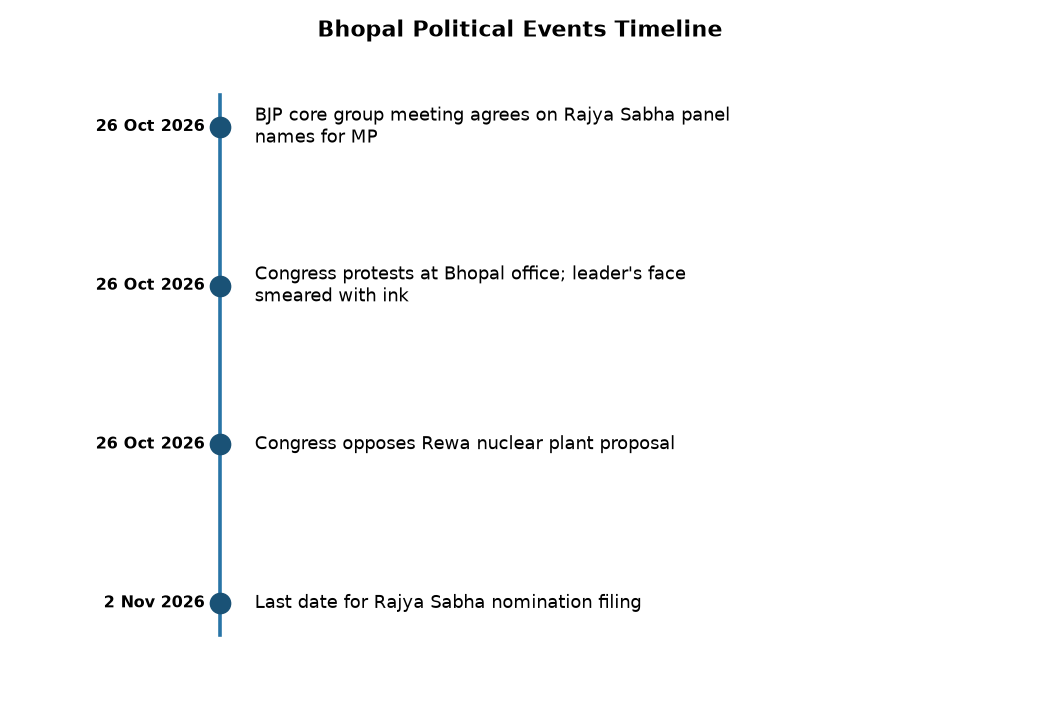
- Rajya Sabha Nominations: The BJP’s Madhya Pradesh unit convened a core group meeting to shortlist potential candidates for the state’s Rajya Sabha seats. The process involves internal consultations, followed by formal nomination and election by the state’s MLAs. The timeline for nominations spans until 2 November 2026.
- Political Demonstrations: The BJP organised a protest at the Congress party’s state office in Bhopal in response to alleged remarks by a Congress leader. The demonstration escalated into a tense standoff, with police intervention using water cannons to disperse crowds. Such protests are indicative of the competitive political environment in the state.
- Incident of Alleged Defacement: The president of the Hindu Festival Committee in Bhopal, Chandrashekhar Tiwari, was allegedly subjected to an act of defacement involving ink. The incident followed accusations of casteist remarks in an interview, highlighting the intersection of social tensions and political mobilisation.
- Nuclear Power Plant Controversy: The proposed nuclear power plant in Rewa district has faced opposition from the Congress party, which has raised concerns over land acquisition, alleged fraudulent Gram Sabha consent, and the death of a protester, Vimla Kol, during a water protest. The opposition has demanded a change in the project site, an inquiry into the death, and compensation for affected families.
Key Features
| Feature | Significance |
|---|---|
| State Assembly’s role in Rajya Sabha nominations | The State Assembly’s political grouping determines the party’s candidate panel for Rajya Sabha elections, reflecting intra-party consensus and state-level representation dynamics. |
| Intra-party coordination mechanisms (BJP Core Group) | The Core Group’s deliberations on candidate selection illustrate the institutional process of consensus-building within a political party before formal nominations. |
| Public demonstrations and counter-protests | Political protests, including encirclement of party offices and counter-demonstrations, highlight the mobilisational strategies and competitive politics between parties at the state level. |
| Civil society dissent on nuclear projects | Opposition to nuclear power plants, such as the proposed Rewa facility, reflects public concerns over environmental impact, land acquisition, and procedural irregularities in governance. |
| Legal and administrative scrutiny of land acquisition | Opposition demands for investigation into alleged irregularities in Gram Sabha consent and compensation for affected communities underscore the legal and administrative challenges in infrastructure projects. |
Why it Matters
Political Process
- The selection of Rajya Sabha candidates by the State Assembly reflects the federal structure of India’s parliamentary democracy, where state legislatures play a direct role in the composition of the Upper House.
- Intra-party consensus mechanisms, such as the BJP Core Group, demonstrate the importance of internal party democracy in candidate selection, balancing regional representation with national party priorities.
- Public protests and counter-protests illustrate the role of political mobilisation in shaping public opinion and influencing party strategies, particularly in the context of state-level governance.
Energy Policy & Governance
- The proposed Rewa nuclear power plant represents a strategic initiative to expand India’s nuclear energy capacity, aligning with the country’s long-term energy security goals.
- Dissent against nuclear projects highlights the tension between developmental imperatives and environmental safeguards, necessitating robust public consultation and regulatory oversight.
- Allegations of procedural irregularities in land acquisition and compensation underscore the need for transparent governance in large-scale infrastructure projects to maintain public trust.
Law & Order
- Political demonstrations, including encirclement of party offices and counter-protests, test the state’s capacity to maintain law and order while safeguarding democratic rights to assembly and expression.
- Incidents of alleged assault or defacement, such as the incident involving the Hindu Utsav Samiti president, raise questions about the enforcement of laws against hate speech and public order violations.
Challenges
1. Political Polarisation and Public Order
- Escalation of political protests risks disrupting public order, particularly in urban centres where party offices and public spaces become focal points of contention.
- Incidents of alleged assault or defacement during protests can exacerbate community tensions and undermine social cohesion, requiring proactive policing and mediation.
UPSC Link: GS-II: Role of State in maintaining law and order
2. Environmental and Social Opposition to Nuclear Projects
- Public resistance to nuclear power plants, driven by concerns over safety, land acquisition, and compensation, poses a challenge to the implementation of India’s energy policy.
- Allegations of procedural irregularities in land acquisition and Gram Sabha consent highlight the need for transparent governance and robust grievance redressal mechanisms.
UPSC Link: GS-III: Environmental governance and nuclear energy policy
3. Balancing Development and Democratic Safeguards
- Large-scale infrastructure projects, such as nuclear power plants, require balancing developmental goals with democratic safeguards, including public consultation and environmental impact assessments.
- Ensuring fair compensation and rehabilitation for affected communities remains a persistent challenge, necessitating adherence to legal frameworks such as the Right to Fair Compensation and Transparency in Land Acquisition, Rehabilitation and Resettlement Act, 2013.
UPSC Link: GS-III: Sustainable development and environmental governance
4. Intra-Party Consensus and Candidate Selection
- The process of selecting Rajya Sabha candidates within political parties must balance regional representation with national party priorities, often requiring complex negotiations.
- Ensuring transparency and inclusivity in candidate selection can mitigate internal party dissent and enhance public trust in democratic processes.
UPSC Link: GS-II: Federalism and role of political parties
Challenges — UPSC Perspective
| Issue | Concern |
|---|---|
| Political protests and counter-demonstrations | Risk of escalation into public disorder, necessitating balanced law enforcement and mediation. |
| Allegations of procedural irregularities in land acquisition | Undermines public trust in governance and requires independent scrutiny of consent and compensation processes. |
| Environmental and safety concerns related to nuclear projects | Public opposition may delay or derail projects critical to India’s energy security. |
| Balancing intra-party consensus with state-level representation | Ensuring fairness and transparency in candidate selection to maintain party cohesion. |
| Enforcement of laws against hate speech and public order violations | Preventing incidents of assault or defacement during political demonstrations. |
Way Forward
- Strengthen institutional mechanisms for intra-party consensus-building in candidate selection to ensure transparency and inclusivity.
- Enhance public consultation processes for large-scale infrastructure projects, including nuclear power plants, to address environmental and social concerns proactively.
- Implement robust grievance redressal mechanisms for land acquisition and compensation, ensuring adherence to legal frameworks such as the LARR Act, 2013.
- Promote dialogue and mediation between political parties to de-escalate tensions during protests and counter-protests, safeguarding public order.
- Conduct independent audits of procedural compliance in land acquisition and Gram Sabha consent to address allegations of irregularities.
- Enforce laws against hate speech and public order violations strictly, while ensuring democratic rights to assembly and expression are protected.
- Foster community engagement and awareness campaigns to build public trust in nuclear energy projects and their safety protocols.
UPSC Value Addition
Keywords for Mains Answer-Writing
Rajya Sabha elections · State Legislative Assembly · Nominated Members of Rajya Sabha · Constitutional provisions for Rajya Sabha · Political party processes · Nuclear power policy in India · Environmental impact assessment · Public participation in nuclear projects · Land acquisition and compensation · Federalism in India · Role of opposition in nuclear policy · Judicial review of executive actions · Constitutional remedies for affected citizens
Concept Flow
State Assembly’s political grouping → Selection of Rajya Sabha candidate panel → Intra-party consensus (Core Group) → Formal nominations → Rajya Sabha elections → Proposed nuclear power plant → Environmental impact assessment → Public consultation → Land acquisition (Gram Sabha consent) → Compensation and rehabilitation → Project implementation → Political protest → Counter-protest → Escalation of tensions → Law enforcement intervention → Public order maintenance → Mediation and de-escalation → Allegations of procedural irregularities → Public scrutiny → Independent audit → Legal and administrative response → Trust restoration → Party office encirclement → Counter-demonstration → Police intervention (water cannons) → Public order challenge → Democratic rights balance
Prelims Practice Questions
Q1. Consider the following statements regarding the election of Rajya Sabha members from States:
1. Rajya Sabha members from States are elected by the respective State Legislative Assemblies.
2. The election is conducted through a system of proportional representation by means of the single transferable vote.
3. Nominated members to the Rajya Sabha are elected by the President of India from among persons having special knowledge or practical experience in literature, science, art and social service.
How many of the above statements are correct?
- Only one
- Only two
- All three
- None
Answer: All three — Statements 1 and 2 are correct as Rajya Sabha members from States are elected by the respective State Legislative Assemblies through proportional representation by single transferable vote. Statement 3 is incorrect because nominated members are appointed by the President, not elected.
Q2. Assertion (A): The consent of the Gram Sabha is mandatory for land acquisition under the Right to Fair Compensation and Transparency in Land Acquisition, Rehabilitation and Resettlement Act, 2013.
Reason (R): The Act mandates that the consent of at least 70% of the affected families is required for land acquisition for nuclear power projects.
In the context of the above two statements, which one of the following is correct?
- Both A and R are true and R is the correct explanation of A
- Both A and R are true but R is not the correct explanation of A
- A is true but R is false
- A is false but R is true
Answer: A is false but R is true — Assertion (A) is true as the Act requires Gram Sabha consent for land acquisition. However, Reason (R) is false because the Act does not specify a 70% consent threshold for nuclear power projects; such thresholds vary by project type and are determined by the competent authority.
Q3. Match the following nuclear power plants with their respective States:
Column I (Nuclear Power Plant) Column II (State)
A. Kakrapar Atomic Power Station 1. Tamil Nadu
B. Kudankulam Nuclear Power Plant 2. Gujarat
C. Tarapur Atomic Power Station 3. Maharashtra
D. Kaiga Atomic Power Station 4. Karnataka
Select the correct match:
- A-2, B-1, C-3, D-4
- A-1, B-2, C-3, D-4
- A-4, B-1, C-2, D-3
- A-2, B-4, C-3, D-1
Answer: A-2, B-1, C-3, D-4 — Kakrapar Atomic Power Station is in Gujarat (A-2), Kudankulam Nuclear Power Plant is in Tamil Nadu (B-1), Tarapur Atomic Power Station is in Maharashtra (C-3), and Kaiga Atomic Power Station is in Karnataka (D-4).
Mains Practice Question
✍ The process of electing members to the Rajya Sabha from States is often described as an indirect election. In this context, critically examine the constitutional provisions governing the election of Rajya Sabha members from States, highlighting the role of the State Legislative Assembly and the system of proportional representation. Also, analyse the implications of such an electoral process on federalism and political representation in India. (15 Marks)
Approach: MODEL-ANSWER SKELETON:
1. Constitutional Provisions:
– Article 80(4) of the Constitution: Election of Rajya Sabha members by State Legislative Assemblies.
– Article 84: Qualification for membership (e.g., citizenship, age, not holding office of profit).
– System of Proportional Representation by Single Transferable Vote (STV): Explanation of the electoral process, role of the State Legislative Assembly, and the concept of transferable votes.
2. Role of State Legislative Assembly:
– Function as an electoral college for Rajya Sabha elections.
– Deliberative role in nominating candidates and reflecting state-level political dynamics.
– Limitations: No direct mandate from the electorate, potential for party-line voting.
3. Implications on Federalism:
– Reinforces cooperative federalism by ensuring state representation in the Upper House.
– Balances the populist mandate of the Lok Sabha with the deliberative and federal character of the Rajya Sabha.
– Potential for over-representation of larger states due to higher number of MLAs.
4. Political Representation:
– Ensures diversity of representation, including minority voices and regional interests.
– Criticisms: Party dominance in candidate selection, reduced accountability to the electorate.
5. Contemporary Relevance:
– Recent trends in Rajya Sabha elections: Role of political parties, nomination of eminent persons, and debates on the need for electoral reforms.
6. Conclusion:
– Summarise the balance between federalism, representation, and the indirect electoral process.
– Suggest reforms if any, e.g., increasing transparency in candidate selection or reducing party influence.
Source: amarujala.com
Madhya Pradesh PCS (MPPSC) — State PCS Practice
Prelims: As per recent developments in Madhya Pradesh, which political party has decided to send a panel of names for the Rajya Sabha elections from the state?
- A. Indian National Congress (INC)
- B. Bharatiya Janata Party (BJP)
- C. Aam Aadmi Party (AAP)
- D. Samajwadi Party (SP)
Answer: B. Bharatiya Janata Party (BJP) — The Bharatiya Janata Party (BJP) has decided to send a panel of names for the Rajya Sabha elections from Madhya Pradesh, as reported in recent state news.
Mains: Discuss the significance of the Bharatiya Janata Party’s decision to send a panel of names for the Rajya Sabha elections from Madhya Pradesh in the context of the state’s political dynamics and its impact on governance. Also, analyze the public sentiment regarding the proposed nuclear power plant in the state and the reasons behind the opposition.
Generated by AanyaAi for educational purpose.
Related guides on our sites
- Current affairs for upsc 2026
- Best PSIR optional coaching for upsc
- Best PSIR optional teacher for upsc
- Best teacher of PSIR optional for upsc

- NAMASTE Scheme: Enhancing Sanitation Workers’ Livelihoods & Safety - November 14, 2026
- एमएसएमई का विशेष अभियान 6.0: स्वच्छता और लंबित मामलों का निपटारा - November 14, 2026
- Sea Vigil-26: Coastal Defence Drills Off Visakhapatnam - November 14, 2026

No Comments