


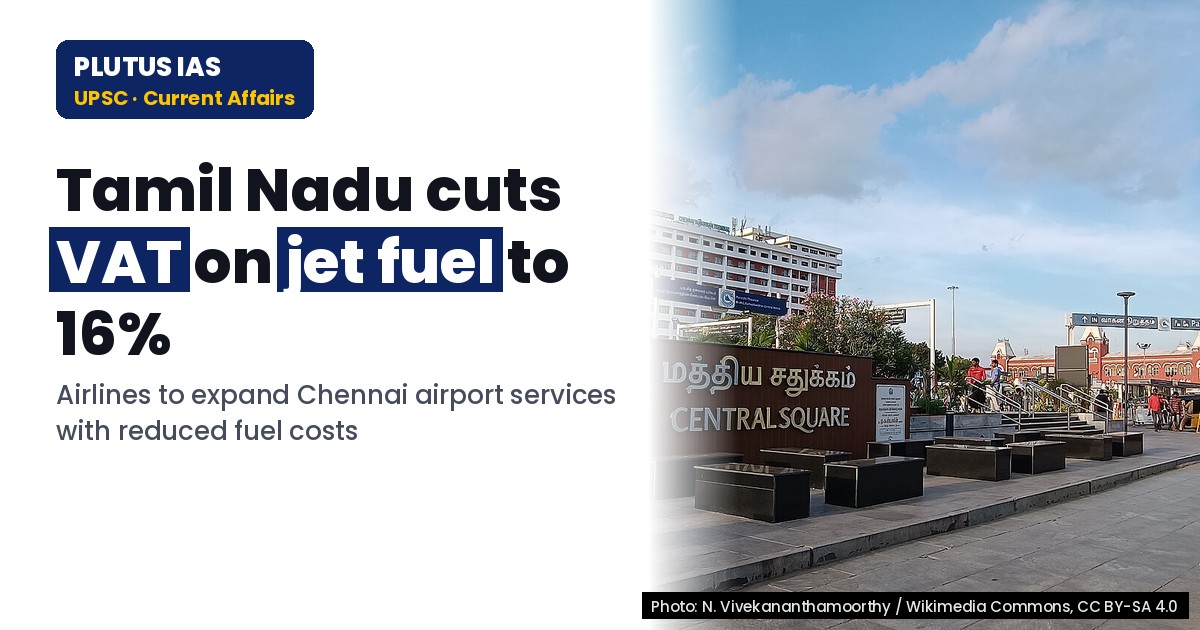
26 Oct Tamil Nadu cuts VAT on jet fuel: How airlines will boost Chennai airport connectivity
✎ Value Added Tax (VAT) on Aviation Turbine Fuel (ATF) is a state-level tax that significantly impacts airline operational costs; rationalising VAT rates can enhance air connectivity and regional economic growth.
Subject Relevance — Where This Topic Fits
- GS Paper II — Government Policies and Interventions for Development in various sectors | GS Paper III — Infrastructure: Energy, Ports, Roads, Airports and Railways | GS Paper III — Indian Economy and issues relating to Planning, Mobilization of Resources
- Prelims: Aviation Turbine Fuel (ATF), Value Added Tax (VAT), Airport Authority of India (AAI), Regional Connectivity Scheme (RCS), Union Budget 2021-22 provisions on ATF taxation
- Essay: The role of fiscal policies in fostering regional economic integration and connectivity, Balancing fiscal federalism and economic growth: The case of state-level taxation in infrastructure sectors
Quick Revision: Value Added Tax (VAT) on Aviation Turbine Fuel (ATF) is a state-level tax that significantly impacts airline operational costs; rationalising VAT rates can enhance air connectivity and regional economic growth.
Why is this in the news?
The Tamil Nadu government’s decision to reduce the Value Added Tax (VAT) on aviation turbine fuel (ATF) from 29% to 16% at Chennai airport has been highlighted as a policy intervention to enhance air connectivity and stimulate economic growth. This measure, coupled with direct engagements between the state government, the Airport Authority of India (AAI), and airline operators, has prompted airlines to commit to expanding flight services from Chennai, including potential new international routes. The development underscores the interplay between state fiscal policies and national aviation infrastructure, particularly in the context of regional economic development and tourism promotion.
Background
- The cost of aviation turbine fuel (ATF) constitutes a significant portion of an airline’s operating expenses, often accounting for 30-40% of total costs, thereby influencing pricing and route viability.
- State governments levy VAT on ATF, which varies across states, creating disparities in operational costs for airlines and affecting air connectivity in different regions.
- The Union Ministry of Civil Aviation and the Airport Authority of India (AAI) have historically advocated for rationalising ATF taxation to improve affordability and expand air travel, aligning with the objectives of the Regional Connectivity Scheme (RCS-UDAN).
- Chennai International Airport, a major hub in South India, serves as a critical node for domestic and international connectivity, particularly for trade and tourism.
- The Regional Connectivity Scheme (RCS-UDAN), launched in 2016, aims to enhance air connectivity to underserved and unserved airports by providing viability gap funding and reducing operational costs for airlines.
- Tamil Nadu’s policy shift reflects a broader trend among states to use fiscal incentives to attract investment and boost infrastructure-led economic growth.
What is Value Added Tax (VAT) on Aviation Turbine Fuel (ATF)?
- VAT on ATF is a state-level tax levied on the sale of aviation turbine fuel, a specialised fuel used by commercial aircraft. Unlike other fuels, ATF is subject to state-specific VAT rates, which vary significantly across India, ranging from 0% to 29%.
- The tax structure on ATF is governed by the Constitution of India, which empowers state governments to levy taxes on the sale or consumption of goods within their jurisdiction, as per Entry 54 of the State List (Seventh Schedule).
- ATF is exempt from the Goods and Services Tax (GST) regime, as it is classified as a ‘declared goods’ under the Constitution, allowing states to retain control over its taxation.
- The high VAT rates on ATF in certain states have been a contentious issue, as they contribute to elevated operational costs for airlines, potentially discouraging the addition of new routes or frequency of flights.
- Airlines often prioritise airports in states with lower VAT rates when planning route expansions, as reduced fuel costs can improve the financial viability of new services.
- The reduction in VAT on ATF by Tamil Nadu from 29% to 16% is expected to lower the cost burden on airlines operating from Chennai International Airport, thereby incentivising the addition of more flights and destinations.
- The policy aligns with the objectives of the National Civil Aviation Policy (NCAP) 2016, which emphasises improving regional connectivity and making air travel more affordable and accessible.
- The decision also reflects the role of state governments in leveraging fiscal policies to support infrastructure development and economic growth, particularly in sectors like aviation that have multiplier effects on tourism and trade.
Key Features
| Feature | Significance |
|---|---|
| Reduction of VAT on ATF from 29% to 16% | Directly lowers operating costs for airlines, enhancing profitability and incentivizing expansion of services from Chennai airport. |
| Assurance of increased flight operations by airlines | Indicates potential growth in air connectivity, tourism, and economic activity in Tamil Nadu. |
| Request for direct international flights (e.g., to Japan) | Signals intent to position Chennai as a regional aviation hub, boosting long-haul connectivity. |
| Collaborative engagement between State Government, AAI, and airlines | Demonstrates multi-stakeholder coordination to address infrastructure and policy bottlenecks. |
| Focus on generating high-value employment | Highlights the linkage between aviation expansion and broader economic development strategies. |
Why it Matters
Economic
- Reduction in ATF VAT directly impacts airline cost structures, potentially lowering airfare prices and increasing passenger affordability.
- Expansion of flight operations from Chennai airport can stimulate tourism, trade, and investment in Tamil Nadu.
- Increased air connectivity may attract business investments, particularly in sectors reliant on rapid intercity and international travel.
- Job creation in aviation, hospitality, and allied sectors is a plausible outcome of enhanced air traffic.
Strategic/Geopolitical
- Strengthening Chennai’s role as a regional aviation hub enhances India’s connectivity with Southeast Asia and East Asia.
- Direct international flights from Chennai could reduce dependence on transit hubs like Dubai or Singapore, improving operational efficiency for airlines.
- Improved air connectivity supports India’s Act East Policy by facilitating smoother trade and people-to-people exchanges.
Policy and Governance
- The State Government’s proactive fiscal policy (VAT reduction) demonstrates the use of taxation as a tool for economic development.
- Coordinated efforts between the State, AAI, and airlines reflect a governance model that prioritizes infrastructure-led growth.
- The move aligns with the Union Government’s UDAN (Ude Desh ka Aam Nagrik) scheme, which aims to enhance regional air connectivity.
Infrastructure
- Expansion of flight operations necessitates evaluation of airport capacity, runway efficiency, and terminal facilities at Chennai airport.
- Improved air connectivity may require upgrades in ground handling, air traffic management, and ancillary services.
Challenges
1. Infrastructure Constraints at Chennai Airport
- Existing runway and terminal capacity may limit the scale of flight operations despite policy incentives.
- Delays in infrastructure upgrades could negate the benefits of VAT reduction, leading to operational bottlenecks.
- Air traffic management challenges may arise with increased flight frequencies, requiring modernisation of ATC systems.
UPSC Link: Airports Authority of India (AAI) Act, 1994
2. Sustainability of Fiscal Incentives
- Long-term revenue losses for the State exchequer due to reduced VAT on ATF may strain fiscal health.
- Dependence on fiscal incentives could create a precedent, encouraging other States to offer similar concessions, leading to a race-to-the-bottom scenario.
- The State must balance short-term gains in connectivity with long-term fiscal prudence.
UPSC Link: Fiscal Responsibility and Budget Management (FRBM) Act
3. Demand Generation and Market Viability
- Expansion of flight operations may not translate into increased passenger traffic without robust demand generation strategies.
- High-value employment generation is critical to sustain air travel demand; without it, the initiative risks underutilisation of capacity.
- Tourism promotion and business facilitation require coordinated efforts beyond aviation policy.
UPSC Link: National Tourism Policy
4. Regulatory and Environmental Concerns
- Increased air traffic may raise environmental concerns, particularly regarding carbon emissions and noise pollution.
- Compliance with international aviation regulations (e.g., ICAO standards) must be ensured to avoid penalties or operational restrictions.
- Balancing economic growth with environmental sustainability remains a key challenge.
UPSC Link: Environment Protection Act, 1986
5. Competition with Other Airports
- Chennai airport may face competition from other major airports (e.g., Delhi, Mumbai, Bengaluru) in attracting airlines and passengers.
- Differentiation through service quality, connectivity, and infrastructure upgrades is essential to maintain competitiveness.
- Regional airports in Tamil Nadu (e.g., Coimbatore, Madurai) may also vie for airline attention, necessitating a state-wide aviation strategy.
UPSC Link: Airports Economic Regulatory Authority (AERA) Act, 2008
Challenges — UPSC Perspective
| Issue | Concern |
|---|---|
| Infrastructure Capacity | Existing runway and terminal limitations may hinder the scale of flight operations despite policy incentives. |
| Fiscal Sustainability | Long-term revenue losses due to reduced VAT on ATF may strain the State’s fiscal health. |
| Demand Generation | Without robust employment and tourism strategies, increased flight operations may not translate into passenger traffic. |
| Environmental Impact | Higher air traffic could exacerbate carbon emissions and noise pollution, requiring mitigation measures. |
| Regulatory Compliance | Ensuring adherence to international aviation standards (e.g., ICAO) is critical to avoid operational restrictions. |
Way Forward
- Conduct a comprehensive capacity assessment of Chennai airport to identify infrastructure bottlenecks and prioritise upgrades.
- Develop a state-wide aviation policy that integrates connectivity goals with infrastructure development and fiscal sustainability.
- Launch targeted employment generation programs in sectors aligned with aviation growth (e.g., hospitality, logistics, MRO).
- Enhance tourism promotion through partnerships with airlines to offer bundled packages and incentives for international visitors.
- Establish a monitoring mechanism to track the impact of VAT reduction on flight operations, passenger traffic, and economic indicators.
- Collaborate with the Ministry of Civil Aviation to align State-level initiatives with national aviation policies (e.g., UDAN scheme).
- Implement environmental safeguards, such as carbon offset programs and noise reduction measures, to address sustainability concerns.
- Explore public-private partnerships (PPPs) for infrastructure development to leverage private sector expertise and funding.
UPSC Value Addition
Keywords for Mains Answer-Writing
Aviation Turbine Fuel (ATF) · Value Added Tax (VAT) · air connectivity · Chennai International Airport · aerodrome economics · regional connectivity · Ministry of Civil Aviation · Airports Authority of India (AAI) · aeronautical tariffs · multi-modal transport integration · state fiscal policy · tourism infrastructure · economic corridors · public-private partnership (PPP) in aviation · airline operating costs
Constitutional & Policy Linkages
- [‘Article 246 – Distribution of Legislative Powers (State List – Entry 29: Taxes on the sale or purchase of goods).’, ‘The State Government’s authority to levy VAT on ATF falls under the State List of the Seventh Schedule.’]
- [‘Article 262 – Adjudication of Inter-State Water Disputes (analogous for inter-State coordination in aviation).’, ‘Facilitates cooperation between States on matters affecting aviation infrastructure and connectivity.’]
Concept Flow
State Government identifies aviation connectivity as a growth driver for Tamil Nadu’s economy. → High VAT on ATF is identified as a key cost barrier for airlines operating from Chennai airport. → State Government reduces VAT on ATF from 29% to 16%, lowering operational costs for airlines. → Airlines respond positively, assuring expansion of flight operations and new route additions. → Increased flight operations stimulate demand for tourism, trade, and employment in Tamil Nadu. → Infrastructure constraints at Chennai airport and fiscal sustainability concerns emerge as challenges. → Government and stakeholders collaborate to address bottlenecks through capacity upgrades, demand generation, and regulatory compliance.
Prelims Practice Questions
Q1. Consider the following statements regarding Aviation Turbine Fuel (ATF) in India:
1. ATF is classified as a petroleum product under the Petroleum and Natural Gas Regulatory Board (PNGRB) Act, 2006.
2. The pricing of ATF in India is determined by the Ministry of Petroleum and Natural Gas in consultation with the Ministry of Civil Aviation.
3. The VAT on ATF is levied by state governments and can vary across different airports in India.
4. The reduction in VAT on ATF directly leads to a proportional decrease in airline ticket prices for passengers.
How many of the above statements are correct?
- Only one
- Only two
- Only three
- All four
Answer: Only three — Statements 1 and 3 are correct. ATF is regulated under the PNGRB Act, and VAT on ATF is a state subject, leading to variations. Statement 2 is incorrect because ATF pricing is market-determined, not centrally fixed by the Ministry of Petroleum and Natural Gas. Statement 4 is incorrect because the reduction in VAT on ATF does not directly translate to proportional ticket price reductions due to other cost components in airline operations.
Q2. Assertion (A): The Airports Authority of India (AAI) is the sole authority responsible for the levy of Value Added Tax (VAT) on Aviation Turbine Fuel (ATF) at Indian airports.
Reason (R): VAT on ATF is a state subject, and the AAI does not have the constitutional authority to levy taxes.
- Both A and R are true, and R is the correct explanation of A
- Both A and R are true, but R is NOT the correct explanation of A
- A is true, but R is false
- A is false, but R is true
Answer: ? — Assertion (A) is false because the levy of VAT on ATF is a state subject under the Constitution of India (State List, Seventh Schedule), and the Airports Authority of India (AAI) does not levy taxes. Reason (R) is true as VAT is indeed a state subject, and the AAI’s role is limited to airport management and tariff regulation, not taxation.
Q3. Match the following pairs related to aviation infrastructure in India:
Column I (Institution/Body)
A. Airports Authority of India (AAI)
B. Ministry of Civil Aviation (MoCA)
C. Directorate General of Civil Aviation (DGCA)
D. Bureau of Civil Aviation Security (BCAS)
Column II (Function)
1. Regulates air transport services and enforces civil aviation standards
2. Manages and develops civil aviation infrastructure in India
3. Ensures security standards at airports and in civil aviation
4. Formulates national policies and programmes for the development of civil aviation
Select the correct match:
- A-2, B-4, C-1, D-3
- A-1, B-3, C-2, D-4
- A-3, B-2, C-4, D-1
- A-4, B-1, C-3, D-2
Answer: A-2, B-4, C-1, D-3 — The correct matches are: A (AAI) – 2 (Manages and develops civil aviation infrastructure), B (MoCA) – 4 (Formulates national policies), C (DGCA) – 1 (Regulates air transport services), and D (BCAS) – 3 (Ensures security standards).
Mains Practice Question
✍ The reduction in Value Added Tax (VAT) on Aviation Turbine Fuel (ATF) by state governments can significantly influence air connectivity and regional economic integration. Critically examine the rationale behind such fiscal interventions and their broader implications for India’s aviation sector and economy. (15 Marks)
Approach: MODEL-ANSWER SKELETON:
1. **Rationale for VAT reduction**:
– ATF constitutes 30–40% of airline operating costs; high VAT inflates costs, reducing profitability and limiting route expansion.
– State governments use fiscal policy to attract airlines, enhance airport utilisation, and stimulate tourism and trade (e.g., Tamil Nadu’s reduction from 29% to 16%).
– Aligns with the Ministry of Civil Aviation’s Regional Connectivity Scheme (RCS-UDAN) to improve air connectivity in underserved regions.
2. **Broader implications**:
– **Economic**: Boosts GDP via tourism, trade, and job creation (e.g., airport-based employment, ancillary industries).
– **Aerodrome economics**: Higher passenger traffic increases non-aeronautical revenue for airports (e.g., retail, parking), improving financial sustainability.
– **Environmental trade-offs**: Increased flights may raise carbon emissions, requiring balanced policy with sustainable aviation fuel (SAF) incentives.
3. **Challenges and limitations**:
– **Revenue loss for states**: VAT reduction reduces state tax collections; requires compensatory mechanisms or broader tax base expansion.
– **Inequitable benefits**: Larger airports (e.g., Delhi, Mumbai) may gain disproportionately, exacerbating regional disparities.
– **Market distortions**: Airlines may prioritise routes with lower operational costs, neglecting socially necessary but commercially unviable routes.
4. **Policy alternatives**:
– **Cross-subsidisation**: Use non-aeronautical revenue (e.g., land monetisation) to offset VAT reductions.
– **PPP models**: Leverage private investment in airport infrastructure to reduce fiscal burden on states.
– **SAF incentives**: Pair VAT reductions with subsidies for sustainable aviation fuel to mitigate environmental impact.
5. **Conclusion**: VAT reduction is a pragmatic short-term tool but must be part of a holistic aviation policy integrating fiscal, environmental, and social objectives.
Source: The Hindu
Tamil Nadu PCS (TNPSC) — State PCS Practice
Prelims: Which of the following is the primary reason cited by the Tamil Nadu government for slashing VAT on jet fuel and requesting airlines to enhance services from Chennai International Airport?
- To boost tourism and economic growth in Tamil Nadu
- To reduce operational costs for airlines and attract more international flights
- To comply with the directives of the central government on aviation policies
- To address the shortage of jet fuel in neighboring states
Answer: To reduce operational costs for airlines and attract more international flights — The Tamil Nadu government aimed to reduce operational costs for airlines by lowering VAT on jet fuel, thereby encouraging them to add more services from Chennai airport.
Mains: Examine the potential economic and social benefits that Tamil Nadu could derive from the decision to slash VAT on jet fuel and the subsequent request to airlines to enhance services from Chennai International Airport. Provide a critical analysis of the challenges that may arise in implementing this policy.
Generated by AanyaAi for educational purpose.
Related guides on our sites
- UPSC EPFO syllabus
- Best economics optional coaching for upsc
- Best economics optional teacher for upsc
- Gs Paper 1 Syllabus

- सेबी के नए निपटान विनियम, 2026: मुख्य प्रावधान और प्रभाव - November 8, 2026
- NCST Seeks Report on Nisha Bhagat’s Death in Jharkhand - November 8, 2026
- भारतीय AI स्टार्टअप्स के मूल्यांकन पर वैश्विक तकनीकी शेयरों में गिरावट का प्रभाव - November 8, 2026

No Comments