


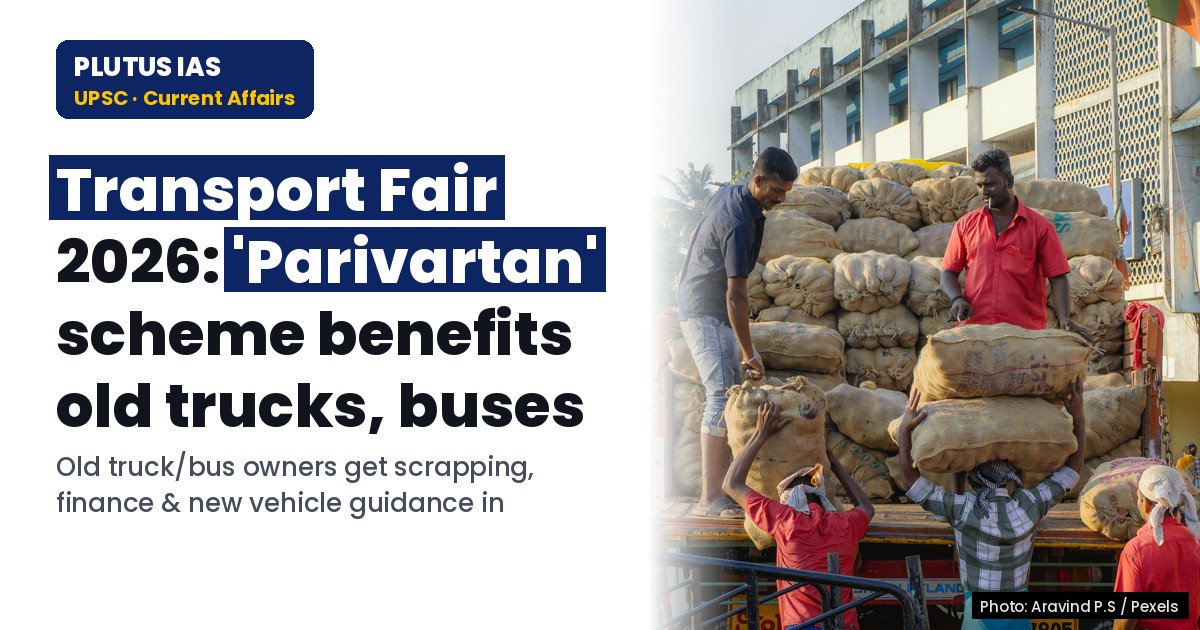
26 Oct UPSC Alert: Transport Fair on ‘Parivartan’ Scheme for Truck Owners in Delhi-NCR
✎ The ‘Parivartan’ Scheme is a voluntary, incentive-driven programme under the VVMP framework, operationalised through Transport Melas, to modernise Delhi-NCR’s commercial vehicle fleet by replacing older, polluting vehicles with…
Subject Relevance — Where This Topic Fits
- GS Paper II — Governance, Transparency and Administrative Mechanisms | GS Paper III — Environment, Transport Infrastructure and Fiscal Incentives
- Prelims: Vehicle Scrapping Policy, Voluntary Vehicle-Fleet Modernisation Programme, Road Tax Exemption, FAME India Scheme, Vehicular Emission Norms, RTO and DTO functions, OEM incentives, NBFC and banking finance
- Essay: Role of public-private partnerships in environmental governance, Balancing economic growth with environmental sustainability in urban transport
Quick Revision: The ‘Parivartan’ Scheme is a voluntary, incentive-driven programme under the VVMP framework, operationalised through Transport Melas, to modernise Delhi-NCR’s commercial vehicle fleet by replacing older, polluting vehicles with newer, cleaner alternatives using fiscal, financial, and technological incentives.
Why is this in the news?
The Ministry of Road Transport and Highways (MoRTH), in collaboration with the Government of Delhi, is organising a Transport Mela under the ‘Parivartan’ Scheme on 28 October 2026 in Burari, Delhi-NCR. This event is designed to provide on-the-spot guidance to owners of old commercial vehicles—primarily trucks and buses—on scrapping, financing, and purchasing newer, more environmentally compliant vehicles, integrating multiple stakeholders including manufacturers, financiers, and fuel providers in a single platform.
Background
- The National Green Tribunal (NGT) and Supreme Court of India have, through successive orders since 2015, directed phased phasing out of old commercial vehicles in Delhi-NCR to reduce vehicular pollution.
- The Voluntary Vehicle-Fleet Modernisation Programme (VVMP) was announced in the Union Budget 2021-22 and notified in August 2021 to incentivise voluntary scrapping of older vehicles and replacement with newer, cleaner ones.
- The ‘Parivartan’ Scheme is an operational extension of the VVMP, tailored for the Delhi-NCR region, integrating financial, fiscal, and technological incentives.
- The scheme aligns with the National Clean Air Programme (NCAP) targets for reducing particulate matter and nitrogen oxides in the region.
- The Delhi government has designated specific Vehicle Scrapping Facilities (VSFs) under the Registered Vehicle Scrapping Facility (RVSF) scheme to ensure compliance with environmental and safety standards.
- The scheme leverages the FAME India Phase-II subsidy framework for electric vehicles to promote zero-emission commercial transport.
What is the ‘Parivartan’ Scheme and the Transport Mela?
- The ‘Parivartan’ Scheme is a state-specific implementation of the national Voluntary Vehicle-Fleet Modernisation Programme (VVMP) in Delhi-NCR, aimed at reducing vehicular pollution by accelerating the replacement of older, high-emission commercial vehicles with newer, cleaner alternatives.
- The scheme provides a suite of fiscal and financial incentives including: (a) manufacturer’s discounts of at least 8%, (b) 5% interest subsidy on vehicle loans, (c) 100% road tax exemption for 10 years, (d) one-time benefits for electric vehicles, (e) monthly fuel vouchers, and (f) exemption from registration fees where applicable.
- The Transport Mela is a one-day outreach event where stakeholders—Original Equipment Manufacturers (OEMs), dealers, registered vehicle scrapping facilities (RVSFs), banks, non-banking financial companies (NBFCs), oil marketing companies (OMCs), and city gas distributors (CGDs)—converge at a designated Vehicle Inspection Unit (VIU) in Burari to offer on-the-spot services and guidance to vehicle owners.
- The event facilitates end-to-end solutions: vehicle owners can register for scrapping, obtain financing options, explore new vehicle purchases (including electric variants), and avail fuel-related benefits in a single location.
- The scheme is voluntary and incentivised, ensuring no coercive measures, thereby encouraging participation from the transport community while aligning with environmental objectives.
- As of the date of the press release, approximately 40,000 beneficiaries have registered on the Parivartan portal, indicating early traction in the scheme’s adoption.
- The scheme is implemented under the administrative oversight of the Ministry of Road Transport and Highways (MoRTH) in coordination with state transport authorities and municipal bodies in Delhi-NCR.
Key Features
| Feature | Significance |
|---|---|
| One-stop platform for stakeholders | Integrates OEMs, dealers, scrap facilities, banks, NBFCs, OMCs, and CGD entities to streamline decision-making for vehicle owners. |
| Multi-modal incentives | Combines purchase discounts, interest subsidies, tax exemptions, fuel vouchers, and registration fee waivers to enhance affordability. |
| Digital registration tracking | 40,000+ beneficiaries registered on the *Parivartan* portal, enabling real-time monitoring of scheme uptake. |
| Environmental compliance focus | Targets replacement of older, high-emission trucks and buses with BS-VI, CNG, or electric variants to reduce vehicular pollution in Delhi-NCR. |
| Localised outreach mechanism | Conducted at a designated Vehicle Inspection Unit in Burari, Delhi, ensuring accessibility for transport operators in the region. |
Why it Matters
Environmental Governance
- Directly advances the National Clean Air Programme (NCAP) by accelerating the phasing-out of older, polluting commercial vehicles in a high-emission zone (Delhi-NCR).
- Aligns with the Bharat Stage VI emission norms by incentivising the adoption of compliant vehicles, thereby reducing NOx, PM, and CO2 emissions.
- Supports India’s Nationally Determined Contributions (NDCs) under the Paris Agreement by curbing vehicular emissions in one of the most polluted urban agglomerations globally.
Economic Policy
- Stimulates demand in the automobile sector by offering purchase incentives, thereby supporting manufacturing, employment, and ancillary industries in the transport ecosystem.
- Reduces the financial burden on transport operators through subsidised loans, tax exemptions, and fuel vouchers, enhancing liquidity in the commercial transport segment.
- Promotes the circular economy via vehicle scrapping policies, generating raw material inputs for metal recycling industries while reducing import dependence for steel and aluminium.
Urban Governance
- Integrates transport policy with urban planning by addressing vehicular congestion and air quality in a rapidly urbanising region (Delhi-NCR).
- Demonstrates a multi-stakeholder governance model, combining central and state agencies (MoRTH, Delhi Government) with private sector actors (OEMs, banks, OMCs).
Technology and Innovation
- Encourages the adoption of cleaner technologies (CNG, electric) in heavy-duty transport, fostering innovation in battery storage, charging infrastructure, and alternative fuels.
- Leverages digital platforms (Parivartan portal) for real-time tracking of incentives, reducing bureaucratic delays and enhancing transparency.
Challenges
1. Implementation Bottlenecks
- Coordination challenges among multiple stakeholders (OEMs, scrap facilities, banks) may delay service delivery despite the one-stop platform.
- Awareness gaps among transport operators regarding eligibility criteria, incentive structures, and procedural requirements for vehicle replacement.
- Logistical hurdles in transporting older vehicles to registered scrap facilities, particularly for operators with limited fleet mobility.
UPSC Link: GS-III: Infrastructure – Transport
2. Financial Viability
- Sustainability of interest subsidies and tax exemptions hinges on budgetary allocations, which may face fiscal constraints in subsequent fiscal years.
- Risk of market distortion if incentives are perceived as excessive, potentially crowding out private investment in vehicle financing or scrapping infrastructure.
UPSC Link: GS-III: Economic Development
3. Environmental Trade-offs
- Limited availability of CNG/electric alternatives for heavy-duty transport in certain segments may constrain the scheme’s effectiveness in achieving emission reduction targets.
- Potential rebound effect where increased vehicle utilisation (due to lower operating costs) offsets emission gains from newer vehicles.
UPSC Link: GS-III: Environment
4. Regulatory Compliance
- Enforcement of scrapping mandates requires robust monitoring mechanisms to prevent circumvention (e.g., re-registration of older vehicles in non-NCR states).
- Alignment with state-level regulations (e.g., Delhi’s air quality control measures) may necessitate periodic policy adjustments.
UPSC Link: GS-II: Government Policies
5. Social Equity
- Small transport operators may face barriers to accessing incentives due to limited bargaining power with banks or OEMs, exacerbating market concentration.
- Displacement risks for informal sector workers (e.g., scrap dealers) if formalisation of the scrapping industry accelerates without adequate safeguards.
UPSC Link: GS-II: Welfare Schemes
Challenges — UPSC Perspective
| Issue | Concern |
|---|---|
| Stakeholder coordination | Delays in service delivery due to fragmented roles among OEMs, banks, and scrap facilities. |
| Awareness deficit | Low uptake among transport operators due to lack of clarity on eligibility and procedural steps. |
| Fiscal sustainability | Long-term viability of subsidies and tax exemptions amid competing budgetary priorities. |
| Technology availability | Limited supply of BS-VI/CNG/electric alternatives for heavy-duty transport segments. |
| Enforcement gaps | Risk of older vehicles being re-registered or sold outside NCR to bypass scrapping mandates. |
| Informal sector impact | Potential job losses in informal scrapping networks without formalisation and reskilling support. |
Way Forward
- Strengthen inter-departmental coordination (MoRTH, Delhi Government, state transport authorities) to streamline incentive disbursal and monitoring.
- Expand digital literacy campaigns via transport associations, unions, and local bodies to enhance beneficiary awareness and participation.
- Incentivise OEMs to expand the availability of BS-VI, CNG, and electric variants for heavy-duty transport through production-linked incentives.
- Develop a grievance redressal mechanism on the Parivartan portal to address delays or disputes in incentive claims.
- Pilot a vehicle buyback programme for operators with older fleets to accelerate scrapping while providing immediate financial relief.
- Collaborate with financial institutions to design low-interest loan products tailored for transport operators, including microfinance options.
- Establish regional scrapping hubs in NCR to reduce logistical costs and improve accessibility for transport operators.
- Monitor air quality and fleet composition data post-implementation to assess the scheme’s impact on emissions and adjust policies accordingly.
UPSC Value Addition
Keywords for Mains Answer-Writing
Vehicle Scrappage Policy · National Green Transport Mission · Delhi-NCR air quality · Fiscal incentives for green transport · Vehicle Scrappage Policy 2021 · Road tax exemption · Interest subsidy on vehicle loans · Electric vehicle adoption · Bharat Stage emission norms · Circular economy in transport sector · National Capital Region transport policy · Fuel vouchers for commercial vehicles · Vehicle Inspection Units · Urban transport decarbonisation · Government incentives for commercial vehicle replacement
Constitutional & Policy Linkages
- [‘Article 21 (Right to Life)’, ‘Environmental protection as part of life and personal liberty.’]
- [‘Article 48A (Directive Principles)’, ‘Protection and improvement of environment and safeguarding forests and wildlife.’]
Concept Flow
High vehicular emissions in Delhi-NCR → Policy response: *Parivartan* scheme → Incentives for scrapping older vehicles → Adoption of BS-VI/CNG/electric alternatives → Reduction in NOx/PM emissions → Alignment with NCAP and Paris Agreement targets. → Fiscal incentives (subsidies, tax exemptions) → Lower cost of compliance for transport operators → Increased uptake of cleaner vehicles → Expansion of secondary markets (scrap metal, alternative fuels) → Economic stimulus in automobile and recycling sectors. → Digital registration (Parivartan portal) → Real-time tracking of beneficiaries → Transparency in incentive disbursal → Reduced bureaucratic delays → Enhanced trust in government schemes. → Multi-stakeholder engagement (OEMs, banks, scrap facilities) → Integrated service delivery → Simplified decision-making for vehicle owners → Accelerated fleet modernisation → Improved urban air quality. → Regulatory enforcement (scrapping mandates) → Phasing out of older vehicles → Compliance with Bharat Stage VI norms → Alignment with global emission standards → Contribution to India’s climate commitments.
Prelims Practice Questions
Q1. Consider the following statements regarding the ‘Parivartan’ scheme launched by the Ministry of Road Transport and Highways:
1. The scheme provides a 5% interest subsidy on vehicle loans for the purchase of new commercial vehicles.
2. It mandates the replacement of all old trucks and buses in Delhi-NCR with electric vehicles only.
3. The scheme offers 100% road tax exemption for a period of 10 years for eligible vehicles.
How many of the above statements are correct?
- Only one
- Only two
- All three
- None
Answer: Only two — Statement 1 is correct: the scheme provides a 5% interest subsidy on vehicle loans. Statement 2 is incorrect: the scheme promotes more environment-friendly vehicles, not exclusively electric vehicles. Statement 3 is correct: 100% road tax exemption is provided for 10 years.
Q2. Assertion (A): The ‘Parivartan’ scheme is designed to address air pollution in Delhi-NCR by incentivizing the replacement of older commercial vehicles.
Reason (R): The scheme offers fiscal incentives such as additional discounts, interest subsidies, and road tax exemptions to promote the adoption of newer, cleaner vehicles.
Options:
A. Both A and R are true, and R is the correct explanation of A.
B. Both A and R are true, but R is not the correct explanation of A.
C. A is true, but R is false.
D. A is false, but R is true.
- A
- B
- C
- D
Answer: A — Both Assertion (A) and Reason (R) are true, and Reason (R) correctly explains Assertion (A). The scheme’s primary objective is to reduce vehicular emissions in Delhi-NCR by incentivizing the replacement of older vehicles with newer, cleaner ones through fiscal measures.
Q3. Match the following incentives provided under the ‘Parivartan’ scheme with their respective details:
Column I (Incentive) Column II (Detail)
1. Additional discount A. 5% interest subsidy on vehicle loans
2. Road tax exemption B. 100% exemption for 10 years
3. Interest subsidy C. Minimum 8% additional discount on new vehicle purchase
4. One-time benefit for electric vehicles D. One-time financial incentive for EV purchase
Options:
A. 1-C, 2-B, 3-A, 4-D
B. 1-A, 2-B, 3-C, 4-D
C. 1-D, 2-A, 3-B, 3-C
D. 1-B, 2-C, 3-D, 4-A
- A
- B
- C
- D
Answer: A — The correct match is: 1-C (Additional discount: minimum 8%), 2-B (Road tax exemption: 100% for 10 years), 3-A (Interest subsidy: 5%), 4-D (One-time benefit for electric vehicles).
Mains Practice Question
✍ The Government of India, through the ‘Parivartan’ scheme, is promoting the replacement of older commercial vehicles with newer, more environment-friendly alternatives in the Delhi-NCR region. Critically examine the policy instruments employed under this scheme and assess their effectiveness in achieving the stated objectives of reducing vehicular emissions and improving air quality. (15 Marks)
Approach: MODEL-ANSWER SKELETON:
1. **Introduction (2 Marks)**
– Briefly introduce the ‘Parivartan’ scheme, its launch context (Delhi-NCR air quality concerns), and its alignment with the National Green Transport Mission and Vehicle Scrappage Policy 2021.
– Mention the scheme’s primary objective: reducing vehicular emissions by incentivizing the replacement of older, polluting commercial vehicles (trucks and buses) with newer, cleaner alternatives.
2. **Policy Instruments and Incentives (5 Marks)**
– **Fiscal Incentives**:
– Additional discounts (minimum 8%) on new vehicle purchases from OEMs.
– 5% interest subsidy on vehicle loans for new purchases.
– 100% road tax exemption for 10 years.
– One-time lump-sum benefits for electric vehicle (EV) purchases.
– Monthly fuel vouchers for eligible vehicles.
– **Regulatory and Procedural Support**:
– Establishment of Vehicle Inspection Units (VIUs) and coordination with District Transport Offices (DTOs) for streamlined processes.
– Integration of stakeholders (OEMs, dealers, registered vehicle scrapping facilities, banks, NBFCs, oil marketing companies) in ‘Transport Melas’ for real-time guidance.
– **Environmental Compliance**:
– Alignment with Bharat Stage (BS) emission norms (e.g., BS-VI for diesel vehicles).
– Promotion of electric and CNG vehicles as alternatives.
3. **Effectiveness and Challenges (5 Marks)**
– **Strengths**:
– Direct fiscal incentives reduce the financial burden on vehicle owners, making the transition economically viable.
– Multi-stakeholder engagement (e.g., Transport Melas) ensures ease of access to information and services.
– Addresses both supply-side (vehicle replacement) and demand-side (fuel efficiency, emissions) aspects.
– Aligns with broader national goals such as decarbonization and circular economy principles.
– **Challenges and Limitations**:
– **Affordability**: Despite subsidies, the upfront cost of new vehicles may still be prohibitive for small operators.
– **Infrastructure Gaps**: Limited availability of charging infrastructure for EVs and CNG refueling stations in certain areas.
– **Awareness and Outreach**: Despite 40,000 registrations, awareness levels may still be low among marginalized vehicle owners.
– **Regulatory Enforcement**: Ensuring strict compliance with scrappage norms and emission standards post-replacement.
– **Equity Concerns**: Potential disproportionate impact on smaller operators compared to large fleet owners.
4. **Comparative Perspective and Way Forward (3 Marks)**
– Compare with similar schemes in other countries (e.g., European Union’s vehicle scrappage programs, China’s ‘old for new’ policy).
– Suggest measures to enhance effectiveness:
– Expand the scope of incentives (e.g., higher subsidies for EVs, extended road tax exemptions).
– Strengthen infrastructure for alternative fuels (EV charging, CNG stations).
– Improve last-mile connectivity in Transport Melas to reach rural and semi-urban areas.
– Integrate with other urban transport policies (e.g., metro expansion, last-mile connectivity solutions).
– Monitor and evaluate outcomes through real-time data on emissions reduction and air quality improvements.
Source: PIB (Press Information Bureau)
Generated by AanyaAi for educational purpose.
Related guides on our sites
- Best PSIR optional coaching in delhi for UPSC
- Best PSIR optional coaching for upsc
- Best PSIR optional teacher for upsc
- Best teacher of PSIR optional for upsc

- NAMASTE Scheme: Enhancing Sanitation Workers’ Livelihoods & Safety - November 14, 2026
- एमएसएमई का विशेष अभियान 6.0: स्वच्छता और लंबित मामलों का निपटारा - November 14, 2026
- Sea Vigil-26: Coastal Defence Drills Off Visakhapatnam - November 14, 2026

No Comments