


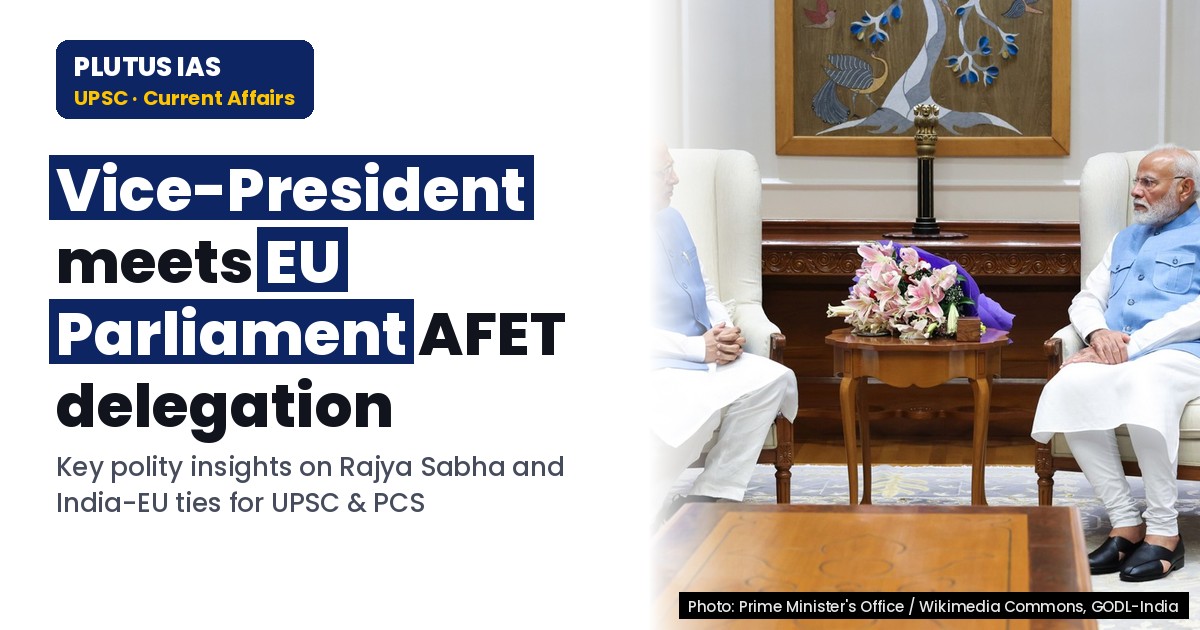
28 Oct Vice-President Meets EU Parliament AFET: Key Polity Insights for UPSC & PCS
✎ The Vice-President of India’s engagement with the European Parliament’s AFET committee exemplifies the role of parliamentary diplomacy in strengthening India-EU relations through institutional dialogue and mutual understanding.
Subject Relevance — Where This Topic Fits
- GS Paper II — International Relations — India and its Neighbourhood, Bilateral, Regional and Global Groupings and Agreements involving India and/or affecting India’s interests | GS Paper II — International Relations — Effect of Policies and Politics of Developed and Developing Countries on India’s interests
- Prelims: Vice-President of India, Rajya Sabha, European Parliament, AFET (Committee on Foreign Affairs, European Parliament), Institutional diplomacy, Parliamentary diplomacy, India-EU strategic partnership
- Essay: The evolving architecture of parliamentary diplomacy in shaping India’s global engagements, Institutional diplomacy as a tool for soft power projection in the 21st century
Quick Revision: The Vice-President of India’s engagement with the European Parliament’s AFET committee exemplifies the role of parliamentary diplomacy in strengthening India-EU relations through institutional dialogue and mutual understanding.
Why is this in the news?
The meeting between the Vice-President of India and Chairman of the Rajya Sabha, Shri C. P. Radhakrishnan, with a delegation of the European Parliament’s Committee on Foreign Affairs (AFET) is significant as it underscores the role of parliamentary diplomacy in strengthening India-EU relations. This engagement, held in the context of evolving geopolitical dynamics, provides a platform for high-level dialogue on shared strategic interests, including trade, climate action, and regional stability, thereby highlighting the institutional mechanisms that facilitate India’s engagements with multilateral parliamentary bodies.
Background
- The European Parliament’s Committee on Foreign Affairs (AFET) is a standing committee responsible for the European Union’s foreign policy, including relations with third countries, multilateral institutions, and human rights issues.
- India-EU relations have historically been anchored in dialogue mechanisms such as the India-EU Summit, the Joint Action Plan, and sectoral dialogues, with parliamentary exchanges serving as a supplementary channel for fostering mutual understanding.
- The Vice-President of India, as ex-officio Chairman of the Rajya Sabha, plays a pivotal role in parliamentary diplomacy, representing India in international parliamentary forums and facilitating high-level exchanges with counterparts from other nations.
- The meeting assumes importance against the backdrop of recent global challenges, including geopolitical tensions, supply chain disruptions, and the need for collaborative approaches to climate change and sustainable development.
- India’s engagement with the European Union is guided by the India-EU Strategic Partnership, which was established in 2004, aiming to enhance cooperation in trade, technology, climate, and security.
- Parliamentary diplomacy, as a subset of public diplomacy, complements traditional state-to-state diplomacy by fostering people-to-people ties and promoting mutual trust through institutional interactions.
What is the Committee on Foreign Affairs (AFET) of the European Parliament?
- The Committee on Foreign Affairs (AFET) is one of the standing committees of the European Parliament, tasked with overseeing the EU’s foreign policy, including relations with non-EU countries, international organisations, and human rights issues.
- AFET plays a critical role in shaping the European Parliament’s positions on international affairs, including trade agreements, sanctions, and humanitarian interventions, through reports, resolutions, and legislative initiatives.
- The committee is composed of Members of the European Parliament (MEPs) elected from across EU member states, with its chairperson and vice-chairs elected from among its members to lead its work.
- AFET’s mandate includes scrutinising the European Commission’s and European External Action Service’s (EEAS) policies, ensuring democratic oversight of the EU’s external actions, and fostering dialogue with third-country parliaments and institutions.
- The committee is instrumental in advancing the EU’s strategic interests, including its Indo-Pacific strategy, neighbourhood policy, and engagement with emerging powers like India, China, and the United States.
- AFET’s work is complemented by other parliamentary committees, such as the Subcommittee on Human Rights (DROI) and the Subcommittee on Security and Defence (SEDE), which address specific aspects of the EU’s external relations.
- The committee’s reports and resolutions often serve as inputs for the European Parliament’s plenary sessions, where they are debated and voted upon, thereby influencing the EU’s foreign policy trajectory.
Key Features
| Feature | Significance |
|---|---|
| Bilateral meeting between the Vice-President of India and the European Parliament’s AFET delegation | Facilitates diplomatic engagement on shared geopolitical, economic, and strategic interests, enhancing India-EU parliamentary cooperation. |
| Focus on foreign affairs and parliamentary diplomacy | Reinforces the role of the Rajya Sabha in international relations, aligning with constitutional provisions for inter-parliamentary exchanges under Article 266(2). |
| Exchange of views on global challenges | Provides a platform for discussing issues such as climate change, trade, security, and multilateral governance, fostering mutual understanding. |
| Institutional representation by the Rajya Sabha Chairman | Demonstrates the constitutional function of the Vice-President as the ex-officio Chairman of the Rajya Sabha in facilitating inter-parliamentary engagements. |
Why it Matters
Diplomatic and Strategic
- Strengthens India’s engagement with the European Union, a key strategic partner, through parliamentary channels, complementing executive-level diplomacy.
- Enhances India’s voice in global governance forums by leveraging the Rajya Sabha’s role in foreign policy discourse.
- Facilitates alignment on shared priorities such as sustainable development, climate action, and multilateral reform.
- Provides a structured mechanism for addressing trade, technology, and security concerns between India and the EU.
Parliamentary and Constitutional
- Reaffirms the constitutional role of the Vice-President as Chairman of the Rajya Sabha in fostering inter-parliamentary relations, as envisaged under Article 64 and Article 89(1) of the Constitution.
- Demonstrates the Rajya Sabha’s function as a platform for international engagement, distinct from the Lok Sabha’s primary role in financial legislation.
- Highlights the importance of parliamentary diplomacy in supplementing executive-led foreign policy, particularly in multilateral contexts.
- Showcases the institutional capacity of the Rajya Sabha to engage with foreign legislative bodies, reinforcing India’s democratic credentials.
Geopolitical and Economic
- Serves as a precursor to potential agreements or frameworks in trade, technology transfer, and climate finance between India and the EU.
- Provides an opportunity to address non-tariff barriers and regulatory harmonisation in sectors critical to both economies.
- Reinforces India’s position in the Indo-Pacific and global supply chains, particularly in critical minerals and green technology.
Challenges
1. Divergent Policy Priorities
- Potential divergence between India’s strategic autonomy stance and the EU’s emphasis on human rights and regulatory alignment in trade agreements.
- Differences in climate action timelines and commitments, particularly in carbon border taxes and green transition pathways.
UPSC Link: GS II: Bilateral Groupings
2. Institutional Coordination Gaps
- Ensuring seamless coordination between the executive and parliamentary branches in framing and executing foreign policy engagements.
- Balancing the Rajya Sabha’s role in diplomacy with its primary legislative functions under the Constitution.
UPSC Link: GS II: Parliament
3. Geopolitical Constraints
- Navigating the complexities of India-EU relations amid global power shifts, including the Russia-Ukraine conflict and China’s rise.
- Addressing sensitivities in areas such as defence cooperation and technology transfer, given the EU’s cautious approach.
UPSC Link: GS II: International Relations
4. Domestic Political Perceptions
- Managing domestic political narratives that may frame international engagements through partisan lenses, despite constitutional neutrality.
- Ensuring that parliamentary diplomacy does not become a tool for electoral posturing.
UPSC Link: GS II: Parliament
Challenges — UPSC Perspective
| Issue | Concern |
|---|---|
| Trade and Regulatory Alignment | Differences in standards, tariffs, and non-tariff barriers may impede economic cooperation. |
| Climate Policy Coordination | Mismatch in decarbonisation timelines and carbon pricing mechanisms could create trade friction. |
| Technology Transfer Restrictions | EU’s export controls and India’s strategic autonomy priorities may clash in critical sectors. |
| Multilateral Governance Reforms | Divergent views on UN Security Council expansion and WTO reforms may limit joint advocacy. |
| Public Diplomacy Narratives | Domestic and international perceptions may skew the framing of bilateral engagements. |
Way Forward
- Institutionalise regular parliamentary exchanges between the Rajya Sabha and the European Parliament’s AFET to sustain diplomatic momentum.
- Establish a joint working group comprising members of the Rajya Sabha and AFET to address specific issues such as trade, climate, and technology.
- Enhance coordination between the Ministry of External Affairs and the Rajya Sabha Secretariat to align parliamentary diplomacy with executive-led foreign policy.
- Promote Track-II diplomacy through think tanks and academic institutions to build consensus on contentious issues.
- Leverage the Rajya Sabha’s role in scrutinising international agreements to ensure parliamentary oversight and public accountability.
- Develop a framework for addressing non-tariff barriers and regulatory harmonisation in key sectors like pharmaceuticals and renewable energy.
- Strengthen India’s position in global governance forums by advocating for reforms in multilateral institutions through parliamentary channels.
UPSC Value Addition
Keywords for Mains Answer-Writing
Rajya Sabha · Vice-President of India · Chairman of Rajya Sabha · European Parliament’s Committee on Foreign Affairs (AFET) · Parliamentary Diplomacy · India-EU Relations · Rajya Sabha’s Role in Foreign Policy · Legislative Diplomacy · Bicameral Parliament · Constitutional Provisions on Rajya Sabha · Committee on External Affairs in Rajya Sabha · India’s Diplomatic Engagement · Parliamentary Committees · Legislative-Foreign Policy Interface
Constitutional & Policy Linkages
- Article 89(1): Role of the Vice-President as Chairman of the Rajya Sabha in facilitating inter-parliamentary engagements.
Concept Flow
Diplomatic engagement initiated by the Vice-President as Chairman of the Rajya Sabha → → Meeting with AFET delegation to discuss shared geopolitical and economic interests → → Exchange of views on trade, climate, and security to identify areas of cooperation → → Potential alignment on policy frameworks and joint statements to formalise commitments → → Implementation through executive action and parliamentary oversight → → Monitoring and review by the Rajya Sabha to ensure accountability and continuity.
Prelims Practice Questions
Q1. Consider the following statements regarding the Vice-President of India and Chairman of Rajya Sabha: 1. The Vice-President of India is the ex-officio Chairman of the Rajya Sabha. 2. The Vice-President is elected by an electoral college consisting of members of both Houses of Parliament. 3. The Vice-President holds office for a term of five years. How many of the above statements are correct?
- Only one
- Only two
- All
- None
Answer: All — Statements 1 and 2 are correct. The Vice-President is elected by an electoral college comprising members of both Houses of Parliament. Statement 3 is incorrect; the Vice-President holds office for a term of five years from the date on which he enters upon his office, but not beyond the age of 65 years if he is already a member of the Council of States.
Q2. Assertion (A): The Rajya Sabha plays a significant role in the formulation and oversight of India’s foreign policy through its deliberations and committees. Reason (R): The Chairman of the Rajya Sabha, being the Vice-President of India, is constitutionally empowered to represent India in international forums and engage with foreign dignitaries.
- Both A and R are true, and R is the correct explanation of A
- Both A and R are true, but R is not the correct explanation of A
- A is true but R is false
- A is false but R is true
Answer: A is true but R is false — Assertion (A) is true as the Rajya Sabha, through its committees like the Committee on External Affairs, discusses and scrutinises foreign policy matters. Reason (R) is true but does not directly explain the assertion, as the Vice-President’s role in international forums is not constitutionally mandated but arises from convention and diplomatic practice.
Q3. Match the following pairs related to the Rajya Sabha and its functions:
Column I
1. Vice-President of India
2. Committee on External Affairs
3. Rajya Sabha Secretariat
4. Nominated Members
Column II
A. Provides administrative and secretarial support
B. Represents specific fields of social and professional achievement
C. Presides over the House and ensures orderly conduct
D. Examines and reports on matters related to foreign policy
- 1-C, 2-D, 3-A, 4-B
- 1-A, 2-B, 3-C, 4-D
- 1-D, 2-A, 3-B, 3-C
- 1-B, 2-C, 3-D, 4-A
Answer: 1-C, 2-D, 3-A, 4-B — The correct match is: 1-C (Vice-President of India presides over the Rajya Sabha), 2-D (Committee on External Affairs examines foreign policy matters), 3-A (Rajya Sabha Secretariat provides administrative support), 4-B (Nominated Members represent fields of social and professional achievement).
Mains Practice Question
✍ The Rajya Sabha, through its Chairman and specialised committees, serves as a critical interface between domestic legislative processes and international diplomatic engagements. Critically examine the role of the Rajya Sabha in shaping India’s foreign policy discourse and its constitutional mandate in this regard. (15 Marks)
Approach: MODEL-ANSWER SKELETON:
1. **Constitutional Position and Role of Rajya Sabha (4 Marks)**
– Article 80: Composition of Rajya Sabha (elected and nominated members).
– Article 89: Role of the Vice-President as ex-officio Chairman.
– Article 105: Powers and privileges of members, including in relation to foreign policy discussions.
– Distinction between Rajya Sabha and Lok Sabha in terms of representation (states vs. population) and its implications for foreign policy debates.
2. **Institutional Mechanisms for Foreign Policy Engagement (5 Marks)**
– **Committee on External Affairs**: Structure, functions, and reports (e.g., on India-EU relations, bilateral treaties).
– **Parliamentary Diplomacy**: Role of the Chairman/Vice-President in hosting foreign delegations (e.g., European Parliament’s Committee on Foreign Affairs).
– **Deliberative Role**: How debates in Rajya Sabha influence government stance on international issues (e.g., trade agreements, climate change, security partnerships).
– **Nominated Members**: Contributions of experts in fields like international law, economics, and diplomacy.
3. **Constitutional and Legal Constraints (3 Marks)**
– **Separation of Powers**: Rajya Sabha’s role is advisory and deliberative; executive retains primacy in foreign policy formulation (Article 73).
– **Judicial Review**: Limits on judicial intervention in foreign policy matters (e.g., *Kesavananda Bharati* case on basic structure doctrine).
– **Federalism**: Rajya Sabha’s role in representing states’ interests in international negotiations (e.g., river water disputes, cultural agreements).
4. **Contemporary Relevance and Challenges (3 Marks)**
– **India-EU Relations**: Recent engagements (e.g., meetings between Chairman of Rajya Sabha and AFET delegation) and their impact on trade, technology, and strategic partnerships.
– **Global Challenges**: How Rajya Sabha addresses issues like climate change, migration, and counter-terrorism in its foreign policy discourse.
– **Parliamentary Oversight**: Strengths and limitations in ensuring transparency and accountability in foreign policy decisions.
**Balance of Views:**
– Proponents argue that Rajya Sabha’s diverse composition and deliberative nature enrich foreign policy debates.
– Critics highlight the lack of binding powers and the executive’s dominance in foreign policy formulation.
**Conclusion:**
– Rajya Sabha acts as a vital bridge between domestic aspirations and international commitments, though its influence is largely consultative.
Source: PIB (Press Information Bureau)
Generated by AanyaAi for educational purpose.
Related guides on our sites
- Current affairs for upsc 2026
- Best PSIR optional coaching for upsc
- Best PSIR optional teacher for upsc
- Best teacher of PSIR optional for upsc

- Vice-President Meets EU Parliament AFET: Key Polity Insights for UPSC & PCS - October 28, 2026
- आंध्र प्रदेश में चक्रवात अरनब: केंद्र से सहायता की अपील, जानिए मुख्य बिंदु - October 28, 2026
- ISRO to launch NVS-03 satellite on October 30: Key details for UPSC & State PCS - October 28, 2026

No Comments