


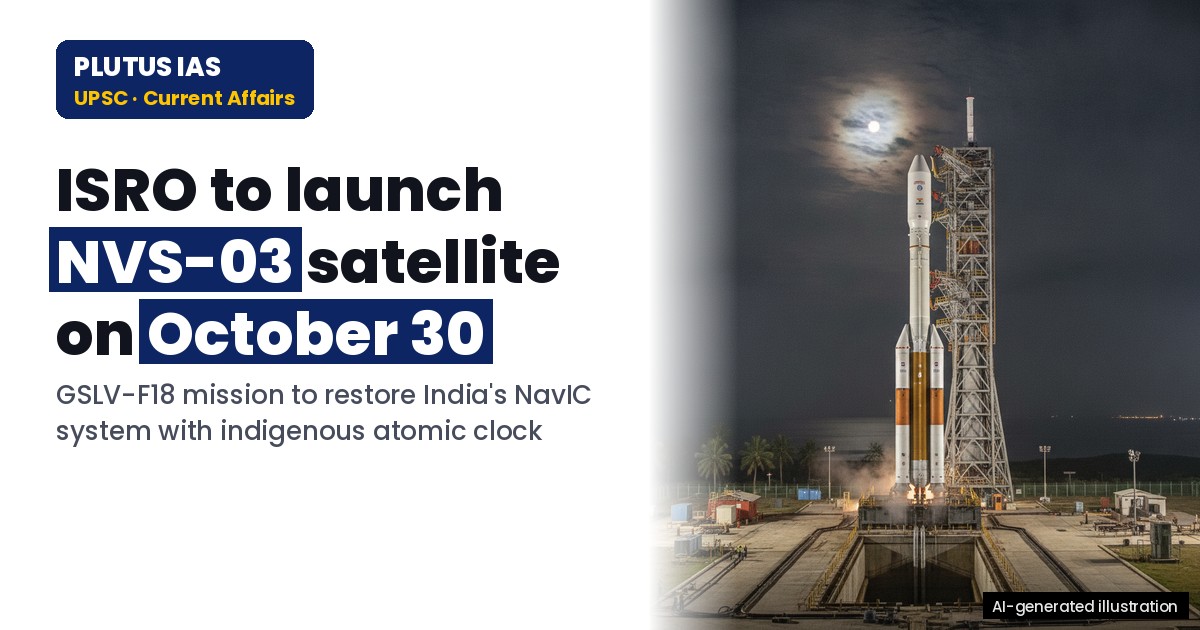
28 Oct ISRO to launch NVS-03 satellite on October 30: Key details for UPSC & State PCS
✎ NavIC is India’s indigenous regional navigation satellite system, and the NVS-03 launch is a critical step in restoring and enhancing its operational capacity by replacing failed atomic clocks and expanding signal coverage.
Subject Relevance — Where This Topic Fits
- GS Paper III — Science and Technology | GS Paper III — Space Technology and Applications
- Prelims: NavIC, GSLV-F18, IRNSS-1F, atomic clock, geosynchronous transfer orbit, Position Navigation Timing (PNT)
- Essay: The role of indigenous innovation in national security: India’s NavIC and its strategic implications
Quick Revision: NavIC is India’s indigenous regional navigation satellite system, and the NVS-03 launch is a critical step in restoring and enhancing its operational capacity by replacing failed atomic clocks and expanding signal coverage.
Why is this in the news?
The Indian Space Research Organisation (ISRO) is scheduled to launch the NVS-03 satellite aboard the Geosynchronous Satellite Launch Vehicle (GSLV-F18) on October 30, 2026. This mission is critical for restoring and enhancing the operational capacity of India’s indigenous regional navigation satellite system, NavIC, which has faced challenges due to the failure of atomic clocks on prior satellites. The launch underscores ISRO’s efforts to ensure continuity and resilience in India’s navigation infrastructure.
Background
- NavIC, formerly known as the Indian Regional Navigation Satellite System (IRNSS), is India’s autonomous regional satellite navigation system developed by ISRO to provide accurate Position, Navigation, and Timing (PNT) services.
- The system is designed to cover India and an area extending up to 1,500 km beyond its geopolitical boundary, serving both civilian and strategic applications.
- NavIC consists of a constellation of seven satellites (IRNSS-1A to IRNSS-1G), launched between 2013 and 2016.
- The NVS series represents the next generation of navigation satellites, incorporating advanced features such as indigenous atomic clocks and expanded signal coverage.
- The failure of an atomic clock on the IRNSS-1F satellite in March 2026 highlighted vulnerabilities in the system, necessitating the deployment of replacement satellites like NVS-03.
- ISRO’s GSLV-F18 mission marks the 20th flight of the GSLV and the third launch in 2026, following the PSLV-C62 and GSLV-F17 missions.
What is the NVS-03 Satellite and NavIC?
- NVS-03 is the third satellite in the NavIC Next Generation (NVS) series, designed to replace and augment the existing IRNSS constellation.
- The satellite carries both indigenous and procured atomic clocks, ensuring redundancy and reliability in timekeeping, which is critical for PNT services.
- NVS-03 includes an additional L1 signal alongside the existing L5/S signals, expanding compatibility with global navigation standards and enhancing user accessibility.
- The satellite will be placed in a geosynchronous transfer orbit (GTO) by the GSLV-F18 launch vehicle before being maneuvered into its final geostationary orbit.
- NavIC provides two types of services: Standard Positioning Service (SPS) for civilian users and Restricted Service (RS) for strategic applications, including defence and security.
- The system’s primary service area covers India and extends up to 1,500 km beyond its borders, supporting applications in transportation, agriculture, disaster management, and surveying.
- NavIC operates independently of global navigation systems like GPS, GLONASS, or Galileo, ensuring strategic autonomy for India.
- The NVS series satellites are equipped with enhanced payloads, including improved atomic clocks and additional navigation signals, to improve accuracy and reliability.
Key Features
| Feature | Significance |
|---|---|
| NVS-03 Satellite | Third satellite in the next-generation NavIC constellation, ensuring continuity of India’s regional navigation services. |
| Indigenous Atomic Clock | Enhances self-reliance in critical timing technology for precise Position, Navigation, and Timing (PNT) services. |
| Procured Atomic Clocks | Redundancy mechanism to mitigate risks associated with indigenous clock failures, ensuring operational resilience. |
| L1 Signal Inclusion | Expands compatibility with global navigation standards, improving interoperability with other satellite systems. |
| Geosynchronous Transfer Orbit (GTO) | Optimal orbital insertion for subsequent geostationary positioning, enabling extended coverage over the primary service area. |
Why it Matters
Strategic Autonomy
- Strengthens India’s independent regional navigation capability, reducing dependence on foreign satellite systems like GPS or GLONASS.
- Supports critical applications in defence, disaster management, and civil aviation, ensuring sovereignty in PNT services.
Technological Advancement
- Demonstrates ISRO’s capability in developing and deploying advanced satellite systems with indigenous atomic clocks.
- Enhances India’s position in the global space economy by contributing to the NavIC constellation, a key component of the Indian Space Programme.
Operational Continuity
- Revives the NavIC system, which was weakened by the failure of the atomic clock on IRNSS-1F, ensuring uninterrupted services for existing users.
- Extends coverage beyond the Indian landmass, supporting regional applications in South Asia and the Indian Ocean.
Economic Impact
- Facilitates the growth of location-based services (LBS), precision agriculture, and urban planning through reliable PNT data.
- Reduces costs associated with reliance on foreign navigation systems for civilian and commercial applications.
Challenges
1. Atomic Clock Failures
- Failure of procured atomic clocks on IRNSS-1F (March 2026) highlights vulnerabilities in timing systems, necessitating redundancy measures.
- Dependence on procured clocks underscores the need for indigenous clock development to achieve full self-reliance.
UPSC Link: GSLV-F18 launch and NavIC constellation
2. Orbit-Raising Anomalies
- NVS-02 (January 2025) faced valve malfunction during orbit-raising, demonstrating technical risks in satellite deployment.
- Such anomalies can delay critical satellite operations, impacting service continuity.
UPSC Link: GSLV-F18 launch and NavIC constellation
3. Global Interoperability
- Limited adoption of NavIC outside India due to lack of L1 signal compatibility with global systems like GPS.
- Need for standardisation and international collaboration to enhance NavIC’s utility in global supply chains.
UPSC Link: Global Navigation Satellite Systems (GNSS)
4. Launch Vehicle Reliability
- GSLV’s mixed track record (20 flights with occasional failures) poses risks to the NavIC constellation’s expansion.
- Ensuring reliability of GSLV-F18 is critical for future NVS launches.
UPSC Link: GSLV-F18 launch and NavIC constellation
Challenges — UPSC Perspective
| Issue | Concern |
|---|---|
| Atomic Clock Failures | Disruption in timing services, impacting PNT accuracy for NavIC users. |
| Orbit-Raising Anomalies | Potential delays in satellite deployment, affecting service continuity. |
| Global Interoperability | Limited adoption of NavIC outside India due to compatibility issues. |
| Launch Vehicle Reliability | GSLV’s performance variability poses risks to future NavIC satellites. |
| Redundancy Mechanisms | Dependence on procured clocks highlights gaps in indigenous technology development. |
Way Forward
- Accelerate indigenous atomic clock development to reduce dependence on procured components and enhance self-reliance.
- Strengthen redundancy mechanisms in satellite systems to mitigate risks of clock failures and orbit-raising anomalies.
- Expand NavIC’s global outreach by promoting L1 signal compatibility and international collaborations.
- Enhance GSLV reliability through rigorous testing and incremental improvements in launch vehicle technology.
- Develop a roadmap for the next-generation NavIC satellites to ensure long-term continuity and scalability of the constellation.
- Promote domestic industries in satellite manufacturing to support ISRO’s growing operational demands.
- Establish a dedicated fund for rapid replacement of failed satellites to maintain uninterrupted PNT services.
UPSC Value Addition
Keywords for Mains Answer-Writing
ISRO · NVS-03 satellite · NavIC (Navigation with Indian Constellation) · IRNSS (Indian Regional Navigation Satellite System) · GSLV-F18 · atomic clocks in satellites · geosynchronous transfer orbit · Satish Dhawan Space Centre · positioning navigation and timing (PNT) services · space-based navigation systems · ISRO’s satellite launch programme · regional navigation satellite systems · space technology and governance · India’s space policy · satellite-based services in India
Concept Flow
ISRO’s NavIC system → Provides regional PNT services → NVS-03 satellite launch → GSLV-F18 deployment → Geosynchronous transfer orbit insertion → Enhanced coverage and redundancy → Continuity of services → Strategic autonomy in navigation.
Prelims Practice Questions
Q1. Consider the following statements regarding the Navigation with Indian Constellation (NavIC) system:
1. NavIC is an independent regional navigation satellite system developed by ISRO.
2. The primary service area of NavIC extends up to 1,500 km beyond the Indian landmass.
3. NavIC provides Position, Navigation, and Timing (PNT) services using atomic clocks onboard satellites.
4. The NVS-03 satellite will be the first to carry an indigenous atomic clock in the NavIC constellation.
How many of the above statements are correct?
- Only one
- Only two
- Only three
- All four
Answer: Only three — Statements 1, 2, and 3 are correct. Statement 4 is incorrect as the NVS-03 satellite will carry both indigenous and procured atomic clocks, not the first indigenous clock.
Q2. Assertion (A): The Geosynchronous Satellite Launch Vehicle (GSLV) is specifically designed to place satellites into geosynchronous transfer orbits.
Reason (R): GSLV uses a cryogenic upper stage, which is essential for launching heavier satellites into higher orbits.
Options:
A. Both A and R are true, and R is the correct explanation of A.
B. Both A and R are true, but R is not the correct explanation of A.
C. A is true, but R is false.
D. A is false, but R is true.
Answer: ? — Assertion (A) is true as GSLV is indeed designed for geosynchronous transfer orbits. Reason (R) is also true, but the cryogenic upper stage is not the sole reason for its capability to place satellites in geosynchronous orbits; it is one of the contributing factors.
Q3. Match the following satellite systems with their respective primary functions:
Column I
A. NavIC
B. IRNSS-1F
C. GSLV-F18
D. EOS-05
Column II
1. Earth observation satellite
2. Navigation satellite with atomic clocks
3. Launch vehicle for geosynchronous missions
4. Navigation satellite with a malfunctioning atomic clock
Options:
A – 2, B – 4, C – 3, D – 1
A – 1, B – 2, C – 4, D – 3
A – 3, B – 1, C – 2, D – 4
A – 2, B – 3, C – 1, D – 4
Answer: ? — A. NavIC is a navigation satellite system (2). B. IRNSS-1F is a navigation satellite with a malfunctioning atomic clock (4). C. GSLV-F18 is a launch vehicle for geosynchronous missions (3). D. EOS-05 is an Earth observation satellite (1).
Mains Practice Question
✍ The launch of the NVS-03 satellite by ISRO marks a critical step in reviving India’s regional navigation satellite system, NavIC. In this context, critically examine the strategic significance of NavIC for India’s sovereignty and technological self-reliance. Also, analyse the challenges faced by the NavIC system in maintaining its operational integrity. (15 Marks)
Approach: MODEL-ANSWER SKELETON:
1. **Strategic Significance of NavIC:**
– **Sovereignty and Autonomy:** NavIC provides India with an independent regional navigation system, reducing dependence on foreign systems like GPS (USA), GLONASS (Russia), Galileo (EU), or BeiDou (China). Discuss how this aligns with India’s policy of ‘Atmanirbhar Bharat’ and strategic autonomy in critical technologies.
– **Security and Defence:** Highlight NavIC’s role in enhancing military precision, border surveillance, and disaster management, particularly in India’s primary service area extending 1,500 km beyond its landmass.
– **Economic and Commercial Applications:** Enumerate sectors benefiting from NavIC, such as agriculture (precision farming), transportation (logistics and traffic management), and civil aviation (air traffic control). Cite examples like the use of NavIC in the ‘UMANG’ app or railway tracking systems.
– **Technological Self-Reliance:** Discuss how NavIC exemplifies India’s indigenous capability in developing high-precision atomic clocks, satellite technology, and ground infrastructure.
2. **Challenges to NavIC’s Operational Integrity:**
– **Atomic Clock Failures:** Explain the significance of atomic clocks in PNT services and the impact of the failure of the atomic clock on the IRNSS-1F satellite (2026). Discuss the redundancy measures, such as the inclusion of both indigenous and procured atomic clocks in NVS-03.
– **Orbit-Raising and Launch Failures:** Reference the malfunction in the NVS-02 satellite’s orbit-raising operations (2025) and its implications for the NavIC constellation’s reliability.
– **Maintenance and Upgrades:** Highlight the need for continuous upgrades to the satellite constellation, ground stations, and user equipment to ensure accuracy and coverage.
– **Global Recognition and Adoption:** Discuss the challenges in achieving global recognition for NavIC, including interoperability with other global navigation systems and adoption by international users.
3. **Way Forward:**
– **Policy and Institutional Support:** Emphasise the role of ISRO, the Department of Space, and the Union Government in ensuring sustained funding, research, and development for NavIC.
– **International Collaborations:** Suggest potential collaborations with like-minded countries or regional blocs to enhance NavIC’s utility and global footprint.
– **Public-Private Partnerships:** Discuss the role of private enterprises in developing user applications and ground infrastructure to expand NavIC’s reach.
Balance the answer by acknowledging both the strategic advantages and the operational hurdles, concluding with a balanced perspective on NavIC’s future trajectory.
Source: The Hindu
Generated by AanyaAi for educational purpose.
Related guides on our sites
- Current affairs for upsc 2026
- How to prepare for GS paper 1 for UPSC CSE mains exam
- Best UPSC coaching for IFOS exam
- Best mentorship programme for upsc

- आंध्र प्रदेश में चक्रवात अरनब: केंद्र से सहायता की अपील, जानिए मुख्य बिंदु - October 28, 2026
- ISRO to launch NVS-03 satellite on October 30: Key details for UPSC & State PCS - October 28, 2026
- चक्रवात अरनब: भारत के डिजिटल भविष्य के लिए एक बड़ा जलवायु जोखिम - October 28, 2026

No Comments