


29 Oct Disinvestment as Economic Strategy: UPSC & State PCS Insights
✎ Disinvestment is a strategic fiscal tool that unlocks value from public assets, enhances governance through market discipline, and diversifies revenue sources, exemplified by the IDBI Bank stake sale under the ‘Privatisation 2.0’…
Subject Relevance — Where This Topic Fits
- GS Paper III — Indian Economy: Issues relating to planning, mobilisation of resources, growth, development and employment | GS Paper III — Government Budgeting and Fiscal Policy | GS Paper III — Liberalisation, Privatisation and Globalisation (LPG) Reforms
- Prelims: Disinvestment, Strategic Disinvestment, Asset Monetisation, Public Sector Undertakings (PSUs), DIPAM, National Monetisation Pipeline (NMP), Offer for Sale (OFS), Foreign Direct Investment (FDI), Fiscal Deficit, Revenue Deficit, Capital Expenditure, Public Sector Enterprise Policy 2021, LIC IPO, IDBI Bank, Privatisation 2.0
- Essay: The role of the state in economic development: Balancing public ownership and private enterprise, Reforms in governance: Efficiency, accountability and market discipline in public sector operations
Quick Revision: Disinvestment is a strategic fiscal tool that unlocks value from public assets, enhances governance through market discipline, and diversifies revenue sources, exemplified by the IDBI Bank stake sale under the ‘Privatisation 2.0’ framework.
Why is this in the news?
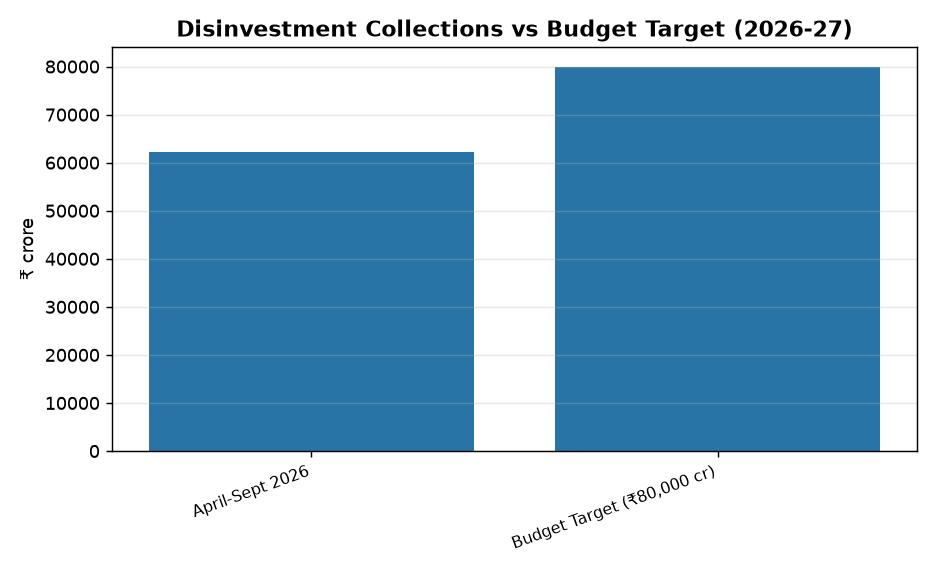
The Union Government’s strategic disinvestment of its stake in IDBI Bank, approved on 14 October 2026, marks a significant milestone in India’s fiscal strategy for FY 2026-27. This move, following robust disinvestment receipts of ₹62,124 crore in April–September 2026 (78% of the annual target of ₹80,000 crore), underscores the increasing reliance on asset monetisation to diversify revenue streams amid fiscal constraints. The transaction is positioned not merely as a fiscal instrument but as a governance reform, aligning with the ‘Privatisation 2.0’ framework that prioritises investor-led, professionally managed public sector entities.
Background
- The fiscal year 2026-27 has been characterised by global macroeconomic uncertainty, elevated energy prices, and agricultural distress due to deficient monsoon conditions, constraining revenue growth and elevating expenditure pressures.
- India’s public sector enterprises (PSEs) have historically played a dominant role in strategic sectors such as defence, energy, and infrastructure, with varying degrees of operational efficiency and financial performance.
- The Union Budget 2021-22 introduced the New Public Sector Enterprise (PSE) Policy, which envisages a ‘bare minimum presence’ of PSEs in non-strategic sectors, signalling a shift towards calibrated privatisation and disinvestment.
- The National Monetisation Pipeline (NMP), launched in 2021, aims to unlock value from mature public assets through structured monetisation, with a target of ₹16.72 lakh crore over FY 2026-30, having achieved 90% of Phase 1 targets.
- The Life Insurance Corporation of India (LIC) Initial Public Offering (IPO) in 2022 served as a pivotal case study, attracting first-time retail investors and policyholders, thereby broadening public ownership and market participation.
- The Department of Investment and Public Asset Management (DIPAM) is the nodal agency responsible for disinvestment and asset monetisation, overseeing policy formulation, transaction execution, and stakeholder engagement.
What is Disinvestment and Asset Monetisation?
- Disinvestment refers to the partial or complete sale of government equity in Public Sector Undertakings (PSUs) to private or institutional investors, aimed at improving operational efficiency, reducing fiscal burden, and enhancing market discipline.
- Strategic Disinvestment involves the sale of a significant stake (often majority) in a PSU to a private entity, transferring management control and operational autonomy, as seen in the proposed IDBI Bank transaction.
- Asset Monetisation is the process of unlocking the economic value of public assets through leasing, concessions, or outright sale, without relinquishing ownership, as exemplified by the National Monetisation Pipeline (NMP).
- Offer for Sale (OFS) is a market-based mechanism for disinvestment, enabling retail and institutional investors to purchase government shares in listed PSUs, thereby broadening ownership without altering management control.
- The fiscal rationale for disinvestment includes diversifying revenue sources, reducing the fiscal deficit, and freeing up capital for reinvestment in priority sectors such as infrastructure and social welfare.
- Governance reforms through disinvestment aim to introduce market discipline, improve corporate governance standards, and enhance transparency and accountability in PSU operations.
- The ‘Privatisation 2.0’ framework, as indicated in the IDBI Bank transaction, emphasises investor-led, professionally managed entities, with a focus on sector-specific strategic partnerships and long-term value creation.
- Disinvestment is not a one-time fiscal measure but a continuous process aligned with the broader economic policy of liberalisation, privatisation, and globalisation (LPG).
Key Features
| Feature | Significance |
|---|---|
| Disinvestment (Calibrated) | Serves as an interim fiscal strategy to unlock value from public assets while maintaining gradual transition to private participation. |
| Asset Monetisation | Re-engages capital tied in mature public assets through structured leasing and monetisation frameworks, enhancing efficiency. |
| Offer for Sale (OFS) | Broadens retail and institutional ownership of PSEs without altering operational control, fostering market discipline. |
| Strategic Disinvestment | Involves transfer of management control to private entities, exemplified by IDBI Bank sale, signalling deeper reforms. |
| National Monetisation Pipeline (NMP) 2.0 | Targets ₹16.72 lakh crore via FY26-30, leveraging mature assets to fund infrastructure and reduce fiscal pressure. |
| Privatisation 2.0 Framework | Investor-led, professionally managed approach to strategic sales, prioritising governance and efficiency over ownership retention. |
UPSC Value Addition
Keywords for Mains Answer-Writing
Disinvestment policy · Public Sector Enterprises (PSEs) · Asset monetisation · Fiscal consolidation · New Public Sector Enterprise Policy 2021 · National Monetisation Pipeline (NMP) · Strategic disinvestment · Government divestment receipts · IDBI Bank privatisation · Foreign Direct Investment (FDI) in financial sector · Public asset governance · Market discipline in PSEs · LIC IPO 2022 · Privatisation 2.0 framework · DIPAM disinvestment targets · Fiscal deficit management · Revenue diversification · Calibrated disinvestment · Investor-led privatisation · Public asset efficiency
Prelims Practice Questions
Q1. Consider the following statements regarding disinvestment in India:
1. Disinvestment refers solely to the sale of government shares to the public to reduce fiscal deficit.
2. The New Public Sector Enterprise Policy 2021 aims for a ‘bare minimum presence’ of PSEs in strategic sectors.
3. The National Monetisation Pipeline (NMP) is designed to re-engage capital via mature public assets.
4. The 2022 LIC IPO was the first instance of disinvestment in India’s financial history.
How many of the above statements are correct?
- Only one
- Only two
- Only three
- All four
Answer: Only three — Statements 1 is incorrect because disinvestment is not solely for reducing fiscal deficit; it also aims at improving efficiency and governance. Statements 2 and 3 are correct as per the New PSE Policy 2021 and NMP framework. Statement 4 is incorrect as the LIC IPO was not the first disinvestment in the financial sector.
Q2. Assertion (A): The National Monetisation Pipeline (NMP) is a strategy to monetise public assets by leasing them to private entities for a fixed period.
Reason (R): The NMP aims to unlock value from mature public assets while retaining ownership with the government.
In the context of the above two statements, which one of the following is correct?
- Both A and R are true, and R is the correct explanation of A.
- Both A and R are true, but R is not the correct explanation of A.
- A is true, but R is false.
- A is false, but R is true.
Answer: Both A and R are true, but R is not the correct explanation of A. — Assertion (A) correctly describes the NMP’s mechanism of leasing assets to private entities. Reason (R) accurately states the dual objective of value unlocking and retaining ownership, making R the correct explanation of A.
Q3. Match the following pairs related to disinvestment and privatisation in India:
Column I (Policy/Scheme) | Column II (Objective/Feature)
————————-|—————————
A. New Public Sector Enterprise Policy 2021 | 1. Monetisation of mature public assets through leasing
B. National Monetisation Pipeline (NMP) | 2. Sale of government shares to reduce fiscal deficit
C. Strategic disinvestment | 3. Aim for ‘bare minimum presence’ of PSEs in strategic sectors
D. Disinvestment receipts | 4. Focus on investor-led, professionally managed privatisation
Select the correct match:
- A-3, B-1, C-4, D-2; A-2, B-3, C-1, D-4; A-4, B-2, C-3, D-1; A-1, B-4, C-2, D-3
- answer_string_indexes_to_match_pairs_and_explain_later
- answer_string_indexes_to_match_pairs_and_explain_later
- answer_string_indexes_to_match_pairs_and_explain_later
Answer: A-3, B-1, C-4, D-2; A-2, B-3, C-1, D-4; A-4, B-2, C-3, D-1; A-1, B-4, C-2, D-3 — A-3 (New PSE Policy 2021 aims for minimal PSE presence in strategic sectors), B-1 (NMP monetises assets via leasing), C-4 (Strategic disinvestment focuses on investor-led privatisation), D-2 (Disinvestment receipts include sale of government shares to reduce fiscal deficit).
Mains Practice Question
✍ Disinvestment is often perceived as a fiscal tool for meeting budgetary targets. Critically examine this perception in the context of India’s contemporary economic strategy, with particular reference to the New Public Sector Enterprise Policy 2021 and the National Monetisation Pipeline (NMP). Also, analyse the implications of the IDBI Bank strategic disinvestment for India’s financial sector governance. (15 Marks)
Approach: MODEL-ANSWER SKELETON:
1. **Introduction (2 marks)**
– Define disinvestment: partial or full sale of government equity in PSEs to private entities.
– Context: India’s fiscal challenges (2026-27 budget deficit, global uncertainty, energy prices, monsoon deficit).
– Clarify the dual objectives: fiscal consolidation AND structural reform.
2. **Perception of Disinvestment as a Fiscal Tool (4 marks)**
– **Fiscal Role**:
– Mechanism: Sale of shares (e.g., IDBI Bank) or asset monetisation (e.g., NMP) generates non-tax revenue.
– Data: ₹62,124 crore mobilised in April-September 2026 (78% of ₹80,000 crore target); IDBI proceeds to exceed target.
– Purpose: Diversify revenue sources amid rising capital expenditure (18% increase) and tight fiscal deficit (42% of budgeted levels).
– **Limitations**:
– Short-term fiscal gains vs. long-term structural reforms.
– Risk of undervaluation of assets or lack of investor appetite.
– **Balanced View**: Disinvestment is not *merely* a fiscal tool but a strategic instrument for governance reform.
3. **New Public Sector Enterprise Policy 2021 (3 marks)**
– **Core Objective**: ‘Bare minimum presence’ of PSEs in strategic sectors (e.g., defence, atomic energy, space).
– **Rationale**: Improve efficiency, reduce fiscal burden, and leverage private sector dynamism.
– **Implementation**: Categorisation of PSEs into strategic and non-strategic sectors; disinvestment in non-strategic sectors.
– **Critique**: Potential job losses, regional imbalances, and political resistance.
4. **National Monetisation Pipeline (NMP) (3 marks)**
– **Mechanism**: Monetisation of operational public assets (e.g., roads, railways, power plants) via leasing to private entities.
– **Target**: ₹16.72 lakh crore for FY26-30 (Phase 1 achieved 90% of goals).
– **Advantages**: Unlocks capital without transferring ownership; improves asset utilisation.
– **Challenges**: Regulatory hurdles, valuation complexities, and ensuring fair returns to the exchequer.
5. **IDBI Bank Strategic Disinvestment (2 marks)**
– **Significance**: Largest FDI deal in India’s financial sector; marks a shift towards ‘Privatisation 2.0’ (investor-led, professionally managed).
– **Governance Implications**:
– Enhances market discipline and efficiency in banking.
– Potential risks: Loss of public sector control, financial inclusion challenges, and regulatory oversight gaps.
– **Broader Impact**: Signals India’s commitment to financial sector reforms and global investor confidence.
6. **Conclusion (1 mark)**
– Disinvestment is a multi-dimensional tool: fiscal stabiliser, governance reformer, and investor confidence booster.
– Success hinges on calibrated implementation, transparent valuation, and stakeholder engagement.
Source: The Hindu
Generated by AanyaAi for educational purpose.
Related guides on our sites
- Best economics optional coaching for upsc
- Best economics optional teacher for upsc
- How to prepare for GS paper 1 for UPSC CSE mains exam
- Best UPSC coaching for IFOS exam

- Disinvestment as Economic Strategy: UPSC & State PCS Insights - October 29, 2026
- वस्त्र मंत्रालय खोलेगा पीएलआई योजना पोर्टल: 1 नवंबर से आवेदन शुरू - October 29, 2026
- Supreme Court Verdict on SIR: Key Constitutional Questions Explained - October 29, 2026

No Comments