


29 Oct India Advocates Women in Military for Conflict Zone Protection at UN
✎ The Women, Peace and Security Agenda (UNSCR 1325) integrates gender perspectives into conflict resolution, with India’s military reforms and UN peacekeeping contributions exemplifying its implementation.
Subject Relevance — Where This Topic Fits
- GS Paper II — International Relations — Role of UN and its agencies, Peace and Conflict Resolution | GS Paper III — Internal Security — Role of Armed Forces in Conflict Zones and Gender Inclusion
- Prelims: Women, Peace and Security (WPS) Agenda, Permanent Commission for Women Officers, UN Military Gender Advocate of the Year Award, Conflict-related sexual violence, Women’s Reservation Act, 2023
- Essay: The Role of Gender Inclusion in Sustainable Peace and Security, Empowerment of Women as a Catalyst for Societal Transformation
Quick Revision: The Women, Peace and Security Agenda (UNSCR 1325) integrates gender perspectives into conflict resolution, with India’s military reforms and UN peacekeeping contributions exemplifying its implementation.
Why is this in the news?
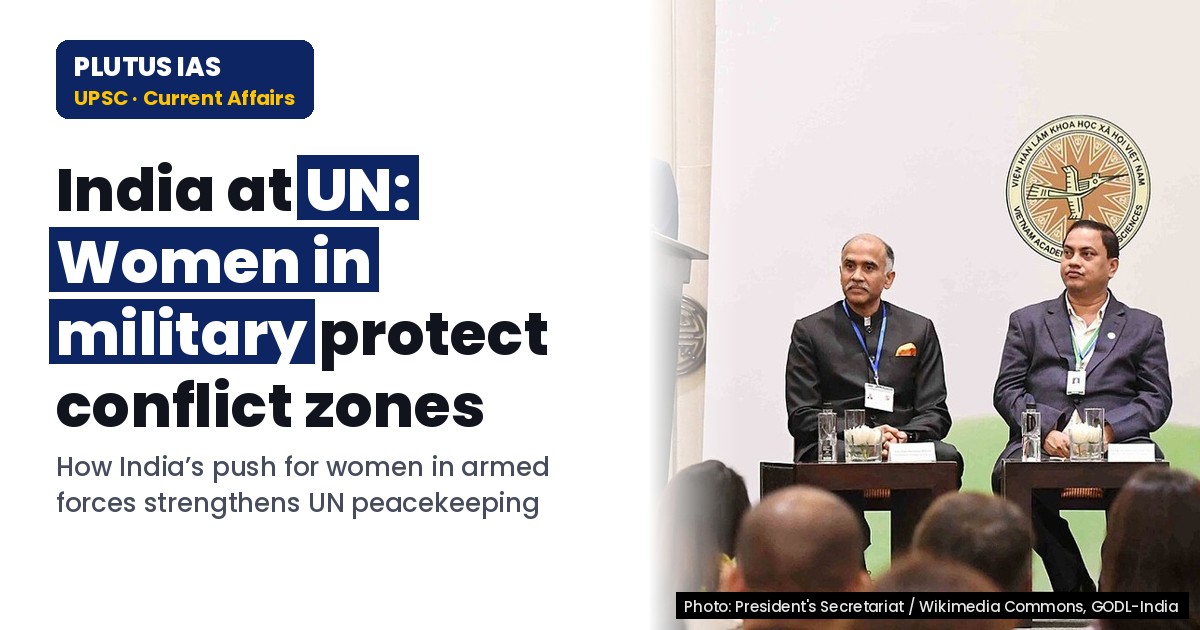
India’s Permanent Representative to the United Nations, P. Harish, highlighted the critical role of women in military and peacekeeping operations at the UN Security Council’s open debate on the Women, Peace and Security (WPS) Agenda. He underscored that increased representation of women in armed forces enhances protection for women in conflict zones, citing India’s initiatives such as the induction of women into combat roles and the establishment of gender-responsive mechanisms in UN peacekeeping missions. This intervention aligns with global reports on the escalation of conflict-related sexual violence and the disproportionate impact on women and girls.
Background
- The Women, Peace and Security (WPS) Agenda was established by the UN Security Council Resolution 1325 (2000), which recognises the disproportionate impact of conflict on women and girls and calls for their increased participation in peace processes and conflict resolution.
- The UN Secretary-General’s reports on conflict-related sexual violence indicate a doubling of verified cases in the past year, with 750 million women and girls living within 50 kilometres of conflict zones.
- The Pramila Patten report highlights sexual violence as a political weapon in modern conflicts, necessitating systemic measures for protection and prevention.
- India’s Armed Forces have progressively inducted women into all combat streams, including fighter pilot roles, following the grant of permanent commission to women officers.
- The Women’s Reservation Act, 2023, extends reservation for women in legislative bodies, reflecting India’s legislative commitment to gender inclusion in decision-making.
What is the Women, Peace and Security (WPS) Agenda?
- The WPS Agenda, enshrined in UNSC Resolution 1325 (2000), mandates the participation of women in peace processes, protection from gender-based violence, and the prevention of conflict-related sexual violence.
- It recognises that women’s inclusion in conflict resolution enhances the effectiveness and sustainability of peace agreements by addressing local grievances and fostering community trust.
- The agenda encompasses four pillars: participation, protection, prevention, and relief and recovery, with a focus on gender-responsive approaches in all peacekeeping and humanitarian operations.
- The UN Security Council, through subsequent resolutions (e.g., 1820, 1888, 1889, 1960, 2106, 2122, 2467, 2493), has expanded the scope of the WPS Agenda to address emerging challenges such as sexual violence as a weapon of war and the protection of women peacekeepers.
- The WPS Agenda is implemented through national action plans (NAPs) by member states, which outline strategies for integrating gender perspectives into military, police, and civilian peacekeeping components.
- The agenda also emphasises the role of women in post-conflict reconstruction, including education, healthcare, and economic empowerment, to ensure long-term stability and gender equality.
- The UN Military Gender Advocate of the Year Award recognises outstanding contributions by uniformed personnel in promoting gender equality and protection in peacekeeping missions.
Key Features
| Feature | Significance |
|---|---|
| Permanent Commission for Women Officers | Enables sustained career progression and leadership roles in the armed forces, enhancing operational effectiveness and gender parity. |
| Induction into Combat Streams | Expands operational roles for women, including fighter pilots, thereby integrating gender diversity into frontline military functions. |
| UN Peacekeeping Missions | Increases Indian women’s participation in global peacekeeping, contributing to the Women, Peace and Security (WPS) agenda through on-ground expertise. |
| Gender-Responsive Training in UN Peacekeeping | Standardises protocols for addressing sexual violence, grievance redressal, and victim-centred support in conflict zones. |
| Women’s Reservation Act, 2023 | Legislates gender quotas in local governance, reinforcing institutional mechanisms for women’s political representation and decision-making. |
Why it Matters
Strategic Security
- Enhanced operational effectiveness in conflict zones through gender-diverse peacekeeping teams, leveraging local insights and community trust.
- Strengthened protection mechanisms for civilians, particularly women and girls, by integrating gender perspectives into military and peacekeeping strategies.
- Demonstrated leadership in UN peacekeeping, with Indian women officers pioneering victim-centred grievance redressal and gender-responsive planning.
Human Rights & Gender Justice
- Direct mitigation of conflict-related sexual violence, a documented weapon of war, through institutionalised gender-sensitive frameworks.
- Promotion of survivor-centric approaches in peacekeeping, aligning with international humanitarian law and UN Security Council Resolution 1325 (2000).
- Empowerment of women in post-conflict reconstruction, ensuring their participation in governance, education, and health systems.
Institutional Capacity Building
- Systematic restructuring of armed forces to accommodate gender diversity, setting a regional precedent for inclusive military modernisation.
- Establishment of the Centre for UN Peacekeeping in New Delhi, serving as a regional hub for training female peacekeepers in gender-responsive operations.
- Development of gender databases and evidence-based planning tools to inform policy and operational decisions in conflict theatres.
Challenges
1. Operational Integration Challenges
- Cultural and institutional resistance within traditional military hierarchies to full gender integration in combat roles.
- Logistical hurdles in deploying women peacekeepers in high-risk conflict zones due to physical and security constraints.
- Need for continuous gender-sensitivity training to prevent tokenism and ensure substantive inclusion in decision-making processes.
UPSC Link: GS3: Security challenges and their management
2. Data and Accountability Gaps
- Underreporting of conflict-related sexual violence due to stigma, lack of access to justice, and systemic biases in data collection.
- Inconsistent enforcement of gender-responsive policies across different military and peacekeeping missions.
- Requirement for robust monitoring mechanisms to track progress on women’s representation and protection outcomes.
UPSC Link: GS2: International organisations and their mandate
3. Policy Implementation Barriers
- Delays in translating legislative commitments (e.g., Women’s Reservation Act) into ground-level administrative reforms.
- Resource constraints in scaling up gender-responsive training and infrastructure for women in military and peacekeeping roles.
- Coordination challenges between central and state authorities in harmonising gender policies across diverse governance structures.
UPSC Link: GS2: Government policies and interventions
Challenges — UPSC Perspective
| Issue | Concern |
|---|---|
| Cultural Resistance | Deep-seated societal norms may impede acceptance of women in combat roles and leadership positions. |
| Security Risks in Conflict Zones | Heightened vulnerability of women peacekeepers to targeted violence or harassment in unstable environments. |
| Training Gaps | Inadequate or outdated gender-sensitivity modules in military training curricula. |
| Data Fragmentation | Lack of standardised, disaggregated data on gender-based violence in conflict zones for evidence-based policymaking. |
| Policy-Practice Divide | Discrepancies between formal gender policies and their practical implementation on the ground. |
Way Forward
- Strengthen institutional mechanisms for gender-responsive military training, including mandatory modules on conflict-related sexual violence and survivor support.
- Expand the Centre for UN Peacekeeping’s capacity-building initiatives to include advanced gender-analysis tools and scenario-based simulations.
- Enhance inter-ministerial coordination to align the Women’s Reservation Act with military and peacekeeping recruitment policies.
- Develop a national database on gender-based violence in conflict zones, integrating inputs from military, UN missions, and civil society.
- Increase funding for research on gender dynamics in conflict resolution, with a focus on evidence-based policy formulation.
- Promote bilateral and multilateral partnerships to share best practices in women’s integration into armed forces and peacekeeping operations.
- Establish rapid-response teams within military structures to address gender-based violence in conflict theatres, with clear escalation protocols.
- Conduct periodic audits of gender policies in military institutions to ensure compliance with international standards (e.g., UNSCR 1325).
UPSC Value Addition
Keywords for Mains Answer-Writing
Women, Peace and Security (WPS) Agenda · United Nations Security Council Resolution 1325 · Gender mainstreaming in armed forces · Conflict-related sexual violence · Permanent Commission for Women in Armed Forces · UN Military Gender Advocate of the Year Award · Women in peacekeeping operations · Gender-responsive governance · Women’s Reservation Act 2023 · Pramila Patten’s report on sexual violence in conflict
Constitutional & Policy Linkages
- [‘Article 14: Equality before law’, ‘Ensures non-discrimination in military recruitment and promotions.’]
- [‘Article 15(3): Special provisions for women’, ‘Permits affirmative action for gender inclusion in armed forces.’]
- [‘Article 16: Equality of opportunity’, ‘Mandates fair access to public employment, including military roles.’]
- [‘Article 51A(e): Fundamental duties’, “Upholds the duty to renounce practices derogatory to women’s dignity in all institutions.”]
Concept Flow
Conflict escalation → Increased gender-based violence in war zones → Recognition of women’s disproportionate vulnerability → Advocacy for Women, Peace and Security (WPS) agenda → India’s call for greater women’s representation in military → Permanent commission and combat roles for women → Enhanced UN peacekeeping contributions → Gender-responsive training and databases → Sustainable peace and reconstruction.
Prelims Practice Questions
Q1. Consider the following statements regarding the Women, Peace and Security (WPS) Agenda of the United Nations:
1. The WPS Agenda is primarily focused on increasing the number of women in combat roles in armed forces.
2. United Nations Security Council Resolution 1325 (2000) is a foundational document for the WPS Agenda.
3. The WPS Agenda emphasizes the protection of women and girls in conflict zones as a critical component of peacebuilding.
How many of the above statements are correct?
- Only one
- Only two
- Only three
- None
Answer: Only three — Statement 1 is incorrect because the WPS Agenda is broader than combat roles and includes participation in peacekeeping, protection, and gender-responsive governance. Statements 2 and 3 are correct as Resolution 1325 (2000) is the foundational document for the WPS Agenda, and it explicitly addresses the protection of women and girls in conflict zones.
Q2. Assertion (A): The Women’s Reservation Act, 2023, aims to reserve one-third of seats in the Lok Sabha and State Legislative Assemblies for women.
Reason (R): The Act seeks to address the underrepresentation of women in political decision-making bodies, aligning with the Women, Peace and Security Agenda.
Options:
A. Both A and R are true, and R is the correct explanation of A.
B. Both A and R are true, but R is NOT the correct explanation of A.
C. A is true, but R is false.
D. A is false, but R is true.
Answer: ? — Both Assertion (A) and Reason (R) are true. The Women’s Reservation Act, 2023, reserves one-third of seats for women in the Lok Sabha and State Legislative Assemblies. The Reason (R) correctly explains the aim of the Act, which is to address underrepresentation and aligns with broader gender equality goals, including the WPS Agenda.
Q3. Match the following initiatives with their respective objectives:
Column I (Initiative) | Column II (Objective)
—————————————————|——————————————————–
A. Permanent Commission for Women in Armed Forces | 1. Enhance women’s participation in peacekeeping operations
B. UN Military Gender Advocate of the Year Award | 2. Recognize contributions to gender-responsive peacekeeping
C. Centre for UN Peacekeeping, New Delhi | 3. Provide training for female peacekeepers
D. Women’s Reservation Act, 2023 | 4. Ensure women’s representation in political institutions
Options:
A. A-1, B-2, C-3, D-4
B. A-2, B-3, C-1, D-4
C. A-3, B-2, C-4, D-1
D. A-4, B-1, C-3, D-2
- A
- B
- C
- D
Answer: A — The correct matching is: A-1 (Permanent Commission for Women in Armed Forces enhances participation in all roles, including peacekeeping), B-2 (UN Military Gender Advocate of the Year Award recognizes gender-responsive peacekeeping contributions), C-3 (Centre for UN Peacekeeping, New Delhi provides training for female peacekeepers), and D-4 (Women’s Reservation Act, 2023 ensures women’s representation in political institutions).
Mains Practice Question
✍ The participation of women in armed forces and peacekeeping operations is increasingly recognized as a critical component of the Women, Peace and Security (WPS) Agenda. In this context, critically examine the role of women in strengthening conflict resolution and post-conflict reconstruction. Also, assess the progress made by India in this regard, citing relevant constitutional and policy provisions. (15 Marks)
Approach: MODEL-ANSWER SKELETON:
1. **Introduction (2 marks)**
– Define the Women, Peace and Security (WPS) Agenda and its origins (UNSCR 1325, 2000).
– Highlight the disproportionate impact of conflict on women and girls (cite Pramila Patten’s report on sexual violence in conflict).
2. **Role of Women in Conflict Resolution and Post-Conflict Reconstruction (5 marks)**
– **Participation in Peacekeeping**: Explain how women contribute to peacekeeping operations (e.g., Major Mouiz Yaseen’s model for victim-centred grievance reporting in UNMISS).
– **Gender-Responsive Governance**: Discuss how women’s representation in decision-making roles enhances safety, health, and education in conflict zones (cite Guterres’ report on women’s representation).
– **Local Grievances and Trust-Building**: Argue that women’s involvement helps address local grievances and builds trust with communities (reference India’s examples at UN).
– **Theoretical Support**: Cite feminist IR theories (e.g., J. Ann Tickner’s work on gender and security) to substantiate the argument.
3. **India’s Progress in Women’s Participation in Armed Forces (4 marks)**
– **Constitutional and Policy Provisions**: Mention Articles 14, 15, and 16 of the Constitution (equality and non-discrimination).
– **Permanent Commission for Women**: Explain the 2020 Supreme Court judgment in *Babita Puniya v. Union of India* and subsequent policy changes.
– **Induction in Combat Roles**: Highlight the inclusion of women in fighter pilot roles, military diplomats, and all combat streams.
– **UN Peacekeeping Contributions**: Cite India’s increasing number of female peacekeepers and training at the Centre for UN Peacekeeping in New Delhi.
4. **Challenges and Way Forward (4 marks)**
– **Challenges**: Discuss barriers such as societal norms, institutional biases, and the need for further gender sensitization.
– **Policy Recommendations**: Suggest measures like expanding training programs, increasing quotas in peacekeeping missions, and strengthening the Women’s Reservation Act, 2023.
– **Conclusion**: Summarize the argument that women’s participation is not only a moral imperative but also a strategic necessity for sustainable peace.
Source: orissapost.com
Generated by AanyaAi for educational purpose.
Related guides on our sites
- Anthropology VS PSIR
- Best PSIR optional coaching
- Best PSIR optional coaching online
- Best PSIR optional teacher

- India Advocates Women in Military for Conflict Zone Protection at UN - October 29, 2026
- कर्नाटक उच्च न्यायालय का लालफीताशाही पर तीखा व्यंग्य: कानून खुद फंसा लालफीताशाही में - October 29, 2026
- NCPCR Directs Koraput Collector to Fix Padua PM SHRI School Safety Issues - October 29, 2026

No Comments