


30 Oct SC Directs Centre to Frame Policy Against Live-Stream Violations
✎ The Supreme Court’s interim directions prohibit the unauthorised extraction, dissemination, or commercial exploitation of live-streamed court proceedings to protect judicial integrity and public trust, while permitting recognised…
Subject Relevance — Where This Topic Fits
- GS Paper II — Polity and Governance: Judiciary and its functioning | GS Paper III — Science and Technology: Digital governance and cyber security
- Prelims: Judicial transparency, live-streaming of court proceedings, digital watermarking, cybersecurity in judiciary, contempt of court, Article 129, Article 215, Supreme Court Rules, 2013 (Order XLIIA), Interim directions of Supreme Court, MeitY, digital signature, watermarking, unauthorised extraction, monetisation of judicial content
- Essay: The balance between judicial transparency and digital accountability in the age of information, Ethics in governance: Protecting judicial integrity in the digital public sphere
Quick Revision: The Supreme Court’s interim directions prohibit the unauthorised extraction, dissemination, or commercial exploitation of live-streamed court proceedings to protect judicial integrity and public trust, while permitting recognised news outlets to report on proceedings without using audio-visual clips.
Why is this in the news?
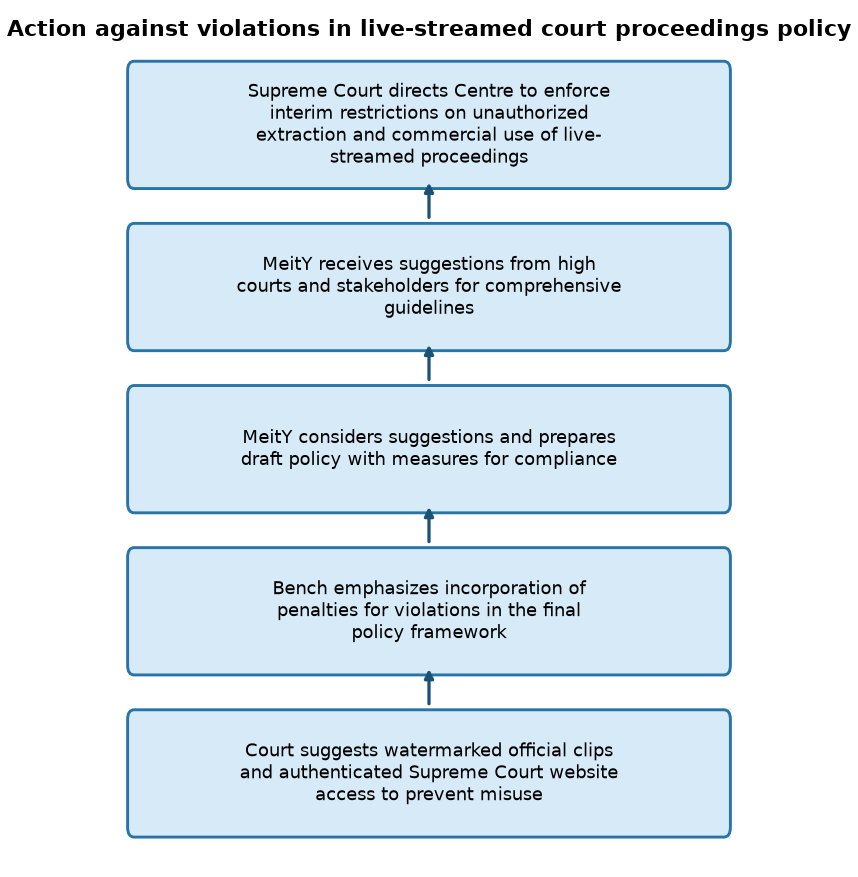
The Supreme Court of India, in a recent order, directed the Union Government to incorporate measures for penalising violations of its interim restrictions on the unauthorised extraction, dissemination, and commercial exploitation of live-streamed court proceedings. This directive underscores the judiciary’s growing concern over the misuse of digital recordings of judicial proceedings, which threatens judicial integrity, public trust, and the orderly administration of justice. The order reflects a proactive stance by the apex court to safeguard the sanctity of judicial proceedings in the digital age while balancing the imperatives of transparency and accountability.
Background
- The Supreme Court of India has been progressively embracing digital transparency, including the live-streaming of court proceedings, to enhance public access to judicial processes.
- On 24 July 2026, the Supreme Court issued interim directions prohibiting the unauthorised extraction, dissemination, monetisation, or modification of audio-visual recordings of judicial proceedings on digital platforms without prior permission from the Secretary General of the Supreme Court or the Registrar Generals of High Courts.
- The restrictions were clarified on 18 September 2026 to exempt recognised news outlets from a blanket prohibition, allowing them to report on judicial proceedings but not to use audio-visual clips without permission.
- The Court reiterated on 9 October 2026 that there was no intention to gag reporting or restrict live-streaming, but emphasised the need to prevent commercial exploitation and misrepresentation of judicial content.
- The Ministry of Electronics and Information Technology (MeitY) is tasked with formulating comprehensive guidelines to operationalise these restrictions, incorporating suggestions from High Courts and other stakeholders.
- Concerns have been raised over the proliferation of manipulated or misleading clips of court proceedings, often accompanied by unauthorised monetisation, which undermines judicial credibility and public trust.
What are the interim restrictions on live-streamed court proceedings and their rationale?
- The Supreme Court’s interim directions prohibit the unauthorised extraction, dissemination, monetisation, posting, reposting, uploading, transmission, modification, storage, or hosting of audio-visual recordings of judicial proceedings on social media or other digital platforms without prior permission from the Secretary General of the Supreme Court or the Registrar Generals of High Courts.
- These restrictions apply to all forms of digital dissemination, including social media platforms, video-sharing websites, and messaging services, to prevent the commercial exploitation of judicial content.
- The directions do not impose a blanket prohibition on reporting judicial proceedings; recognised news outlets are permitted to report on court proceedings but are barred from using audio-visual clips without explicit permission.
- The rationale behind these restrictions is to safeguard the integrity of judicial proceedings, prevent misrepresentation or manipulation of courtroom content, and protect the dignity of the judicial process.
- The Court has emphasised that the restrictions are not intended to gag transparency or restrict live-streaming but to regulate the unauthorised use of such content to maintain public trust in the judiciary.
- The interim directions are grounded in the constitutional provisions of Article 129 (Supreme Court as a court of record) and Article 215 (High Courts as courts of record), which empower the judiciary to regulate its proceedings and maintain their sanctity.
- The Supreme Court Rules, 2013 (Order XLIIA) provide the procedural framework for the live-streaming of court proceedings, and the interim directions are an extension of this regulatory authority to the digital domain.
UPSC Value Addition
Keywords for Mains Answer-Writing
Judicial transparency · live-streaming of court proceedings · interim restrictions on courtroom recordings · Supreme Court guidelines on judicial proceedings · digital watermarking of court footage · commercial exploitation of judicial content · Article 19(1)(a) and judicial proceedings · open justice principle · right to information vs judicial integrity · MeitY guidelines for courtroom recordings · verifiable digital signatures in judicial content · balancing transparency and privacy in judiciary
Prelims Practice Questions
Q1. Consider the following statements regarding the Supreme Court’s interim directions on live-streamed court proceedings:
1. The Supreme Court has prohibited the extraction, dissemination, monetisation, posting, reposting, uploading, transmission, modification, storage or hosting of audio-video recordings of judicial proceedings on social media or other digital platforms without prior permission.
2. The restrictions apply to recognised news outlets reporting court proceedings, prohibiting them from using audio or video clips of hearings in their reportage.
3. The Supreme Court has clarified that there is no blanket prohibition on live-streaming of court proceedings.
How many of the above statements are correct?
- Only one
- Only two
- All three
- None
Answer: All three — Statements 1 and 3 are correct. Statement 2 is incorrect because the Supreme Court clarified that recognised news outlets are permitted to continue reporting on judicial proceedings but cannot use audio or video clips of the hearings in their reportage.
Q2. Assertion (A): The Supreme Court has directed the Ministry of Electronics and Information Technology (MeitY) to incorporate measures for taking action against violations of its interim restrictions on unauthorised extraction and dissemination of live-streamed court proceedings.
Reason (R): The Supreme Court is concerned about the commercial exploitation of courtroom recordings through monetisation and misleading representations on digital platforms.
- Both A and R are true, and R is the correct explanation of A.
- Both A and R are true, but R is not the correct explanation of A.
- A is true, but R is false.
- A is false, but R is true.
Answer: Both A and R are true, but R is not the correct explanation of A. — Both the assertion and reason are true. The Supreme Court’s directive to MeitY to incorporate enforcement measures (A) is directly linked to its concern over the commercial exploitation of courtroom recordings (R).
Q3. Match the following provisions related to judicial proceedings with their respective legal or institutional frameworks:
Column I
1. Supreme Court’s interim directions on live-streamed proceedings
2. Right to Information Act, 2005
3. Article 19(1)(a) of the Constitution of India
4. Guidelines for digital watermarking of court footage
Column II
A. Fundamental right to freedom of speech and expression
B. Judicial governance and transparency
C. Access to public records and information
D. Authentication and verification of digital content
Select the correct match:
- 1-B, 2-C, 3-A, 4-D
- 1-A, 2-B, 3-C, 4-D
- 1-D, 2-A, 3-B, 4-C
- 1-C, 2-D, 3-A, 4-B
Answer: 1-B, 2-C, 3-A, 4-D — 1-B: Supreme Court’s interim directions on live-streamed proceedings relate to judicial governance and transparency. 2-C: The Right to Information Act, 2005 governs access to public records and information. 3-A: Article 19(1)(a) of the Constitution guarantees the fundamental right to freedom of speech and expression. 4-D: Guidelines for digital watermarking of court footage aim to authenticate and verify digital content.
Mains Practice Question
✍ The Supreme Court has recently reiterated its commitment to the principle of open justice while simultaneously imposing interim restrictions on the unauthorised extraction, dissemination, and commercial exploitation of live-streamed court proceedings. Critically examine the balance between transparency and judicial integrity in this context. Also, analyse the constitutional and legal provisions that underpin this balance. (15 Marks)
Approach: MODEL-ANSWER SKELETON:
1. **Introduction (2 marks)**:
– Define the principle of open justice and its constitutional basis (Article 14, 19(1)(a), and 21).
– State the Supreme Court’s role as the guardian of constitutional values and its responsibility to ensure justice is seen to be done.
2. **Supreme Court’s Interim Directions (3 marks)**:
– Summarise the interim restrictions imposed on October 9, 2026, and earlier orders (July 24, 2026, and September 18, 2026).
– Highlight the distinction between live-streaming (permitted) and unauthorised extraction/dissemination (prohibited).
– Mention the concerns over commercial exploitation, misleading representations, and digital manipulation.
3. **Constitutional and Legal Provisions (4 marks)**:
– **Article 19(1)(a)**: Right to freedom of speech and expression vs. reasonable restrictions under Article 19(2) (decency, morality, sovereignty, integrity, public order, contempt of court).
– **Article 21**: Right to a fair trial and dignity of the judicial process.
– **Contempt of Courts Act, 1971**: Provisions against scandalising the judiciary or prejudicing pending proceedings.
– **Right to Information Act, 2005**: Public’s right to access judicial records vs. judicial independence.
4. **Balance Between Transparency and Judicial Integrity (3 marks)**:
– **Transparency**: Open justice ensures accountability, public trust, and scrutiny of judicial processes.
– **Judicial Integrity**: Unauthorised recordings may lead to sensationalism, misrepresentation, and commercial exploitation, undermining the solemnity of judicial proceedings.
– **Judicial Precedents**: Cite relevant cases such as *R. Rajagopal v. State of Tamil Nadu* (1994) on the right to publish and *P.N. Duda v. V. P. Singh* (1988) on judicial independence.
5. **Measures for Compliance and Enforcement (2 marks)**:
– Discuss the proposed policy framework by MeitY, including digital watermarking, verifiable digital signatures, and removal of unauthorised content.
– Evaluate the role of the Supreme Court’s Secretary General and High Court Registrars in granting permissions.
6. **Conclusion (1 mark)**:
– Reiterate the need for a balanced approach that upholds both transparency and the integrity of the judicial process.
– Emphasise the importance of evolving guidelines that adapt to technological advancements while safeguarding constitutional principles.
Source: orissapost.com
Generated by AanyaAi for educational purpose.
Related guides on our sites
- Anthropology VS PSIR
- Best PSIR optional coaching
- Best PSIR optional coaching online
- Best PSIR optional teacher

- SC Directs Centre to Frame Policy Against Live-Stream Violations - October 30, 2026
- छत्तीसगढ़ शिक्षक भर्ती परीक्षा पर हाईकोर्ट ने लगाई रोक, राज्य सरकार को नोटिस - October 30, 2026
- Nationwide Digital Life Certificate Campaign 5 for Pensioners: Key Details - October 30, 2026

No Comments