


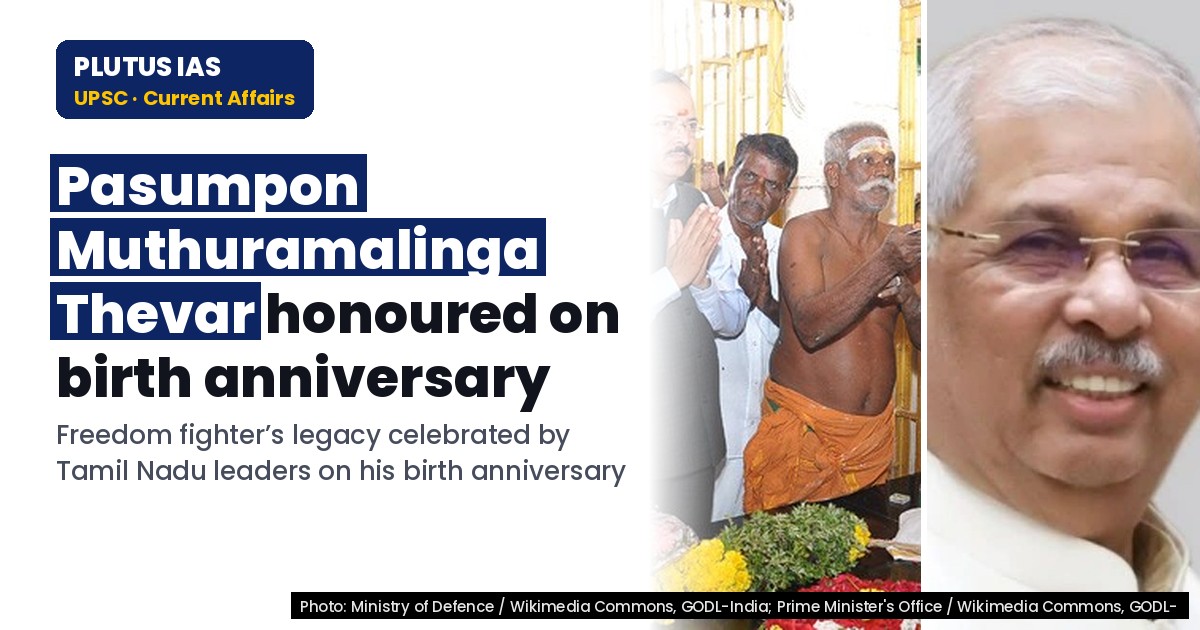
30 Oct Tamil Nadu pays tribute to freedom fighter Pasumpon Muthuramalinga Thevar
✎ Pasumpon Muthuramalinga Thevar was a freedom fighter, Forward Bloc leader, and social reformer who integrated nationalism with spiritual ideals, opposed the Criminal Tribes Act, and supported the Temple Entry Movement, while…
Subject Relevance — Where This Topic Fits
- GS Paper I — Modern Indian History (Freedom Struggle) | GS Paper I — Indian Culture (Tamil Literature and Reform Movements) | GS Paper II — Polity and Governance (Role of Governors and State Leadership)
- Prelims: Forward Bloc, Temple Entry Movement, Criminal Tribes Act, 1871, Netaji Subhas Chandra Bose, Indian National Army (INA), Vallalar, Ramakrishna Paramahamsa, Swami Vivekananda, Pasumpon Muthuramalinga Thevar, Anna Salai, Nandanam
- Essay: Nationalism and Spirituality: The Dual Pillars of India’s Freedom Struggle, Social Reform Movements in India: Bridging Caste and Religious Divides
Quick Revision: Pasumpon Muthuramalinga Thevar was a freedom fighter, Forward Bloc leader, and social reformer who integrated nationalism with spiritual ideals, opposed the Criminal Tribes Act, and supported the Temple Entry Movement, while closely associating with Netaji Subhas Chandra Bose and the Indian National Army.
Why is this in the news?
On 30 October 2026, the Governor of Tamil Nadu and the Chief Minister paid tributes to Pasumpon Muthuramalinga Thevar, a prominent freedom fighter and social reformer from Tamil Nadu, highlighting his multifaceted contributions to the independence movement, social justice, and national integration. The event underscores the enduring relevance of his ideals in contemporary governance and public memory.
Background
- Pasumpon Muthuramalinga Thevar (1908–1963) was a key figure in the Indian independence movement, closely associated with Subhas Chandra Bose and the Indian National Army (INA).
- He was a prominent leader of the Forward Bloc, a left-wing nationalist political party founded by Bose in 1939, which advocated for complete independence from British rule.
- Thevar’s activism extended beyond political struggle to social reform, including his support for the Temple Entry Movement, which aimed to abolish caste-based restrictions in Hindu temples.
- He opposed the Criminal Tribes Act, 1871, a colonial law that stigmatised and restricted the mobility of certain communities, advocating for their rights and dignity.
- Thevar was deeply influenced by spiritual leaders such as Vallalar (Ramalinga Swamigal), Ramakrishna Paramahamsa, and Swami Vivekananda, integrating spiritual ideals with nationalist fervour.
- His legacy is commemorated in Tamil Nadu through statues, including one on Anna Salai in Chennai, and his life is studied as part of the state’s social and political history.
Who was Pasumpon Muthuramalinga Thevar?
- Pasumpon Muthuramalinga Thevar was a freedom fighter, social reformer, and political leader from Tamil Nadu, born in Pasumpon village in Ramanathapuram district in 1908.
- He was a prominent member of the Forward Bloc, a political party founded by Subhas Chandra Bose, which advocated for uncompromising independence from British rule and socialist principles.
- Thevar played a significant role in mobilising support for the Indian National Army (INA) and was a close associate of Netaji Subhas Chandra Bose, participating in the INA’s activities during the Quit India Movement.
- His contributions to social reform included active support for the Temple Entry Movement, which sought to dismantle caste-based discrimination in Hindu religious institutions.
- He opposed the Criminal Tribes Act, 1871, a repressive colonial legislation that labelled certain communities as ‘criminal tribes’ and restricted their movements, and advocated for their rehabilitation and rights.
- Thevar was renowned for his oratory skills and deep knowledge of Tamil literature, often delivering speeches that blended nationalist fervour with spiritual and cultural themes.
- He was influenced by spiritual leaders such as Vallalar (Ramalinga Swamigal), Ramakrishna Paramahamsa, and Swami Vivekananda, whose teachings shaped his philosophy of nationalism and social justice.
- His legacy is commemorated in Tamil Nadu through statues, memorials, and public events, reflecting his enduring impact on the state’s social and political consciousness.
Key Features
| Feature | Significance |
|---|---|
| Freedom fighter status of Pasumpon Muthuramalinga Thevar | Represents the ideological and political legacy of anti-colonial resistance in Tamil Nadu, contributing to the broader narrative of India’s independence movement. |
| Association with Netaji Subhas Chandra Bose and the Indian National Army (INA) | Highlights the trans-regional collaboration among freedom fighters, underscoring the ideological diversity within the independence struggle. |
| Advocacy for temple entry movement | Demonstrates commitment to social justice and reform, particularly in challenging caste-based discrimination in religious spaces. |
| Opposition to the Criminal Tribes Act (repeal) | Shows alignment with civil liberties and critique of colonial-era laws that stigmatised communities. |
| Adherence to teachings of Vallalar, Ramakrishna Paramahamsa, and Swami Vivekananda | Reflects the synthesis of spiritual and social reformist thought in the freedom movement. |
Why it Matters
Historical and Cultural
- Preserves the memory of a regional freedom fighter whose contributions are integral to Tamil Nadu’s socio-political heritage.
- Reinforces the role of spiritual leaders in shaping nationalist thought, bridging regional and pan-Indian ideologies.
- Highlights the intersection of caste reform and anti-colonialism in the independence movement.
Political
- Illustrates the continuity of ideological pluralism in Indian politics, with Thevar’s legacy resonating across party lines.
- Demonstrates the symbolic role of state institutions (Governor, CM) in acknowledging historical figures, reinforcing cultural diplomacy.
Social
- Underscores the enduring relevance of social justice movements in post-colonial India, particularly in combating caste discrimination.
- Showcases the role of public remembrance in fostering national unity and inclusivity.
Challenges
1. Preservation of Historical Memory
- Risk of historical figures being reduced to political symbols, diluting their substantive contributions.
- Challenges in mainstreaming regional freedom fighters’ narratives in national discourse.
UPSC Link: GS-I: Indian Freedom Struggle
2. Balancing Pluralism in Public Remembrance
- Ensuring tributes to historical figures do not inadvertently exclude or marginalise other communities’ narratives.
- Addressing potential politicisation of freedom fighters’ legacies.
UPSC Link: GS-II: Constitutional Framework
3. Integration of Spiritual and Political Discourse
- Maintaining a balance between spiritual teachings and secular governance in public policy discourse.
- Avoiding the conflation of religious symbolism with state functions.
UPSC Link: GS-IV: Ethics and Integrity
Challenges — UPSC Perspective
| Issue | Concern |
|---|---|
| Politicisation of historical figures | Risk of selective appropriation of legacy for partisan gains. |
| Fragmentation of historical narratives | Lack of cohesive national discourse on regional freedom fighters. |
| Overemphasis on symbolic gestures | Potential neglect of substantive policy actions inspired by historical ideals. |
| Caste and religious sensitivities | Challenges in acknowledging contributions without reinforcing divisive identities. |
Way Forward
- Incorporate regional freedom fighters’ narratives into school curricula to ensure intergenerational transmission of historical memory.
- Establish state-funded archives or digital repositories to document and disseminate the works and speeches of lesser-known freedom fighters.
- Promote interdisciplinary research on the intersection of spirituality, social reform, and nationalism in India’s freedom struggle.
- Encourage cross-party consensus on commemorative events to prevent politicisation of historical figures.
- Develop public-private partnerships to create museums or cultural centres dedicated to regional freedom movements.
- Facilitate national seminars or lectures series to highlight the contributions of diverse freedom fighters across regions.
- Strengthen the role of state institutions in preserving cultural heritage without compromising their constitutional neutrality.
UPSC Value Addition
Keywords for Mains Answer-Writing
Pasumpon Muthuramalinga Thevar · Forward Bloc · Tamil Nadu Freedom Struggle · Criminal Tribes Act repeal · Temple Entry Movement · Indian National Army · Netaji Subhas Chandra Bose · Social Justice in Indian Freedom Movement · Non-Brahmin Movement · Tamil Literature and Freedom Struggle · Governor’s Role in State Affairs · Freedom Fighters’ Ideological Contributions · Caste and Religious Boundaries in Nationalism
Constitutional & Policy Linkages
- [‘Article 51A (Fundamental Duties): Promoting harmony and the spirit of common brotherhood.’]
- [‘Article 29 (Cultural and Educational Rights): Protection of minority interests in preserving cultural heritage.’]
Concept Flow
Colonial-era social discrimination (Criminal Tribes Act) → Activism for repeal and temple entry → Alignment with anti-colonial movements (INA, Netaji) → Synthesis of spiritual and nationalist thought → Legacy as a regional icon → Public remembrance and institutional tribute.
Prelims Practice Questions
Q1. Consider the following statements regarding Pasumpon Muthuramalinga Thevar:
1. He was a prominent leader of the Forward Bloc and closely associated with Netaji Subhas Chandra Bose.
2. He actively participated in the Temple Entry Movement and fought against the repeal of the Criminal Tribes Act.
3. He was known for his oratory skills and was well-versed in Tamil literature.
4. He served as the Governor of Tamil Nadu during the freedom struggle.
How many of the above statements are correct?
- Only one
- Only two
- Only three
- All four
Answer: Only three — Statements 1, 2, and 3 are correct as per historical records. Statement 4 is incorrect as Pasumpon Muthuramalinga Thevar was a freedom fighter and not the Governor of Tamil Nadu.
Q2. Assertion (A): The Criminal Tribes Act, 1871, was repealed in independent India due to its discriminatory nature.
Reason (R): The Act classified certain tribes as ‘criminal by birth’ and subjected them to surveillance and restrictions.
In the context of the above two statements, which of the following is correct?
- Both A and R are true, and R is the correct explanation of A.
- Both A and R are true, but R is NOT the correct explanation of A.
- A is true, but R is false.
- A is false, but R is true.
Answer: Both A and R are true, and R is the correct explanation of A. — Both the Assertion (A) and Reason (R) are factually correct. The Criminal Tribes Act was repealed post-independence as it was discriminatory, and the Reason correctly explains the Assertion.
Q3. Match the following leaders with their associated movements or contributions:
Column I
A. Pasumpon Muthuramalinga Thevar
B. Vallalar
C. Ramakrishna Paramahamsa
D. Swami Vivekananda
Column II
1. Spiritual teachings and social reform
2. Tamil literature and non-Brahmin movement
3. Ramakrishna Mission and Vedanta philosophy
4. Service to humanity and abolition of caste
Select the correct match:
- A-2, B-4, C-1, D-3
- A-1, B-2, C-3, D-4
- A-3, B-1, C-4, D-2
- A-4, B-3, C-2, D-1
Answer: A-2, B-4, C-1, D-3 — The correct matches are: A (Pasumpon Muthuramalinga Thevar) with 2 (Tamil literature and non-Brahmin movement), B (Vallalar) with 4 (Service to humanity and abolition of caste), C (Ramakrishna Paramahamsa) with 1 (Spiritual teachings and social reform), and D (Swami Vivekananda) with 3 (Ramakrishna Mission and Vedanta philosophy).
Mains Practice Question
✍ The contributions of regional freedom fighters like Pasumpon Muthuramalinga Thevar extended beyond mere political agitation to encompass social reform, literary revival, and ideological pluralism. Critically examine this statement with reference to his life, ideological affiliations, and impact on the freedom struggle in Tamil Nadu. (15 Marks)
Approach: MODEL-ANSWER SKELETON:
1. **Introduction (2 marks)**: Briefly introduce Pasumpon Muthuramalinga Thevar’s role as a freedom fighter, his association with the Forward Bloc, and his ideological influences (Vallalar, Ramakrishna Paramahamsa, Swami Vivekananda).
2. **Political Contributions (3 marks)**:
– Participation in the Temple Entry Movement and opposition to the Criminal Tribes Act.
– Electoral victories without traditional campaigning, highlighting his mass appeal.
– Association with Netaji Subhas Chandra Bose and the Indian National Army (INA).
3. **Social Reform and Literary Contributions (4 marks)**:
– Advocacy for social justice and opposition to caste and religious boundaries.
– Promotion of Tamil literature and its role in the non-Brahmin movement.
– Influence of spiritual leaders like Vallalar on his reformist ideas.
4. **Ideological Pluralism (3 marks)**:
– Synthesis of nationalism, spirituality, and social reform in his ideology.
– Contrast with other regional leaders to highlight his unique contributions.
– Impact on post-independence Tamil Nadu’s socio-political landscape.
5. **Critical Analysis (3 marks)**:
– Limitations of his contributions (e.g., regional focus, limited pan-Indian impact).
– Challenges in reconciling nationalism with social reform in a diverse society.
– Relevance of his ideals in contemporary India (e.g., caste annihilation, secularism).
Source: The Hindu
Tamil Nadu PCS (TNPSC) — State PCS Practice
Prelims: Which of the following statements is/are correct regarding the tribute paid by Tamil Nadu Governor R.N. Ravi and Chief Minister M.K. Stalin to freedom fighter Pasumpon Muthuramalinga Thevar? 1) The tribute was paid on his birth anniversary. 2) Thevar was a prominent leader of the Dravida Munnetra Kazhagam (DMK). 3) Thevar is known for his role in the Vaikom Satyagraha. 4) The tribute was paid at his memorial in Pasumpon.
- 1 and 3 only
- 2 and 4 only
- 1, 3, and 4 only
- All of the above
Answer: 1, 3, and 4 only — The tribute was paid at his memorial in Pasumpon (4), and Thevar is known for his role in the Vaikom Satyagraha (3). Thevar was not a DMK leader (2), and the tribute was not on his birth anniversary (1).
Mains: Discuss the historical significance of Pasumpon Muthuramalinga Thevar’s contributions to the freedom struggle in Tamil Nadu, highlighting his association with social reform movements and the impact of his legacy on contemporary Tamil Nadu politics.
Generated by AanyaAi for educational purpose.
Related guides on our sites
- Anthropology VS PSIR
- Best PSIR optional coaching
- Best PSIR optional coaching online
- Best sociology optional coaching

- Tamil Nadu pays tribute to freedom fighter Pasumpon Muthuramalinga Thevar - October 30, 2026
- गुजरात: बनासकांठा में पीएम के भाषण से उठे विकास के नए आयाम - October 30, 2026
- NCW Chairperson Holds Public Hearing in Dehradun: Key Issues for UPSC & State PCS - October 30, 2026

No Comments