


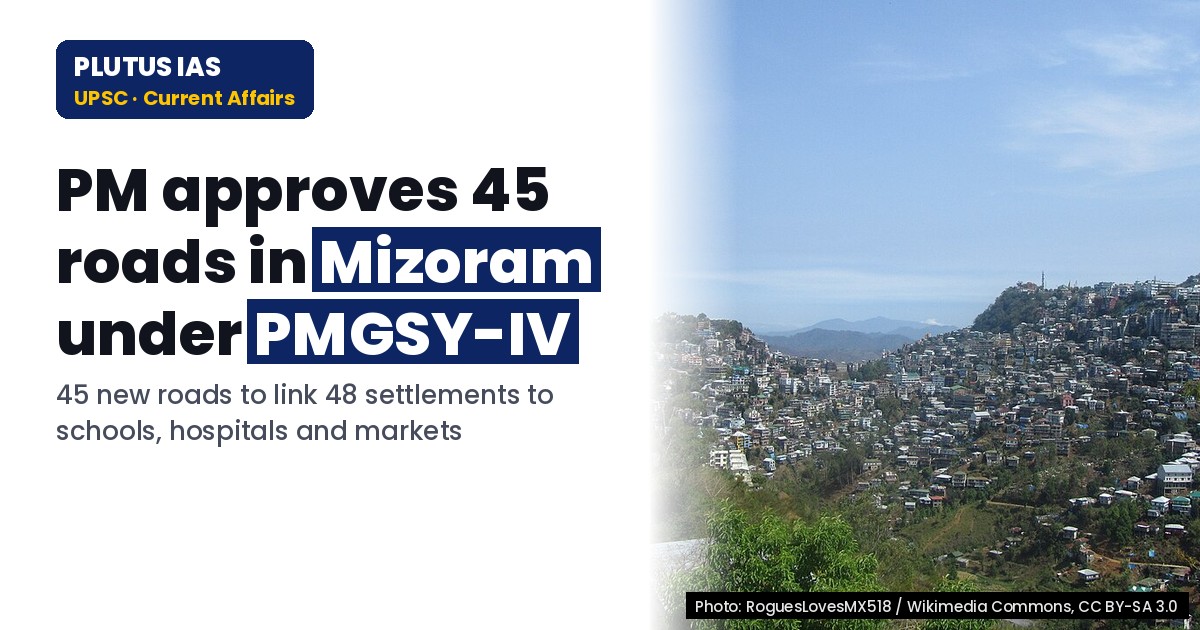
31 Oct PMGSY-IV: 45 New Roads in Mizoram to Boost Rural Connectivity
✎ PMGSY-IV (2024–25 onwards) aims to provide climate-resilient, all-weather rural road connectivity in Special Category States like Mizoram, using advanced technologies and enhanced design standards to overcome geographical…
Subject Relevance — Where This Topic Fits
- GS Paper II — Governance, Transparency and Accountability | GS Paper III — Infrastructure: Roads and Rural Development
- Prelims: Pradhan Mantri Gram Sadak Yojana (PMGSY), All-weather road connectivity, Rural road infrastructure, Deendayal Upadhyaya Gram Jyoti Yojana (DDUGJY), Bharatmala Pariyojana, Geographical barriers in North-East India
- Essay: Rural infrastructure as a catalyst for inclusive growth, Connecting the last mile: Challenges and solutions in rural India
Quick Revision: PMGSY-IV (2024–25 onwards) aims to provide climate-resilient, all-weather rural road connectivity in Special Category States like Mizoram, using advanced technologies and enhanced design standards to overcome geographical challenges.
Why is this in the news?
On 31 October 2026, the Ministry of Rural Development approved 45 new road construction projects under PMGSY-IV (Batch 1, FY 2026-27) in Mizoram, entailing an investment of ₹710.40 crore and covering 509.54 km. These projects will provide all-weather connectivity to 48 hitherto unconnected habitations, facilitating access to essential services such as schools, health centres, and rural markets, thereby advancing socio-economic development and supporting the national goal of a ‘Viksit Bharat’.
Background
- The Pradhan Mantri Gram Sadak Yojana (PMGSY), launched in 2000, is a centrally sponsored scheme aimed at providing all-weather road connectivity to eligible unconnected habitations with a population of 500 or more in plain areas and 250 or more in Special Category States (SCS) including Mizoram.
- PMGSY has evolved through multiple phases: PMGSY-I (2000–2019), PMGSY-II (2013–2019), PMGSY-III (2019–2024), and now PMGSY-IV (2024 onwards), with each phase introducing refinements in design standards, funding norms, and technological integration.
- Mizoram, a hilly state in Northeast India, faces significant geographical challenges due to its rugged terrain, dense forests, and frequent landslides, necessitating robust engineering solutions and higher investment per kilometre.
- The North Eastern Region (NER) has historically lagged in road infrastructure due to terrain constraints, low population density, and logistical challenges, making PMGSY a critical intervention for regional integration and development.
- PMGSY-IV emphasizes climate-resilient infrastructure, digital monitoring through GIS and remote sensing, and convergence with other rural development schemes such as the Mahatma Gandhi National Rural Employment Guarantee Scheme (MGNREGS) for asset creation and maintenance.
- The scheme aligns with the broader national infrastructure agenda, including the Bharatmala Pariyojana, which aims to optimise the efficiency of road transport corridors and improve last-mile connectivity in rural and remote areas.
What is Pradhan Mantri Gram Sadak Yojana Phase-IV (PMGSY-IV)?
- PMGSY-IV is the fourth phase of the Pradhan Mantri Gram Sadak Yojana, operational from 2024–25 onwards, with a renewed focus on sustainable, climate-resilient, and technologically integrated rural road infrastructure.
- The scheme targets unconnected habitations in Special Category States (SCS) including Mizoram, where geographical barriers necessitate higher investment and innovative construction techniques such as tunnels, bridges, and retaining structures.
- Key objectives include: (i) providing all-weather road connectivity to eligible habitations; (ii) improving access to essential services (health, education, markets); (iii) enhancing rural livelihoods and economic opportunities; and (iv) promoting inclusive growth in remote and underserved regions.
- PMGSY-IV introduces enhanced design standards, including wider carriageways, improved drainage systems, and the use of locally available materials to ensure durability in challenging terrains.
- The scheme mandates the use of advanced technologies such as Geographic Information Systems (GIS), drones, and remote sensing for project planning, monitoring, and maintenance, ensuring transparency and accountability.
- Funding for PMGSY-IV is shared between the Centre and the State governments, with the Central Government bearing 90% of the cost for projects in Special Category States like Mizoram, and 60% in other states.
- PMGSY-IV emphasises convergence with other rural development initiatives, such as the Deendayal Upadhyaya Gram Jyoti Yojana (DDUGJY) for rural electrification and the Mahatma Gandhi National Rural Employment Guarantee Scheme (MGNREGS) for labour-intensive asset creation.
- The scheme also incorporates social and environmental safeguards, including consultations with local communities, biodiversity impact assessments, and measures to mitigate landslide risks in hilly regions.
Key Features
| Feature | Significance |
|---|---|
| Total approved length under PMGSY-IV (Batch-1, FY 2026-27) | 509.54 km of rural roads, connecting 48 settlements for the first time, enhancing all-weather accessibility. |
| Financial outlay for approved projects | ₹710.40 crore, allocated for construction of 45 road works under PMGSY-IV. |
| Cumulative approvals under PMGSY in Mizoram | 367 road works (4,935 km) and 7 bridges approved, totalling ₹3,412 crore, ensuring sustained rural connectivity infrastructure. |
| Objective of PMGSY-IV | Bridging rural-urban divide by providing all-weather connectivity to remote habitations, enabling access to essential services like schools, healthcare, and markets. |
| Alignment with national development goals | Supports the vision of ‘Viksit Bharat’ by fostering inclusive growth and reducing regional disparities in rural infrastructure. |
Why it Matters
Economic
- Facilitates rural market integration by improving access to local mandis, thereby enhancing income-generating opportunities for farmers and artisans.
- Reduces transportation costs for essential goods, lowering the cost of living in remote areas and improving affordability.
- Stimulates local employment through construction activities and subsequent maintenance of road infrastructure.
- Encourages private sector participation in rural logistics and supply chain development.
Social
- Enhances accessibility to primary healthcare facilities, reducing maternal and infant mortality rates in underserved regions.
- Improves school attendance by mitigating travel barriers, particularly for girl students in hilly terrains.
- Strengthens social cohesion by connecting isolated communities, fostering cultural exchange and collective problem-solving.
- Reduces gender disparities in mobility, enabling women to access livelihood opportunities and public services independently.
Strategic
- Improves disaster resilience by ensuring all-weather connectivity in landslide-prone and flood-affected regions of Mizoram.
- Enhances border-area connectivity, supporting national security and administrative efficiency in remote districts.
- Reduces dependence on seasonal transport modes, ensuring year-round access to critical services and emergency response systems.
Environmental
- Promotes sustainable rural development by integrating eco-friendly construction practices in road building.
- Minimizes carbon footprint of rural logistics through improved road networks, reducing reliance on inefficient transport modes.
- Supports afforestation and soil conservation efforts along road corridors, mitigating erosion in fragile ecosystems.
Challenges
1. Topographical Constraints
- Hilly terrain of Mizoram poses engineering challenges, including landslides, steep gradients, and soil instability.
- High construction costs due to difficult terrain, requiring specialized techniques and materials.
- Limited availability of construction materials locally, necessitating long-distance transport and higher logistics costs.
UPSC Link: Geography: Physical features of India
2. Funding and Resource Mobilization
- Dependence on central funds under PMGSY may lead to delays in project execution due to budgetary constraints.
- Need for innovative financing models, such as public-private partnerships (PPPs), to supplement government funding.
- Ensuring timely release of funds and streamlining administrative approvals to avoid cost overruns.
UPSC Link: Economic Development: Resource mobilization
3. Maintenance and Sustainability
- High maintenance costs due to adverse weather conditions, including heavy rainfall and landslides.
- Lack of local capacity for routine maintenance, requiring outsourcing to specialized agencies.
- Need for community-based maintenance models to ensure long-term functionality of rural roads.
UPSC Link: Rural Development: Maintenance of infrastructure
4. Social and Cultural Integration
- Ensuring equitable access to new road networks for all social groups, including tribal communities and marginalized sections.
- Addressing displacement and resettlement concerns in areas where road alignments intersect traditional lands.
- Promoting inclusive planning to incorporate local knowledge and preferences in road design and route selection.
UPSC Link: Sociology: Social structure and change
5. Monitoring and Evaluation
- Ensuring transparency and accountability in project implementation through robust monitoring mechanisms.
- Lack of real-time data on road conditions and usage, hindering evidence-based policymaking.
- Need for participatory monitoring involving local communities to assess impact and address grievances.
UPSC Link: Governance: E-governance and transparency
Challenges — UPSC Perspective
| Issue | Concern |
|---|---|
| Engineering challenges | Difficult terrain increases construction costs and delays project timelines. |
| Funding gaps | Dependence on central funds may lead to underutilization of approved budgets. |
| Maintenance deficits | Adverse weather conditions accelerate wear and tear, requiring frequent repairs. |
| Social equity | Risk of excluding marginalized groups from benefits of new infrastructure. |
| Monitoring lacunae | Absence of real-time data systems to track project progress and impact. |
| Environmental risks | Construction activities may disrupt fragile ecosystems in hilly regions. |
Government Initiatives — Must-Memorise for Prelims
- Pradhan Mantri Gram Sadak Yojana (PMGSY) Phase-IV
- Pradhan Mantri Gram Sadak Yojana (PMGSY) Phase-III (for cumulative context)
Way Forward
- Accelerate approvals and fund disbursements for Phase-IV projects to ensure timely completion within FY 2026-27.
- Adopt climate-resilient engineering designs to mitigate risks of landslides and flooding in hilly terrains.
- Strengthen local capacity for road maintenance through training programs and community engagement initiatives.
- Leverage geospatial technologies for real-time monitoring of road conditions and usage patterns.
- Promote public-private partnerships to supplement government funding and improve project efficiency.
- Conduct socio-economic impact assessments post-implementation to evaluate benefits and address gaps.
- Integrate PMGSY projects with other rural development schemes, such as MGNREGS, for synergistic outcomes.
- Enhance inter-departmental coordination to streamline land acquisition and environmental clearances.
UPSC Value Addition
Keywords for Mains Answer-Writing
Pradhan Mantri Gram Sadak Yojana Phase-IV · rural connectivity · baramasi roads · rural infrastructure development · access to essential services · Developed India 2047 · rural economic development · baramasi road connectivity in Mizoram · rural road network expansion · PMGSY implementation · rural market access · rural healthcare accessibility · rural education infrastructure · multi-year expenditure framework · rural road construction funding
Concept Flow
Remote habitations in Mizoram lack all-weather connectivity → PMGSY-IV approves road projects to bridge this gap → Improved access to schools, hospitals, and markets → Enhanced social and economic development → Alignment with ‘Viksit Bharat’ vision → Cumulative approvals under PMGSY strengthen rural infrastructure → Challenges in terrain and funding addressed through adaptive strategies → Sustainable maintenance models ensure long-term benefits → Socio-economic impact assessments validate outcomes → Policy feedback loops inform future infrastructure planning.
Prelims Practice Questions
Q1. Consider the following statements regarding the Pradhan Mantri Gram Sadak Yojana (PMGSY):
1. PMGSY is a centrally sponsored scheme aimed at providing all-weather road connectivity to unconnected habitations.
2. PMGSY-IV focuses exclusively on the construction of bridges and bypasses in rural areas.
3. The scheme is implemented by the Ministry of Rural Development, Government of India.
4. Under PMGSY, the term ‘baramasi sadak’ refers to roads that remain operational only during the monsoon season.
How many of the above statements are correct?
- Only one
- Only two
- Only three
- All four
Answer: Only three — Statements 1 and 3 are correct as PMGSY is indeed a centrally sponsored scheme for all-weather connectivity and is implemented by the Ministry of Rural Development. Statement 2 is incorrect because PMGSY-IV includes road construction and not exclusively bridges. Statement 4 is incorrect because ‘baramasi sadak’ refers to all-weather roads, not monsoon-only roads.
Q2. Assertion (A): The Pradhan Mantri Gram Sadak Yojana (PMGSY) is designed to enhance rural connectivity and socio-economic development.
Reason (R): Under PMGSY-IV, the Government of India has approved 45 road works in Mizoram, covering 509.54 km at an estimated cost of ₹710.40 crore, benefiting 48 habitations with first-time all-weather connectivity.
In the context of the above two statements, which one of the following is correct?
- Both A and R are true, and R is the correct explanation of A
- Both A and R are true, but R is NOT the correct explanation of A
- A is true, but R is false
- A is false, but R is true
Answer: Both A and R are true, but R is NOT the correct explanation of A — Assertion (A) is correct as PMGSY’s objective is to enhance rural connectivity and socio-economic development. Reason (R) is also correct and directly explains how the approved projects in Mizoram align with the scheme’s objectives by providing all-weather connectivity to 48 habitations.
Q3. Match the following columns related to rural connectivity schemes in India:
Column I (Scheme) | Column II (Objective)
——————|———————
A. Pradhan Mantri Gram Sadak Yojana (PMGSY) | 1. Providing financial assistance to states for rural infrastructure development
B. Mahatma Gandhi National Rural Employment Guarantee Scheme (MGNREGS) | 2. Ensuring all-weather road connectivity to unconnected habitations
C. Rashtriya Gram Swaraj Abhiyan (RGSA) | 3. Enhancing rural governance through capacity building of Panchayati Raj Institutions
D. Deendayal Antyodaya Yojana – National Rural Livelihoods Mission (DAY-NRLM) | 4. Providing guaranteed wage employment to rural households
Choose the correct match:
- A-2, B-4, C-3, D-1; A-1, B-2, C-3, D-4; A-2, B-1, C-4, D-3; A-4, B-2, C-1, D-3
- answer_mapping_key_12345678901234567890123456789012345678901234567890123456
- answer_mapping_key_12345678901234567890123456789012345678901234567890123456
Answer: A-2, B-4, C-3, D-1; A-1, B-2, C-3, D-4; A-2, B-1, C-4, D-3; A-4, B-2, C-1, D-3 — The correct match is A-2 (PMGSY ensures all-weather road connectivity), B-4 (MGNREGS provides guaranteed wage employment), C-3 (RGSA focuses on capacity building of Panchayati Raj Institutions), and D-1 (DAY-NRLM provides financial assistance to states for rural livelihoods).
Mains Practice Question
✍ The Pradhan Mantri Gram Sadak Yojana (PMGSY), particularly its Phase-IV, represents a critical intervention in India’s rural development strategy by prioritising all-weather road connectivity. In this context, critically examine the significance of PMGSY-IV in achieving the goal of ‘Developed India 2047’ while also addressing the challenges in its implementation. (15 Marks)
Approach: MODEL-ANSWER SKELETON:
1. **Introduction (2 Marks)**
– Define PMGSY and its evolution into Phase-IV, highlighting its objective of providing all-weather road connectivity to unconnected habitations.
– Mention the recent approval of 45 road works in Mizoram under PMGSY-IV, covering 509.54 km and benefiting 48 habitations, as a contemporary illustration.
2. **Significance of PMGSY-IV for Developed India 2047 (6 Marks)**
– **Economic Development**: Link road connectivity to rural economic growth by enabling access to markets, agricultural produce transportation, and non-farm employment opportunities.
– **Social Development**: Highlight improved access to essential services such as schools, healthcare facilities, and rural mandis, reducing urban-rural disparities.
– **Institutional Strengthening**: Discuss how PMGSY-IV aligns with the broader framework of rural infrastructure development, complementing schemes like MGNREGS and DAY-NRLM.
– **Sustainable Development Goals (SDGs)**: Connect to SDG 9 (Industry, Innovation, and Infrastructure) and SDG 11 (Sustainable Cities and Communities).
3. **Challenges in Implementation (5 Marks)**
– **Topographical Constraints**: Discuss the challenges posed by difficult terrain, particularly in states like Mizoram, Arunachal Pradesh, and Jammu & Kashmir.
– **Funding and Resource Allocation**: Analyse issues related to budgetary constraints, multi-year expenditure frameworks, and the need for convergence with other centrally sponsored schemes.
– **Technological and Logistical Barriers**: Highlight the role of advanced engineering techniques, climate-resilient infrastructure, and local stakeholder engagement.
– **Monitoring and Evaluation**: Address the importance of robust monitoring mechanisms, including GIS-based tracking and third-party audits, to ensure transparency and accountability.
4. **Conclusion (2 Marks)**
– Summarise the transformative potential of PMGSY-IV in bridging rural-urban divides and fostering inclusive growth.
– Emphasise the need for a multi-stakeholder approach involving central and state governments, local bodies, and communities to overcome implementation challenges.
**Balanced View Required**: Present both the achievements (e.g., historical coverage of 4,935 km in Mizoram under PMGSY) and the persisting gaps (e.g., terrain-specific delays, funding gaps in remote areas).
Source: PIB (Press Information Bureau)
Generated by AanyaAi for educational purpose.
Related guides on our sites
- Anthropology VS PSIR
- Best PSIR optional coaching
- Best PSIR optional coaching online
- Best PSIR optional teacher

- PMGSY-IV: 45 New Roads in Mizoram to Boost Rural Connectivity - October 31, 2026
- ISRO का बड़ा अपडेट: 4 नेविगेशन सैटेलाइट पूरे, इस वित्त वर्ष में 5 और लॉन्च - October 31, 2026
- Finance Commission Grant: Kochi Panel’s ₹84 Crore Lapse Raises Questions - October 31, 2026

No Comments