


31 Oct MCAs Nationwide Cleanliness Campaign 6.0: Key Achievements for UPSC & State PCS
✎ Swachhta Abhiyan is a government-led campaign to promote cleanliness, efficiency, and accountability in offices, focusing on sanitation, record management, e-waste recycling, and grievance redressal, with measurable outcomes in…
Subject Relevance — Where This Topic Fits
- GS Paper II — Governance, Transparency and Accountability | GS Paper III — Environment and Sustainable Development
- Prelims: Swachhta Abhiyan, E-waste Management Rules, 2022, Right to Information Act, 2005, Digitisation of records, Revenue from waste recycling, Office space optimisation
- Essay: Governance reforms and administrative efficiency in India, Sustainable development through waste management
Quick Revision: Swachhta Abhiyan is a government-led campaign to promote cleanliness, efficiency, and accountability in offices, focusing on sanitation, record management, e-waste recycling, and grievance redressal, with measurable outcomes in space optimisation and revenue generation.
Why is this in the news?
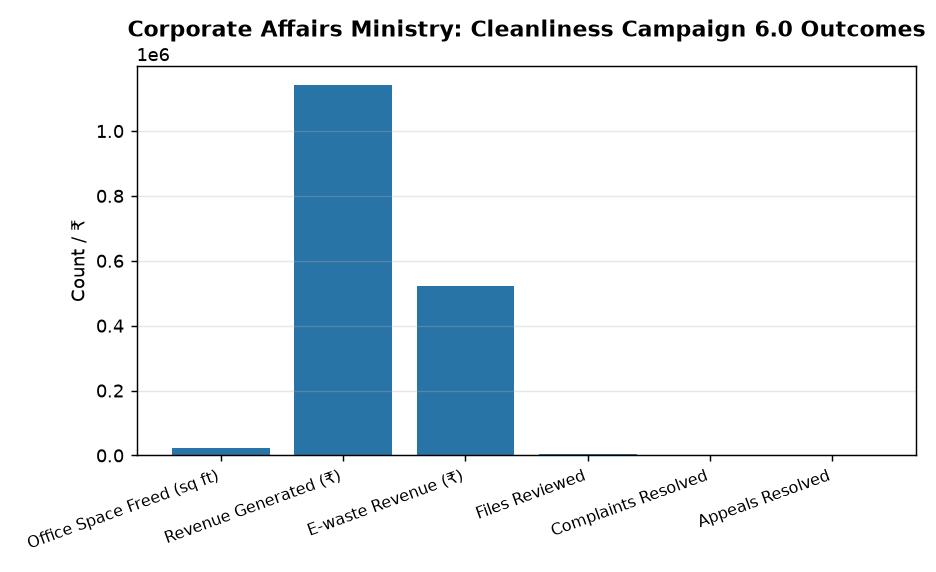
The Ministry of Corporate Affairs (MCA) successfully concluded Swachhta Abhiyan 6.0, a nationwide campaign aimed at enhancing office space utilisation, sanitation, record management, and grievance redressal. The campaign achieved measurable outcomes, including the clearance of 23,285 square feet of office space, revenue generation of ₹11,41,975 through e-waste recycling and other initiatives, and the disposal of 3,658 physical files. The initiative underscores the MCA’s commitment to administrative efficiency, transparency, and citizen-centric governance, aligning with broader national objectives of sustainable development and digital transformation.
Background
- The Swachhta Abhiyan series is a flagship initiative of the Government of India, launched under the broader framework of ‘Swachh Bharat Mission’ to promote cleanliness, efficiency, and accountability in government offices.
- The campaign is conducted periodically by various ministries and departments to streamline administrative processes, optimise resource utilisation, and enhance service delivery.
- E-waste management has emerged as a critical environmental and economic challenge, necessitating systematic recycling and revenue generation mechanisms under the E-waste (Management) Rules, 2022.
- The Right to Information Act, 2005, mandates proactive disclosure and digitisation of records, reinforcing the need for systematic record management in government offices.
- Digitisation and space optimisation are key components of the Government’s Digital India initiative, aimed at reducing physical footprints and improving operational efficiency.
- The MCA’s initiatives reflect the broader trend of administrative reforms in India, focusing on outcomes-based governance and citizen satisfaction.
What is the Swachhta Abhiyan initiative?
- Swachhta Abhiyan is a nationwide campaign launched by the Government of India to promote cleanliness, efficiency, and accountability in government offices through systematic audits and reforms.
- The initiative is conducted periodically by ministries and departments to identify and eliminate redundant processes, optimise space utilisation, and enhance service delivery.
- Key focus areas include sanitation, record management, grievance redressal, and revenue generation through waste recycling, particularly e-waste.
- The campaign aligns with the ‘Swachh Bharat Mission’ and the broader objectives of sustainable development and digital transformation in governance.
- Swachhta Abhiyan 6.0, conducted by the Ministry of Corporate Affairs (MCA), achieved significant milestones, including the clearance of 23,285 sq. ft. of office space and revenue generation of ₹11,41,975 through e-waste recycling and other initiatives.
- E-waste management under the campaign adheres to the E-waste (Management) Rules, 2022, which mandate systematic recycling, disposal, and revenue generation from e-waste.
- The initiative reflects the government’s commitment to administrative efficiency, transparency, and citizen-centric governance, with measurable outcomes in space optimisation, revenue generation, and grievance redressal.
Key Features
| Feature | Significance |
|---|---|
| Office space rationalisation | Enhanced utilisation of government office space, reducing redundancy and optimising resource allocation for improved administrative efficiency. |
| E-waste management | Systematic recycling of electronic waste (IT, telecom, consumer electronics, electrical equipment) generating revenue while ensuring environmentally responsible disposal. |
| Records management | Digitisation and disposal of outdated physical files (3,658 reviewed and closed out of 9,309), improving transparency and reducing storage burdens. |
| Public grievance redressal | Resolution of 322 out of 330 grievances and 342 out of 435 appeals, demonstrating responsiveness to citizen concerns. |
| Cross-institutional coordination | Timely disposal of references from Parliament, PMO, and state governments, reinforcing inter-governmental synergy. |
Why it Matters
Administrative Efficiency
- Demonstrates the Ministry of Corporate Affairs’ commitment to the Special Campaign 2.0 framework for cleanliness and efficiency in governance.
- Highlights the importance of periodic audits and space optimisation in reducing operational costs and improving service delivery.
- Shows measurable outcomes in revenue generation (₹11.42 lakh) and resource conservation (23,285 sq ft space freed).
Sustainable Governance
- Integrates environmental sustainability through e-waste recycling, aligning with India’s commitments under the Solid Waste Management Rules, 2016.
- Promotes circular economy principles by monetising discarded IT assets, reducing landfill burden.
- Supports the Digital India initiative by encouraging digitisation of records to minimise physical storage.
Citizen-Centric Governance
- Strengthens public trust by expediting grievance redressal and inter-governmental reference disposal.
- Enhances transparency through systematic review and disposal of outdated records, reducing information asymmetry.
- Aligns with the Right to Information (RTI) Act’s emphasis on proactive disclosure and efficient record-keeping.
Fiscal Prudence
- Generates revenue from underutilised assets, contributing to fiscal discipline and optimal resource utilisation.
- Reduces long-term storage costs for physical records, freeing up budgetary allocations for critical public services.
Challenges
1. Resistance to Change in Bureaucratic Processes
- Traditional reliance on physical records may hinder digitisation efforts due to cultural inertia in government departments.
- Staff training and capacity-building required to adapt to new record management systems and e-waste handling protocols.
UPSC Link: GS-II: Governance, Transparency
2. Resource Constraints in Implementation
- Limited availability of certified e-waste recyclers may pose logistical challenges in compliance with the E-Waste (Management) Rules, 2022.
- Inadequate infrastructure for secure data wiping before disposal of IT assets could risk data privacy breaches.
UPSC Link: GS-III: Environmental Governance
3. Inter-Departmental Coordination Gaps
- Delays in inter-ministerial or inter-state coordination may impede the timely disposal of references and grievances.
- Lack of standardised protocols across departments can lead to inconsistent implementation of cleanliness and efficiency drives.
UPSC Link: GS-II: Intergovernmental Relations
4. Public Awareness and Participation
- Low awareness among citizens about the importance of e-waste segregation and proper disposal may reduce the effectiveness of recycling initiatives.
- Citizens may lack trust in government-led digitisation, perceiving it as a loss of access to physical records.
UPSC Link: GS-IV: Ethics in Governance
Challenges — UPSC Perspective
| Issue | Concern |
|---|---|
| Cultural resistance to digitisation | Risk of low adoption of digital record-keeping systems due to entrenched bureaucratic practices. |
| Limited e-waste recycling infrastructure | Potential bottlenecks in compliance with e-waste management regulations due to insufficient certified recyclers. |
| Data privacy risks in IT asset disposal | Threat of sensitive information leakage if secure data wiping protocols are not followed. |
| Inter-departmental silos | Fragmented implementation of cleanliness drives due to lack of unified governance frameworks. |
| Citizen scepticism towards digital governance | Possible erosion of public trust if digitisation is perceived as exclusionary. |
Way Forward
- Institutionalise periodic audits of office spaces and records to sustain momentum beyond campaign mode.
- Expand partnerships with certified e-waste recyclers to ensure compliance with the E-Waste (Management) Rules, 2022.
- Develop a national-level training programme for government staff on digital record-keeping and e-waste management.
- Establish a centralised grievance redressal dashboard to track and expedite public complaints across ministries.
- Launch public awareness campaigns to educate citizens on e-waste segregation and the benefits of digitisation.
- Integrate AI-driven tools for predictive maintenance of office infrastructure to pre-empt space underutilisation.
- Strengthen inter-ministerial task forces to ensure seamless coordination in cross-governmental reference disposal.
UPSC Value Addition
Keywords for Mains Answer-Writing
Administrative reforms in India · Swachhata Abhiyaan · Ministry of Corporate Affairs (MCA) · E-governance initiatives · E-waste management · Record management in government · Public grievance redressal · Administrative efficiency · Sushasan (Good Governance) · Space optimization in government offices
Constitutional & Policy Linkages
- [‘Article 19(1)(a) – Right to Information’, ‘Proactive disclosure of records’]
- [‘Article 41 – Directive Principles of State Policy’, ‘Efficient governance and resource utilisation’]
- [‘Article 51A(g) – Fundamental Duties’, ‘Environmental protection’]
Concept Flow
Government offices accumulate redundant physical records and underutilised assets -> → Ministry of Corporate Affairs launches Special Campaign 6.0 under the ‘Special Campaign 2.0’ framework -> → Conducts 75 cleanliness drives to rationalise office space and digitise records -> → Generates revenue (₹11.42 lakh) from e-waste recycling and space optimisation -> → Resolves public grievances (322/330) and inter-governmental references -> → Enhances administrative efficiency, transparency, and citizen-centric governance -> → Demonstrates sustainable and fiscally prudent governance practices
Prelims Practice Questions
Q1. Consider the following statements regarding the Swachhata Abhiyaan 6.0 conducted by the Ministry of Corporate Affairs (MCA):
1. The campaign aimed to optimize office space and enhance record management.
2. A total of 23,285 square feet of office space was vacated as part of the campaign.
3. The campaign generated revenue of ₹11,41,975 through the recycling of e-waste.
4. The campaign exclusively focused on the disposal of physical records and did not address e-waste.
How many of the above statements are correct?
- Only one
- Only two
- Only three
- All four
Answer: Only three — Statements 1, 2, and 3 are correct as per the official PIB release. Statement 4 is incorrect because the campaign addressed both physical record disposal and e-waste management.
Q2. Assertion (A): The Swachhata Abhiyaan 6.0 by the Ministry of Corporate Affairs (MCA) included initiatives for public grievance redressal.
Reason (R): The campaign aimed to enhance administrative efficiency and citizen-centric governance.
Options:
A. Both A and R are true, and R is the correct explanation of A.
B. Both A and R are true, but R is NOT the correct explanation of A.
C. A is true, but R is false.
D. A is false, but R is true.
Answer: ? — Both the assertion and reason are true. The campaign included public grievance redressal as a key component, and the broader goal of enhancing administrative efficiency and citizen-centric governance explains this inclusion.
Q3. Match the following initiatives under the Swachhata Abhiyaan 6.0 with their respective outcomes:
Column I (Initiative) | Column II (Outcome)
1. Office space optimization | A. 3,658 physical files reviewed and disposed
2. E-waste management | B. 23,285 square feet of office space vacated
3. Record management | C. Revenue of ₹5,22,000 generated
4. Public grievance redressal | D. 322 out of 330 grievances resolved
Options:
A. 1-B, 2-C, 3-A, 4-D
B. 1-A, 2-B, 3-C, 4-D
C. 1-D, 2-A, 3-B, 4-C
D. 1-C, 2-D, 3-A, 4-B
Answer: ? — The correct matching is: 1-B (Office space optimization led to 23,285 sq ft vacated), 2-C (E-waste management generated ₹5,22,000), 3-A (Record management reviewed and disposed 3,658 files), 4-D (Public grievance redressal resolved 322 grievances).
Mains Practice Question
✍ The Swachhata Abhiyaan 6.0, launched by the Ministry of Corporate Affairs (MCA), exemplifies a broader trend of administrative reforms in India aimed at enhancing efficiency, transparency, and citizen-centric governance. Critically analyse the significance of such campaigns in the context of India’s administrative architecture and the challenges they address. (15 Marks)
Approach: Introduction: Define administrative reforms and their importance in India’s governance paradigm. Key Components of Swachhata Abhiyaan 6.0: 1. Office space optimization (23,285 sq ft vacated) — link to fiscal prudence and resource efficiency. 2. E-waste management (₹5,22,000 revenue) — connect to environmental sustainability and circular economy principles. 3. Record management (3,658 files reviewed/disposed) — discuss the Right to Information Act, 2005 and digitization efforts. 4. Public grievance redressal (322/330 grievances resolved) — link to the Citizen’s Charter and grievance redressal mechanisms under the Department of Administrative Reforms and Public Grievances (DARPG). Administrative Reforms in India: 1. Constitutional and statutory frameworks (e.g., Article 309, All India Services Act, 1951). 2. Institutional mechanisms (e.g., DARPG, National e-Governance Plan, Digital India Mission). 3. Challenges: Red tape, lack of digitization, resistance to change, and accountability mechanisms. Significance and Impact: 1. Enhancing transparency and reducing corruption. 2. Improving service delivery and citizen satisfaction. 3. Fiscal benefits (e.g., revenue generation from e-waste recycling). 4. Alignment with Sustainable Development Goals (SDGs), particularly SDG 12 (Responsible Consumption and Production) and SDG 16 (Peace, Justice, and Strong Institutions). Critique and Way Forward: 1. Limitations: Scale of implementation, inter-ministerial coordination, and long-term sustainability. 2. Recommendations: Strengthening institutional capacity, leveraging technology (AI, blockchain for record management), and fostering a culture of continuous improvement. Conclusion: Summarize the transformative potential of such campaigns in India’s administrative landscape.
Source: PIB (Press Information Bureau)
Generated by AanyaAi for educational purpose.
Related guides on our sites
- Best PSIR optional coaching for upsc
- Best PSIR optional teacher for upsc
- Best teacher of PSIR optional for upsc
- Best PSIR optional coaching in delhi for UPSC

- MCAs Nationwide Cleanliness Campaign 6.0: Key Achievements for UPSC & State PCS - October 31, 2026
- संयुक्त राष्ट्र ने नेपाल को एलडीसी श्रेणी से बाहर निकलने की तैयारी के लिए 2029 तक का समय दिया - October 31, 2026
- Ministry of Parliamentary Affairs Concludes Special Campaign 6.0: Key Highlights for UPSC & State PCS - October 31, 2026

No Comments