


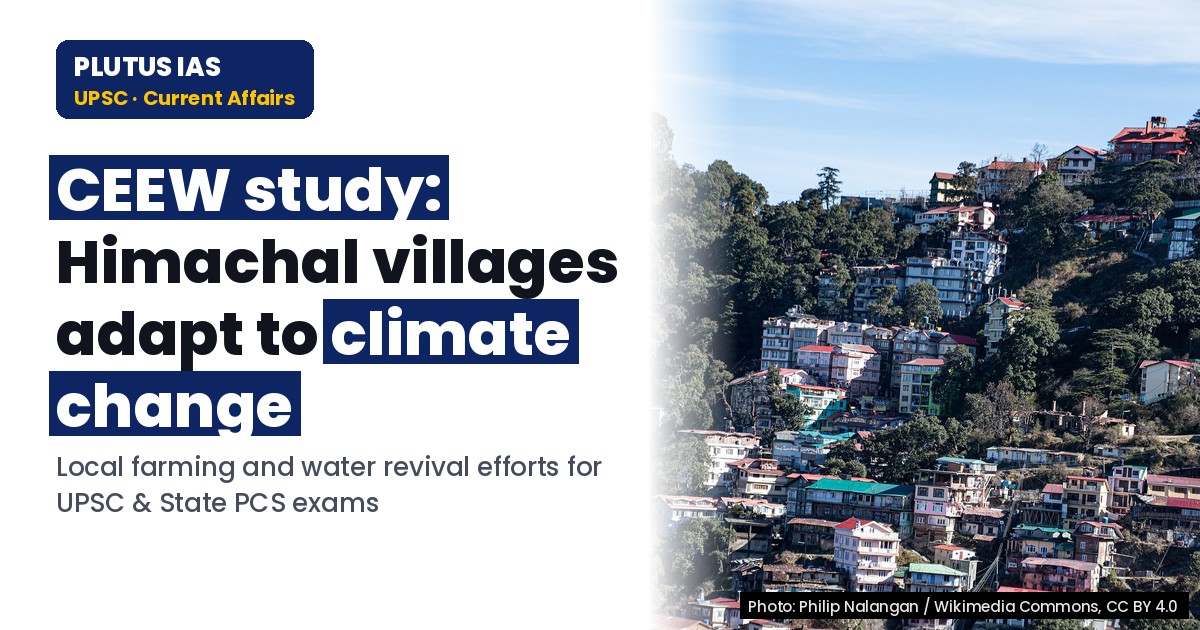
31 Oct Himachal Villages Adapt to Climate Change: CEEW Report Insights for UPSC & State PCS
✎ Climate change adaptation in mountainous regions must prioritise community-led, ecosystem-based solutions, integrating traditional knowledge with institutional support to mitigate risks such as landslides and water scarcity.
Subject Relevance — Where This Topic Fits
- GS Paper III — Environment and Disaster Management
- Prelims: Climate change adaptation, Disaster risk reduction, Community-based disaster management, Himalayan ecosystem vulnerabilities, Sustainable agriculture in fragile ecosystems
- Essay: Climate resilience and sustainable development, Role of local governance in environmental governance
Quick Revision: Climate change adaptation in mountainous regions must prioritise community-led, ecosystem-based solutions, integrating traditional knowledge with institutional support to mitigate risks such as landslides and water scarcity.
Why is this in the news?
A study by the Council on Energy, Environment and Water (CEEW), in collaboration with the International Centre for Integrated Mountain Development (ICIMOD), highlights grassroots-level climate change adaptation measures being implemented in Himachal Pradesh’s rural communities. The findings, released in Shimla, underscore the efficacy of localised solutions in mitigating climate-induced risks such as erratic rainfall, landslides, and agricultural disruptions, while aligning with national disaster management frameworks.
Background
- The Himalayas are among the most climate-vulnerable regions globally, with projections indicating increased frequency of extreme weather events, glacial retreat, and biodiversity loss.
- India’s National Action Plan on Climate Change (NAPCC) and the National Mission for Sustaining the Himalayan Ecosystem (NMSHE) emphasize the need for region-specific adaptation strategies.
- The Disaster Management Act, 2005, mandates the establishment of disaster management authorities at the state, district, and local levels, including Gram Panchayats.
- Himachal Pradesh, with 90% of its area under mountainous terrain, faces heightened risks from landslides, flash floods, and water scarcity, necessitating community-driven resilience measures.
- The CEEW study focuses on 12 Gram Panchayats across Mandi, Kullu, Sirmaur, and Shimla districts, reflecting the diversity of ecological and socio-economic challenges in the state.
What is Climate Change Adaptation in Mountainous Regions?
- Climate change adaptation refers to adjustments in ecological, social, or economic systems in response to actual or expected climatic stimuli and their effects, moderating harm or exploiting beneficial opportunities.
- In mountainous regions, adaptation strategies often include water conservation, sustainable agriculture, afforestation, and community-based disaster preparedness to address vulnerabilities such as landslides, glacial lake outbursts, and changing precipitation patterns.
- Local adaptation measures are critical due to the high dependence of mountain communities on natural resources for livelihoods, coupled with limited institutional capacity at higher governance levels.
- The Himalayas, as a water tower for South Asia, require adaptation strategies that balance ecological integrity with socio-economic development to ensure long-term resilience.
- Key adaptation domains in the Himalayas include water resource management, agricultural diversification, forest conservation, and infrastructure resilience against climate extremes.
- The CEEW study identifies 25 adaptation solutions, including natural farming, revival of traditional water bodies (e.g., baoli), and community-led disaster risk reduction, which are scalable through policy integration.
- Institutional mechanisms such as the Himachal Pradesh State Disaster Management Authority (HPSDMA) play a pivotal role in mainstreaming local adaptation efforts into state-level planning.
- The integration of traditional knowledge with modern science enhances the effectiveness of adaptation measures, as demonstrated by the revival of indigenous agricultural practices in Himachal Pradesh.
Key Features
| Feature | Significance |
|---|---|
| Local adaptation initiatives in Himachal Pradesh villages | Demonstrates grassroots-level climate resilience through community-driven measures such as natural farming, crop diversification, and water source revival. |
| Formation of Gram Panchayat Disaster Management Committees | Institutionalises local disaster preparedness and response mechanisms, exemplified by Shoghi Panchayat post-2023 landslide. |
| Integration of traditional and modern agricultural practices | Showcases adaptive strategies like introducing Japanese plums in place of apples in Kullu and garlic cultivation in Sirmaur. |
| Revitalisation of traditional water systems (e.g., bavdis) | Restores critical local water infrastructure, with women-led groups in Thana Keshog revitalising five bavdis. |
| Strategic Foresight Methodology by CEEW | Identifies 25 adaptation solutions aligned with 30+ government policies, ensuring evidence-based policymaking. |
Why it Matters
Environmental Sustainability
- Highlights the role of decentralised climate adaptation in mitigating risks posed by glacial retreat, erratic rainfall, and increased frequency of extreme weather events in Himalayan ecosystems.
- Emphasises the preservation of biodiversity through sustainable agricultural practices and water conservation in ecologically fragile regions.
Institutional Capacity Building
- Illustrates the effectiveness of local governance structures (Gram Panchayats) in disaster risk reduction and climate resilience.
- Demonstrates synergy between civil society (CEEW, ICIMOD) and government agencies (HPSDMA) in implementing adaptive measures.
Economic Resilience
- Showcases diversification of livelihoods to reduce climate vulnerability, such as transitioning from traditional apple cultivation to alternative high-value crops.
- Underscores the economic cost of inaction, with Himachal Pradesh incurring losses exceeding ₹20,000 crore due to recent disasters.
Social Equity
- Highlights gender-inclusive approaches, with women-led groups actively participating in water conservation and disaster preparedness initiatives.
- Promotes equitable access to resources through community-based adaptation, ensuring marginalised groups benefit from resilience-building efforts.
Challenges
1. Scalability and Replicability
- Limited capacity of Gram Panchayats to sustain and scale adaptation measures without adequate funding and technical support.
- Risk of top-down imposition of solutions that may not align with local ecological and socio-cultural contexts.
UPSC Link: GS3: Climate Change; Disaster Management
2. Funding and Resource Constraints
- Insufficient financial allocations for climate adaptation at the local level, despite identified solutions aligning with national policies.
- Dependence on external funding (e.g., CEEW-ICIMOD partnership) raises questions about long-term sustainability.
UPSC Link: GS2: Centre-State Relations; GS3: Environmental Governance
3. Data Gaps and Monitoring
- Lack of systematic data collection on climate impacts and adaptation outcomes at the village level hinders evidence-based policymaking.
- Need for robust monitoring mechanisms to assess the effectiveness of adaptation strategies over time.
UPSC Link: GS3: Science and Technology; Environment
4. Policy-Implementation Gap
- Despite alignment with 30+ policies, on-ground implementation remains uneven due to bureaucratic delays and lack of inter-departmental coordination.
- Need for convergence between climate adaptation plans and existing developmental schemes (e.g., MGNREGA, Pradhan Mantri Krishi Sinchai Yojana).
UPSC Link: GS2: Governance; GS3: Policy Implementation
5. Climate Migration and Demographic Shifts
- Increasing out-migration from vulnerable villages due to climate-induced livelihood insecurity may undermine community-based adaptation efforts.
- Aging population in rural areas poses challenges for sustaining traditional knowledge systems and labour-intensive adaptation practices.
UPSC Link: GS1: Population and Associated Issues; GS3: Climate Change
Challenges — UPSC Perspective
| Issue | Concern |
|---|---|
| Limited local capacity | Inadequate technical and financial resources for Gram Panchayats to implement adaptation measures. |
| Policy fragmentation | Lack of convergence between climate adaptation plans and existing developmental schemes. |
| Data paucity | Absence of systematic monitoring to evaluate adaptation outcomes and inform future strategies. |
| Climate-induced migration | Out-migration reduces community participation in adaptation initiatives, exacerbating vulnerability. |
| Gender disparities | Unequal access to resources and decision-making roles may marginalise women in adaptation planning. |
Government Initiatives — Must-Memorise for Prelims
- Himachal Pradesh State Disaster Management Authority (HPSDMA) initiatives
- Mahatma Gandhi National Rural Employment Guarantee Scheme (MGNREGS) for water conservation works
Way Forward
- Strengthen Gram Panchayat-level disaster management committees with dedicated funding and capacity-building programmes.
- Establish a state-level climate adaptation fund to support scalable and replicable village-level initiatives.
- Develop a comprehensive monitoring and evaluation framework to track adaptation outcomes and inform policy adjustments.
- Promote convergence between climate adaptation plans and existing schemes like MGNREGS and PMKSY for integrated implementation.
- Enhance technical support for farmers to transition to climate-resilient agricultural practices through extension services.
- Integrate gender-sensitive approaches in adaptation planning to ensure equitable participation and benefits.
- Leverage partnerships with civil society organisations and research institutions for knowledge sharing and capacity building.
- Incorporate climate risk assessments into local development plans to mainstream adaptation into governance.
UPSC Value Addition
Keywords for Mains Answer-Writing
Climate change adaptation · Community-based disaster risk reduction · Local governance and climate resilience · Panchayati Raj Institutions and climate action · Himalayan ecosystem vulnerability · Disaster risk management at grassroots · Natural resource revival in rural areas · Strategic Foresight Methodology · Council on Energy, Environment and Water (CEEW) · Himachal Pradesh State Disaster Management Authority (HPSDMA) · Grama Panchayat-level disaster management committees · Climate-resilient agriculture practices
Constitutional & Policy Linkages
- Article 243G: Powers, authority and responsibilities of Panchayats
Concept Flow
Climate change impacts (glacial retreat, erratic rainfall) → Increased frequency of extreme weather events → Vulnerability of Himalayan ecosystems → Localised adaptation measures (crop diversification, water conservation) → Institutionalisation via Gram Panchayat committees → Policy alignment with national schemes → Scalability challenges and resource constraints → Need for sustainable funding and monitoring → Long-term resilience building.
Prelims Practice Questions
Q1. Consider the following statements regarding the Council on Energy, Environment and Water (CEEW):
1. CEEW is an autonomous, non-profit policy research institution.
2. It focuses exclusively on energy policy and does not engage in climate adaptation research.
3. CEEW collaborated with the International Centre for Integrated Mountain Development (ICIMOD) for the Himachal Pradesh climate adaptation study.
How many of the above statements are correct?
- Only one
- Only two
- All three
- None
Answer: Only two — Statement 1 is correct as CEEW is an autonomous, non-profit policy research institution. Statement 2 is incorrect because CEEW engages in climate adaptation research. Statement 3 is correct as CEEW collaborated with ICIMOD for the study.
Q2. Which of the following districts of Himachal Pradesh were included in the CEEW-ICIMOD study on climate change adaptation?
1. Mandi
2. Kullu
3. Shimla
4. Solan
5. Sirmaur
Select the correct answer using the code below:
- 1, 2 and 3 only
- 1, 2, 3 and 5 only
- 2, 3, 4 and 5 only
- 1, 3 and 4 only
Answer: 1, 2, 3 and 5 only — The study included Mandi, Kullu, Shimla, and Sirmaur districts. Solan was not included in the study.
Q3. Assertion (A): The Himachal Pradesh State Disaster Management Authority (HPSDMA) was established to address climate-induced disasters.
Reason (R): The HPSDMA was constituted under the Disaster Management Act, 2005, to ensure a holistic and coordinated approach to disaster management.
Options:
A. Both A and R are true, and R is the correct explanation of A.
B. Both A and R are true, but R is not the correct explanation of A.
C. A is true, but R is false.
D. A is false, but R is true.
Answer: ? — Both A and R are true. The HPSDMA was established under the Disaster Management Act, 2005, to address disasters, including those induced by climate change.
Mains Practice Question
✍ Critically examine the role of local self-governance institutions, particularly Panchayati Raj Institutions (PRIs), in building climate resilience at the grassroots level. Substantiate your arguments with reference to recent initiatives in Himachal Pradesh. (15 Marks)
Approach: MODEL-ANSWER SKELETON:
1. **Introduction (2 Marks)**
– Define climate resilience and its significance for rural communities, especially in ecologically fragile regions like the Himalayas.
– Mention the constitutional mandate for PRIs under Article 243G and the 73rd Amendment Act, 1992, empowering them to address local environmental challenges.
2. **Role of PRIs in Climate Resilience (5 Marks)**
– **Disaster Risk Reduction (DRR):**
– Formation of Gram Panchayat-level disaster management committees (e.g., Shoghi Panchayat’s initiative post-2023 landslides).
– Training of villagers in first aid and safe evacuation (as highlighted in the CEEW-ICIMOD study).
– **Natural Resource Management:**
– Revival of traditional water bodies (e.g., 5 baoris revived in Thana Koshog).
– Promotion of climate-resilient agriculture (e.g., adoption of Japanese plums in Kullu, garlic cultivation in Sirmaur).
– **Policy Integration:**
– Alignment with national schemes like the National Mission for Sustaining the Himalayan Ecosystem (NMSHE) and State Action Plans on Climate Change (SAPCC).
– Strategic Foresight Methodology used by CEEW to identify 25 adaptation solutions.
3. **Challenges and Limitations (4 Marks)**
– **Institutional Constraints:**
– Limited financial autonomy and dependency on state/central funds.
– Lack of technical expertise for climate risk assessment.
– **Implementation Gaps:**
– Inconsistent capacity-building across PRIs.
– Need for stronger convergence with line departments (e.g., agriculture, forestry).
– **Climate Justice Concerns:**
– Marginalized groups (women, small farmers) may lack equal participation in decision-making.
4. **Comparative Perspective (2 Marks)**
– Contrast Himachal’s approach with other Himalayan states (e.g., Uttarakhand’s Van Panchayats or Sikkim’s organic farming initiatives).
5. **Conclusion and Way Forward (2 Marks)**
– PRIs are critical but require enhanced financial devolution, technical support, and multi-stakeholder partnerships.
– Recommendations:
– Institutionalize climate budgeting at the Panchayat level.
– Scale up community-led DRR programs (e.g., HPSDMA’s 2026 ‘Disaster Rakshak Yojana’).
– Integrate traditional knowledge with modern science (e.g., revival of indigenous water harvesting systems).
Source: amarujala.com
Himachal Pradesh PCS (HPPSC (HAS)) — State PCS Practice
Prelims: As per the recent CEEW study on climate adaptation in Himachal Pradesh villages, which of the following is a key focus area for local adaptation efforts?
- A. Promotion of large-scale industrialization to boost economy
- B. Implementation of traditional water harvesting systems like ‘kuhls’ and ‘khadins’
- C. Expansion of urban infrastructure in rural areas
- D. Increase in fossil fuel-based transportation
Answer: B. Implementation of traditional water harvesting systems like ‘kuhls’ and ‘khadins’ — The CEEW study highlights traditional water harvesting systems like ‘kuhls’ and ‘khadins’ as critical adaptation measures in Himachal Pradesh villages.
Mains: Discuss the role of traditional knowledge systems in climate change adaptation in Himachal Pradesh, citing examples from the recent CEEW study. (200 words)
Generated by AanyaAi for educational purpose.
Related guides on our sites
- Best PSIR optional coaching for upsc
- Best economics optional coaching for upsc
- Best PSIR optional teacher for upsc
- Best teacher of PSIR optional for upsc


No Comments