


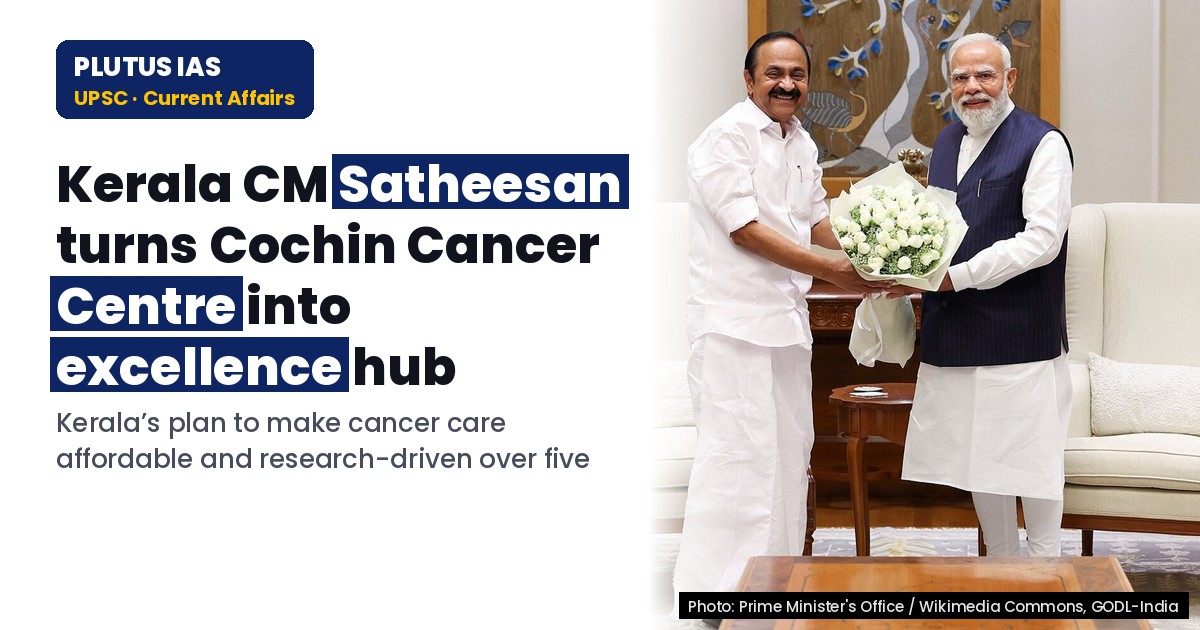
01 Nov Cochin Cancer Research Centre to be Developed into Centre of Excellence by Kerala CM
✎ The Cochin Cancer Research Centre’s transformation into a Centre of Excellence underscores the critical role of public sector institutions in reducing financial toxicity and improving access to affordable, high-quality cancer…
Subject Relevance — Where This Topic Fits
- GS Paper II — Governance, Administration and Challenges (Public Health Governance) | GS Paper III — Science and Technology (Health Research and Innovation)
- Prelims: Cancer epidemiology in India, Public health infrastructure, Affordable healthcare, National Health Mission (NHM), Generic medicines, Medical pluralism
- Essay: Public health as a determinant of national development, Equity in healthcare: Balancing access, affordability, and quality
Quick Revision: The Cochin Cancer Research Centre’s transformation into a Centre of Excellence underscores the critical role of public sector institutions in reducing financial toxicity and improving access to affordable, high-quality cancer care in India.
Why is this in the news?
The Chief Minister of Kerala announced the phased transformation of the Cochin Cancer Research Centre (CCRC) into a Centre of Excellence, emphasizing its role in affordable cancer treatment, research, and prevention. This initiative highlights the intersection of public health policy, institutional capacity building, and the need for equitable healthcare delivery in India, particularly in the context of rising cancer burden and financial toxicity associated with treatment.
Background
- Kerala, with a high Human Development Index (HDI), reports one of the highest cancer incidence rates in India, necessitating robust public health infrastructure.
- Public sector cancer care in India remains underutilized due to gaps in accessibility, affordability, and quality, despite initiatives like the National Cancer Grid (NCG).
- The Cochin Cancer Research Centre (CCRC), established in 2016, has been a key public sector institution in Kerala, providing treatment and conducting research, but faces challenges in scaling up to meet demand.
- The Union Government’s National Health Policy (2017) and Ayushman Bharat (2018) emphasize preventive, promotive, and curative healthcare, including cancer management.
- Kerala’s ‘Aardram Mission’ and ‘Keralam Health Action Plan’ prioritize strengthening public health systems, including tertiary care and research institutions.
What is the Cochin Cancer Research Centre (CCRC)?
- The Cochin Cancer Research Centre (CCRC) is a public sector tertiary care and research institution located in Kochi, Kerala, established in 2016.
- It functions under the Kerala State Health Services and is affiliated with the National Cancer Grid (NCG), a network of cancer centers in India.
- The centre provides comprehensive cancer care, including diagnosis, treatment (surgery, chemotherapy, radiotherapy), palliative care, and rehabilitation.
- CCRC conducts research on cancer epidemiology, treatment protocols, and public health interventions, with a focus on Kerala’s demographic and environmental context.
- The centre serves as a referral hub for cancer patients from Kerala and neighboring states, addressing gaps in tertiary care.
- CCRC’s transformation into a Centre of Excellence aligns with Kerala’s broader public health strategy to reduce out-of-pocket expenditure (OOP) on cancer treatment.
- The initiative emphasizes integration of research, clinical care, and preventive oncology to address the rising burden of non-communicable diseases (NCDs).
- Capacity building at CCRC includes upgrading infrastructure, human resource development, and collaboration with national and international research institutions.
Key Features
| Feature | Significance |
|---|---|
| Development of Cochin Cancer Research Centre into a centre of excellence | Enhances public sector capacity for advanced cancer treatment and research, ensuring affordability and accessibility for economically disadvantaged populations. |
| Five-year phased development plan | Provides structured, time-bound implementation with annual targets, enabling systematic resource allocation and progress monitoring. |
| Emphasis on prevention and early diagnosis | Aligns with global best practices in oncology, reducing late-stage treatment costs and improving survival rates through proactive healthcare. |
| Provision for low-cost or free diagnostic tests | Mitigates financial burden on families, particularly those from economically weaker sections, by reducing out-of-pocket expenditure. |
| Availability of high-quality generic medicines | Promotes cost-effective treatment alternatives, reducing reliance on expensive patented drugs and enhancing public health equity. |
Why it Matters
Public Health Governance
- Demonstrates the role of state-led healthcare institutions in addressing non-communicable diseases (NCDs) like cancer, which constitute a growing burden in India.
- Highlights the constitutional directive under Article 47 to improve public health standards and reduce preventable mortality.
- Reinforces the principle of universal health coverage (UHC) by ensuring equitable access to cancer care without financial hardship.
Economic Implications
- Reduces catastrophic health expenditure (CHE) for households, a critical issue in India where cancer treatment often leads to impoverishment.
- Lowers long-term economic costs by prioritising prevention and early intervention, thereby reducing the need for expensive tertiary care.
- Supports the government’s commitment to reducing out-of-pocket expenditure (OOPE) in healthcare, as outlined in the National Health Policy 2017.
Research and Innovation
- Positions Kerala as a hub for cancer research, leveraging existing infrastructure and expertise to contribute to national and global oncology advancements.
- Encourages interdisciplinary collaboration between clinicians, epidemiologists, and public health experts to address regional cancer epidemiology.
- Supports the development of indigenous research capabilities, reducing dependence on imported diagnostics and therapeutics.
Social Equity
- Ensures that marginalised and economically weaker sections (EWS) have access to high-quality cancer care, aligning with the Sustainable Development Goal (SDG) 3.8 on UHC.
- Promotes health as a public good, countering the commercialisation of healthcare services in the private sector.
- Strengthens the public sector’s role as a safety net, preventing financial ruin due to medical expenses.
Challenges
1. Resource Mobilisation and Allocation
- Securing sustained funding for long-term infrastructure development and research activities beyond the initial ₹5.25 crore allocation.
- Balancing immediate healthcare needs with investment in research and preventive measures to ensure holistic cancer control.
- Ensuring efficient utilisation of funds to avoid delays or misallocation, which could undermine public trust.
UPSC Link: GS2: Health, GS3: Resource Mobilisation
2. Human Resource Development
- Addressing the shortage of oncologists, radiologists, and allied healthcare professionals in public institutions.
- Providing continuous medical education (CME) and training to keep staff updated with advancements in cancer diagnostics and treatment.
- Retaining skilled personnel in public sector institutions, which often face competition from higher-paying private sector roles.
UPSC Link: GS2: Health, GS3: Human Resource Development
3. Regional Cancer Epidemiology and Prevention
- Identifying and addressing local risk factors contributing to rising cancer incidence in Kerala, such as lifestyle changes, environmental pollutants, or occupational hazards.
- Developing targeted prevention strategies, including awareness campaigns, vaccination (e.g., HPV for cervical cancer), and screening programmes.
- Integrating cancer registry data with national health information systems for evidence-based policymaking.
UPSC Link: GS2: Health, GS3: Science and Technology
4. Regulatory and Ethical Oversight
- Ensuring the ethical conduct of clinical trials and research, particularly when involving vulnerable populations.
- Implementing robust quality control measures for generic medicines to guarantee efficacy and safety.
- Preventing the proliferation of unproven or pseudoscientific treatments in the public sector.
UPSC Link: GS2: Health, GS4: Ethics in Governance
5. Public-Private Partnership (PPP) Dynamics
- Leveraging PPP models to augment infrastructure and expertise without compromising affordability or equity.
- Avoiding over-reliance on private sector partnerships, which may prioritise profit over public health goals.
- Ensuring transparency and accountability in PPP agreements to prevent conflicts of interest.
UPSC Link: GS2: Health, GS3: PPP Models
6. Public Awareness and Stigma Reduction
- Countering myths and misconceptions about cancer, which often delay diagnosis and treatment-seeking behaviour.
- Promoting early detection through community-based screening programmes and health education.
- Addressing socio-cultural barriers, such as gender norms or superstitions, that hinder access to cancer care.
UPSC Link: GS2: Health, GS4: Social Justice
Challenges — UPSC Perspective
| Issue | Concern |
|---|---|
| Funding gaps for long-term development | Risk of project stalling due to insufficient or discontinuous financial support. |
| Shortage of specialised healthcare workforce | Limited capacity to deliver advanced cancer care and conduct research. |
| High out-of-pocket expenditure in private sector | Continued financial burden on families despite public sector efforts. |
| Regional disparities in cancer burden | Need for tailored interventions to address Kerala-specific risk factors. |
| Ethical concerns in clinical research | Ensuring informed consent and equitable benefit-sharing in research studies. |
| Public scepticism towards generic medicines | Overcoming perceptions of lower efficacy compared to branded drugs. |
Way Forward
- Formulate a detailed five-year roadmap with annual milestones for infrastructure upgradation, research initiatives, and preventive measures.
- Establish a dedicated fund for cancer research and treatment, supplemented by state and central government allocations, as well as CSR contributions.
- Strengthen the Kerala Cancer Registry to improve data-driven policymaking and identify high-risk populations for targeted interventions.
- Expand training programmes for oncologists, nurses, and paramedical staff, in collaboration with national institutions like AIIMS and NCI.
- Launch community awareness campaigns on cancer prevention, early symptoms, and the benefits of public sector treatment facilities.
- Develop protocols for low-cost or free diagnostic tests, ensuring accessibility for EWS populations through Ayushman Bharat and state health schemes.
- Promote the production and distribution of high-quality generic medicines through public sector undertakings like HLL Lifecare Limited.
- Foster partnerships with academic institutions and international organisations (e.g., WHO, NCI) to enhance research capabilities and knowledge exchange.
UPSC Value Addition
Keywords for Mains Answer-Writing
Cancer treatment in India · Public health infrastructure · Affordable healthcare · Medical research institutions · Generic medicines policy · Cancer prevention and early diagnosis · Public sector healthcare · Kerala healthcare model · Healthcare financing · Universal Health Coverage (UHC) · National Cancer Grid · Ayushman Bharat Scheme · WHO Framework Convention on Tobacco Control · Cancer epidemiology in India · Public health governance
Concept Flow
Rising cancer incidence in Kerala → Recognition of public sector role in affordable care → Chief Minister’s announcement to develop Cochin Cancer Research Centre → Phased development plan with research and treatment focus → Emphasis on prevention, early diagnosis, and low-cost diagnostics → Strengthening public health infrastructure → Reduction in catastrophic health expenditure → Alignment with SDG 3.8 (UHC) → Enhanced social equity and health governance.
Prelims Practice Questions
Q1. Consider the following statements regarding the Cochin Cancer Research Centre (CCRC):
1. The CCRC is being developed into a centre of excellence for cancer treatment and research.
2. The Chief Minister of Kerala announced a comprehensive five-year development plan for the CCRC.
3. The CCRC is a private sector initiative aimed at reducing the financial burden on families affected by cancer.
How many of the above statements are correct?
- Only one
- Only two
- All three
- None
Answer: Only two — Statements 1 and 2 are correct as per the news report. Statement 3 is incorrect because the CCRC is a public sector institution, not a private sector initiative.
Q2. Assertion (A): Public sector healthcare institutions play a crucial role in making cancer treatment accessible and affordable to the common people.
Reason (R): The Cochin Cancer Research Centre (CCRC) is being developed into a centre of excellence to address the rising burden of cancer in Kerala.
Options:
A. Both A and R are true, and R is the correct explanation of A.
B. Both A and R are true, but R is not the correct explanation of A.
C. A is true, but R is false.
D. A is false, but R is true.
Answer: ? — Both A and R are true. The CCRC’s development into a centre of excellence is a specific example of how public sector healthcare institutions can address the rising burden of cancer, but R does not fully explain A, as A is a general statement about public sector healthcare.
Q3. Match the following initiatives with their respective objectives:
Column I (Initiative) | Column II (Objective)
— | —
1. Cochin Cancer Research Centre (CCRC) development plan | A. Providing free medical tests to economically disadvantaged sections
2. National Cancer Grid | B. Strengthening cancer care infrastructure across India
3. Ayushman Bharat Scheme | C. Ensuring access to affordable healthcare for the underprivileged
4. WHO Framework Convention on Tobacco Control | D. Reducing tobacco consumption to prevent cancer
Options:
A. 1-A, 2-B, 3-C, 4-D
B. 1-C, 2-B, 3-A, 4-D
C. 1-B, 2-A, 3-C, 4-D
D. 1-D, 2-C, 3-B, 4-A
Answer: ? — 1-A: The CCRC development plan includes provisions for free medical tests for economically disadvantaged sections. 2-B: The National Cancer Grid aims to strengthen cancer care infrastructure across India. 3-C: The Ayushman Bharat Scheme ensures access to affordable healthcare for the underprivileged. 4-D: The WHO Framework Convention on Tobacco Control aims to reduce tobacco consumption to prevent cancer.
Mains Practice Question
✍ Critically examine the role of public sector healthcare institutions in addressing the rising burden of cancer in India. In your answer, discuss the significance of initiatives like the Cochin Cancer Research Centre (CCRC) development plan and the need for affordable cancer care. Also, analyse the challenges faced by public healthcare systems in achieving Universal Health Coverage (UHC) for cancer treatment. (15 Marks)
Approach: MODEL-ANSWER SKELETON:
1. **Introduction (2 Marks)**
– Define cancer as a non-communicable disease (NCD) and highlight its growing burden in India (e.g., rising incidence, mortality rates, and economic impact).
– Mention the constitutional provision (Article 47 of the Directive Principles of State Policy) that underscores the state’s responsibility for improving public health.
2. **Role of Public Sector Healthcare Institutions (4 Marks)**
– **Accessibility and Affordability**: Discuss how public sector institutions like the CCRC can provide cost-effective cancer treatment, reducing financial hardship for families (reference to the news report on CCRC’s development plan).
– **Research and Innovation**: Highlight the importance of public research institutions in advancing cancer treatment and prevention strategies (e.g., National Cancer Grid, ICMR initiatives).
– **Preventive Healthcare**: Emphasise the role of public health programmes in early diagnosis and prevention (e.g., screening programmes, awareness campaigns).
– **Policy Support**: Reference schemes like Ayushman Bharat and the National Health Mission (NHM) that aim to expand healthcare access.
3. **Challenges in Achieving UHC for Cancer Care (5 Marks)**
– **Infrastructure and Manpower Shortages**: Discuss the gaps in healthcare infrastructure, lack of oncologists, and diagnostic facilities, particularly in rural and underserved areas.
– **Financial Constraints**: Analyse the high cost of cancer treatment, including chemotherapy, radiotherapy, and surgical interventions, and the burden on low-income families.
– **Regulatory and Governance Issues**: Highlight challenges in implementing policies, ensuring quality control, and integrating public and private healthcare systems.
– **Data and Surveillance Gaps**: Discuss the lack of reliable cancer registry data, which hampers evidence-based policymaking.
– **Inter-sectoral Coordination**: Emphasise the need for collaboration between health ministries, research institutions, and international bodies (e.g., WHO, National Cancer Grid).
4. **Way Forward (4 Marks)**
– **Strengthening Public Health Infrastructure**: Propose measures like increasing budgetary allocations, expanding tertiary care centres, and training healthcare professionals.
– **Policy Interventions**: Discuss the role of the National Cancer Control Programme (NCCP), Ayushman Bharat, and generic medicine policies in reducing costs.
– **Preventive Strategies**: Highlight the importance of tobacco control (WHO Framework Convention on Tobacco Control), vaccination (HPV, Hepatitis B), and lifestyle interventions.
– **Public-Private Partnerships (PPPs)**: Suggest models like the CCRC development plan to leverage private sector expertise while ensuring affordability.
5. **Conclusion (2 Marks)**
– Summarise the critical role of public sector institutions in addressing the cancer burden.
– Reiterate the need for a multi-pronged approach combining healthcare infrastructure, policy reforms, and preventive strategies to achieve UHC.
Source: The Hindu
Generated by AanyaAi for educational purpose.

- Cochin Cancer Research Centre to be Developed into Centre of Excellence by Kerala CM - November 1, 2026
- रुपये की गिरावट: घबराहट नहीं, नीति चाहिए - November 1, 2026
- ‘आत्मनिर्भर पंचायतों’ निर्माण हेतु केंद्र सरकार का अभियान: पीवीजीएसवाई - November 1, 2026

No Comments