


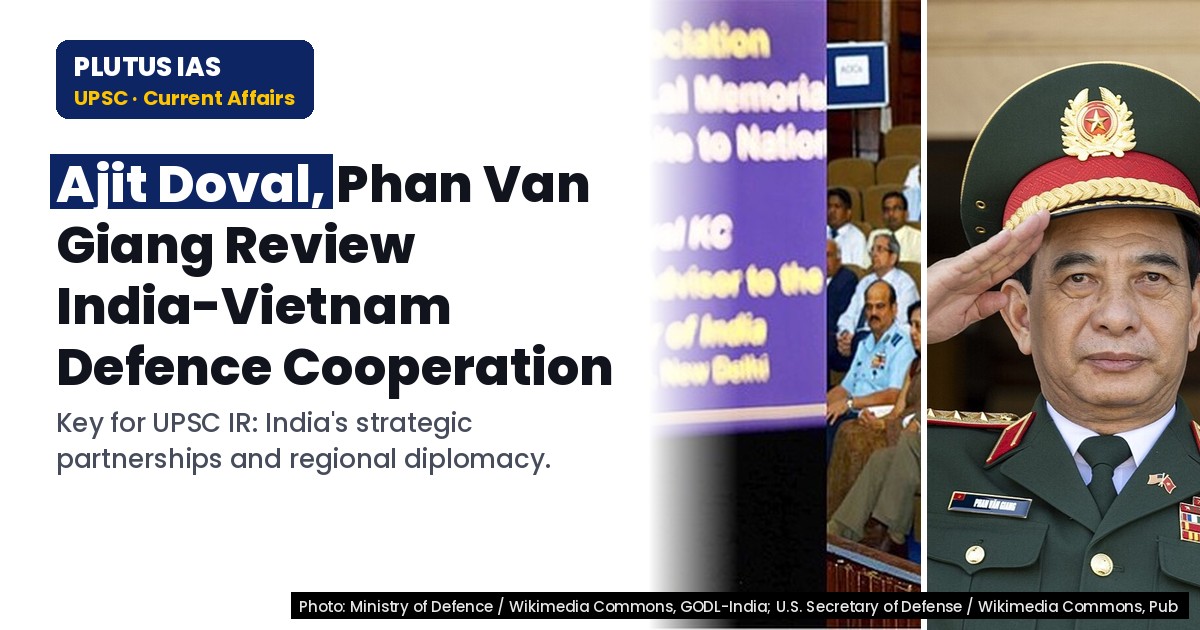
02 Nov India-Vietnam Defence Ties Deepen: UPSC IR Analysis
✎ India and Vietnam's Enhanced Comprehensive Strategic Partnership is significantly underpinned by robust defence cooperation, aimed at bolstering regional stability and a rules-based Indo-Pacific order.
Subject Relevance — Where This Topic Fits
- GS Paper II — International Relations: Bilateral, Regional and Global Groupings and Agreements Involving India and/or Affecting India’s Interests; India and its Neighborhood- Relations. | GS Paper III — Security: Challenges to Internal Security through Communication Networks, Role of Media and Social Networking Sites in Internal Security Challenges, Basics of Cyber Security; Money-Laundering and its Prevention; Security Challenges and their Management in Border Areas – Linkages of Organized Crime with Terrorism.
- Prelims: India-Vietnam relations, Enhanced Comprehensive Strategic Partnership, National Security Advisor (NSA), Act East Policy, Indo-Pacific region, Defence cooperation agreements, Bilateral trade targets
- Essay: India’s Act East Policy and its implications for regional stability., The role of defence diplomacy in strengthening bilateral relations and promoting national interests.
Quick Revision: India and Vietnam’s Enhanced Comprehensive Strategic Partnership is significantly underpinned by robust defence cooperation, aimed at bolstering regional stability and a rules-based Indo-Pacific order.
Why is this in the news?
The National Security Advisor (NSA) of India, Ajit Doval, recently met with Vietnam’s Deputy Prime Minister and Minister of National Defence, General Phan Van Giang, in Hanoi. The meeting focused on reviewing the existing bilateral defence cooperation and exploring avenues for further deepening engagement in this critical sector. This high-level interaction underscores the ongoing commitment of both nations to bolster their strategic partnership, particularly in defence and security domains, aligning with the broader objectives of their Enhanced Comprehensive Strategic Partnership.
Background
- India and Vietnam share a long-standing relationship rooted in historical and cultural ties, which has evolved into a robust strategic partnership.
- The relationship was elevated to an ‘Enhanced Comprehensive Strategic Partnership’ during Vietnamese President To Lam’s visit to India in May, signifying a significant upgrade in the breadth and depth of bilateral engagement.
- Defence cooperation forms a crucial component of this partnership, encompassing areas such as military training, joint exercises, defence technology transfer, and maritime security collaboration.
- India’s ‘Act East Policy’ places Vietnam as a key partner in the Indo-Pacific region, emphasizing enhanced engagement across various sectors, including defence and security.
- Both nations share common interests in maintaining peace, stability, and a rules-based order in the Indo-Pacific, particularly concerning maritime security and freedom of navigation.
- A bilateral trade target of USD 25 billion annually by 2030 has been set, reflecting the growing economic interdependence and ambition for deeper commercial ties alongside strategic cooperation.
India-Vietnam Defence Cooperation
- India-Vietnam defence cooperation is a cornerstone of their Enhanced Comprehensive Strategic Partnership, reflecting shared strategic interests and a commitment to regional stability.
- The cooperation encompasses a wide array of activities, including regular high-level exchanges, joint military exercises, and capacity-building initiatives.
- India provides training to Vietnamese military personnel in various specialized fields, contributing to the modernization and professionalization of Vietnam’s armed forces.
- Technology transfer in defence equipment and platforms is an emerging area, with India offering lines of credit to Vietnam for defence procurement, thereby strengthening Vietnam’s defence capabilities.
- Maritime security is a significant focus, given both countries’ extensive coastlines and strategic locations in the Indo-Pacific. This includes cooperation in hydrography, information sharing, and combating piracy.
- Joint naval exercises and port calls by naval vessels facilitate interoperability and mutual understanding between the two navies.
- The cooperation is underpinned by the shared vision of a free, open, inclusive, and rules-based Indo-Pacific region, where international law, particularly the UNCLOS, is respected.
- This partnership contributes to India’s broader ‘Act East Policy’ objectives, aiming to strengthen engagement with Southeast Asian nations for mutual benefit and regional security.
Key Features
| Feature | Significance |
|---|---|
| Enhanced Comprehensive Strategic Partnership | Elevates bilateral relations to a higher plane, encompassing diverse sectors beyond traditional diplomacy. |
| Bilateral Defence Cooperation | Focuses on mutual security interests, capacity building, and regional stability in the Indo-Pacific. |
| High-Level Engagements (NSA, Deputy PM) | Demonstrates commitment to strategic dialogue and ensures top-level oversight of partnership implementation. |
| Trade Target of USD 25 Billion by 2030 | Establishes an ambitious economic goal, signifying deepening commercial ties and mutual prosperity. |
| Regular Review Mechanisms | Ensures continuous assessment of progress and identification of new avenues for collaboration. |
Why it Matters
Strategic Significance
- Reinforces India’s ‘Act East’ policy, strengthening engagement with Southeast Asian nations.
- Contributes to regional security architecture in the Indo-Pacific, particularly concerning maritime domain awareness and freedom of navigation.
- Diversifies India’s strategic partnerships, reducing over-reliance on traditional alliances and fostering multi-polarity.
- Enhances India’s role as a net security provider in the Indian Ocean Region and beyond.
Geopolitical Significance
- Positions India and Vietnam as key partners in maintaining a rules-based international order.
- Provides a counter-balance to growing assertiveness in the South China Sea, promoting peaceful resolution of disputes.
- Fosters greater integration and cooperation within ASEAN-led mechanisms, supporting regional stability.
Economic Significance
- Aims to achieve a substantial bilateral trade target, indicating potential for increased economic integration and investment flows.
- Opens avenues for collaboration in emerging sectors, contributing to economic diversification for both nations.
- Facilitates greater connectivity and supply chain resilience between South Asia and Southeast Asia.
Defence and Security Significance
- Strengthens military-to-military ties through joint exercises, training, and technology transfer.
- Enhances capabilities in areas such as maritime security, counter-terrorism, and disaster relief operations.
- Promotes interoperability and mutual understanding between the armed forces of both countries.
Challenges
1. Geopolitical Complexities in the Indo-Pacific
- Navigating competing interests of major powers in the region, which can complicate bilateral initiatives.
- Managing potential sensitivities arising from differing approaches to regional security issues.
UPSC Link: International Relations
2. Economic Integration and Trade Barriers
- Addressing non-tariff barriers and ensuring smooth implementation of trade agreements to meet ambitious targets.
- Facilitating greater investment flows and addressing regulatory hurdles for businesses operating in both countries.
UPSC Link: Economy, International Trade
3. Capacity Building and Technology Transfer
- Ensuring effective transfer of defence technology and expertise, requiring sustained commitment and resources.
- Developing robust frameworks for joint research and development in defence manufacturing.
UPSC Link: Defence Technology, International Relations
4. Maritime Security Challenges
- Coordinating efforts to address common threats such as piracy, illegal fishing, and maritime terrorism.
- Enhancing information sharing and surveillance capabilities to ensure maritime domain awareness.
UPSC Link: Internal Security, International Relations
Challenges — UPSC Perspective
| Issue | Concern |
|---|---|
| South China Sea Disputes | Potential for regional instability and impact on freedom of navigation, requiring careful diplomatic engagement. |
| Global Economic Headwinds | External economic pressures that could affect the achievement of bilateral trade targets and investment goals. |
| Cybersecurity Threats | Increasing sophistication of cyberattacks necessitating enhanced cooperation in cyber defence and information security. |
| Climate Change and Disaster Management | Vulnerability of coastal regions to climate impacts, requiring joint efforts in disaster preparedness and response. |
Way Forward
- Sustain high-level political engagement to provide strategic direction and impetus to the partnership.
- Diversify defence cooperation beyond traditional areas to include cybersecurity, space, and emerging technologies.
- Promote greater economic integration through trade facilitation, investment promotion, and connectivity projects.
- Strengthen people-to-people linkages through cultural exchanges, tourism, and educational collaborations.
- Enhance multilateral cooperation within ASEAN and other regional forums to address common challenges.
- Focus on joint research and development in defence manufacturing to foster self-reliance and technological advancement.
- Develop a robust mechanism for regular review and implementation of agreed-upon initiatives across all sectors.
UPSC Value Addition
Keywords for Mains Answer-Writing
India-Vietnam defence cooperation · Enhanced Comprehensive Strategic Partnership · Act East Policy · Indo-Pacific security · South China Sea dispute · Maritime security · Defence exports · Bilateral trade targets · National Security Advisor · Geopolitical alignment
Concept Flow
High-level diplomatic visit (NSA Doval to Vietnam) → Review of existing bilateral defence cooperation → Agreement to further deepen engagement in defence sector → Reinforcement of Enhanced Comprehensive Strategic Partnership → Contribution to regional stability and ‘Act East’ policy objectives
Prelims Practice Questions
Q1. Consider the following statements regarding India-Vietnam relations:
1. India and Vietnam elevated their ties to an Enhanced Comprehensive Strategic Partnership in May 2026.
2. Both nations have set a bilateral trade target of USD 25 billion annually by 2030.
3. Vietnam is a key pillar of India’s ‘Act East Policy’.
How many of the above statements are correct?
- Only one
- Only two
- Only three
- None
Answer: Only three — Statement 1 is correct as per the news. Statement 2 is correct as per the news. Statement 3 is correct as Vietnam is a crucial partner in India’s ‘Act East Policy’ due to its strategic location and shared interests.
Q2. Which of the following best describes the significance of India’s defence cooperation with Vietnam in the context of the Indo-Pacific region?
- It primarily aims to counter China’s influence in the Indian Ocean.
- It is a component of India’s broader strategy to enhance maritime security and regional stability.
- It is focused exclusively on land-based military exercises and training.
- It is a precursor to forming a military alliance against specific regional powers.
Answer: It is a component of India’s broader strategy to enhance maritime security and regional stability. — India’s defence cooperation with Vietnam is part of its comprehensive strategy to promote a free, open, and inclusive Indo-Pacific, focusing on maritime security, capacity building, and regional stability, rather than forming exclusive alliances or focusing solely on one aspect.
Mains Practice Question
✍ Examine the strategic imperatives driving India’s Enhanced Comprehensive Strategic Partnership with Vietnam. Discuss how this partnership contributes to India’s ‘Act East Policy’ and its broader Indo-Pacific vision. (15 Marks)
Approach: Introduction: Briefly define the India-Vietnam Enhanced Comprehensive Strategic Partnership and its recent elevation.
Strategic Imperatives: Detail the key factors driving the partnership, including:
1. Geopolitical significance: Vietnam’s location in Southeast Asia, proximity to South China Sea.
2. Maritime security: Shared concerns regarding freedom of navigation, rule of law in international waters.
3. Defence cooperation: Training, technology transfer, joint exercises, defence exports.
4. Economic engagement: Bilateral trade targets, investment, energy cooperation.
5. Multilateral forums: Cooperation in ASEAN, East Asia Summit, UN.
6. Counterbalancing regional assertiveness: Implicit alignment on regional stability.
Contribution to ‘Act East Policy’: Explain how Vietnam fits into the ‘Act East Policy’ objectives:
1. Deepening engagement with Southeast Asian nations.
2. Promoting economic integration and connectivity.
3. Enhancing security cooperation and regional stability.
4. Strengthening cultural and people-to-people ties.
Broader Indo-Pacific Vision: Elaborate on how the partnership supports India’s Indo-Pacific strategy:
1. Promoting a free, open, inclusive, and rules-based Indo-Pacific.
2. Ensuring maritime commons security.
3. Capacity building for regional partners.
4. Diversifying strategic partnerships beyond traditional blocs.
Conclusion: Summarise the mutual benefits and the long-term strategic importance of the partnership for both nations and regional stability.
Source: orissapost.com
Generated by AanyaAi for educational purpose.
Related guides on our sites
- Current affairs for upsc 2026
- Best PSIR optional coaching for upsc
- Best PSIR optional teacher for upsc
- Best teacher of PSIR optional for upsc

- India-Vietnam Defence Ties Deepen: UPSC IR Analysis - November 2, 2026
- ओडिशा में चक्रवात प्रभावितों हेतु विशेष राहत पैकेज की घोषणा - November 2, 2026
- Quad’s Role for India: Strategic Alignment or Divergence? - November 2, 2026

No Comments