


03 Nov Cyclone Murasu: AP’s Disaster Preparedness & Power Resilience
✎ Tropical cyclones are severe weather phenomena requiring robust early warning systems and comprehensive disaster management strategies for effective mitigation and response.
Subject Relevance — Where This Topic Fits
- GS Paper I — Geography (Physical Geography, Important Geophysical Phenomena) | GS Paper III — Disaster Management (Disaster and Disaster Management) | GS Paper III — Environment (Environmental Pollution and Degradation, Environmental Impact Assessment)
- Prelims: Tropical Cyclones, Bay of Bengal, Landfall, Disaster Management Act, 2005, National Disaster Management Authority (NDMA), State Disaster Management Authority (SDMA), Real Time Governance Society (RTGS), Early Warning Systems, Cyclone Shelters, Risk Reduction
- Essay: The role of technology in enhancing disaster preparedness and response mechanisms., Coastal vulnerability and the imperative for sustainable disaster management strategies in India.
Quick Revision: Tropical cyclones are severe weather phenomena requiring robust early warning systems and comprehensive disaster management strategies for effective mitigation and response.
Why is this in the news?
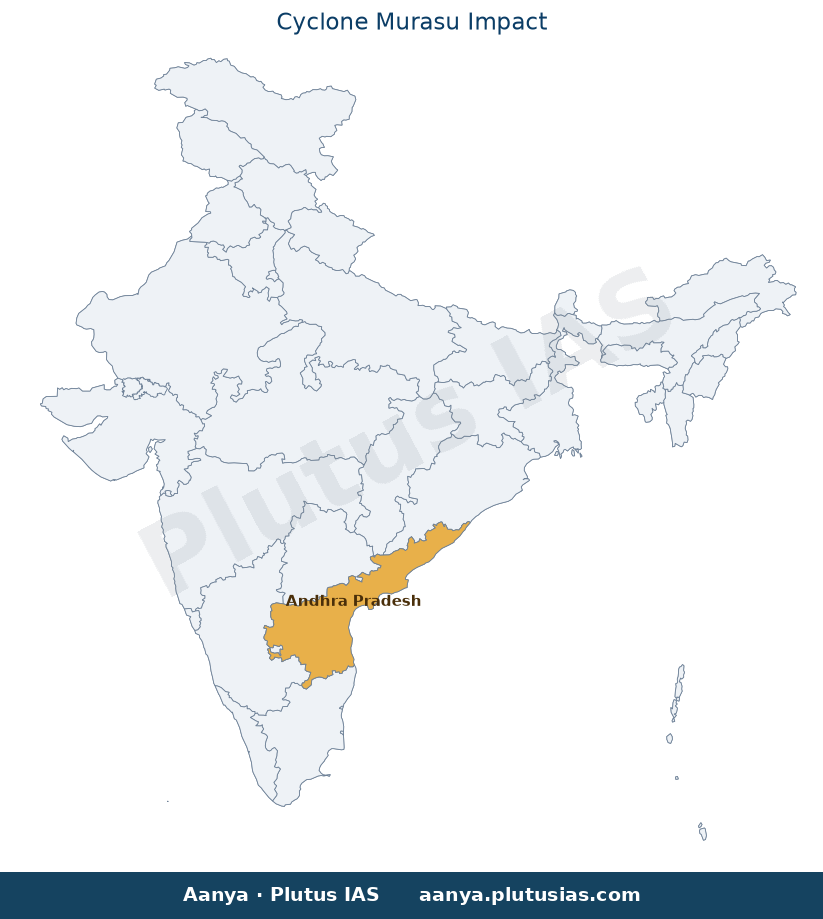
The severe cyclonic storm Murasu recently made landfall near Kothapatnam in coastal Andhra Pradesh, causing significant damage to infrastructure, agriculture, and property. Despite the widespread destruction, initial reports indicated no major power disruptions, highlighting the efficacy of pre-emptive measures and disaster preparedness efforts by state authorities. The Andhra Pradesh government also activated its ‘Mana Mitra’ WhatsApp Governance platform for real-time grievance redressal and citizen assistance during the crisis.
Background
- India’s peninsular coastline, particularly the eastern coast, is highly susceptible to tropical cyclones originating in the Bay of Bengal and the Arabian Sea.
- The Bay of Bengal is a major breeding ground for cyclones, with a higher frequency and intensity of storms compared to the Arabian Sea.
- Cyclones are intense low-pressure systems forming over warm tropical oceans, characterised by strong winds, heavy rainfall, and storm surges.
- The National Disaster Management Authority (NDMA) and State Disaster Management Authorities (SDMAs) are apex bodies responsible for disaster management in India at national and state levels, respectively, operating under the Disaster Management Act, 2005.
- Early warning systems, including satellite imagery, radar observations, and numerical weather prediction models, are crucial for effective cyclone forecasting and timely evacuation.
- Coastal states regularly undertake mock drills, community awareness campaigns, and infrastructure strengthening projects to enhance resilience against cyclonic events.
What are Tropical Cyclones and their Impact?
- Tropical cyclones are violent storms that originate over tropical oceans and move over to coastal areas, bringing about large-scale destruction due to violent winds, very heavy rainfall, and storm surges.
- They are characterised by a low-pressure centre (the ‘eye’), surrounded by a spiral arrangement of thunderstorms that produce heavy rain and strong winds.
- The energy for tropical cyclones comes from the latent heat released when water vapour condenses into rain, requiring warm ocean waters (typically above 26.5°C) to form and sustain.
- The Coriolis effect is essential for the formation of the rotating wind patterns; hence, cyclones do not form within 5 degrees of the equator.
- Impacts include widespread damage to infrastructure (roads, buildings, power lines), disruption of communication networks, destruction of agricultural crops, and loss of life.
- Storm surges, which are abnormal rises in sea level caused by the cyclone’s winds pushing water ashore, are often the most destructive aspect of a tropical cyclone, leading to coastal inundation.
- Post-cyclone challenges involve rescue and relief operations, rehabilitation of affected populations, restoration of essential services, and management of public health issues.
- Effective disaster management strategies encompass pre-disaster mitigation (e.g., cyclone-resistant infrastructure, mangrove plantations), preparedness (e.g., early warning systems, evacuation plans), response (e.g., search and rescue), and post-disaster recovery.
Key Features
| Feature | Significance |
|---|---|
| Cyclone Murasu | A severe cyclonic storm impacting coastal Andhra Pradesh, highlighting the vulnerability of Indian coastal regions to natural disasters. |
| Landfall near Kothapatnam | Indicates the geographical impact zone and the need for region-specific disaster preparedness and response mechanisms. |
| No power disruptions reported | Suggests effective pre-emptive measures and infrastructure resilience in the energy sector, a critical aspect of disaster management. |
| Damage to infrastructure and crops | Underscores the economic and social costs of cyclones, necessitating robust disaster mitigation and rehabilitation strategies. |
| ‘Mana Mitra’ WhatsApp helpline | Demonstrates the leveraging of digital technology for real-time grievance redressal and citizen-administration communication during emergencies. |
Why it Matters
Disaster Management and Preparedness
- The incident highlights the critical importance of proactive disaster management strategies, including early warning systems, evacuation protocols, and resilient infrastructure development, to minimise loss of life and property.
- The reported absence of power disruptions indicates successful implementation of pre-cyclone preparedness measures by the energy department, serving as a best practice for other vulnerable regions.
Technological Integration in Governance
- The activation of the ‘Mana Mitra’ WhatsApp helpline by the Real Time Governance Society (RTGS) exemplifies the effective integration of digital platforms for citizen engagement and rapid response during crises.
- Such initiatives enhance transparency and accountability in disaster relief operations by establishing direct communication channels between affected citizens and administrative authorities.
Climate Change and Coastal Vulnerability
- The recurring incidence of severe cyclonic storms along India’s coastline underscores the increasing vulnerability of these regions to extreme weather events, potentially exacerbated by climate change.
- This necessitates long-term strategies for coastal protection, climate-resilient infrastructure, and sustainable land-use planning to adapt to evolving climatic patterns.
Socio-economic Impact
- Damage to standing crops, fishing boats, and thatched houses directly impacts the livelihoods of coastal communities, particularly those dependent on agriculture and fishing, necessitating comprehensive rehabilitation and compensation mechanisms.
- The disruption to daily life and potential displacement of residents underscore the humanitarian aspects of disaster response, requiring coordinated efforts for shelter, food, and medical aid.
Challenges
1. Infrastructure Resilience
- Despite some successes, the extensive damage to electric poles, trees, and houses indicates persistent vulnerabilities in infrastructure, particularly in rural and informal settlements.
- Ensuring all critical infrastructure, including communication networks, roads, and public buildings, can withstand severe cyclonic impacts remains a significant challenge.
UPSC Link: Disaster Management; Infrastructure
2. Last-Mile Connectivity and Awareness
- While digital platforms like WhatsApp helplines are effective, ensuring their reach to all segments of the population, especially in remote or digitally underserved areas, remains a challenge.
- Continuous public awareness campaigns are essential to ensure that citizens understand and utilise available emergency services and adhere to safety advisories.
UPSC Link: Governance; Social Sector
3. Post-Disaster Rehabilitation and Recovery
- The process of rebuilding damaged homes, restoring livelihoods, and providing adequate compensation to affected farmers and fishermen is often protracted and resource-intensive.
- Ensuring equitable and timely distribution of aid and facilitating long-term economic recovery for vulnerable communities poses a significant administrative and logistical challenge.
UPSC Link: Disaster Management; Social Justice
4. Climate Change Adaptation
- The increasing frequency and intensity of cyclones necessitate a shift from reactive disaster response to proactive climate change adaptation strategies.
- Developing and implementing long-term plans for coastal zone management, mangrove restoration, and climate-resilient agricultural practices are crucial but complex undertakings.
UPSC Link: Environment; Disaster Management
Challenges — UPSC Perspective
| Issue | Concern |
|---|---|
| Uprooted trees and damaged electric poles | Indicates vulnerability of green cover and power transmission infrastructure to high wind speeds, leading to potential prolonged service disruptions. |
| Wrecked fishing boats and damaged standing crops | Direct economic impact on primary sector livelihoods, exacerbating rural poverty and food insecurity in affected regions. |
| Collapsed thatched houses and stranded residents | Highlights the housing vulnerability of economically weaker sections and the immediate need for emergency shelter and rescue operations. |
| Waterlogging in many places | Poses risks of waterborne diseases, disrupts transportation, and damages urban and rural infrastructure, requiring efficient drainage systems. |
| Statue collapse due to falling tree | Symbolises the widespread physical impact of the cyclone, affecting even public monuments and requiring comprehensive damage assessment. |
Way Forward
- Strengthen early warning systems and disseminate information effectively through multiple channels, including traditional media, digital platforms, and community networks, ensuring last-mile reach.
- Invest in climate-resilient infrastructure, particularly in coastal areas, focusing on underground cabling for power, cyclone-resistant housing, and robust communication networks.
- Enhance the capacity of local self-governing bodies and community-level volunteers in disaster preparedness, response, and rehabilitation efforts through regular training and resource provision.
- Promote ecological restoration initiatives such as mangrove plantations and coastal shelterbelts, which act as natural barriers against storm surges and high winds.
- Develop comprehensive post-disaster recovery frameworks that include timely damage assessment, equitable compensation mechanisms, and sustainable livelihood restoration programmes for affected communities.
- Leverage technology further by integrating Artificial Intelligence and Machine Learning for predictive modelling of cyclone paths and impacts, and for efficient resource allocation during emergencies.
- Conduct regular drills and mock exercises involving all stakeholders, including government agencies, NGOs, and local communities, to refine response protocols and identify operational gaps.
UPSC Value Addition
Keywords for Mains Answer-Writing
Cyclone Murasu · Disaster Management Act 2005 · National Disaster Management Authority (NDMA) · State Disaster Management Authority (SDMA) · Real-Time Governance Society (RTGS) · Early Warning Systems · Cyclone Preparedness · Coastal Vulnerability · Disaster Risk Reduction (DRR) · Community Resilience · Inter-Agency Coordination · Climate Change Adaptation
Concept Flow
Formation of Cyclone Murasu over Bay of Bengal → Cyclone makes landfall in coastal Andhra Pradesh → Heavy rainfall and gusty winds cause widespread damage → Infrastructure (poles, houses) and livelihoods (crops, boats) affected → Government activates ‘Mana Mitra’ helpline for grievance redressal → Disaster management efforts focus on rescue, relief, and recovery
Prelims Practice Questions
Q1. Consider the following statements regarding tropical cyclones in India:
1. Tropical cyclones typically form over warm ocean waters and are characterised by a low-pressure centre.
2. The Bay of Bengal is more prone to cyclonic storms than the Arabian Sea.
3. The India Meteorological Department (IMD) is the nodal agency for issuing cyclone warnings in India.
How many of the above statements are correct?
- Only one
- Only two
- All three
- None
Answer: All three — Statement 1 is correct: Tropical cyclones require sea surface temperatures of at least 26.5°C to form and sustain, featuring a central low-pressure area. Statement 2 is correct: The Bay of Bengal experiences a higher frequency and intensity of cyclones compared to the Arabian Sea, primarily due to warmer waters and specific atmospheric conditions. Statement 3 is correct: The IMD is responsible for monitoring, forecasting, and issuing warnings for tropical cyclones and other severe weather phenomena in India.
Q2. Which of the following bodies is responsible for laying down the policies, plans, and guidelines for disaster management in India, as per the Disaster Management Act, 2005?
- State Disaster Management Authority (SDMA)
- National Disaster Response Force (NDRF)
- National Disaster Management Authority (NDMA)
- District Disaster Management Authority (DDMA)
Answer: National Disaster Management Authority (NDMA) — The National Disaster Management Authority (NDMA), chaired by the Prime Minister, is the apex body for disaster management in India. It is mandated to lay down policies, plans, and guidelines for disaster management to ensure a timely and effective response to disasters.
Mains Practice Question
✍ Examine the multi-pronged approach adopted by Indian disaster management agencies in mitigating the impact of tropical cyclones. How far have technological advancements, such as real-time governance platforms, enhanced preparedness and response mechanisms? (15 Marks)
Approach: MODEL-ANSWER SKELETON:
1. Introduction: Briefly define tropical cyclones and acknowledge India’s vulnerability, particularly its coastal regions.
2. Multi-pronged Approach (Mitigation):
a. Structural Measures: Cyclone shelters, embankments, coastal regulation zone (CRZ) norms, resilient infrastructure.
b. Non-Structural Measures: Early Warning Systems (EWS) by IMD, public awareness campaigns, capacity building (NDRF, SDRF), mock drills, community-based disaster management.
c. Legal and Institutional Framework: Disaster Management Act, 2005; roles of NDMA, SDMA, DDMA.
3. Role of Technological Advancements:
a. Forecasting and Tracking: Satellite imagery (e.g., INSAT series), Doppler Weather Radars, numerical weather prediction models.
b. Communication and Dissemination: SMS alerts, social media, dedicated mobile applications (e.g., ‘Mana Mitra’ WhatsApp platform mentioned in the news), GIS mapping for vulnerability assessment.
c. Real-Time Governance (RTG) Platforms: Enhanced coordination among agencies, efficient resource allocation, grievance redressal, data-driven decision making (e.g., Andhra Pradesh RTGS).
4. Enhancement of Preparedness and Response:
a. Improved Lead Time: Better forecasting allows for timely evacuation and pre-positioning of resources.
b. Efficient Resource Mobilisation: Real-time data aids in targeted deployment of NDRF/SDRF teams, medical supplies, and relief materials.
c. Citizen Engagement: Platforms like ‘Mana Mitra’ empower citizens to report incidents directly, facilitating quicker intervention.
d. Damage Assessment: Technology assists in rapid post-disaster damage assessment for rehabilitation efforts.
5. Challenges and Way Forward: Data integration issues, last-mile connectivity, ensuring accessibility for all sections of society, continuous technological upgrades.
6. Conclusion: Summarise the significant progress made due to integrated approaches and technology, while highlighting the need for continuous improvement and community resilience building.
Source: The Hindu
Generated by AanyaAi for educational purpose.
Related guides on our sites
- Current affairs for upsc 2026
- Best PSIR optional coaching for upsc
- Best economics optional coaching for upsc
- Best PSIR optional teacher for upsc

- संयुक्त राष्ट्र रिपोर्ट: 2030 तक ‘जीरो हंगर’ लक्ष्य पर संकट - November 3, 2026
- Cyclone Murasu: AP’s Disaster Preparedness & Power Resilience - November 3, 2026
- ई-फाइलिंग 3.0 कार्यशाला: ई-न्यायालय मिशन मोड परियोजना का एक महत्वपूर्ण कदम - November 3, 2026

No Comments