


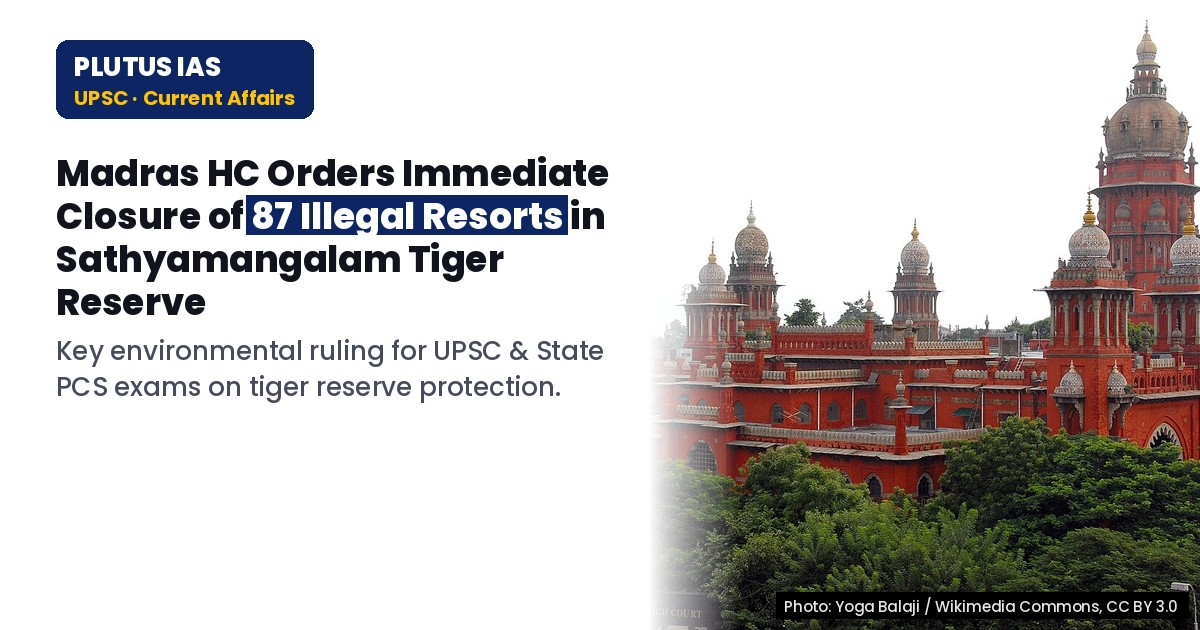
03 Nov Madras HC Orders Closure of 87 Illegal Resorts in STR
✎ The Madras High Court's order for the closure and demolition of 87 illegal resorts in the Sathyamangalam Tiger Reserve underscores the judiciary's role in enforcing environmental regulations and protecting ecologically sensitive…
Subject Relevance — Where This Topic Fits
- GS Paper II — Governance, Constitution, Polity, Social Justice and International Relations | GS Paper III — Environment, Ecology, Biodiversity, Science & Technology, Disaster Management and Security
- Prelims: Sathyamangalam Tiger Reserve, Madras High Court, Public Interest Litigation (PIL), Directorate of Town and Country Planning (DTCP), Hill Area Conservation Authority (HACA), National Tiger Conservation Authority (NTCA), National Board for Wildlife (NBWL), Wildlife Protection Act, 1972
- Essay: Environmental Conservation and Sustainable Development: Balancing Economic Growth with Ecological Preservation, Judicial Activism and Environmental Protection: Role of Courts in Upholding Ecological Integrity
Quick Revision: The Madras High Court’s order for the closure and demolition of 87 illegal resorts in the Sathyamangalam Tiger Reserve underscores the judiciary’s role in enforcing environmental regulations and protecting ecologically sensitive areas from unauthorized commercial exploitation.
Why is this in the news?
The Madras High Court has issued a directive for the immediate closure of 87 resorts operating without requisite planning permission and building approval within the Sathyamangalam Tiger Reserve (STR) area. This judicial intervention follows a Public Interest Litigation (PIL) highlighting severe environmental damage caused by these illegal establishments, underscoring the critical role of judicial oversight in environmental protection and adherence to regulatory frameworks in ecologically sensitive zones.
Background
- The Sathyamangalam Tiger Reserve (STR) is a protected area located in the Western Ghats, a UNESCO World Heritage Site, and is a crucial wildlife corridor connecting the Eastern and Western Ghats.
- Environmental activist R. Karpagam filed a Public Interest Litigation (PIL) alleging that illegal resorts operating within the STR were causing significant environmental degradation to the hill region.
- A status report submitted by the Erode Collector confirmed the presence of 87 resort establishments in the area, none of which possessed planning permission or building approval from the Directorate of Town and Country Planning (DTCP).
- Furthermore, the report indicated a lack of records demonstrating that these establishments had obtained permission from the Hill Area Conservation Authority (HACA) for converting land use from residential to commercial purposes.
- The Madras High Court, specifically a Division Bench dealing with forest-related cases, observed that all illegal structures necessitated immediate closure and subsequent demolition in accordance with legal provisions.
- The court also noted instances where certain resorts had obtained interim orders from another Division Bench without disclosing the pendency of the primary issue before the designated forest-related bench, prompting directions for tagging these petitions.
- The directive mandates authorities to proceed against resorts operating without valid licenses, implement lock and seal procedures, and initiate demolition actions, with a status report on compliance due by November 27.
- Copies of the court order have been marked to key environmental and conservation bodies, including the Chief Conservator of Forests and Field Director, Sathyamangalam Tiger Reserve, the National Board for Wildlife, the National Tiger Conservation Authority, and the Chairman of the Tamil Nadu Hill Areas Conservation Authority.
Key Regulatory and Conservation Authorities Involved
- **Directorate of Town and Country Planning (DTCP):** A statutory body responsible for regulating urban and rural development, including land use planning, building approvals, and ensuring planned growth in Tamil Nadu. Its role is crucial in preventing unauthorized constructions and ensuring adherence to zoning regulations.
- **Hill Area Conservation Authority (HACA):** Established to regulate development activities in ecologically fragile hill areas, HACA’s mandate includes preventing uncontrolled construction, preserving natural landscapes, and ensuring that land use changes are environmentally sustainable. It plays a vital role in protecting biodiversity and ecological balance in such regions.
- **National Tiger Conservation Authority (NTCA):** A statutory body under the Ministry of Environment, Forest and Climate Change, Government of India, constituted under the provisions of the Wildlife (Protection) Act, 1972. Its primary role is to strengthen tiger conservation, monitor tiger reserves, and ensure the implementation of conservation plans.
- **National Board for Wildlife (NBWL):** A statutory body constituted under the Wildlife (Protection) Act, 1972, chaired by the Prime Minister. It serves as an advisory body to the Central and State Governments on matters related to wildlife conservation, including the establishment and management of protected areas and approval of projects in or near such areas.
- **Wildlife (Protection) Act, 1972:** A landmark legislation in India providing for the protection of wild animals, birds, and plants, and for matters connected therewith or ancillary or incidental thereto. It establishes protected areas like National Parks and Wildlife Sanctuaries and regulates activities within and around them to conserve biodiversity.
- **Public Interest Litigation (PIL):** A legal mechanism in India that allows any member of the public or an organization to approach the court for the enforcement of public rights or interests, especially when the affected parties are unable to do so. It has been instrumental in environmental protection and social justice causes.
Key Features
| Feature | Significance |
|---|---|
| Madras High Court Order | Directs immediate closure and demolition of 87 illegal resorts in Sathyamangalam Tiger Reserve, underscoring judicial activism in environmental protection. |
| Public Interest Litigation (PIL) | Initiated by an environmental activist, demonstrating the role of civil society and legal mechanisms in addressing environmental degradation. |
| Absence of Planning Permission and Building Approval | Highlights systemic failures in regulatory compliance and enforcement by local authorities and developers. |
| Lack of Hill Area Conservation Authority (HACA) Permission | Indicates non-adherence to specific environmental safeguards designed for ecologically sensitive hill regions, crucial for land use change. |
| Non-disclosure by Resorts in Other Petitions | Reveals attempts to circumvent legal processes, emphasizing the importance of judicial integrity and full disclosure in legal proceedings. |
| Involvement of Multiple Authorities | Requires coordinated action from the Erode district administration, Directorate of Town and Country Planning (DTCP), HACA, Chief Conservator of Forests, National Board for Wildlife, and National Tiger Conservation Authority. |
Why it Matters
Environmental Conservation
- The ruling reinforces the imperative of protecting ecologically sensitive areas, particularly Tiger Reserves, from unregulated commercial exploitation.
- It sets a precedent for stringent enforcement against illegal constructions that threaten biodiversity and natural habitats.
- The closure of illegal resorts mitigates environmental damage, including habitat fragmentation, pollution, and disturbance to wildlife.
Governance and Rule of Law
- The High Court’s intervention underscores the judiciary’s role in upholding environmental laws and ensuring accountability of administrative bodies.
- It highlights the critical need for effective implementation of planning and building regulations, especially in protected areas.
- The case exposes regulatory gaps and enforcement deficiencies that allow illegal commercial activities to proliferate in sensitive zones.
Sustainable Development
- The judgment emphasizes that economic development, particularly tourism, must be balanced with ecological preservation and adhere to legal frameworks.
- It promotes the concept of responsible tourism and sustainable land use planning in biodiversity-rich regions.
- The incident serves as a reminder for policy makers to integrate environmental impact assessments and regulatory compliance into development projects.
Challenges
1. Enforcement and Compliance
- Ensuring complete and timely closure and demolition of all illegal establishments, given potential resistance and legal challenges.
- Preventing the re-emergence of illegal operations through ‘backdoor’ methods, requiring continuous vigilance and monitoring.
UPSC Link: Environmental governance; Law enforcement
2. Inter-Agency Coordination
- Achieving seamless coordination among district administration, forest department, planning authorities, and environmental bodies for effective action.
- Addressing jurisdictional overlaps and ensuring clarity of roles and responsibilities in managing protected areas.
UPSC Link: Government policies; Institutional mechanisms
3. Regulatory Loopholes and Corruption
- Identifying and rectifying systemic weaknesses in planning permission, building approval, and land use conversion processes.
- Combating potential corruption or negligence that facilitates the establishment and operation of illegal entities in sensitive zones.
UPSC Link: Ethics in governance; Transparency
4. Balancing Development and Conservation
- Formulating sustainable tourism policies that generate local livelihoods without compromising ecological integrity of protected areas.
- Managing human-wildlife interface challenges that arise from increased human presence and infrastructure development near wildlife habitats.
UPSC Link: Conservation; Sustainable development
Challenges — UPSC Perspective
| Issue | Concern |
|---|---|
| Illegal Resort Operations | Unregulated commercial activities causing severe environmental damage and habitat disturbance within a Tiger Reserve. |
| Lack of Statutory Permissions | Absence of planning permission, building approval, and HACA clearance indicates widespread non-compliance with environmental and land-use laws. |
| Judicial Evasion Tactics | Attempts by some resorts to obtain interim orders through non-disclosure, undermining judicial process and prolonging illegal operations. |
| Post-Closure Operation | Reports of resorts continuing to function surreptitiously, highlighting the difficulty in ensuring complete cessation of illegal activities. |
| Threat to Biodiversity | Increased human footprint and infrastructure development in STR poses a direct threat to tiger populations and other wildlife. |
| Accountability of Authorities | Questions regarding the failure of regulatory bodies to prevent and address illegal constructions and land-use changes over time. |
Way Forward
- Strict and expeditious enforcement of the High Court’s order, ensuring immediate closure and systematic demolition of all illegal structures.
- Comprehensive review and strengthening of planning, building, and land-use conversion regulations, particularly for ecologically sensitive areas.
- Enhancement of inter-agency coordination and information sharing among district administration, forest department, and planning authorities to prevent future encroachments.
- Implementation of robust monitoring mechanisms, including satellite imagery and regular ground surveys, to detect and deter illegal constructions.
- Development of a transparent and efficient single-window clearance system for legitimate tourism projects, ensuring adherence to environmental norms.
- Capacity building for local administrative and forest personnel in environmental law enforcement and sustainable resource management.
- Promotion of community-based eco-tourism models that provide alternative livelihoods for local populations while ensuring conservation goals.
- Initiation of public awareness campaigns regarding the ecological significance of protected areas and the legal consequences of environmental violations.
UPSC Value Addition
Keywords for Mains Answer-Writing
Sathyamangalam Tiger Reserve · Environmental Protection Act 1986 · Wildlife Protection Act 1972 · Hill Area Conservation Authority · Directorate of Town and Country Planning · Public Interest Litigation · Sustainable Development · Judicial Activism · Conservation Management · Ecotourism Regulation · Forest Governance · Land Use Planning
Constitutional & Policy Linkages
- Article 21: Right to life and personal liberty, including the right to a clean environment.
- Article 48A: Protection and improvement of environment and safeguarding of forests and wildlife.
- Article 51A(g): Fundamental duty to protect and improve the natural environment including forests, lakes, rivers and wildlife, and to have compassion for living creatures.
Concept Flow
Environmental activist files PIL regarding illegal resorts in STR. → Madras High Court orders closure and demolition of 87 illegal resorts. → Resorts found operating without planning permission, building approval, or HACA clearance. → Illegal operations cause severe environmental damage to the Tiger Reserve. → Court directs authorities to ensure compliance and file status report. → Action aims to protect biodiversity and uphold environmental laws.
Prelims Practice Questions
Q1. Consider the following statements regarding protected areas in India:
1. Tiger Reserves are established under the Wildlife Protection Act, 1972.
2. The National Tiger Conservation Authority (NTCA) is a statutory body.
3. The Hill Area Conservation Authority (HACA) is primarily concerned with the ecological protection of designated hill regions.
How many of the above statements are correct?
- Only one
- Only two
- All three
- None
Answer: All three — Statement 1 is correct: Tiger Reserves are designated under the Wildlife Protection Act, 1972. Statement 2 is correct: The NTCA was constituted under the provisions of the Wildlife (Protection) Act, 1972, as amended in 2006. Statement 3 is correct: HACA’s mandate includes regulating development activities in ecologically sensitive hill areas to ensure their conservation.
Q2. Which of the following bodies is responsible for granting planning permission and building approval for developments in urban and rural areas of a state, including those bordering protected areas?
- National Board for Wildlife
- National Tiger Conservation Authority
- Directorate of Town and Country Planning
- Ministry of Environment, Forest and Climate Change
Answer: Directorate of Town and Country Planning — The Directorate of Town and Country Planning (DTCP) is the state-level agency responsible for regulating urban and rural development through planning permissions and building approvals, ensuring compliance with land use regulations.
Mains Practice Question
✍ The Madras High Court’s directive to close illegal resorts in Sathyamangalam Tiger Reserve highlights the persistent challenges in balancing developmental aspirations with environmental conservation. Critically examine the institutional and legal frameworks governing such conflicts in India. (15 Marks)
Approach: MODEL-ANSWER SKELETON: Introduction: Briefly contextualise the issue with the Madras High Court’s order. Part 1: Institutional Frameworks – Discuss the roles of the National Tiger Conservation Authority (NTCA), National Board for Wildlife (NBWL), State Forest Departments, Directorate of Town and Country Planning (DTCP), and specific bodies like the Hill Area Conservation Authority (HACA). Part 2: Legal Frameworks – Detail relevant provisions from the Wildlife Protection Act, 1972, Environmental Protection Act, 1986, Forest (Conservation) Act, 1980, and relevant state-level planning laws. Discuss the role of Public Interest Litigations (PILs) and judicial intervention. Challenges: Address issues such as jurisdictional overlaps, enforcement deficits, lack of inter-agency coordination, illegal land use changes, and the pressure from tourism development. Conclusion: Suggest measures for strengthening governance, promoting sustainable ecotourism, and ensuring effective implementation of conservation laws.
Source: The Hindu
Generated by AanyaAi for educational purpose.
Related guides on our sites
- Best PSIR optional coaching for upsc
- Best PSIR optional teacher for upsc
- Best teacher of PSIR optional for upsc
- Best PSIR optional coaching in delhi for UPSC

- Madras HC Orders Closure of 87 Illegal Resorts in STR - November 3, 2026
- वैश्विक सौर सहयोग: BRE शिखर सम्मेलन में भारत की प्रतिबद्धता - November 3, 2026
- Odisha’s Godabarisha Yojana: Laptop Aid for Plus II Pass-outs - November 3, 2026

No Comments