


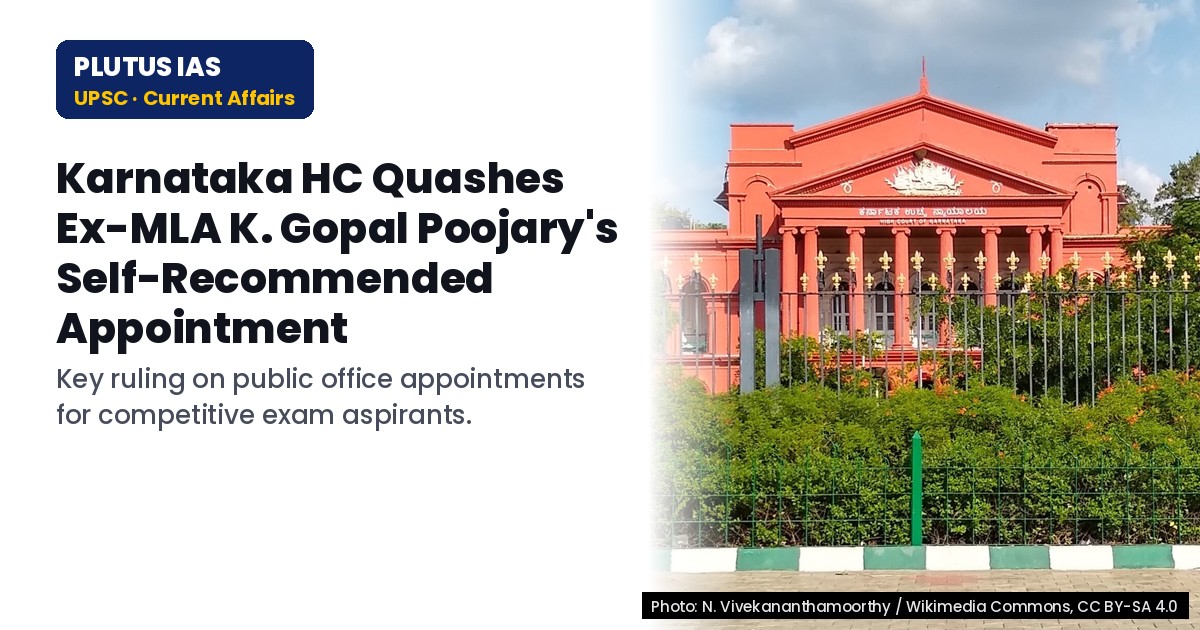
03 Nov Karnataka HC: Public Office Not Consolation Prize
✎ The judiciary plays a vital role in ensuring that appointments to public office adhere to principles of legality, transparency, and public service, preventing their use as political rewards or consolation prizes.
Subject Relevance — Where This Topic Fits
- GS Paper II — Polity and Governance | GS Paper IV — Ethics, Integrity, and Aptitude
- Prelims: Judicial review, Public office appointments, Karnataka Land Revenue Act, Rule of law, Separation of powers, Accountability in governance
- Essay: The role of judiciary in upholding constitutional values and good governance, Ethical considerations in public administration and political appointments
Quick Revision: The judiciary plays a vital role in ensuring that appointments to public office adhere to principles of legality, transparency, and public service, preventing their use as political rewards or consolation prizes.
Why is this in the news?
The Karnataka High Court recently quashed the constitution of an additional committee for regularisation of unauthorised occupation of government lands, specifically the appointment of a former MLA as its chairperson. The court observed that public office should not be treated as a ‘consolation prize’ for defeated politicians or a reward for political loyalty, emphasising that appointments must serve statutory purposes rather than personal desires for power.
Background
- The case involved the constitution of an additional committee under the Karnataka Land Revenue Act for processing applications related to the regularisation of unauthorised occupation of government lands.
- A former MLA, who had been defeated in the assembly elections, wrote to the district in-charge Minister, recommending himself as the chairperson and proposing members for an additional committee.
- Acting on this recommendation, the state government constituted the additional committee, assigning it a significant number of applications, while the main committee, headed by the incumbent MLA, received fewer.
- The incumbent MLA challenged the constitution of this additional committee and the appointment of the former MLA as its chairperson.
- The court highlighted that the power entrusted to public authorities is for public service, not for providing refuge or rewards for political standing.
Principles of Public Office and Governance
- Public office refers to a position of authority or service within a government or public institution, carrying specific duties and responsibilities towards the citizenry.
- Appointments to public office are expected to be based on merit, competence, and the fulfillment of statutory or constitutional requirements, ensuring efficient and impartial administration.
- The principle of ‘Rule of Law’ dictates that all governmental actions, including appointments, must be in accordance with established legal frameworks and not arbitrary or motivated by extraneous considerations.
- Judicial review is a fundamental aspect of the Indian Constitution, allowing courts to examine the legality and constitutional validity of executive and legislative actions, thereby ensuring accountability.
- Good governance principles include transparency, accountability, participation, effectiveness, and equity, all of which are undermined when appointments are made based on political patronage rather than public interest.
- The Karnataka Land Revenue Act provides for the regularisation of unauthorised occupation of government lands, a process that requires fair and objective decision-making by designated committees.
- The judiciary’s role is crucial in upholding the integrity of public institutions and preventing the misuse of executive power for political or personal gains, reinforcing the democratic ethos.
- Ethical considerations in public service demand that officeholders act with integrity, impartiality, and a commitment to public welfare, avoiding conflicts of interest and the pursuit of personal advantage.
Key Features
| Feature | Significance |
|---|---|
| Quashing of Committee Constitution | Reinforces the principle that public office is not a political patronage tool but a position of public trust. |
| Judicial Scrutiny of Appointments | Highlights the judiciary’s role in upholding administrative integrity and preventing potential misuse of executive power in public appointments. |
| Basis of Committee Formation | Emphasises that governmental decisions, especially regarding public bodies, must be based on objective assessment of need, not personal recommendations or political considerations. |
| Role of Elected Representatives | Clarifies that while MLAs head main committees, additional committees require a transparent and guideline-based appointment process, not an ‘indirect route’ for defeated politicians. |
| Statutory Purpose of Committees | Underscores that committees are established to fulfil specific statutory objectives (e.g., land regularisation) and their constitution must align with this purpose, free from extraneous motives. |
Why it Matters
Governance and Ethics
- Upholds the principles of good governance by ensuring that public appointments are merit-based and serve public interest, rather than being used as political rewards or rehabilitation for electoral defeats.
- Reinforces ethical conduct in public life by condemning attempts to secure positions of authority through non-electoral means after failing to gain public mandate.
- Promotes transparency and accountability in administrative processes, particularly in the constitution of committees that wield significant public power and resources.
Judicial Oversight
- Demonstrates the judiciary’s active role in safeguarding constitutional values and preventing executive overreach or arbitrary decision-making in public administration.
- Sets a precedent for future governmental actions concerning the formation of public committees and the appointment of their chairpersons, mandating adherence to established norms and guidelines.
- Strengthens public trust in institutions by showing that judicial review can correct administrative anomalies and ensure fairness in governance.
Public Administration
- Mandates the formulation of clear guidelines for appointing chairpersons to additional committees, thereby standardising the process and reducing discretion.
- Ensures that the constitution of statutory bodies is driven by genuine administrative necessity and public service objectives, rather than political expediency.
- Contributes to the professionalisation of public administration by separating political patronage from administrative appointments.
Challenges
1. Political Patronage and Clientelism
- The tendency of political executives to appoint loyalists or defeated candidates to public offices, undermining meritocracy and institutional integrity.
- This practice can lead to inefficient administration and a lack of accountability, as appointees may prioritise political allegiance over public service.
- It erodes public trust in governance and perpetuates a system where political connections outweigh competence.
UPSC Link: GS-II: Governance, Transparency & Accountability
2. Lack of Standardised Appointment Procedures
- Absence of clear, objective guidelines for appointments to various committees and statutory bodies can lead to arbitrary decisions and favouritism.
- This ambiguity creates avenues for ‘indirect routes’ to power, circumventing democratic processes and merit-based selections.
- It can result in the appointment of individuals who may not possess the requisite expertise or commitment for the role.
UPSC Link: GS-II: Governance, Institutions
3. Erosion of Democratic Principles
- When public offices are treated as ‘consolation prizes,’ it devalues the electoral process and the mandate of the people.
- It suggests that political power can be acquired through means other than direct public election, weakening the democratic fabric.
- Such practices can lead to a perception that political defeat does not necessarily mean an end to public influence, fostering a culture of entitlement.
UPSC Link: GS-II: Indian Constitution, Democratic Process
4. Accountability Deficit in Executive Actions
- Government decisions based on personal recommendations rather than objective assessments indicate a lapse in accountability mechanisms.
- The executive’s failure to independently assess the need for a committee, relying instead on a politician’s letter, highlights a potential weakness in administrative due diligence.
- This can lead to the creation of unnecessary bodies or the misallocation of resources, impacting effective governance.
UPSC Link: GS-II: Governance, Accountability
Challenges — UPSC Perspective
| Issue | Concern |
|---|---|
| Appointment of Defeated Politicians | Undermines democratic mandate, promotes political patronage over merit, and can lead to inefficient administration. |
| Lack of Clear Guidelines for Appointments | Fosters arbitrariness, favouritism, and allows for ‘indirect routes’ to public office, bypassing legitimate processes. |
| Executive Discretion in Committee Formation | Risk of forming committees based on political expediency rather than genuine public need or statutory requirements. |
| Potential for Misuse of Public Office | Positions intended for public service may be converted into rewards for political loyalty or personal ambition, compromising integrity. |
| Erosion of Public Trust | When appointments appear politically motivated, it diminishes public confidence in the fairness and impartiality of governmental institutions. |
Way Forward
- Establish comprehensive and transparent guidelines for the constitution of all government committees and the appointment of their chairpersons and members, ensuring merit and public interest are paramount.
- Mandate an objective and independent assessment of the necessity for any new committee or additional committee, based on administrative requirements and statutory provisions, rather than political recommendations.
- Implement a robust system of checks and balances to scrutinise executive decisions regarding public appointments, potentially involving a non-partisan expert body.
- Promote a culture of ethical governance where public office is strictly viewed as a position of service and trust, devoid of political patronage.
- Strengthen the capacity of administrative departments to conduct thorough due diligence before acting on proposals for committee formations or appointments.
- Encourage greater judicial activism in cases involving administrative impropriety and political favouritism to uphold the rule of law and constitutional principles.
- Educate public officials on the ethical implications of using public office for personal or political gain, fostering a commitment to integrity.
UPSC Value Addition
Keywords for Mains Answer-Writing
Public Office Accountability · Judicial Review · Separation of Powers · Rule of Law · Administrative Discretion · Good Governance · Constitutional Morality · Land Regularisation Committees · Karnataka Land Revenue Act · Political Appointments
Constitutional & Policy Linkages
- Article 14: Equality before law
- Article 16: Equality of opportunity in public employment
- Article 226: High Courts’ power to issue writs
Concept Flow
Defeated politician recommends self for public office. → Minister acts on recommendation without independent assessment. → Government constitutes additional committee with politician as chairperson. → High Court reviews appointment based on appeal. → Court rules public office not a ‘consolation prize’. → Appointment quashed, government directed to frame guidelines.
Prelims Practice Questions
Q1. Consider the following statements regarding the powers of the High Court in India:
1. A High Court has the power to quash executive orders if they are found to be arbitrary or unconstitutional.
2. The High Court can review the constitutionality of legislative enactments passed by the state legislature.
3. The High Court’s power of judicial review extends to examining appointments made to public offices by the state government.
How many of the above statements are correct?
- Only one
- Only two
- Only three
- None
Answer: Only three — Statement 1 is correct: High Courts, under Article 226 and 227 of the Constitution, can issue writs and exercise supervisory jurisdiction over lower courts and tribunals, including quashing arbitrary executive orders. Statement 2 is correct: High Courts possess the power of judicial review over state legislation, ensuring its conformity with the Constitution. Statement 3 is correct: Appointments to public offices are subject to judicial scrutiny by High Courts to ensure adherence to legal provisions and principles of fairness and non-arbitrariness.
Q2. Assertion (A): The Karnataka High Court quashed the appointment of a former MLA to a land regularisation committee.
Reason (R): The High Court observed that public office cannot be treated as a consolation prize for a defeated politician or a reward for political loyalty.
Which one of the following is correct in respect of the above statements?
- Both A and R are true and R is the correct explanation of A.
- Both A and R are true but R is not the correct explanation of A.
- A is true but R is false.
- A is false but R is true.
Answer: Both A and R are true and R is the correct explanation of A. — Assertion (A) is true as per the news. Reason (R) is also true, as it reflects the specific observation made by the High Court in its judgment, which directly informed its decision to quash the appointment. Therefore, R is the correct explanation of A.
Mains Practice Question
✍ Examine the principle of ‘public office as a public trust’ in the context of judicial pronouncements on appointments to governmental committees. Discuss the implications of such judicial interventions for administrative discretion and good governance. (15 Marks)
Approach: MODEL-ANSWER SKELETON:
1. Introduction: Define ‘public office as a public trust’ – a fundamental principle in administrative law and constitutional governance, implying that public officials hold power not for personal gain but for the welfare of the public.
2. Constitutional and Legal Basis: Reference relevant constitutional articles (e.g., Article 14, 16, 226) and statutory provisions that underpin fair and non-arbitrary appointments. Mention the Karnataka High Court’s recent observation.
3. Judicial Pronouncements: Discuss key Supreme Court/High Court judgments that have upheld this principle, particularly concerning appointments to public bodies, statutory committees, or quasi-judicial roles. Cite specific cases (e.g., Common Cause v. Union of India, S.P. Gupta v. Union of India, or similar cases emphasizing merit and public interest over political patronage).
4. Implications for Administrative Discretion:
a. Checks and Balances: How judicial review acts as a check on executive power and prevents arbitrary exercise of discretion.
b. Transparency and Accountability: Promotion of transparent processes and accountability in public appointments.
c. Limits on Patronage: Restriction on using public offices as rewards for political loyalty or as ‘consolation prizes’.
5. Implications for Good Governance:
a. Meritocracy: Encouragement of merit-based appointments.
b. Efficiency and Effectiveness: Ensuring that committees are constituted with competent individuals focused on statutory objectives.
c. Public Confidence: Upholding public trust in governmental institutions.
d. Rule of Law: Reinforcement of the principle that all actions, including appointments, must conform to law.
6. Conclusion: Summarise the critical role of judicial oversight in safeguarding the integrity of public office and ensuring that administrative actions align with the principles of public trust and good governance.
Source: The Hindu
Karnataka PCS (KPSC) — State PCS Practice
Prelims: Which of the following principles was emphasized by the Karnataka High Court in its recent observation that ‘public office is not a consolation prize for defeated politicians’?
- A. The principle of political patronage in appointments.
- B. The necessity of electoral victory for holding any public office.
- C. The importance of meritocracy and public service over political rehabilitation.
- D. The right of every citizen, including defeated politicians, to hold public office.
Answer: C. The importance of meritocracy and public service over political rehabilitation. — The Karnataka High Court’s observation underscores the principle that public office should be based on merit and service, not as a reward for electoral defeat.
Mains: Analyze the implications of the Karnataka High Court’s statement, ‘public office is not a consolation prize for defeated politicians,’ on governance and public administration in the context of Karnataka. Discuss how this observation aligns with the principles of good governance and accountability.
Generated by AanyaAi for educational purpose.
Related guides on our sites
- Best PSIR optional coaching for upsc
- Best PSIR optional teacher for upsc
- Best teacher of PSIR optional for upsc
- Best PSIR optional coaching in delhi for UPSC

- Rajasthan HC Summons Report on LS Speaker’s OSD Threat Case - November 7, 2026
- केरल में आबकारी विभाग में भ्रष्टाचार: मंत्री पर आरोप, यूपीएससी के लिए विश्लेषण - November 7, 2026
- SC on Compulsory Retirement: Not Punitive, No Misconduct - November 7, 2026

No Comments