


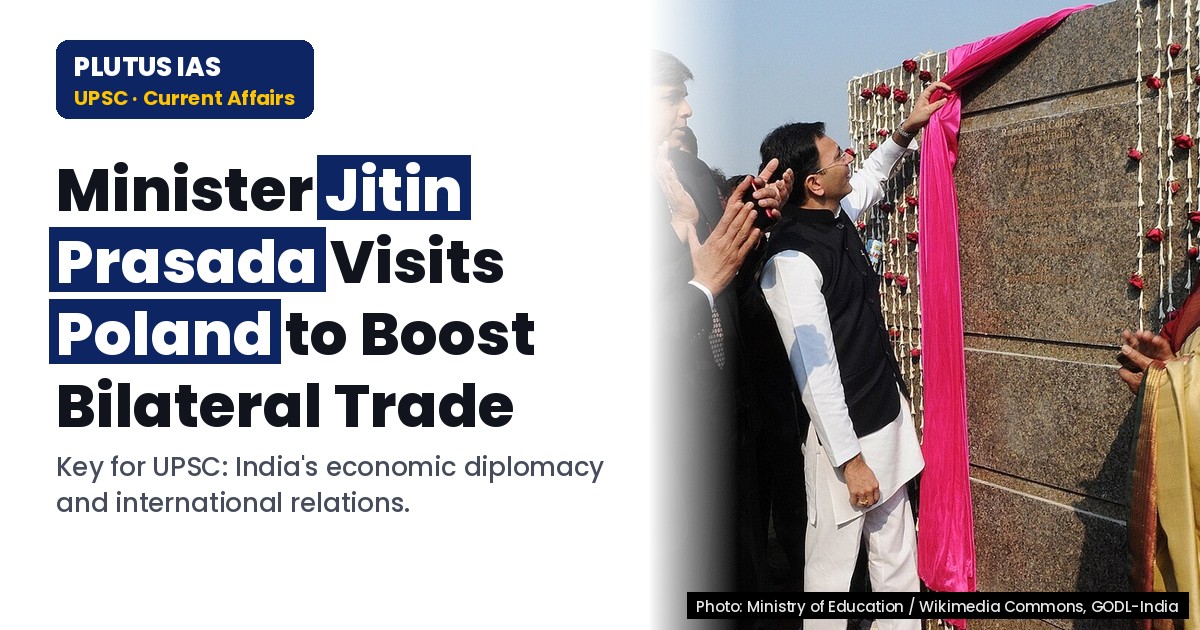
04 Nov India-Poland Bilateral Trade: Minister Prasada’s Visit
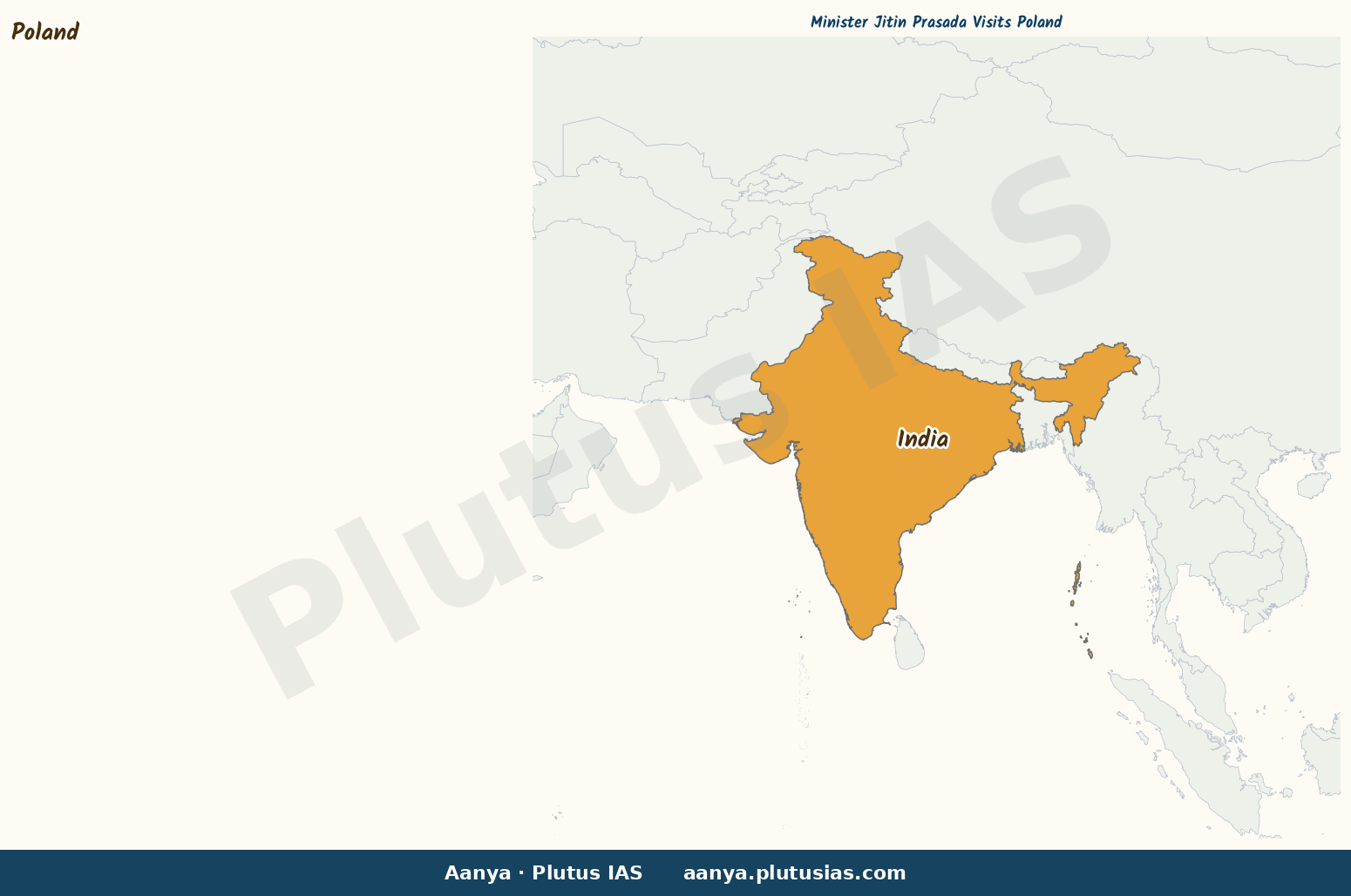
✎ India's engagement with Poland aims to bolster bilateral trade, investment, and technology cooperation, leveraging Poland's strategic position within the European Union for mutual economic growth and diversification.
Subject Relevance — Where This Topic Fits
- GS Paper II — International Relations: Bilateral, regional and global groupings and agreements involving India and/or affecting India’s interests | GS Paper III — Economy: Indian Economy and issues relating to planning, mobilization of resources, growth, development and employment
- Prelims: India-Poland relations, Bilateral trade agreements, Foreign Direct Investment (FDI), Technology cooperation, Look East Policy, European Union trade
- Essay: The evolving dynamics of India’s foreign policy and its economic implications., Enhancing global partnerships for sustainable economic growth and technological advancement.
Quick Revision: India’s engagement with Poland aims to bolster bilateral trade, investment, and technology cooperation, leveraging Poland’s strategic position within the European Union for mutual economic growth and diversification.
Why is this in the news?
A Minister of State for Commerce and Industry recently undertook an official visit to Poland, aimed at reinforcing bilateral trade, investment flows, and fostering technology cooperation between India and Poland. This high-level engagement underscores India’s commitment to diversifying its economic partnerships and strengthening its presence in Central and Eastern Europe, aligning with broader strategic objectives.
Background
- India and Poland have historically maintained cordial relations, which have evolved into a multifaceted partnership encompassing political, economic, cultural, and scientific cooperation.
- Poland, as a significant member of the European Union (EU) and a rapidly developing economy in Central Europe, represents a crucial gateway for India’s economic outreach to the broader European market.
- Bilateral trade between India and Poland has witnessed consistent growth over the past decade, driven by increasing demand for diverse goods and services in both economies.
- Indian companies have made notable investments in Poland, particularly in sectors such as IT, pharmaceuticals, manufacturing, and automotive components, contributing to local employment and economic development.
- Poland has also shown interest in India’s burgeoning market, with Polish firms exploring opportunities in sectors like food processing, mining, and renewable energy.
- The visit is part of India’s broader strategy to enhance economic diplomacy and forge stronger ties with countries that offer potential for trade diversification and technological collaboration.
What is the significance of India’s engagement with Poland?
- Poland’s strategic geographical location in Central Europe positions it as a vital hub for trade and logistics, offering access to both Western and Eastern European markets.
- As an EU member state, Poland adheres to the EU’s single market regulations, which can facilitate smoother trade and investment flows for Indian businesses seeking to operate within the EU.
- Poland possesses a skilled workforce and a robust industrial base, making it an attractive destination for Indian companies looking for manufacturing and research and development partnerships.
- The focus on technology cooperation aligns with India’s national initiatives such as ‘Make in India’ and ‘Digital India,’ seeking to leverage global expertise for domestic technological advancement.
- Enhanced bilateral trade with Poland contributes to India’s export diversification strategy, reducing reliance on traditional markets and exploring new avenues for economic growth.
- Investment cooperation fosters capital inflow and outflow, promoting economic integration and creating opportunities for joint ventures and technology transfers.
- Strengthening ties with Poland can also have geopolitical implications, enhancing India’s diplomatic footprint and influence within the European continent.
Key Features
| Feature | Significance |
|---|---|
| Ministerial Delegation | Elevates the level of bilateral engagement, signifying a strategic commitment to enhancing economic ties. |
| Focus on Bilateral Trade | Aims to expand market access for Indian goods and services in Poland and vice-versa, contributing to export diversification. |
| Investment Promotion | Seeks to attract Polish investments into India’s priority sectors and facilitate Indian investments in Poland, fostering capital flows. |
| Technology Cooperation | Explores avenues for collaborative research, development, and transfer of technology, particularly in advanced manufacturing and digital sectors. |
| Engagement with Polish Counterparts | Facilitates direct dialogue with key Polish government officials and business leaders, addressing specific trade and investment barriers. |
| Sectoral Discussions | Identifies specific sectors with high potential for collaboration, such as automotive, IT, and pharmaceuticals, to drive targeted growth. |
Why it Matters
Economic Significance
- Diversification of India’s export markets, reducing reliance on traditional trade partners and enhancing resilience against global economic fluctuations.
- Attraction of Foreign Direct Investment (FDI) into critical sectors, contributing to capital formation, job creation, and technological upgradation within India.
- Promotion of ‘Make in India’ initiative through increased exports and potential for joint ventures in manufacturing, leveraging Poland’s position as a gateway to Central and Eastern Europe.
- Enhancement of India’s economic diplomacy, strengthening its global trade footprint and fostering mutually beneficial economic partnerships.
Strategic Significance
- Strengthening of bilateral relations with a key European Union member state, contributing to India’s broader engagement with the EU.
- Leveraging Poland’s strategic geographical location as a hub for accessing Central and Eastern European markets, expanding India’s regional influence.
- Fostering partnerships in critical and emerging technologies, which is vital for India’s technological self-reliance and national security.
- Enhancement of India’s soft power and diplomatic outreach through economic cooperation, building goodwill and mutual understanding.
Geopolitical Significance
- Reinforcement of India’s multi-aligned foreign policy by engaging with diverse global partners, thereby reducing dependence on any single bloc.
- Contribution to global supply chain resilience by fostering diversified trade routes and manufacturing bases, mitigating risks from geopolitical disruptions.
- Projection of India as a reliable and significant economic partner on the global stage, enhancing its role in shaping international economic order.
- Facilitation of dialogue on broader international issues, beyond economic matters, given the enhanced diplomatic engagement.
Challenges
1. Trade Imbalances and Market Access
- Addressing existing trade imbalances and identifying specific non-tariff barriers that hinder market access for Indian products in Poland.
- Navigating varying regulatory standards and certification requirements that can impede the smooth flow of goods and services.
UPSC Link: International Trade; Bilateral Relations
2. Investment Climate and Ease of Doing Business
- Ensuring a conducive investment environment, including legal certainty, efficient dispute resolution mechanisms, and transparent regulatory frameworks for Polish investors in India.
- Promoting awareness of investment opportunities and facilitating ease of entry and operation for Indian businesses in Poland.
UPSC Link: Investment Policy; Economic Reforms
3. Technological Gaps and Intellectual Property
- Identifying specific areas for technology transfer and collaboration where both nations possess complementary strengths, while ensuring equitable benefit sharing.
- Addressing concerns related to intellectual property rights protection to foster trust and encourage advanced technological partnerships.
UPSC Link: Science and Technology; IPR
4. Logistics and Connectivity
- Improving logistical infrastructure and connectivity between India and Poland to reduce transit times and costs, thereby enhancing trade efficiency.
- Exploring multimodal transport solutions, including sea, air, and rail, to optimize supply chains.
UPSC Link: Infrastructure; Supply Chain Management
5. Awareness and Information Asymmetry
- Bridging the information gap regarding business opportunities, regulatory frameworks, and cultural nuances in both countries for potential investors and traders.
- Promoting business-to-business interactions and platforms for knowledge sharing.
UPSC Link: Economic Diplomacy; Market Intelligence
Challenges — UPSC Perspective
| Issue | Concern |
|---|---|
| Trade Deficit | Potential for India to face a trade deficit with Poland if imports significantly outpace exports, impacting balance of payments. |
| Regulatory Divergence | Differences in product standards, certifications, and legal frameworks between India and the EU (of which Poland is a member) can create market access hurdles. |
| Geopolitical Instability | Regional conflicts or political tensions in Europe could disrupt supply chains and impact investor confidence, affecting bilateral trade and investment flows. |
| Competition from Other Economies | Both India and Poland face intense global competition for trade and investment, necessitating robust strategies to attract and retain partners. |
| Limited Bilateral Awareness | Insufficient knowledge among businesses in both countries about respective market potential, regulatory environments, and cultural practices. |
| Infrastructure Bottlenecks | Inadequate logistics and transport infrastructure could increase the cost and time of trade, hindering efficient bilateral commerce. |
Way Forward
- Establish a Joint Working Group on Trade and Investment to regularly review progress, identify bottlenecks, and propose solutions.
- Organize targeted business forums and B2B meetings in key sectors such as automotive, IT, pharmaceuticals, and renewable energy to foster direct collaborations.
- Streamline visa processes and facilitate easier movement of business personnel to encourage greater interaction and investment.
- Promote greater awareness of each other’s market potential, regulatory frameworks, and investment incentives through dedicated trade promotion bodies.
- Explore opportunities for joint research and development projects, particularly in advanced technologies and green industries, with shared intellectual property frameworks.
- Enhance logistical connectivity through improved shipping routes, air cargo links, and potential railway corridors to reduce trade costs and transit times.
- Address non-tariff barriers and regulatory divergences through bilateral dialogue and harmonization efforts, aligning with international best practices.
- Encourage cultural exchange programs to build mutual understanding and trust, which are foundational for robust economic partnerships.
UPSC Value Addition
Keywords for Mains Answer-Writing
India-Poland relations · Bilateral trade · Investment cooperation · Technology collaboration · Look East Policy · Act East Policy · European Union trade · Economic diplomacy · Foreign Trade Policy · Diversification of trade partners · Strategic partnerships · Global value chains
Constitutional & Policy Linkages
- {‘article’: ‘Article 253’, ‘note’: ‘Implementation of international agreements’}
- {‘article’: ‘Seventh Schedule, Union List (Entry 10)’, ‘note’: ‘Foreign affairs; all matters which bring India into relation with any foreign country’}
- {‘article’: ‘Seventh Schedule, Union List (Entry 14)’, ‘note’: ‘Entering into treaties and agreements with foreign countries and implementing of treaties, agreements and conventions with foreign countries’}
Concept Flow
High-level ministerial visit to Poland → Discussions on trade, investment, and technology cooperation → Identification of potential sectors for collaboration → Facilitation of business-to-business interactions → Increased bilateral trade and investment flows → Strengthened economic ties and strategic partnership
Prelims Practice Questions
Q1. Consider the following statements regarding India’s trade relations with European countries:
1. India’s ‘Look East Policy’ primarily focused on strengthening economic ties with Southeast Asian nations.
2. The European Union is India’s largest trading partner bloc.
3. Bilateral trade agreements with individual European nations are prohibited under the EU’s common commercial policy.
How many of the above statements are correct?
- Only one
- Only two
- Only three
- None
Answer: Only two — Statement 1 is correct: India’s ‘Look East Policy’, later upgraded to ‘Act East Policy’, primarily aimed at enhancing economic, strategic, and cultural relations with Southeast Asian countries, East Asia, and Oceania. Statement 2 is incorrect: While the EU is a significant trading partner, the United States is currently India’s largest trading partner. Statement 3 is incorrect: While the EU has a common commercial policy, individual member states can pursue bilateral investment treaties or specific sector-wise agreements, and India engages in bilateral discussions with individual EU nations to enhance trade and investment.
Q2. Which of the following is a key objective of India’s current Foreign Trade Policy (FTP)?
- To achieve a trade surplus with all major trading partners.
- To promote exports through various schemes and incentives.
- To restrict imports to protect domestic industries.
- To exclusively focus on trade with SAARC member countries.
Answer: To promote exports through various schemes and incentives. — A key objective of India’s Foreign Trade Policy is to promote exports through various schemes, incentives, and infrastructure support to enhance India’s competitiveness in global markets. While achieving a trade surplus is desirable, it is not the sole or primary objective across all partners. Restricting imports is not a blanket policy but is done selectively. The FTP has a global focus, not exclusively on SAARC.
Mains Practice Question
✍ Examine the significance of bilateral trade and investment cooperation for India’s economic growth and strategic autonomy, with particular reference to its engagement with Central and Eastern European countries like Poland. (15 Marks)
Approach: Introduction: Briefly define bilateral trade and investment cooperation and its general importance for India. Thesis: Argue for the growing significance of diversifying trade partners, especially in Central and Eastern Europe (CEE), for India’s economic and strategic objectives.
Body Paragraph 1: Economic Significance of Bilateral Trade and Investment:
* Market Diversification: Reducing dependence on traditional markets, exploring new consumer bases for Indian goods and services.
* Export Promotion: Access to new markets for Indian exports, boosting domestic manufacturing and job creation.
* Investment Inflows: Attracting Foreign Direct Investment (FDI) and Foreign Institutional Investment (FII) into critical sectors, technology transfer.
* Import of Critical Technologies/Resources: Securing essential inputs for industrial development and energy security.
* Global Value Chain Integration: Enhancing India’s position in global supply chains through strategic partnerships.
Body Paragraph 2: Strategic Autonomy and Geopolitical Significance:
* Reducing Geopolitical Risks: Diversifying economic partners to mitigate risks associated with over-reliance on a few countries/blocs.
* Strengthening Diplomatic Ties: Economic engagement often underpins broader diplomatic and strategic partnerships.
* Regional Influence: India’s growing economic footprint in CEE can enhance its influence in the broader European region.
* Counterbalancing: Opportunities to forge new alliances and partnerships that align with India’s multi-alignment foreign policy.
Body Paragraph 3: Specific Reference to Central and Eastern European Countries (CEE) like Poland:
* Untapped Potential: CEE countries offer growing markets, skilled labor, and strategic locations within Europe.
* Sectoral Opportunities: Potential for cooperation in IT, automotive, manufacturing, defence, energy, and agriculture.
* Technology and Innovation: Access to advanced technologies and R&D capabilities.
* Connectivity Initiatives: Role in India’s connectivity projects (e.g., International North-South Transport Corridor) and broader Eurasian integration.
* EU Gateway: CEE nations can serve as gateways to the wider European Union market.
Conclusion: Summarize the dual benefits of economic growth and strategic autonomy from diversified bilateral engagements. Reiterate the importance of proactive economic diplomacy with emerging partners like Poland for India’s long-term national interests.
Source: PIB (Press Information Bureau)
Generated by AanyaAi for educational purpose.
Related guides on our sites
- Best PSIR optional coaching for upsc
- Best economics optional coaching for upsc
- Best PSIR optional teacher for upsc
- Best teacher of PSIR optional for upsc

- NAMASTE Scheme: Enhancing Sanitation Workers’ Livelihoods & Safety - November 14, 2026
- एमएसएमई का विशेष अभियान 6.0: स्वच्छता और लंबित मामलों का निपटारा - November 14, 2026
- Sea Vigil-26: Coastal Defence Drills Off Visakhapatnam - November 14, 2026

No Comments