


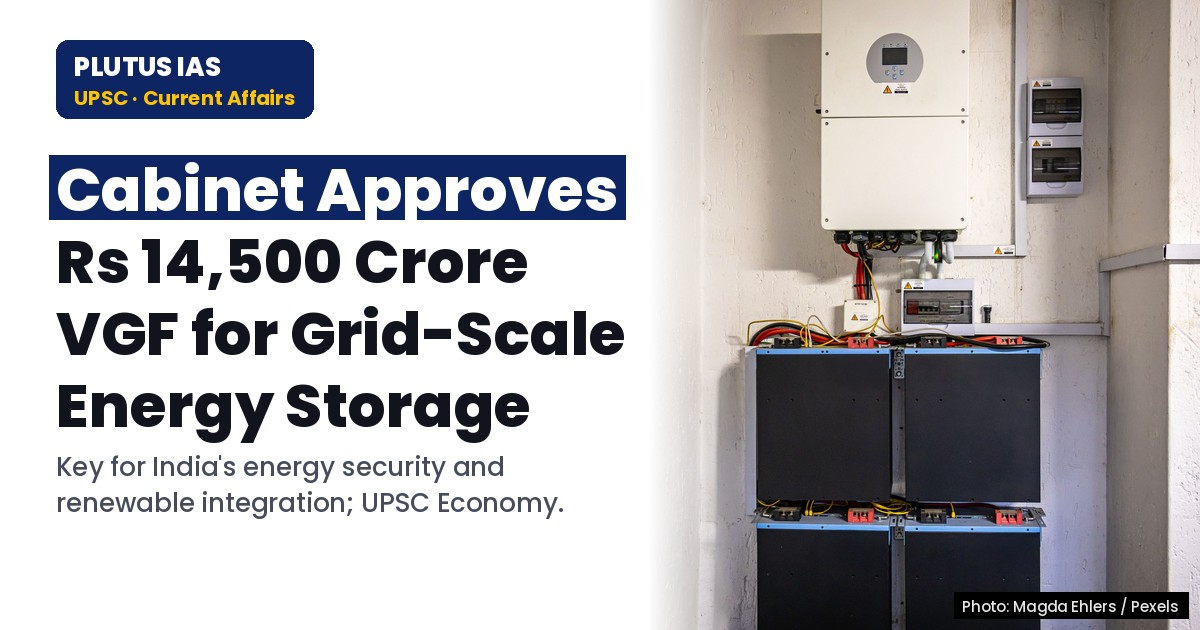
04 Nov Cabinet Approves VGF for Grid-Scale Energy Storage Systems
✎ The Viability Gap Funding Scheme for Grid-Scale Energy Storage Systems is a strategic government intervention to accelerate India's energy transition by promoting large-scale energy storage, enhancing grid stability, and…
Subject Relevance — Where This Topic Fits
- GS Paper III — Economy (Infrastructure: Energy, Investment Models) | GS Paper III — Environment (Conservation, Environmental Pollution and Degradation, Environmental Impact Assessment) | GS Paper III — Science and Technology (Developments and their applications and effects in everyday life)
- Prelims: Viability Gap Funding (VGF) Scheme, Grid-Scale Energy Storage Systems (ESS), Renewable Energy Integration, Energy Transition, Peak Load Management, Ancillary Services, National Green Hydrogen Mission, Battery Energy Storage Systems (BESS), Pumped Hydro Storage (PHS)
- Essay: India’s Energy Security and Sustainable Development, The Role of Technology in Achieving Climate Goals
Quick Revision: The Viability Gap Funding Scheme for Grid-Scale Energy Storage Systems is a strategic government intervention to accelerate India’s energy transition by promoting large-scale energy storage, enhancing grid stability, and integrating renewable energy sources.
Why is this in the news?
The Union Cabinet has approved a Viability Gap Funding (VGF) Scheme amounting to Rs. 14,500 crore for the development of 92 GWh of Grid-Scale Energy Storage Systems (ESS) by 2030-31. This initiative aims to bolster India’s renewable energy integration, enhance grid stability, and reduce dependence on fossil fuels, thereby accelerating the nation’s energy transition goals.
Background
- India has set ambitious targets for renewable energy capacity addition, aiming for 500 GW of non-fossil fuel-based electricity capacity by 2030.
- The intermittent nature of renewable energy sources like solar and wind necessitates robust energy storage solutions for grid stability and reliable power supply.
- Grid-scale energy storage systems play a crucial role in balancing demand and supply, managing peak loads, and providing ancillary services to the grid.
- The high capital costs associated with developing large-scale energy storage projects often deter private investment, creating a need for financial support mechanisms.
- The VGF scheme is designed to bridge the financial gap that makes such projects commercially unviable under current market conditions.
- This initiative aligns with India’s commitments under the Paris Agreement and its broader strategy for achieving energy independence and sustainability.
- The scheme is expected to facilitate the deployment of various storage technologies, including Battery Energy Storage Systems (BESS) and Pumped Hydro Storage (PHS).
What are Grid-Scale Energy Storage Systems and Viability Gap Funding?
- Grid-Scale Energy Storage Systems (ESS) are large-capacity facilities designed to store electrical energy and dispatch it back to the grid when needed. They are crucial for integrating intermittent renewable energy sources, enhancing grid stability, and managing peak demand.
- ESS can store energy generated during periods of low demand or high renewable output and release it during periods of high demand or low renewable output, thereby optimising grid operations.
- Common technologies for grid-scale ESS include Battery Energy Storage Systems (BESS), Pumped Hydro Storage (PHS), Compressed Air Energy Storage (CAES), and Flywheels, each with distinct characteristics and applications.
- Viability Gap Funding (VGF) is a financial support mechanism provided by the government to infrastructure projects that are economically justified but not financially viable due to high capital costs or long gestation periods.
- The VGF aims to bridge the gap between the project’s internal rate of return (IRR) and the minimum acceptable IRR for private investors, thereby attracting private sector participation.
- Under this scheme, the VGF will be disbursed in five tranches, linked to the project’s commissioning milestones, ensuring phased support and accountability.
- The scheme mandates that 85% of the ESS capacity developed under the VGF must be made available to Distribution Companies (DISCOMs), promoting equitable access and grid integration.
- The development of grid-scale ESS is vital for India’s energy security, enabling better utilisation of renewable energy, reducing curtailment, and deferring investments in conventional power plants and transmission infrastructure.
- This initiative is expected to reduce the cost of electricity from renewable sources, facilitate green hydrogen production, and contribute to India’s net-zero emissions target by 2070.
Key Features
| Feature | Significance |
|---|---|
| Viability Gap Funding (VGF) Scheme | Provides financial support to bridge the gap between the project cost and the revenue generated, making economically unviable but strategically important projects feasible. |
| 92 GWh Grid-Scale Energy Storage Systems | Establishes a substantial capacity for energy storage, crucial for integrating intermittent renewable energy sources and ensuring grid stability. |
| Rs. 14,500 crore outlay | Represents a significant governmental commitment to developing critical energy infrastructure and fostering a robust renewable energy ecosystem. |
| Public-Private Partnership (PPP) model | Leverages private sector efficiency and capital while ensuring strategic alignment with national energy goals through government support. |
| Phased implementation | Allows for adaptive planning and technological evolution, ensuring optimal resource allocation and project execution over time. |
Why it Matters
Economic Implications
- Stimulates investment in the energy storage sector, fostering job creation and technological advancement within the domestic industry.
- Reduces reliance on conventional fossil fuels, leading to potential savings in import bills and enhanced energy security.
- Facilitates the growth of renewable energy projects by providing essential grid balancing and storage capabilities, thereby improving their economic viability.
Strategic Importance
- Crucial for India’s energy transition goals, enabling a higher penetration of renewable energy into the national grid without compromising stability.
- Enhances grid resilience and reliability, particularly in managing peak demand and addressing supply fluctuations from intermittent sources like solar and wind.
- Positions India as a leader in sustainable energy infrastructure development, contributing to global climate change mitigation efforts.
Environmental Benefits
- Supports the reduction of greenhouse gas emissions by promoting the integration of clean energy sources and minimizing the need for fossil fuel-based peaking power plants.
- Contributes to improved air quality by decreasing the operational hours of thermal power stations.
- Aligns with India’s commitments under international climate agreements, showcasing proactive measures towards a greener economy.
Challenges
1. High Capital Costs
- The initial investment required for grid-scale energy storage systems, particularly advanced battery technologies, remains substantial.
- Despite VGF, the overall financial outlay can still be a deterrent for private investors without further incentives or risk mitigation.
UPSC Link: Economy: Infrastructure, Investment Models
2. Technology Dependence and Supply Chain Vulnerabilities
- Reliance on imported critical minerals (e.g., lithium, cobalt) and advanced manufacturing components for battery storage systems creates supply chain risks.
- Developing indigenous manufacturing capabilities and securing raw material access is essential for long-term sustainability and strategic autonomy.
UPSC Link: Science & Tech: Energy, Critical Minerals
3. Integration and Grid Management Complexities
- Integrating large-scale energy storage systems into the existing grid infrastructure requires sophisticated control mechanisms and advanced forecasting tools.
- Ensuring seamless operation and optimal dispatch of stored energy necessitates robust regulatory frameworks and skilled human resources.
UPSC Link: Economy: Infrastructure, Energy Policy
4. Regulatory and Policy Framework Gaps
- The evolving nature of energy storage technologies requires dynamic and adaptive regulatory policies to address market mechanisms, safety standards, and performance benchmarks.
- Clear tariff structures and revenue certainty are crucial for attracting sustained private sector investment in this nascent sector.
UPSC Link: Governance: Government Policies, Regulation
Challenges — UPSC Perspective
| Issue | Concern |
|---|---|
| Financial Viability | Despite VGF, ensuring adequate returns for private investors given the long gestation periods and evolving market dynamics. |
| Technological Obsolescence | Rapid advancements in energy storage technologies pose a risk of current investments becoming outdated quickly. |
| Land Acquisition | Securing suitable land for large-scale energy storage projects can be challenging due to competing demands and environmental considerations. |
| Skilled Workforce | Availability of trained personnel for the installation, operation, and maintenance of advanced energy storage systems. |
| Environmental Impact | Disposal and recycling of battery components at the end of their lifecycle present significant environmental management challenges. |
Government Initiatives — Must-Memorise for Prelims
- Viability Gap Funding Scheme
Way Forward
- Promote indigenous research and development in advanced energy storage technologies to reduce import dependence and foster domestic manufacturing.
- Develop comprehensive recycling policies and infrastructure for battery components to address environmental concerns and promote a circular economy.
- Strengthen regulatory frameworks to provide clarity on market mechanisms, tariff structures, and grid integration protocols for energy storage systems.
- Invest in skill development programs to create a specialized workforce capable of designing, installing, operating, and maintaining energy storage infrastructure.
- Explore innovative financing mechanisms beyond VGF, such as green bonds and concessional loans, to attract a broader spectrum of investors.
- Establish pilot projects for diverse energy storage technologies to assess their performance under Indian grid conditions and refine deployment strategies.
- Foster international collaborations for technology transfer, knowledge sharing, and securing critical raw material supply chains.
UPSC Value Addition
Keywords for Mains Answer-Writing
Viability Gap Funding · Grid-Scale Energy Storage Systems · Renewable Energy Integration · Energy Transition · Climate Change Mitigation · Energy Security · Power Sector Reforms · Sustainable Development Goals · Green Hydrogen · Battery Energy Storage Systems
Concept Flow
Intermittent Renewable Energy Generation → Grid Instability and Reliability Concerns → Need for Energy Storage Systems → Viability Gap Funding (VGF) Scheme Approval → Development of Grid-Scale Energy Storage Capacity → Enhanced Grid Stability and Renewable Energy Integration → Achieving National Energy Transition Goals
Prelims Practice Questions
Q1. Consider the following statements regarding Viability Gap Funding (VGF) Schemes in India:
1. VGF is typically provided for infrastructure projects that are economically justified but financially unviable.
2. The VGF scheme for Grid-Scale Energy Storage Systems aims to support projects that might not attract private investment due to long gestation periods and high capital costs.
3. VGF is usually disbursed as a one-time grant at the construction stage of a project.
How many of the above statements are correct?
- Only one
- Only two
- All three
- None
Answer: All three — Statement 1 is correct: VGF bridges the gap between the project cost and the revenue it can generate, making it attractive for private investment. Statement 2 is correct: Energy storage projects often have high upfront costs and uncertain revenue streams, making VGF crucial for their development. Statement 3 is incorrect: VGF can be disbursed at various stages, including during construction or over the operational period, depending on the scheme’s design.
Q2. Which of the following best describes the primary objective of Grid-Scale Energy Storage Systems?
- To provide backup power for residential consumers during outages.
- To store surplus renewable energy and ensure grid stability.
- To reduce the overall cost of electricity generation from fossil fuels.
- To facilitate direct energy transfer between different national grids.
Answer: To store surplus renewable energy and ensure grid stability. — Grid-Scale Energy Storage Systems are crucial for integrating intermittent renewable energy sources like solar and wind into the national grid. They store excess energy when generation exceeds demand and release it when demand is high or generation is low, thereby ensuring grid stability and reliability.
Mains Practice Question
✍ Examine the significance of Viability Gap Funding (VGF) in promoting critical infrastructure development in India. Discuss how the recent VGF scheme for Grid-Scale Energy Storage Systems can contribute to India’s energy transition goals. (15 Marks)
Approach: Introduction: Define Viability Gap Funding (VGF) and its purpose in infrastructure development.
Part 1: Significance of VGF in critical infrastructure development:
– Address market failures where projects are economically beneficial but financially unviable.
– Attract private sector investment in high-capital, long-gestation projects.
– Facilitate development in sectors like renewable energy, roads, ports, etc.
– Reduce financial risk for private developers.
– Examples of sectors where VGF has been applied successfully.
Part 2: Contribution of the VGF scheme for Grid-Scale Energy Storage Systems to India’s energy transition goals:
– Integration of intermittent renewable energy sources (solar, wind) into the grid.
– Enhance grid stability and reliability.
– Reduce reliance on fossil fuel-based peaking power plants.
– Support the ’24×7 Power for All’ initiative.
– Facilitate achievement of India’s Nationally Determined Contributions (NDCs) under the Paris Agreement.
– Promote indigenous manufacturing and technological development in energy storage.
– Potential for green hydrogen production and related industries.
Conclusion: Summarize the dual benefits of VGF in de-risking projects and accelerating India’s sustainable energy future.
Source: PIB (Press Information Bureau)
Generated by AanyaAi for educational purpose.
Related guides on our sites
- Best PSIR optional coaching for upsc
- Best PSIR optional teacher for upsc
- Best teacher of PSIR optional for upsc
- Best PSIR optional coaching in delhi for UPSC

- Visit of Prime Minister to Manila, Philippines (November 16–17, 2026) - November 12, 2026
- Nasha Mukt Bharat Abhiyaan: Impact on Youth & Women - November 12, 2026
- वैश्विक उत्सर्जन में गिरावट के बावजूद भारत में कार्बन उत्सर्जन वृद्धि: कारण और निहितार्थ - November 12, 2026

No Comments