


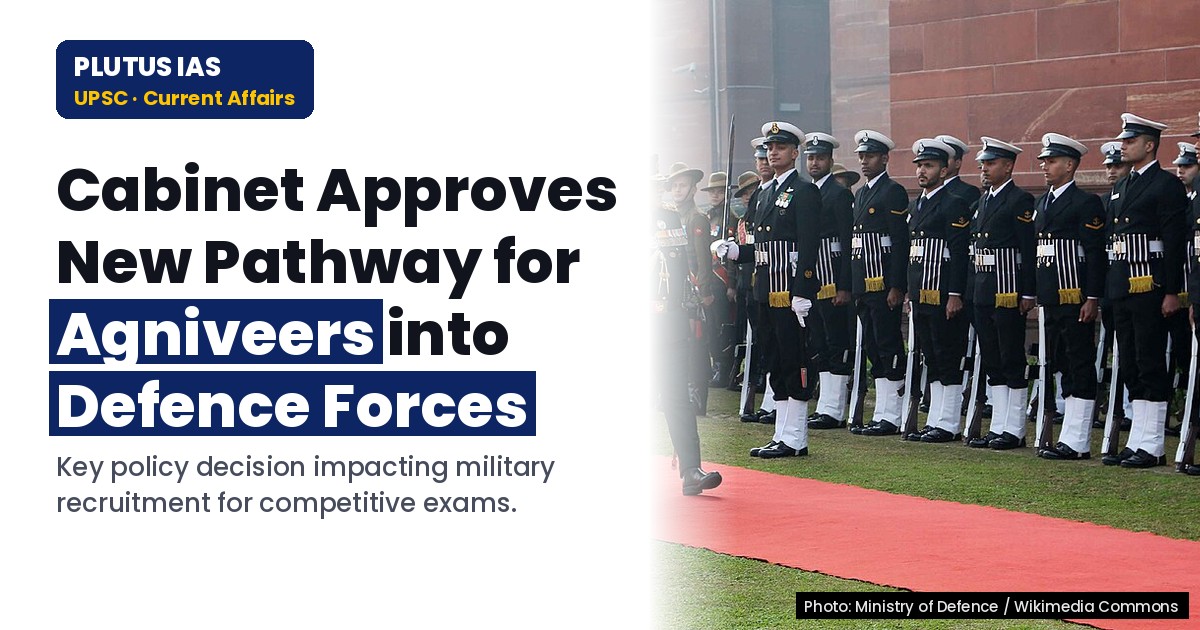
04 Nov Agniveer Absorption in Defence Forces: Cabinet Decision
✎ The Agnipath scheme is a transformative recruitment policy for the Indian Armed Forces, enrolling 'Agniveers' for a four-year tenure, with a recent Cabinet decision enhancing their absorption pathway into regular service.
Subject Relevance — Where This Topic Fits
- GS Paper II — Governance, Welfare Schemes, Government Policies and Interventions | GS Paper III — Security, Defence Technology, Employment
- Prelims: Agnipath Scheme, Agniveers, Indian Armed Forces, Short-term military recruitment, Defence Ministry, Cabinet Committee on Security (CCS)
- Essay: Reforming India’s Defence Sector: Balancing Modernisation, Manpower, and Fiscal Prudence, Youth Employment and National Security: The Dual Imperatives of India’s Future
Quick Revision: The Agnipath scheme is a transformative recruitment policy for the Indian Armed Forces, enrolling ‘Agniveers’ for a four-year tenure, with a recent Cabinet decision enhancing their absorption pathway into regular service.
Why is this in the news?
The Union Cabinet has recently approved a significant policy change, creating a structured pathway for Agniveers to be absorbed into the regular cadre of the Defence Forces. This decision aims to address concerns regarding the post-service prospects of Agniveers and enhance the attractiveness of the Agnipath scheme, ensuring a more seamless transition and integration into the armed forces for a select cohort, thereby strengthening the long-term human resource strategy of the Indian military.
Background
- The Agnipath scheme was launched in June 2022 by the Government of India, marking a transformative reform in the recruitment process for the Indian Armed Forces.
- It introduced a new model for enrolling soldiers, sailors, and airmen, termed ‘Agniveers’, for a four-year tenure.
- The primary objectives of the scheme included reducing the average age of the armed forces, enhancing combat readiness, and cutting down on the burgeoning pension bill.
- Upon completion of the four-year service, up to 25% of the Agniveers were initially envisaged to be absorbed into the regular cadre based on merit, willingness, and medical fitness.
- The scheme faced initial protests and discussions regarding the short service tenure and the future employment prospects for the majority of Agniveers who would not be retained.
- The recent Cabinet decision signifies a policy refinement, aiming to provide greater clarity and opportunity for Agniveers to continue their service in the Defence Forces.
- This move is expected to bolster morale among recruits and ensure a more experienced and motivated force for national security.
What is the Agnipath Scheme?
- The Agnipath scheme is a pan-India merit-based recruitment scheme for enrolling soldiers, sailors, and airmen into the Indian Armed Forces.
- Recruits under this scheme are known as ‘Agniveers’ and serve for a period of four years.
- The scheme targets individuals aged between 17.5 and 21 years, with educational qualifications varying based on the specific service requirements.
- Agniveers receive a monthly salary, along with risk and hardship allowances, and a non-contributory ‘Seva Nidhi’ package upon exit, which is a lump sum payment.
- During their service, Agniveers receive comprehensive training in military skills, leadership, and various technical trades.
- The scheme aims to create a younger, fitter, and more technologically adept armed force, while also reducing the long-term pension burden on the defence budget.
- Upon completion of the four-year tenure, a maximum of 25% of Agniveers are eligible to apply for regular enrolment in the armed forces, subject to organisational requirements and merit-based selection.
- The recent Cabinet decision enhances the absorption prospects, providing a more defined pathway for continued service for a larger proportion of eligible Agniveers.
Key Features
| Feature | Significance |
|---|---|
| Agnipath Scheme | A transformative recruitment scheme for the Indian Armed Forces, designed to induct younger, fitter personnel for a fixed tenure. |
| Agniveers | Personnel recruited under the Agnipath scheme for a four-year period, aiming to enhance the youthful profile of the armed forces. |
| Absorption Pathway | A recent Cabinet decision creating a mechanism for a proportion of Agniveers to be absorbed into the regular cadre of the Defence Forces upon completion of their four-year tenure. |
| Enhanced Retention | The absorption pathway provides an opportunity for skilled and experienced Agniveers to continue their service, addressing concerns about post-service employment. |
| Optimised Manpower Utilisation | Allows the armed forces to retain valuable human capital, ensuring continuity and leveraging the training and experience gained by Agniveers. |
Why it Matters
National Security Implications
- Strengthens the long-term human resource strategy of the Indian Armed Forces by ensuring a balance between short-term induction and long-term retention of trained personnel.
- Contributes to maintaining a youthful and agile fighting force while also providing avenues for experienced personnel to contribute to national defence over a longer period.
Socio-Economic Impact
- Offers enhanced career stability and post-service prospects for Agniveers, potentially mitigating concerns regarding unemployment after their four-year tenure.
- Promotes skill development and disciplined work ethic among a large cohort of youth, contributing to the nation’s human capital development.
Military Reforms and Modernisation
- Represents a significant step in the ongoing reforms within the Indian military, aiming to create a more efficient, technologically adept, and youthful force.
- Facilitates better planning and utilisation of defence budgets by optimising personnel costs while ensuring operational readiness.
Governance and Policy
- Demonstrates the government’s adaptive approach to policy implementation, responding to feedback and refining schemes to enhance their effectiveness and address stakeholder concerns.
- Highlights the role of the Cabinet in making strategic decisions that impact national security, human resources, and social welfare.
Challenges
1. Selection and Retention Criteria
- Developing transparent, merit-based, and objective criteria for the absorption of Agniveers into the regular cadre to ensure fairness and prevent subjective biases.
- Balancing the need for a youthful profile with the retention of experienced personnel, ensuring that the absorption process does not undermine the original intent of the Agnipath scheme.
UPSC Link: Governance; Defence Policy
2. Training and Skill Development
- Ensuring that Agniveers receive comprehensive training that prepares them not only for their initial four-year tenure but also for potential absorption into the permanent cadre.
- Providing opportunities for continuous skill enhancement and specialisation during their service to meet the evolving demands of modern warfare and facilitate career progression.
UPSC Link: Human Resource Development; National Security
3. Cadre Management and Integration
- Effectively integrating absorbed Agniveers into the existing regimental system and ensuring smooth transition and acceptance within the permanent cadre.
- Addressing potential disparities in service conditions, pay scales, and pension benefits between absorbed Agniveers and existing permanent cadre personnel.
UPSC Link: Defence Administration; Public Administration
4. Financial Implications
- Assessing the long-term financial impact of absorbing a proportion of Agniveers on the defence budget, particularly concerning pension liabilities and other emoluments.
- Ensuring sustainable funding mechanisms for the scheme, balancing immediate operational needs with future personnel costs.
UPSC Link: Government Budgeting; Defence Economics
Challenges — UPSC Perspective
| Issue | Concern |
|---|---|
| Fair Selection Process | Ensuring transparency and objectivity in the criteria for absorbing Agniveers into the permanent cadre. |
| Integration Challenges | Smooth assimilation of absorbed Agniveers into the existing regimental structure and addressing potential cadre disparities. |
| Skill Gap Management | Ensuring continuous training and skill upgradation for Agniveers to meet evolving military requirements. |
| Financial Sustainability | Managing the long-term financial implications, particularly pension liabilities, associated with increased absorption. |
| Morale and Motivation | Maintaining high morale among both Agniveers and existing permanent cadre during the transition and integration phases. |
Government Initiatives — Must-Memorise for Prelims
- Agnipath Scheme
Way Forward
- Establish clear, objective, and transparent criteria for the selection and absorption of Agniveers into the permanent cadre, ensuring meritocracy.
- Implement robust training and skill development programmes for Agniveers, focusing on both military proficiency and transferable skills for future career paths.
- Develop a comprehensive integration strategy to ensure smooth assimilation of absorbed Agniveers into the existing armed forces structure, addressing potential disparities.
- Conduct periodic reviews and evaluations of the Agnipath scheme and the absorption pathway to identify areas for improvement and adapt to evolving requirements.
- Enhance communication and awareness campaigns to clarify the scheme’s provisions, benefits, and career progression opportunities for prospective Agniveers.
- Explore avenues for collaboration with other government departments and industries to facilitate alternative employment opportunities for Agniveers not absorbed into the defence forces.
- Ensure adequate budgetary allocation and financial planning to support the long-term sustainability of the Agnipath scheme and the absorption process.
UPSC Value Addition
Keywords for Mains Answer-Writing
Agnipath Scheme · Agniveers · Defence Forces recruitment · Cabinet Committee on Security · National Security · Youth employment · Skill development · Military reforms · Human resource management · Armed Forces modernisation
Constitutional & Policy Linkages
- {‘article’: ‘Article 53’, ‘note’: ‘Supreme Command of Defence Forces’}
- {‘article’: ‘Seventh Schedule’, ‘note’: ‘Union List (Defence of India)’}
Concept Flow
Agnipath Scheme introduced for short-term recruitment. → Agniveers serve for a four-year tenure. → Cabinet approves pathway for absorption. → Selected Agniveers join permanent cadre. → Enhanced retention and experienced personnel. → Modernisation and youthful armed forces.
Prelims Practice Questions
Q1. Consider the following statements regarding the Agnipath Scheme:
1. The scheme aims to recruit youth into the Indian Armed Forces for a four-year tenure.
2. Agniveers are eligible for a 25% retention in the regular cadre of the armed forces after completing their tenure.
3. The scheme provides for a ‘Seva Nidhi’ package upon completion of service, which is entirely tax-exempt.
How many of the above statements are correct?
- Only one
- Only two
- All three
- None
Answer: Only two — Statement 1 is correct: The Agnipath Scheme recruits youth for a four-year period. Statement 2 is incorrect: Initially, 25% of Agniveers were to be absorbed into the regular cadre; however, the recent Cabinet decision creates a pathway for all Agniveers to be absorbed, subject to organisational requirements and policies. Statement 3 is incorrect: The ‘Seva Nidhi’ package is partially tax-exempt, with the government’s contribution being tax-exempt, but the Agniveer’s contribution is not.
Q2. Which of the following bodies is responsible for approving major defence policy changes, including those related to recruitment and service conditions in the Indian Armed Forces?
- Parliamentary Standing Committee on Defence
- Ministry of Defence
- Cabinet Committee on Security (CCS)
- Chiefs of Staff Committee
Answer: Cabinet Committee on Security (CCS) — The Cabinet Committee on Security (CCS) is the apex government body responsible for deliberating and making decisions on matters related to India’s defence policy, national security, and strategic affairs, including significant changes to armed forces’ structure and recruitment.
Mains Practice Question
✍ Critically examine the implications of the recent Cabinet decision to create a pathway for all Agniveers to be absorbed into the Defence Forces. Discuss its potential impact on the operational readiness, human resource management, and long-term financial sustainability of the Indian Armed Forces. (15 Marks)
Approach: MODEL-ANSWER SKELETON: The answer should begin by outlining the core provisions of the Agnipath Scheme and the recent Cabinet decision. It should then critically examine the implications across three key dimensions:
1. **Operational Readiness:** Discuss potential effects on troop morale, training continuity, experience levels, and the overall combat effectiveness of units. Consider arguments for and against the previous 25% retention model versus the new ‘all-Agniveer’ pathway.
2. **Human Resource Management:** Analyse the impact on recruitment processes, career progression, skill development within the forces, and the management of a potentially larger pool of permanent personnel. Mention the balance between youthful profile and experienced leadership.
3. **Long-term Financial Sustainability:** Evaluate the financial implications of absorbing a larger cohort of Agniveers into permanent service, considering aspects like pensions, salaries, and other benefits, contrasting it with the original financial objectives of the Agnipath Scheme.
Conclude with a balanced perspective on the reform’s potential benefits and challenges for India’s defence sector.
Source: PIB (Press Information Bureau)
Generated by AanyaAi for educational purpose.
Related guides on our sites
- How to prepare for GS paper 1 for UPSC CSE mains exam
- Best UPSC coaching for IFOS exam
- Best mentorship programme for upsc
- UPSC+BA degree

- NAMASTE Scheme: Enhancing Sanitation Workers’ Livelihoods & Safety - November 14, 2026
- एमएसएमई का विशेष अभियान 6.0: स्वच्छता और लंबित मामलों का निपटारा - November 14, 2026
- Sea Vigil-26: Coastal Defence Drills Off Visakhapatnam - November 14, 2026

No Comments