


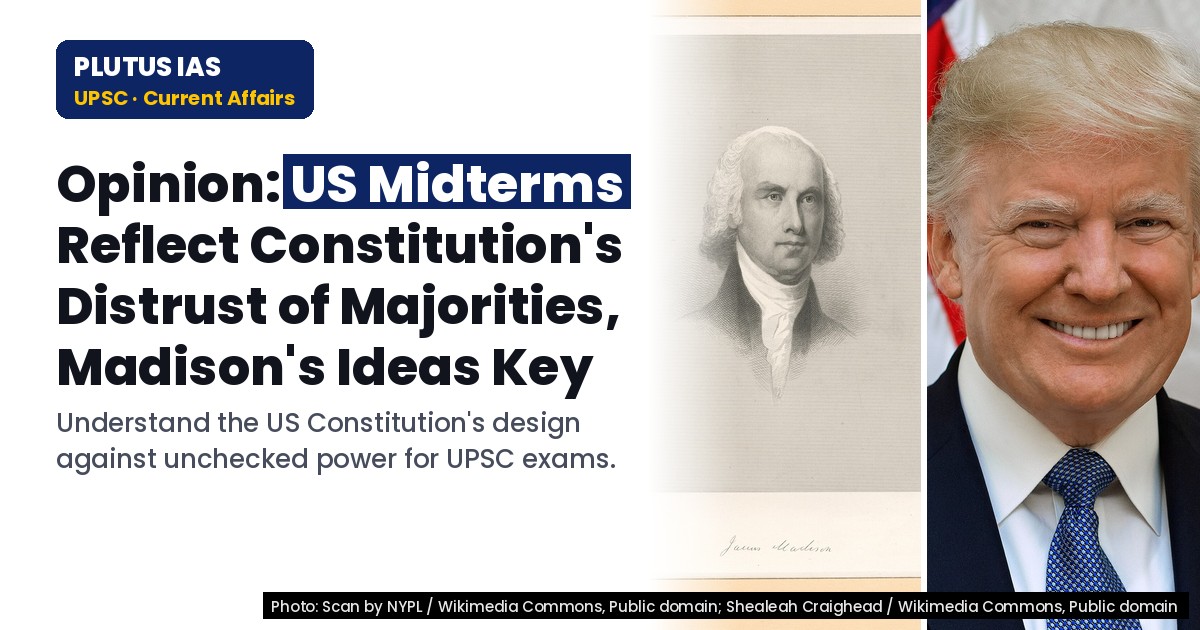
05 Nov US Midterms & Constitutional Distrust of Majorities
✎ The US Constitution employs a sophisticated architecture of separation of powers, checks and balances, bicameralism, and federalism to prevent majoritarian tyranny and ensure governmental accountability.
Subject Relevance — Where This Topic Fits
- GS Paper II — Polity and Governance | GS Paper II — International Relations | GS Paper II — Comparative Constitutions
- Prelims: US Constitution, Separation of Powers, Checks and Balances, Bicameralism, Federalism, Midterm Elections, Federalist Papers
- Essay: The delicate balance between majority rule and minority rights in a democracy, Constitutional design as a bulwark against unchecked power
Quick Revision: The US Constitution employs a sophisticated architecture of separation of powers, checks and balances, bicameralism, and federalism to prevent majoritarian tyranny and ensure governmental accountability.
Why is this in the news?
The recent US midterm election results, which have led to a shift in the control of Congress, underscore the foundational principles embedded in the American Constitution designed to mitigate the risks of majoritarianism. This electoral outcome provides a contemporary illustration of how constitutional mechanisms, such as the separation of powers and a bicameral legislature, function to ensure governmental accountability and prevent the concentration of unchecked authority, aligning with the framers’ original intent to balance popular sovereignty with institutional restraints.
Background
- The US Constitution, drafted in 1787, was significantly influenced by the political philosophy of James Madison, who articulated concerns regarding the potential tyranny of factions, particularly majority factions, in a democratic system.
- Madison’s arguments, notably in Federalist Papers No. 10 and No. 51, highlighted the inherent challenge of designing a government that could both control the governed and be obliged to control itself.
- The framers sought to create a system that would preserve majority rule while simultaneously preventing any single faction or branch of government from exercising absolute power.
- Midterm elections in the US occur approximately two years into a President’s four-year term, allowing voters to elect new members of Congress (House of Representatives and a third of the Senate), often serving as a referendum on the incumbent administration’s performance.
- These elections can lead to a divided government, where the presidency and one or both chambers of Congress are controlled by different political parties, thereby enhancing legislative oversight and checks on executive power.
- The 2026 US midterms, occurring two years into the second term of the incumbent President, have resulted in significant gains for the Democratic party in both the House of Representatives and the Senate, indicating an increased likelihood of Congressional oversight over the executive branch.
Constitutional Mechanisms to Counter Majoritarianism
- **Separation of Powers:** The US Constitution divides governmental authority into three distinct branches—legislative (Congress), executive (President), and judicial (Supreme Court)—each with its own specific functions and personnel, preventing the concentration of power in a single entity.
- **Checks and Balances:** This system allows each branch of government to limit the powers of the other branches, ensuring mutual accountability. Examples include presidential veto power over legislation, congressional power to impeach the President or judges, and judicial review of legislative and executive actions.
- **Bicameral Legislature:** The US Congress is composed of two chambers: the House of Representatives, with representation based on population, and the Senate, with equal representation for each state. This structure ensures that legislation must pass through two different bodies with distinct electoral bases, requiring broader consensus and preventing hasty or factional lawmaking.
- **Federalism:** Power is divided between the national (federal) government and state governments, allowing for diverse policies across states and providing multiple arenas for political participation, thereby diffusing power and preventing a single national majority from dominating all aspects of governance.
- **Constitutional Amendments:** The process for amending the Constitution is deliberately arduous, requiring supermajorities, which protects fundamental rights and structural principles from being easily altered by temporary majorities.
- **Judicial Review:** The judiciary, through its power of judicial review, can declare laws or executive actions unconstitutional, serving as a critical safeguard against legislative or executive overreach and protecting individual rights and constitutional principles.
Key Features
| Feature | Significance |
|---|---|
| Separation of Powers | Divides governmental authority among legislative, executive, and judicial branches to prevent concentration of power and ensure mutual accountability. |
| Bicameral Legislature | Establishes two distinct legislative chambers (House of Representatives and Senate) with different electoral bases and terms, requiring consensus for lawmaking and mitigating hasty decisions. |
| Federalism | Distributes power between a central government and constituent states, allowing for diverse local governance while maintaining national unity and providing checks on central authority. |
| Checks and Balances | Grants each branch of government specific powers to limit the actions of the other branches, ensuring no single branch becomes dominant. |
| Midterm Elections | Provides an opportunity for the electorate to reassess and potentially alter the balance of power within the legislative branch midway through a presidential term, acting as a check on executive power. |
Why it Matters
Political Governance
- The US constitutional framework, particularly its emphasis on separation of powers and checks and balances, is designed to prevent the unchecked exercise of power by any single branch or majority faction.
- Midterm elections serve as a crucial mechanism for democratic accountability, allowing citizens to influence legislative composition and thereby impose oversight on the executive branch.
- The concept of ‘ambition counteracting ambition’ embedded in the US system highlights the deliberate design to harness human nature for governmental stability and protection of rights.
Constitutional Philosophy
- The foundational distrust of majoritarianism, as articulated by James Madison, underscores the importance of safeguarding minority rights and preventing the tyranny of the majority.
- The Federalist Papers, particularly No. 10 and No. 51, provide profound insights into the challenges of governing diverse societies and designing institutions that balance liberty with order.
International Relations
- Changes in the US Congressional landscape following midterms can influence the executive’s ability to pursue specific foreign policy agendas, affecting international engagements and alliances.
- The stability and design of democratic institutions in major global powers like the US have implications for global governance and the promotion of democratic values worldwide.
Challenges
1. Governmental Gridlock
- The elaborate system of checks and balances, while preventing tyranny, can lead to legislative stalemates, especially when different political parties control the executive and legislative branches.
- Policy implementation and critical decision-making can be hampered by partisan divisions, affecting national progress and responsiveness to societal needs.
UPSC Link: Indian Constitution—historical underpinnings, evolution, features, amendments, significant provisions and basic structure.
2. Accountability Deficit
- While designed for accountability, the diffusion of power across multiple institutions can sometimes make it difficult to pinpoint responsibility for policy failures or governmental inaction.
- The complexity of the system can obscure the decision-making process, potentially reducing public understanding and engagement.
UPSC Link: Separation of powers between various organs dispute redressal mechanisms and institutions.
3. Risk of Factionalism
- Madison’s concern about ‘factions’ remains relevant, as intense partisan divisions can prioritize narrow group interests over the broader public good.
- The constitutional design, while mitigating factional power, does not eliminate the potential for political polarization to undermine effective governance.
UPSC Link: Role of political parties and pressure groups in the Indian political system.
Challenges — UPSC Perspective
| Issue | Concern |
|---|---|
| Majoritarianism | The potential for a majority faction to disregard the rights and interests of minority groups or the broader public good. |
| Concentration of Power | The risk that any single branch or individual within government could accumulate excessive authority, leading to authoritarian tendencies. |
| Legislative Inefficiency | The challenge of achieving timely and effective policy outcomes when multiple checks and balances require extensive negotiation and compromise. |
| Political Polarization | The exacerbation of ideological divides, potentially leading to governmental paralysis and an inability to address national challenges collaboratively. |
Way Forward
- Foster a culture of constitutionalism and respect for institutional norms to ensure the effective functioning of democratic checks and balances.
- Promote civic education to enhance public understanding of governmental structures and the importance of active, informed participation in democratic processes.
- Encourage bipartisan cooperation and consensus-building among political actors to overcome legislative gridlock and address critical national issues.
- Strengthen independent institutions, including the judiciary and oversight bodies, to ensure impartial enforcement of laws and accountability of all governmental branches.
- Develop mechanisms for continuous institutional reform to adapt constitutional frameworks to evolving societal needs while preserving core democratic principles.
- Emphasize ethical governance and public service to mitigate the risks of factionalism and ensure that public policy serves the collective interest.
UPSC Value Addition
Keywords for Mains Answer-Writing
Separation of Powers · Checks and Balances · Bicameralism · Federalism · Constitutionalism · Limited Government · Majoritarianism · Minority Rights · Factions · Constitutional Design · Democratic Governance · Accountability
Constitutional & Policy Linkages
- {‘article’: ‘Article 1 (US Constitution)’, ‘note’: ‘Vests legislative power in Congress.’}
- {‘article’: ‘Article 2 (US Constitution)’, ‘note’: ‘Assigns executive powers to President.’}
- {‘article’: ‘Article 3 (US Constitution)’, ‘note’: ‘Establishes the judicial branch.’}
Concept Flow
Concern over ‘factions’ and majoritarian tyranny. → Framers design Constitution with distrust of unchecked power. → Separation of powers, bicameralism, federalism implemented. → Checks and balances system established. → Midterm elections provide periodic democratic oversight. → Electoral outcomes reshape legislative balance of power. → Increased Congressional oversight on the executive.
Prelims Practice Questions
Q1. Consider the following statements regarding the principles of constitutional governance:
1. The concept of ‘separation of powers’ ensures that legislative, executive, and judicial functions are always vested in entirely distinct and independent bodies.
2. ‘Checks and balances’ aim to prevent the concentration of power by allowing different branches of government to limit each other’s actions.
3. ‘Bicameralism’ is a legislative system where the legislature consists of two chambers or houses, often intended to provide a review mechanism.
How many of the above statements are correct?
- Only one
- Only two
- All three
- None
Answer: All three — Statement 1 is incorrect because while separation of powers advocates distinct functions, in practice, there is often some overlap or interdependence, especially in parliamentary systems, and even in presidential systems, complete independence is not absolute. Statement 2 is correct as checks and balances are designed precisely to prevent any single branch from becoming too powerful. Statement 3 is correct, as bicameralism provides for deliberation and review, often with different electoral bases for each house.
Q2. Which of the following constitutional principles is most directly associated with James Madison’s concern about ‘factions’ and the potential for a majority to infringe upon the rights of others?
- Judicial Review
- Electoral College
- Checks and Balances
- Popular Sovereignty
Answer: Checks and Balances — James Madison, in the Federalist Papers, particularly No. 10 and No. 51, articulated concerns about factions and the need to prevent any single group, including a majority, from dominating. The system of ‘checks and balances’ was designed to make ‘ambition counteract ambition’ and prevent the concentration of power, thereby safeguarding against the tyranny of a majority faction. While other options are part of the US constitutional design, checks and balances directly address Madison’s specific concern about controlling governmental power to protect rights.
Mains Practice Question
✍ The architecture of democratic governance often incorporates mechanisms to prevent the concentration of power and safeguard against majoritarian excesses. Discuss this statement in the context of constitutional principles like separation of powers and checks and balances, citing relevant examples from constitutional democracies. (15 Marks)
Approach: MODEL-ANSWER SKELETON:
1. **Introduction:** Define democratic governance and the inherent tension between majority rule and minority rights.
2. **Core Argument:** Explain how constitutional design seeks to mitigate the risks of concentrated power and majoritarianism.
3. **Separation of Powers:**
* **Definition:** Division of governmental functions (legislative, executive, judicial) into distinct branches.
* **Purpose:** Prevents tyranny, promotes efficiency, ensures accountability.
* **Example:** Articles I, II, III of the US Constitution; Indian Constitution’s distinct roles for Parliament, Executive, and Judiciary.
4. **Checks and Balances:**
* **Definition:** System where each branch can limit the powers of the others.
* **Purpose:** Prevents abuse of power, ensures mutual accountability, fosters deliberation.
* **Example:** US Presidential veto, Congressional oversight, Judicial review; Indian Parliament’s control over the executive (no-confidence motion), judicial review of executive and legislative actions.
5. **Other Mitigating Mechanisms (Briefly):**
* **Bicameralism:** (e.g., Lok Sabha and Rajya Sabha in India; House of Representatives and Senate in US) provides a second chamber for review and representation of diverse interests.
* **Federalism:** (e.g., India, US) decentralises power, preventing centralisation and allowing for regional diversity.
* **Fundamental Rights/Bill of Rights:** (e.g., Part III of Indian Constitution, US Bill of Rights) entrenches individual liberties beyond the reach of ordinary legislation.
* **Independent Institutions:** (e.g., Election Commission, CAG, UPSC in India) act as watchdogs.
6. **Conclusion:** Reiterate the importance of these principles in maintaining a robust, limited, and accountable democratic system, ensuring both effective governance and protection of individual and collective rights.
Source: The Indian Express
Generated by AanyaAi for educational purpose.
Related guides on our sites
- Current affairs for upsc 2026
- Anthropology VS PSIR
- Best PSIR optional coaching
- Best PSIR optional coaching online

- भारत की जलवायु नीति: ’35 तक 35′ लक्ष्य पर सतर्कता - November 5, 2026
- US Midterms & Constitutional Distrust of Majorities - November 5, 2026
- एनसीआर के 4 शहरों में प्रदूषण स्रोत अध्ययन अधूरा: एक गंभीर चुनौती - November 5, 2026

No Comments