


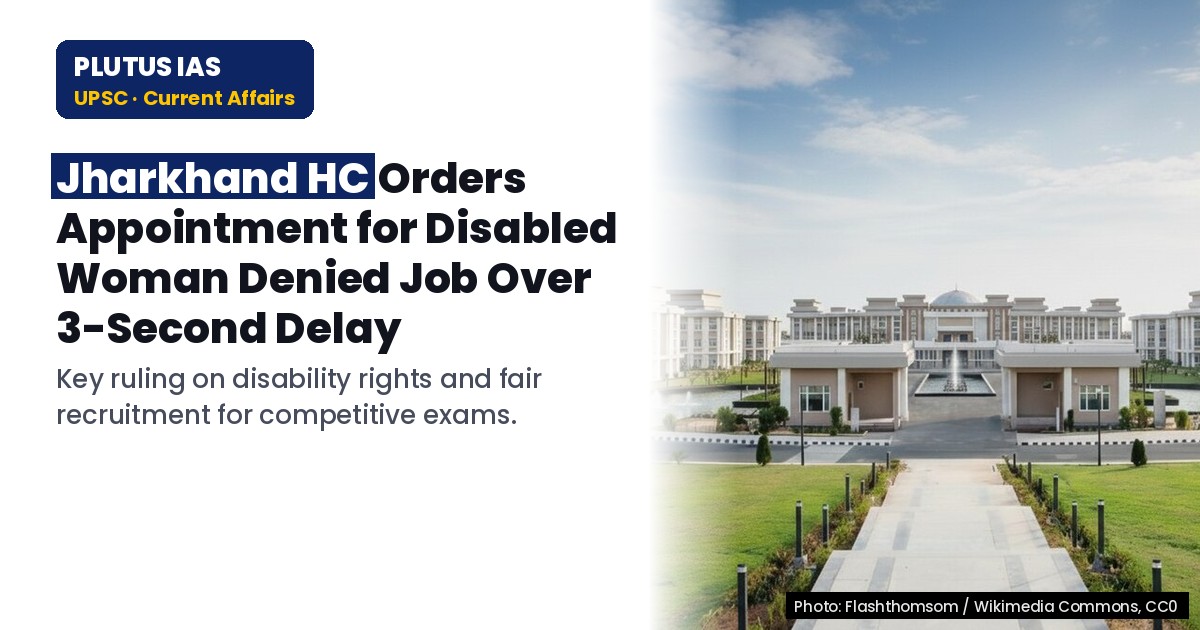
05 Nov Jharkhand HC: Disabled Applicant’s Job Denial for 3-Second Delay Wrong
✎ The Jharkhand High Court's ruling underscores the mandatory nature of 'reasonable accommodation' under the Rights of Persons with Disabilities Act, 2016, ensuring equal opportunities in public employment for disabled individuals.
Subject Relevance — Where This Topic Fits
- GS Paper II — Governance, Constitution, Polity, Social Justice | GS Paper III — Inclusive Growth
- Prelims: Rights of Persons with Disabilities Act, 2016, Reasonable Accommodation, Public Employment, Judicial Review, Article 14, Article 16
- Essay: Ensuring inclusive governance and social justice in India, The role of judiciary in upholding fundamental rights and promoting equality
Quick Revision: The Jharkhand High Court’s ruling underscores the mandatory nature of ‘reasonable accommodation’ under the Rights of Persons with Disabilities Act, 2016, ensuring equal opportunities in public employment for disabled individuals.
Why is this in the news?
The Jharkhand High Court recently ruled that disqualifying a physically disabled female candidate from a watchman recruitment process for a mere three-second delay in completing a physical endurance test was erroneous. The court directed the state government to issue an appointment letter to the candidate within eight weeks, emphasizing the state’s responsibility to provide reasonable accommodation to persons with disabilities.
Background
- The case involved the recruitment for 328 watchman posts in Dumka district, where a disabled candidate, after clearing the written examination, was subjected to a physical test.
- During the physical endurance test (running), the disabled candidate was made to compete alongside general candidates without any provision for additional time or special facilities commensurate with her disability.
- The candidate completed the race in 10 minutes and three seconds, exceeding the stipulated time by only three seconds, leading to her disqualification by the selection committee.
- The petitioner challenged this decision in the High Court, citing the provisions of the Rights of Persons with Disabilities Act, 2016, and relevant Supreme Court judgments.
- The state government argued that existing recruitment rules did not provide for additional time for disabled candidates in physical tests.
- The High Court, however, upheld the principle of reasonable accommodation, asserting that the state has a legal and constitutional obligation to provide appropriate facilities to persons with disabilities.
Rights of Persons with Disabilities Act, 2016 and Reasonable Accommodation
- The Rights of Persons with Disabilities Act, 2016 (RPwD Act) replaced the Persons with Disabilities (Equal Opportunities, Protection of Rights and Full Participation) Act, 1995, aligning Indian law with the United Nations Convention on the Rights of Persons with Disabilities (UNCRPD).
- The Act defines ‘person with disability’ as a person with long-term physical, mental, intellectual, or sensory impairment which, in interaction with barriers, hinders full and effective participation in society equally with others.
- Section 2(y) of the RPwD Act defines ‘reasonable accommodation’ as necessary and appropriate modification and adjustments, not imposing a disproportionate or undue burden, where needed in a particular case, to ensure persons with disabilities enjoy or exercise all human rights and fundamental freedoms on an equal basis with others.
- Section 20 of the Act specifically mandates that no Government establishment shall discriminate against any person with disability in any matter relating to employment, including promotion, and shall provide reasonable accommodation.
- The Act also reserves 4% of the total number of vacancies in government establishments for persons with benchmark disabilities.
- The Supreme Court, in cases like Vikas Kumar v. Union Public Service Commission, has consistently emphasized the importance of reasonable accommodation to ensure substantive equality for persons with disabilities.
- The principle of reasonable accommodation is crucial for ensuring that persons with disabilities have equal opportunities in education, employment, and other spheres of life, addressing systemic barriers rather than merely treating everyone identically.
- This judicial intervention reinforces the constitutional mandate of equality (Article 14) and equal opportunity in public employment (Article 16) for persons with disabilities, ensuring their full and effective participation in society.
Key Features
| Feature | Significance |
|---|---|
| Judicial Intervention | The High Court’s directive ensures the protection of rights for persons with disabilities, reinforcing the judiciary’s role in upholding statutory provisions. |
| Reasonable Accommodation | The ruling underscores the principle of ‘reasonable accommodation’ for disabled individuals in employment, as mandated by law. |
| Inclusion in Public Employment | It promotes inclusive practices in government recruitment, ensuring that minor discrepancies due to disability do not lead to disqualification. |
| Interpretation of Recruitment Rules | The court clarified that existing rules must be interpreted in consonance with disability rights legislation, even if specific provisions for accommodation are absent. |
| Timely Justice | The eight-week deadline for issuing an appointment letter reflects the court’s emphasis on expeditious implementation of its directives. |
Why it Matters
Social Justice
- The judgment upholds the principles of equality and non-discrimination, ensuring that persons with disabilities are not unfairly disadvantaged in public employment.
- It reinforces the state’s obligation to create an inclusive society where disabled individuals can participate fully and equally.
Governance and Administration
- The ruling mandates government agencies to review and reform their recruitment processes to incorporate provisions for reasonable accommodation, aligning with disability rights legislation.
- It serves as a precedent for administrative authorities to adopt a more empathetic and legally compliant approach towards disabled applicants.
Legal Precedent
- The High Court’s decision, referencing the Supreme Court’s ‘Vikas Kumar vs. Union Public Service Commission’ case, strengthens the legal framework for disability rights in employment.
- It clarifies that the absence of specific rules for accommodation does not absolve the state of its duty to provide such facilities under existing laws.
Challenges
1. Implementation of Disability Rights Legislation
- Ensuring that all government departments and public sector undertakings uniformly implement the provisions of the Rights of Persons with Disabilities Act, 2016.
- Overcoming bureaucratic inertia and resistance to change in established recruitment protocols.
UPSC Link: Social Justice: Welfare schemes for vulnerable sections
2. Designing Inclusive Recruitment Processes
- Developing standardized guidelines for providing reasonable accommodation during physical examinations and other stages of recruitment.
- Training recruitment personnel to understand and apply disability-inclusive practices effectively.
UPSC Link: Governance: Government policies and interventions
3. Attitudinal Barriers
- Addressing societal prejudices and stereotypes against persons with disabilities that may manifest in recruitment decisions.
- Promoting a culture of empathy and understanding within administrative bodies towards disabled applicants.
UPSC Link: Social Justice: Issues relating to development and management of Social Sector/Services relating to Health, Education, Human Resources
Challenges — UPSC Perspective
| Issue | Concern |
|---|---|
| Lack of Specific Accommodation Rules | Many existing recruitment rules do not explicitly provide for additional time or facilities for persons with disabilities during physical tests, leading to arbitrary disqualifications. |
| Uniform Application of Standards | Applying the same physical standards to both disabled and non-disabled candidates without necessary modifications is discriminatory and violates disability rights. |
| Judicial Overload | Disabled individuals are often compelled to seek legal recourse to enforce their fundamental rights, indicating systemic failures in administrative compliance. |
| Awareness and Training | Lack of adequate awareness and training among recruitment committees regarding disability rights laws and the concept of reasonable accommodation. |
Government Initiatives — Must-Memorise for Prelims
- Rights of Persons with Disabilities Act, 2016
Way Forward
- Mandate a comprehensive review of all public employment recruitment rules to ensure explicit provisions for reasonable accommodation for persons with disabilities.
- Develop and disseminate clear, standardized guidelines for assessing and providing accommodations to disabled candidates across all government departments.
- Conduct regular sensitivity training and legal awareness programs for all personnel involved in recruitment processes, focusing on the Rights of Persons with Disabilities Act, 2016.
- Establish a robust grievance redressal mechanism within each recruiting agency to address complaints from disabled applicants promptly and effectively.
- Utilize technology to create accessible examination environments and physical tests, where appropriate, to facilitate participation of persons with disabilities.
- Promote a proactive approach by government agencies to identify and remove barriers to employment for persons with disabilities, rather than waiting for judicial intervention.
UPSC Value Addition
Keywords for Mains Answer-Writing
Rights of Persons with Disabilities Act 2016 · Reasonable Accommodation · Equal Opportunity · Non-discrimination · Constitutional Mandate · Judicial Review · Inclusive Employment · Disability Rights · Public Employment · Vikas Kumar vs UPSC
Constitutional & Policy Linkages
- Article 14: Equality before law
- Article 15: Prohibition of discrimination
- Article 16: Equality of opportunity in public employment
- Article 21: Protection of life and personal liberty
- Article 41: Right to work, to education and to public assistance in certain cases
Concept Flow
Disabled applicant qualifies written exam → Faces physical test without accommodation → Disqualified for minor time delay → Challenges disqualification in High Court → Court upholds right to reasonable accommodation → Directs appointment within specified period
Prelims Practice Questions
Q1. Consider the following statements regarding the Rights of Persons with Disabilities Act, 2016:
1. The Act mandates that appropriate governments shall ensure that persons with disabilities enjoy the right to equality, life with dignity and respect for his or her integrity equally with others.
2. It defines ‘reasonable accommodation’ as necessary and appropriate modification and adjustments, not imposing a disproportionate or undue burden, where needed in a particular case, to ensure to persons with disabilities the enjoyment or exercise of all human rights and fundamental freedoms on an equal basis with others.
3. The Act specifies that no person with disability shall be discriminated against on the ground of disability, unless it is shown that the impugned act or omission is a proportionate means of achieving a legitimate aim.
How many of the above statements are correct?
- Only one
- Only two
- Only three
- None
Answer: Only three — Statement 1 is correct, reflecting the core objective of the Act. Statement 2 is correct, providing the statutory definition of ‘reasonable accommodation’. Statement 3 is also correct, outlining the principle of non-discrimination and its limited exceptions.
Q2. Which of the following Supreme Court judgments is most relevant to the principle of ‘reasonable accommodation’ for persons with disabilities in competitive examinations and public employment?
- Indra Sawhney v. Union of India
- Maneka Gandhi v. Union of India
- Vikas Kumar v. Union Public Service Commission
- S.R. Bommai v. Union of India
Answer: Vikas Kumar v. Union Public Service Commission — The Vikas Kumar v. Union Public Service Commission judgment specifically addressed the right to reasonable accommodation for persons with disabilities in competitive examinations, emphasizing the state’s obligation to provide necessary facilities.
Mains Practice Question
✍ Elucidate the concept of ‘reasonable accommodation’ for persons with disabilities in public employment, as mandated by the Rights of Persons with Disabilities Act, 2016. Discuss how recent judicial pronouncements have reinforced the state’s obligation to ensure inclusive opportunities. (15 Marks)
Approach: MODEL-ANSWER SKELETON:
1. **Introduction**: Briefly define ‘reasonable accommodation’ in the context of disability rights and its importance for equality.
2. **Statutory Basis**: Explain ‘reasonable accommodation’ as defined under Section 2(y) of the Rights of Persons with Disabilities Act, 2016. Mention related provisions like Section 3 (equality and non-discrimination) and Section 20 (equal opportunity in employment).
3. **Components of Reasonable Accommodation**: Discuss practical aspects such as modifications in infrastructure, examination procedures (e.g., extra time, scribes), work environment adjustments, and flexible policies.
4. **Judicial Reinforcement**: Refer to key Supreme Court judgments, particularly ‘Vikas Kumar v. Union Public Service Commission’, which emphasized the state’s affirmative obligation to provide reasonable accommodation. Mention the recent Jharkhand High Court ruling (as per the news) as a specific instance reinforcing this principle, highlighting the rejection of minor delays as grounds for disqualification.
5. **State’s Obligation**: Elaborate on the state’s constitutional and statutory duty to ensure an inclusive environment, moving beyond mere non-discrimination to active facilitation.
6. **Challenges and Way Forward**: Briefly touch upon implementation challenges and the need for proactive policy formulation and sensitivity training.
7. **Conclusion**: Reiterate the significance of reasonable accommodation in achieving substantive equality and social justice for persons with disabilities.
Source: amarujala.com
Generated by AanyaAi for educational purpose.
Related guides on our sites
- Current affairs for upsc 2026
- Best PSIR optional coaching for upsc
- Best PSIR optional teacher for upsc
- Best teacher of PSIR optional for upsc

- Jharkhand HC: Disabled Applicant’s Job Denial for 3-Second Delay Wrong - November 5, 2026
- केरल उच्च न्यायालय ने मॉर्फ्ड तस्वीरों के प्रसार के आरोपी छात्र की जमानत याचिका खारिज की - November 5, 2026
- Maharashtra Ordinance: Impact on Cooperative Governance & Politics - November 5, 2026

No Comments