


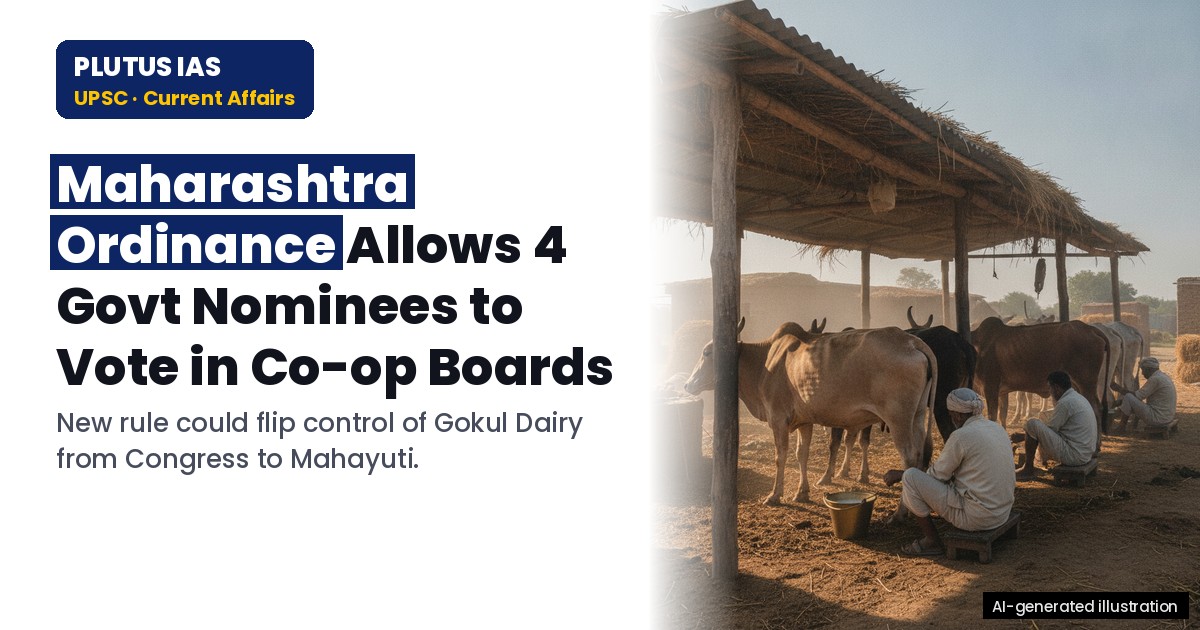
05 Nov Maharashtra Ordinance: Impact on Cooperative Governance & Politics
✎ The Governor's ordinance-making power (Article 213) allows for temporary legislation when the state legislature is not in session, subject to subsequent legislative approval, to address urgent matters like amendments to…
Subject Relevance — Where This Topic Fits
- GS Paper II — Polity and Governance | GS Paper III — Indian Economy and related issues
- Prelims: Cooperative Societies Act, Ordinance-making power, State List, Concurrent List, Seventh Schedule, Cooperative federalism, Milk cooperatives, Electoral processes in cooperatives
- Essay: The role of cooperatives in rural development and economic empowerment, Balancing state intervention and cooperative autonomy in India
Quick Revision: The Governor’s ordinance-making power (Article 213) allows for temporary legislation when the state legislature is not in session, subject to subsequent legislative approval, to address urgent matters like amendments to cooperative laws.
Why is this in the news?
The Maharashtra Cabinet recently approved an amendment to the Maharashtra Cooperative Societies Act, 1960, allowing four government-nominated members with voting rights on the boards of large cooperative federations receiving state assistance. This decision has garnered attention due to its potential impact on the balance of power within the Kolhapur District Cooperative Milk Producers’ Union (Gokul Dairy), a significant cooperative body in the state, particularly in light of an impending election for its chairman.
Background
- Cooperative societies in India operate under state-specific legislation, with the Maharashtra Cooperative Societies Act, 1960, governing cooperatives within Maharashtra.
- The 97th Constitutional Amendment Act, 2011, granted constitutional status and protection to cooperative societies, inserting Article 43B (Promotion of Cooperative Societies) and Part IXB (The Cooperative Societies) into the Constitution.
- Gokul Dairy, established in 1963, is one of Maharashtra’s largest milk unions, playing a crucial role in the state’s dairy sector with a substantial annual turnover and extensive network of milk producers and village-level societies.
- The management and control of large cooperatives like Gokul Dairy often involve significant political interest due to their economic influence and extensive reach within rural communities.
- Ordinances are temporary laws promulgated by the Governor of a state when the State Legislature is not in session, under Article 213 of the Constitution, to address urgent matters.
- The amendment in question specifically targets cooperative federations that receive government assistance, introducing a mechanism for state-nominated members to participate in board decisions with voting rights.
- The Bombay High Court had ordered a fresh meeting for the election of Gokul Dairy’s chairman, following a dispute over quorum and the validity of a prior election attempt.
- The existing board of Gokul Dairy comprises 25 elected members, with a recent election resulting in a narrow majority for one panel over another.
- The introduction of government nominees with voting rights could potentially alter the numerical composition and decision-making dynamics of such cooperative boards.
- The principle of cooperative autonomy, emphasizing democratic member control, is a fundamental tenet of cooperative governance, which is often balanced against the need for regulatory oversight and state support.
Ordinance-Making Power of the Governor
- Article 213 of the Indian Constitution empowers the Governor of a state to promulgate ordinances when the State Legislative Assembly (or both Houses, in states with a bicameral legislature) is not in session.
- An ordinance has the same force and effect as an Act of the State Legislature.
- The Governor can promulgate an ordinance only when satisfied that circumstances exist which render it necessary for him to take immediate action.
- Every ordinance promulgated by the Governor must be laid before the State Legislature when it reassembles.
- It ceases to operate at the expiration of six weeks from the reassembly of the State Legislature, or if before the expiration of that period, a resolution disapproving it is passed by the Legislative Assembly (and agreed to by the Legislative Council, if any).
- An ordinance can also be withdrawn by the Governor at any time.
- The maximum life of an ordinance is six months and six weeks (if the legislature does not reassemble within six months).
- The Governor’s power to issue ordinances is not a discretionary power; it must be exercised on the advice of the Council of Ministers.
- Ordinances are intended for extraordinary situations requiring immediate legislative action and are subject to judicial review on grounds of mala fide intent or exceeding constitutional limits.
- The legislative intent behind an ordinance is to address urgent public matters that cannot await the normal legislative process.
Key Features
| Feature | Significance |
|---|---|
| Government Nominees in Cooperative Boards | The Maharashtra cabinet approved an amendment allowing four government-nominated members to vote on the boards of large cooperative federations receiving government assistance. This introduces a mechanism for state influence over the governance of such entities. |
| Impact on Board Composition | The addition of four voting government nominees can alter the numerical balance of power within cooperative boards, potentially shifting majorities and control from elected representatives to state-appointed individuals. |
| Gokul Dairy’s Scale and Reach | Gokul Dairy, established in 1963, reported an annual turnover of Rs 3,966.28 crore in 2024-25, engaging approximately 4.41 lakh milk producers and operating through 8,009 village-level societies. Its extensive network underscores its significant economic and social footprint in the Kolhapur region. |
| Political Significance of Cooperatives | Control over large cooperatives like Gokul Dairy is highly contested due to their substantial economic resources, extensive rural reach, and influence over a large number of stakeholders, making them crucial centers of power in local and regional politics. |
Why it Matters
Governance and Autonomy of Cooperatives
- The ordinance raises questions regarding the balance between government oversight and the democratic autonomy of cooperative institutions, which are intended to be member-driven and self-governing.
- It highlights the potential for state intervention to influence the internal decision-making processes and leadership selection within cooperatives, thereby impacting their operational independence.
Economic Impact on Rural Livelihoods
- Large milk unions like Gokul play a pivotal role in the rural economy by providing a stable market for milk producers, facilitating income generation, and supporting allied agricultural activities.
- Changes in the governance structure and leadership of such cooperatives can have direct implications for the welfare and economic stability of a large number of farmers and rural households.
Political Economy of Cooperatives
- The incident underscores the deep entanglement of cooperative institutions with regional political dynamics, where control over these entities is a significant aspect of political power and patronage.
- It illustrates how legislative or executive actions can be utilized to shift political majorities and influence outcomes in key economic sectors, reflecting the broader political economy of states.
Challenges
1. Maintaining Cooperative Autonomy
- The introduction of government-nominated voting members challenges the principle of democratic self-governance inherent in cooperative societies, potentially diluting the voice of elected representatives.
- Ensuring that cooperatives remain member-centric and operate free from undue external influence is crucial for their long-term viability and adherence to cooperative principles.
UPSC Link: Indian Economy: Cooperative Movement
2. Ensuring Fair and Transparent Governance
- The potential for political appointments to alter electoral outcomes within cooperatives raises concerns about the fairness and transparency of governance processes.
- Mechanisms must be in place to prevent the politicization of cooperative boards and ensure that decisions are made in the best interest of the members, rather than political expediency.
UPSC Link: Governance: Transparency and Accountability
3. Balancing State Oversight and Support
- While government assistance to cooperatives is often necessary for their growth and stability, the nature of such support should not compromise their foundational democratic character.
- Striking an appropriate balance between providing financial and technical support and respecting the internal democratic processes of cooperatives is a persistent challenge.
UPSC Link: Indian Economy: Government Policies
4. Preventing Politicization of Economic Institutions
- The intense political contestation over cooperative bodies like Gokul Dairy highlights the broader issue of political interference in economic institutions.
- Such politicization can detract from the primary economic objectives of cooperatives, potentially leading to inefficient management and diversion of resources.
UPSC Link: Governance: Role of Political Parties
Challenges — UPSC Perspective
| Issue | Concern |
|---|---|
| Government Nominees’ Voting Rights | Potential erosion of democratic principles within cooperatives by allowing non-elected members to influence critical decisions. |
| Shift in Power Balance | Risk of altering the majority control on cooperative boards, potentially undermining the mandate of elected representatives. |
| Politicization of Cooperatives | Increased susceptibility of cooperative institutions to political maneuvering, possibly at the expense of member welfare and economic efficiency. |
| Impact on Member Trust | Actions perceived as politically motivated could diminish members’ trust in the fairness and impartiality of cooperative governance. |
Way Forward
- Strengthen the legal framework to clearly delineate the boundaries of government intervention in cooperative affairs, ensuring that autonomy is preserved.
- Implement robust mechanisms for transparent selection and accountability of government nominees, ensuring their contribution aligns with cooperative principles.
- Promote internal democratic processes within cooperatives, empowering members to actively participate in governance and decision-making.
- Encourage capacity building for cooperative leaders and members to enhance their understanding of governance, financial management, and cooperative ethics.
- Establish independent regulatory bodies to oversee cooperative elections and resolve disputes, thereby reducing political interference.
- Foster a culture of good governance and ethical leadership within cooperatives, prioritizing member welfare over political considerations.
- Review and update cooperative laws to reflect contemporary challenges while upholding the fundamental values of the cooperative movement.
UPSC Value Addition
Keywords for Mains Answer-Writing
Cooperative federalism · State legislative competence · Ordinance-making power · Cooperative societies governance · Democratic principles · Autonomy of cooperatives · Government intervention in cooperatives · Checks and balances · Rule of law · Seventh Schedule
Constitutional & Policy Linkages
- {‘article’: ‘Article 19(1)(c)’, ‘note’: ‘Right to form associations/unions/cooperative societies’}
- {‘article’: ‘Part IXB’, ‘note’: ‘The Cooperative Societies (Articles 243ZH-243ZT)’}
- {‘article’: ‘Article 243ZI’, ‘note’: ‘Incorporation of cooperative societies’}
- {‘article’: ‘Article 243ZJ’, ‘note’: ‘Number and term of members of board’}
Concept Flow
State cabinet approves ordinance for voting government nominees. → Four government nominees appointed to large cooperative boards. → Balance of power on cooperative boards shifts. → Elected majorities potentially overridden by nominated members. → Autonomy of cooperative institutions challenged. → Impact on democratic governance and economic operations.
Prelims Practice Questions
Q1. Consider the following statements regarding cooperative societies in India:
1. The 97th Constitutional Amendment Act of 2011 accorded constitutional status and protection to cooperative societies.
2. The subject of ‘cooperative societies’ falls under the State List of the Seventh Schedule to the Constitution of India.
3. Government-nominated members on the boards of cooperative societies are explicitly prohibited from voting by the Constitution.
- Only one
- Only two
- Only three
- None
Answer: Only two — Statement 1 is correct: The 97th Constitutional Amendment Act, 2011, added Part IXB to the Constitution, dealing with cooperative societies, making their formation a fundamental right (Article 19(1)(c)) and including provisions for their democratic functioning. Statement 2 is correct: ‘Cooperative societies’ is indeed an entry in the State List (Entry 32). Statement 3 is incorrect: While the 97th Amendment promotes democratic control, it does not explicitly prohibit government-nominated members from voting; specific state laws or bylaws often govern such provisions, and the recent ordinance is an example of state-level legislative action.
Q2. Assertion (A): State governments possess the power to issue ordinances on subjects enumerated in the State List during the recess of the State Legislature.
Reason (R): An ordinance issued by a Governor has the same force and effect as an Act of the State Legislature but must be laid before the State Legislature and ceases to operate if not approved within six weeks from its reassembly.
- Both A and R are true and R is the correct explanation of A.
- Both A and R are true but R is not the correct explanation of A.
- A is true but R is false.
- A is false but R is true.
Answer: Both A and R are true and R is the correct explanation of A. — Assertion (A) is true: Article 213 of the Constitution empowers the Governor to promulgate ordinances when the State Legislature is not in session, provided certain conditions are met, including the necessity of immediate action. Reason (R) is true: An ordinance has the same legal authority as a legislative act. However, it is a temporary measure and must be approved by the State Legislature within six weeks of its reassembly, failing which it ceases to operate. R correctly explains A by detailing the nature and limitations of the ordinance-making power.
Mains Practice Question
✍ Critically examine the implications of government intervention, through legislative amendments or ordinances, on the autonomy and democratic functioning of cooperative societies in India. Discuss with reference to the constitutional provisions governing cooperatives. (15 Marks)
Approach: MODEL-ANSWER SKELETON:
1. **Introduction**: Briefly define cooperative societies and their foundational principles (voluntary association, democratic member control). Mention the constitutional recognition via the 97th Amendment Act, 2011.
2. **Constitutional Provisions**: Detail relevant articles:
* Article 19(1)(c): Right to form cooperative societies.
* Article 43B: Promotion of cooperative societies (DPSP).
* Part IXB: Provisions for incorporation, elections, audit, and supersession of boards.
* Seventh Schedule: ‘Cooperative societies’ as a State List subject (Entry 32).
3. **Arguments for Government Intervention (Justifications)**:
* Ensuring financial probity and preventing mismanagement.
* Protecting the interests of members, especially vulnerable sections.
* Promoting public interest and achieving socio-economic objectives (e.g., food security, rural development).
* Addressing systemic failures or governance deficits.
* Ensuring compliance with regulatory frameworks, especially for large cooperatives receiving state aid.
4. **Arguments Against Government Intervention (Impact on Autonomy/Democracy)**:
* Undermining democratic member control and self-governance (e.g., through nominated members with voting rights).
* Politicisation of cooperative bodies, leading to partisan control rather than member welfare.
* Erosion of the cooperative spirit and principles.
* Potential for arbitrary exercise of power and misuse of legislative tools like ordinances.
* Impact on operational efficiency and accountability to members.
5. **Critical Examination (Balancing Act)**:
* Discuss the tension between state regulation (necessary for accountability and public interest) and cooperative autonomy (essential for democratic functioning).
* Reference the Supreme Court’s stance on the 97th Amendment, particularly its emphasis on democratic control and limited supersession.
* Suggest a framework for intervention that is minimal, transparent, and aimed at strengthening, not supplanting, democratic processes.
6. **Conclusion**: Summarise the need for a balanced approach where government intervention is a last resort, focused on enabling and regulating rather than controlling, thereby upholding the constitutional mandate for autonomous and democratically managed cooperative societies.
Source: The Indian Express
Maharashtra PCS (MPSC) — State PCS Practice
Prelims: Regarding the recent Maharashtra ordinance concerning a Congress-won dairy, which of the following statements is/are correct?
I. The ordinance aims to facilitate the transfer of administration of certain cooperative societies.
II. The dairy in question was previously under the control of a political party now part of the Mahayuti alliance.
III. The ordinance has been criticized for potentially undermining the democratic process in cooperative elections.
Choose the correct option:
- A. Only I
- B. Only III
- C. I and III
- D. I, II and III
Answer: C. I and III — The ordinance facilitates transfer of administration and has been criticized for its potential impact on democratic processes in cooperatives, specifically regarding a Congress-won dairy potentially going to the Mahayuti.
Mains: Analyze the implications of the new Maharashtra ordinance, which could transfer a Congress-won dairy to the Mahayuti, on the principles of cooperative democracy and political fairness within the state’s cooperative sector. Discuss potential challenges and benefits of such legislative interventions.
Generated by AanyaAi for educational purpose.
Related guides on our sites
- Current affairs for upsc 2026
- Best PSIR optional coaching for upsc
- Best PSIR optional teacher for upsc
- Best teacher of PSIR optional for upsc

- Maharashtra Ordinance: Impact on Cooperative Governance & Politics - November 5, 2026
- श्रम संहिताओं पर क्षेत्रीय क्षमता निर्माण एवं जागरूकता कार्यक्रम - November 5, 2026
- DLC-5 Camp: Digital Empowerment for Pensioners - November 5, 2026

No Comments