


05 Nov COP31: UN Climate Summit Stakes for UPSC & State PCS
✎ COP31 represents a critical juncture for global climate action, focusing on accelerating the implementation of the Paris Agreement, ensuring equitable access to clean energy technologies, and enhancing resilience against…
Subject Relevance — Where This Topic Fits
- GS Paper II — International Relations, International Institutions | GS Paper III — Environment, Climate Change, Conservation, Renewable Energy
- Prelims: COP (Conference of the Parties), UNFCCC (United Nations Framework Convention on Climate Change), Paris Agreement, Climate Finance, Nationally Determined Contributions (NDCs), Global Stocktake, Loss and Damage
- Essay: Climate Change: A Global Imperative for Sustainable Development, International Cooperation in Addressing Environmental Challenges
Quick Revision: COP31 represents a critical juncture for global climate action, focusing on accelerating the implementation of the Paris Agreement, ensuring equitable access to clean energy technologies, and enhancing resilience against escalating climate impacts.
Why is this in the news?
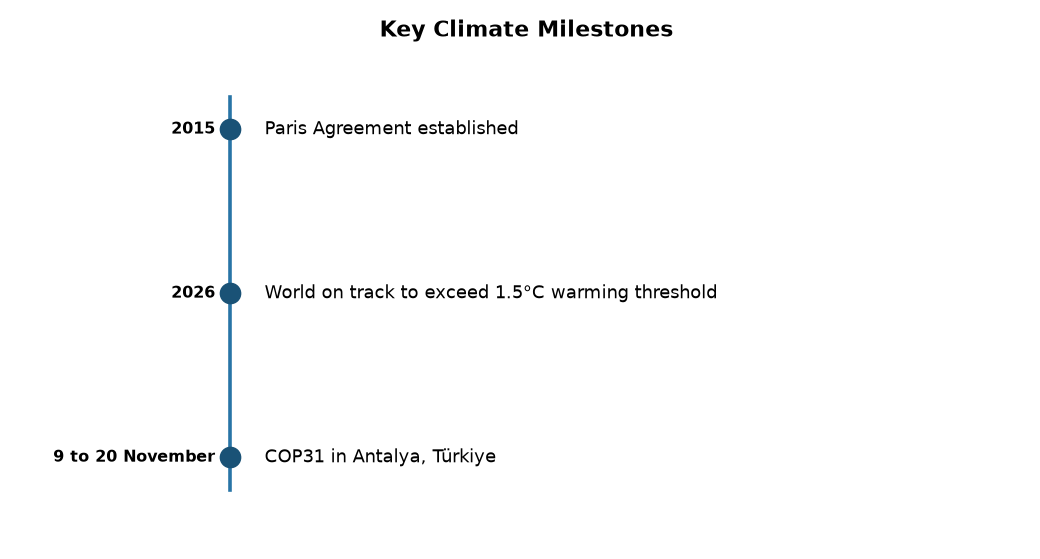
The 31st Conference of the Parties (COP31) to the UNFCCC is slated to convene in Antalya, Türkiye, from November 9 to 20, 2026. This annual summit serves as a critical platform for over 190 nations to assess collective progress in tackling climate change, negotiate future actions, and address the escalating impacts of global warming, which have manifested in severe weather events throughout 2026, pushing the world towards exceeding the Paris Agreement’s 1.5°C warming threshold.
Background
- The United Nations Framework Convention on Climate Change (UNFCCC) was adopted in 1992 at the Rio Earth Summit, establishing an international environmental treaty to combat “dangerous human interference with the climate system.”
- The Conference of the Parties (COP) is the supreme decision-making body of the UNFCCC, comprising representatives from all countries that are Parties to the Convention, meeting annually to review the Convention’s implementation.
- The Paris Agreement, adopted at COP21 in 2015, is a legally binding international treaty on climate change, aiming to limit global warming to well below 2°C, preferably to 1.5°C, compared to pre-industrial levels.
- Nationally Determined Contributions (NDCs) are at the core of the Paris Agreement, representing each country’s efforts to reduce national emissions and adapt to the impacts of climate change.
- Climate finance is a crucial element of international climate action, involving financial resources provided by developed countries to developing countries to support their mitigation and adaptation efforts.
- The year 2026 has been marked by significant climate-related disasters, including catastrophic floods, deadly heatwaves, and prolonged droughts, underscoring the urgency of enhanced climate action and resilience building.
- The increasing accessibility of clean energy technologies, such as solar power, electric vehicles, and battery storage, presents opportunities for accelerated decarbonization, yet equitable access and affordability remain significant challenges for many nations.
- The intensifying El Niño phenomenon is anticipated to exacerbate climate impacts, adding further urgency to the deliberations and outcomes expected from COP31.
- Beyond governmental negotiations, COPs increasingly involve a diverse array of stakeholders, including businesses, scientists, Indigenous Peoples, youth, and civil society organizations, reflecting the multifaceted nature of the climate crisis and the need for comprehensive solutions.
The Conference of the Parties (COP)
- The COP is the highest decision-making body of the United Nations Framework Convention on Climate Change (UNFCCC), bringing together the 197 Parties (196 countries and the European Union) that have ratified the Convention.
- Its primary function is to review the implementation of the UNFCCC and any other legal instruments that the COP adopts, such as the Kyoto Protocol and the Paris Agreement.
- COPs serve as crucial forums for international climate diplomacy, enabling governments to negotiate new agreements, set targets, and develop policies to address climate change.
- Key outcomes of COPs often include negotiated agreements on issues such as climate finance, emissions reductions, adaptation strategies, and mechanisms for transparency and accountability.
- Beyond formal negotiations, COPs facilitate the ‘Action Agenda,’ where governments, development banks, businesses, and civil society organizations collaborate on practical solutions for climate action.
- Countries utilize COPs to announce national commitments, including updated climate plans (NDCs), pledges to transition away from fossil fuels, and contributions to global climate funds.
- The effectiveness of a COP is not solely measured by a single grand agreement but also by the cumulative impact of negotiated outcomes, collaborative initiatives, and national commitments that collectively advance global climate action.
- The participation of non-state actors, including scientists, Indigenous Peoples, and civil society, has become increasingly integral to COPs, enriching discussions and broadening the scope of climate solutions.
Key Features
| Feature | Significance |
|---|---|
| Conference of the Parties (COP) | The supreme decision-making body of the UNFCCC, comprising countries that are parties to the Convention. It assesses progress and negotiates global responses to climate change. |
| UN Framework Convention on Climate Change (UNFCCC) | An international environmental treaty adopted in 1992, establishing the foundational framework for international cooperation to combat climate change. |
| Paris Agreement (2015) | A landmark international treaty negotiated under the UNFCCC, aiming to limit global warming to well below 2°C, preferably to 1.5°C, compared to pre-industrial levels. |
| 1.5°C Warming Threshold | A critical scientific benchmark indicating the maximum acceptable global temperature increase to avoid the most catastrophic impacts of climate change. |
| Climate Finance | Financial resources provided by developed countries to developing countries to support their climate change mitigation and adaptation efforts. |
| Action Agenda | A collaborative platform at COPs involving governments, development banks, businesses, and civil society for practical solutions in climate action. |
Why it Matters
Environmental Imperative
- The annual COP serves as a critical forum for assessing the global trajectory towards climate goals, particularly the 1.5°C target of the Paris Agreement, which is currently projected to be exceeded.
- It addresses the escalating frequency and intensity of extreme weather events, such as floods, heatwaves, and droughts, which underscore the urgency of global climate action.
Technological Advancement and Dissemination
- COPs highlight the rapid advancements in clean energy technologies, including solar power, electric vehicles, and battery storage, which offer viable alternatives to fossil fuels.
- The conferences emphasize the challenge of ensuring equitable access to these technologies, particularly for developing nations, to facilitate a just transition.
International Cooperation and Diplomacy
- These summits are pivotal for fostering multilateral cooperation among over 190 countries to address a challenge that transcends national borders.
- They provide a platform for negotiating agreements on crucial aspects like climate finance, emissions reductions, and adaptation strategies, despite geopolitical complexities.
Multi-Stakeholder Engagement
- COPs have evolved to include diverse stakeholders beyond governmental delegations, incorporating businesses, scientists, Indigenous Peoples, and civil society, reflecting a comprehensive approach to climate solutions.
- This broad participation ensures that a wide range of perspectives and innovative solutions are brought to the forefront of climate discussions.
Challenges
1. Affordability and Accessibility of Clean Technologies
- Despite rapid technological advancements in clean energy, many developing countries face significant barriers in affording and accessing these solutions.
- The economic disparity impedes a universal transition away from fossil fuels, exacerbating global emissions.
UPSC Link: Environmental Pollution & Degradation
2. Geopolitical Divisions and Consensus Building
- Achieving ambitious outcomes in negotiated agreements is frequently hampered by divergent national interests and geopolitical tensions among member states.
- This often leads to compromises that may not fully address the scale of the climate crisis.
UPSC Link: International Relations
3. Fossil Fuel Dependence and Transition
- Fossil fuels remain the primary driver of global warming emissions, and many economies are heavily reliant on them, making a rapid transition challenging.
- The transition requires substantial investment in renewable energy infrastructure and policies to phase out fossil fuel subsidies.
UPSC Link: Energy Security
4. Inadequate Climate Finance
- Developed nations have often fallen short of their commitments to provide adequate financial support to developing countries for climate action.
- This shortfall hinders mitigation and adaptation efforts in vulnerable nations, perpetuating climate injustice.
UPSC Link: Climate Change Policy
Challenges — UPSC Perspective
| Issue | Concern |
|---|---|
| Exceeding 1.5°C Threshold | Scientific consensus indicates the world is on track to surpass the Paris Agreement’s critical warming limit, leading to irreversible environmental damage. |
| Climate Impact Intensification | Catastrophic floods, deadly heatwaves, and prolonged droughts are becoming more frequent and severe, exacerbated by phenomena like El Niño, posing significant humanitarian and economic threats. |
| Access to Clean Energy | Despite technological progress, many countries, particularly developing ones, struggle with the affordability and infrastructure required to adopt clean energy solutions. |
| Pace of Decarbonization | The global rate of transitioning away from fossil fuels is insufficient to meet climate targets, necessitating more aggressive policies and investments. |
| Implementation of National Commitments | Ensuring that countries translate their announced climate plans and contributions into concrete, measurable actions remains a persistent challenge. |
Way Forward
- Enhance international cooperation to facilitate technology transfer and capacity building for developing nations, ensuring equitable access to clean energy solutions.
- Mobilize increased and predictable climate finance from developed countries to support mitigation and adaptation efforts in vulnerable economies.
- Strengthen national climate policies and commitments, including clear roadmaps for phasing out fossil fuels and accelerating renewable energy deployment.
- Foster multi-stakeholder partnerships involving governments, private sector, civil society, and indigenous communities to implement comprehensive climate action plans.
- Invest in climate-resilient infrastructure and early warning systems to minimize the impacts of extreme weather events and enhance adaptive capacity.
- Promote research and development in climate science and innovative technologies to provide more effective and sustainable solutions.
- Integrate climate considerations into national development planning and economic policies to ensure a just and inclusive transition.
UPSC Value Addition
Keywords for Mains Answer-Writing
COP31 · UNFCCC · Paris Agreement · Climate Finance · Emissions Reductions · Adaptation · Global Warming · 1.5°C Target · Clean Energy Technologies · Climate Diplomacy · Nationally Determined Contributions (NDCs) · Loss and Damage
Concept Flow
Global warming exceeds 1.5°C threshold → Intensification of extreme weather events → Increased urgency for climate action → Annual COP convenes parties to UNFCCC → Negotiations on climate finance, emissions, adaptation → Challenges in technology access and geopolitical consensus → Need for enhanced international cooperation and national commitments
Prelims Practice Questions
Q1. Consider the following statements regarding the Conference of the Parties (COP) to the UNFCCC:
1. COP is an annual gathering of countries that are parties to the UN Framework Convention on Climate Change.
2. The Paris Agreement, committing countries to limit global warming, was an outcome of a COP meeting.
3. Beyond government negotiations, businesses, scientists, and civil society increasingly participate in COPs.
How many of the above statements are correct?
- Only one
- Only two
- All three
- None
Answer: All three — Statement 1 is correct: COP stands for Conference of the Parties, representing the countries that are parties to the UNFCCC, and these are annual gatherings. Statement 2 is correct: The Paris Agreement was indeed a landmark outcome of COP21 in 2015. Statement 3 is correct: COPs have evolved to include a wide range of stakeholders beyond just government representatives, reflecting the multi-faceted nature of climate action.
Q2. Which of the following international agreements aims to keep global warming ‘well below 2°C’ and pursue efforts to limit it to ‘1.5°C above pre-industrial levels’?
- Kyoto Protocol
- Montreal Protocol
- Paris Agreement
- Nagoya Protocol
Answer: Paris Agreement — The Paris Agreement, adopted in 2015 at COP21, sets the long-term goal of holding the increase in the global average temperature to well below 2°C above pre-industrial levels and pursuing efforts to limit the temperature increase to 1.5°C above pre-industrial levels.
Mains Practice Question
✍ The annual Conference of the Parties (COP) under the UNFCCC serves as a crucial platform for global climate action. Examine the multifaceted roles and potential achievements of these conferences, particularly in the context of advancing clean energy technologies and addressing climate finance. (15 Marks)
Approach: MODEL-ANSWER SKELETON:
1. Introduction: Briefly define COP and its significance as the supreme decision-making body of the UNFCCC.
2. Multifaceted Roles of COPs:
a. Negotiated Agreements: Discuss consensus-building on issues like emissions reductions (NDCs), adaptation, and climate finance (e.g., Green Climate Fund, Loss and Damage Fund).
b. Action Agenda: Explain the role in fostering practical solutions through collaboration among governments, development banks, businesses, and civil society (e.g., renewable energy expansion, methane reduction initiatives).
c. National Commitments: Highlight how COPs serve as a platform for countries to announce domestic climate plans and contributions.
3. Potential Achievements in Clean Energy Technologies:
a. Facilitating Technology Transfer: Mechanisms for sharing advanced clean energy solutions (solar, EV, battery storage) with developing nations.
b. Policy Frameworks: Encouraging national policies and incentives for clean energy adoption.
c. Investment Mobilisation: Attracting public and private investments into clean energy infrastructure.
4. Addressing Climate Finance:
a. Mobilising Funds: Discuss the commitment of developed nations to provide financial resources to developing countries for mitigation and adaptation.
b. Addressing Affordability: Strategies to ensure clean energy technologies are accessible and affordable globally.
c. Loss and Damage: The evolving discourse and mechanisms for addressing irreversible impacts of climate change.
5. Challenges and Limitations: Briefly touch upon geopolitical divisions, implementation gaps, and the gap between commitments and actions.
6. Conclusion: Reiterate the indispensable role of COPs in global climate governance, despite inherent complexities, for driving collective action towards the Paris Agreement goals.
Source: news.un.org
Generated by AanyaAi for educational purpose.
Related guides on our sites
- Best PSIR optional coaching for upsc
- Best PSIR optional teacher for upsc
- Best teacher of PSIR optional for upsc
- Best PSIR optional coaching in delhi for UPSC

- COP31: UN Climate Summit Stakes for UPSC & State PCS - November 5, 2026
- स्वामित्व योजना: ग्रामीण संपत्तियों की मुफ्त रजिस्ट्री और सरकार का वित्तीय भार - November 5, 2026
- Khelo India Quiz: Boosting Sports Ecosystem & Manufacturing - November 5, 2026

No Comments