


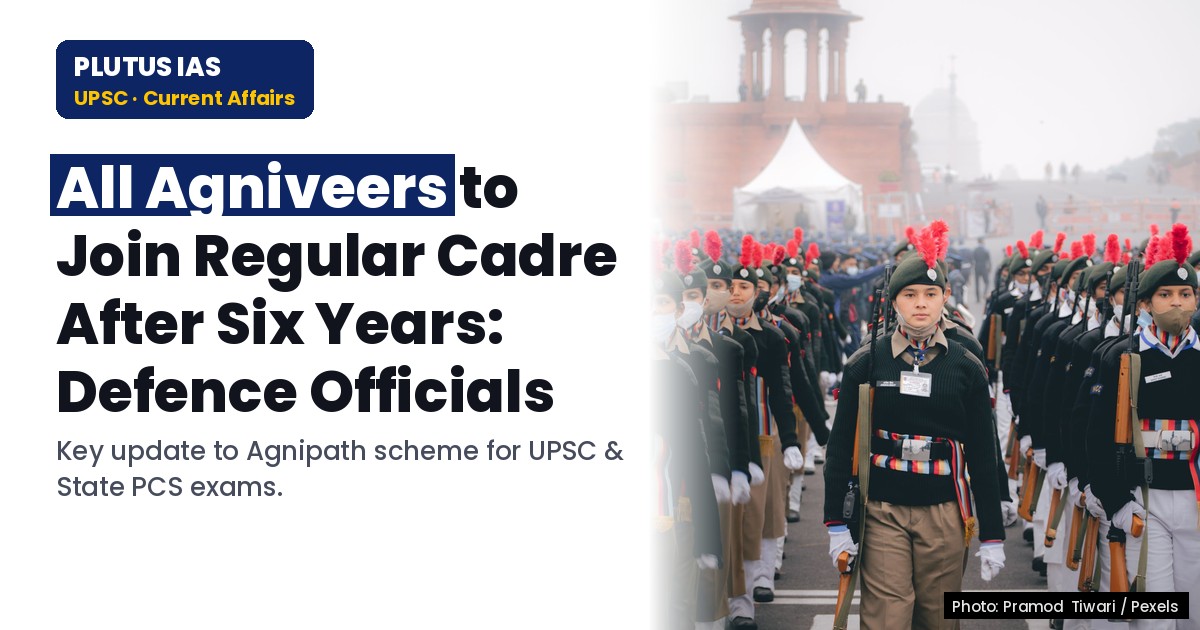
05 Nov Agniveers to Join Regular Cadre: Agnipath Scheme Update
✎ The Agnipath scheme has been modified to ensure the absorption of all willing, physically fit, and disciplined Agniveers into the regular cadre of the Indian Armed Forces after an extended engagement period, thereby providing a…
Subject Relevance — Where This Topic Fits
- GS Paper II — Governance, Welfare Schemes, Government Policies and Interventions | GS Paper III — Security Challenges and their Management in Border Areas, Various Security Forces and Agencies and their Mandate
- Prelims: Agnipath Scheme, Agniveers, Chief of Defence Staff (CDS), Indian Armed Forces recruitment, Defence policy reforms, Personnel management in defence
- Essay: Defence Sector Reforms and National Security, Youth Employment and Skill Development in India
Quick Revision: The Agnipath scheme has been modified to ensure the absorption of all willing, physically fit, and disciplined Agniveers into the regular cadre of the Indian Armed Forces after an extended engagement period, thereby providing a clear pathway for permanent service.
Why is this in the news?
The Agnipath recruitment scheme has undergone significant modifications, with defence officials announcing that all serving Agniveers will now be absorbed as regular soldiers after an initial engagement period, provided they meet specific eligibility criteria. This clarification follows an earlier government announcement of a two-year extension for Agniveers completing their initial four-year tenure, creating a pathway for their permanent recruitment into the armed forces.
Background
- The Agnipath scheme was launched in June 2022, aiming to recruit soldiers for a four-year term, with a provision to retain only 25 per cent in regular service.
- The primary objective of the scheme was to reduce the average age profile of the Indian Armed Forces and enhance their youthful vigour and technological adaptability.
- The initial framework stipulated that 75 per cent of Agniveers would be demobilised after four years, without entitlement to pensionary benefits, leading to concerns regarding their post-service rehabilitation.
- The recent modifications introduce an additional two-year engagement period, allowing all Agniveers to transition into regular cadres, subject to willingness, physical fitness, and discipline.
- This decision was taken at a Cabinet meeting and announced by the Chief of Defence Staff just before the first batch of Agniveers was due to complete their four-year service.
- The seniority of Agniveers transitioning to regular cadre will be protected, ensuring they are placed immediately after their own batchmates who joined the regular cadre after four years.
What is the Agnipath Scheme?
- The Agnipath scheme is a transformative recruitment policy for the Indian Armed Forces, designed to enlist soldiers for a fixed term, primarily to lower the average age of the forces.
- Under the original scheme, individuals between 17.5 and 21 years of age were recruited for a four-year period, with a limited number of extensions for regular service.
- Recruits under this scheme are known as ‘Agniveers’, and they undergo rigorous training in various branches of the armed forces (Army, Navy, Air Force).
- The scheme aimed to foster a more youthful, agile, and technologically adept fighting force, while also reducing the pension burden on the defence budget.
- The recent amendments ensure that all Agniveers, upon completing their initial four-year tenure and an additional two-year engagement period, will be absorbed into the regular cadre of the armed forces, provided they meet specified criteria.
- This revised structure aims to provide a clear career progression path for all Agniveers, addressing previous concerns regarding job security and post-service opportunities.
- Eligibility for permanent absorption is contingent upon the Agniveer’s willingness to continue service, maintenance of physical fitness standards, and adherence to disciplinary norms.
- The scheme is distinct from traditional recruitment processes, which offered permanent commission from the outset, and represents a significant reform in defence personnel management.
- The modifications ensure that Agniveers’ seniority will be maintained upon their absorption into the regular cadre, preventing them from becoming junior to subsequent batches of recruits.
Key Features
| Feature | Significance |
|---|---|
| Initial Recruitment Tenure | Previously, soldiers under Agnipath were recruited for a four-year term, with a limited retention provision. |
| Extended Engagement Period | A new two-year extension has been introduced, allowing Agniveers to serve for a total of six years before permanent absorption. |
| Permanent Absorption Criteria | All Agniveers are now eligible for absorption into the regular cadre after six years, subject to willingness, physical fitness, and disciplinary standards. |
| Seniority Protection | Absorbed Agniveers will have their seniority protected, being placed immediately after their batchmates who joined the regular cadre earlier. |
| Age Profile Management | The Agnipath scheme was initially designed to reduce the average age of the armed forces, a goal that will now be balanced with permanent recruitment. |
Why it Matters
National Security Implications
- The revised scheme aims to enhance the morale and commitment of Agniveers by providing a clear pathway to permanent service, potentially improving force cohesion and operational effectiveness.
- Ensuring a stable and experienced cadre of soldiers contributes to maintaining military readiness and institutional knowledge within the armed forces.
- Addressing concerns regarding the post-service rehabilitation of Agniveers may reduce potential social unrest and ensure a more dedicated workforce during their tenure.
Human Resource Management in Defence
- The extended engagement period allows for greater investment in training and skill development, leading to a more proficient and specialized military workforce.
- A guaranteed pathway to permanent service can attract a higher quality of recruits, as the scheme now offers long-term career prospects in the armed forces.
- The policy adjustment reflects an adaptive approach to military personnel management, balancing the need for a youthful force with the imperative of retaining experienced personnel.
Socio-Economic Impact
- Providing permanent employment opportunities to Agniveers addresses concerns about potential unemployment for a significant portion of recruits after their initial four-year term.
- The revised scheme offers enhanced career stability and social security benefits for a larger number of individuals serving in the armed forces, contributing to their long-term welfare.
- By ensuring a more secure future, the scheme can positively influence public perception and attract a broader demographic of youth towards military service.
Challenges
1. Fiscal Implications
- The absorption of all Agniveers into the regular cadre will entail increased expenditure on salaries, pensions, and associated benefits, impacting the defence budget.
- Long-term financial planning is necessary to accommodate the expanded permanent force, potentially requiring re-prioritization of defence allocations.
UPSC Link: Government Budgeting; Defence Expenditure
2. Maintaining Youthful Profile
- The original objective of reducing the average age of the armed forces might be partially diluted by the permanent absorption of all Agniveers.
- Balancing the need for experienced personnel with the imperative of a youthful and agile fighting force remains a key challenge.
UPSC Link: Defence Reforms; Human Resource Management
3. Training and Skill Development
- The extended service period necessitates a re-evaluation of training modules and career progression pathways to ensure continuous skill enhancement and specialization.
- Ensuring that all absorbed Agniveers meet the evolving operational requirements of the modern military will require robust training infrastructure.
UPSC Link: Skill Development; Defence Preparedness
4. Integration and Seniority Management
- While seniority protection is assured, the integration of a large cohort of Agniveers into the existing regular cadre requires careful management to avoid potential friction.
- Developing clear and equitable promotion policies for absorbed Agniveers alongside existing regular soldiers is crucial for morale and career progression.
UPSC Link: Organisational Behaviour; Personnel Administration
Challenges — UPSC Perspective
| Issue | Concern |
|---|---|
| Budgetary Strain | Increased long-term expenditure on salaries, pensions, and benefits for a larger permanent force. |
| Age Profile Management | Potential impact on the original objective of reducing the average age of the armed forces. |
| Training Infrastructure | Need for enhanced and adapted training facilities to support extended service and skill development for all Agniveers. |
| Cadre Integration | Smooth assimilation of a large number of Agniveers into the existing regular cadre while maintaining morale and equity. |
| Policy Consistency | Perception of policy shifts and the need to ensure clarity and stability in defence recruitment policies. |
Government Initiatives — Must-Memorise for Prelims
- Agnipath scheme
Way Forward
- Implement a comprehensive review of the defence budget to accommodate the increased long-term personnel costs associated with permanent absorption.
- Develop a robust and adaptive training framework that ensures continuous skill upgradation and specialization for Agniveers throughout their extended service and beyond.
- Establish clear and transparent career progression and promotion policies for absorbed Agniveers, ensuring equitable opportunities alongside existing regular cadre personnel.
- Monitor the demographic profile of the armed forces to ensure that the revised scheme effectively balances youthfulness with experience and institutional knowledge.
- Initiate regular feedback mechanisms from Agniveers and serving personnel to address any integration challenges and refine human resource policies.
- Communicate policy changes with clarity and consistency to all stakeholders, including potential recruits, serving personnel, and the public, to build trust and understanding.
UPSC Value Addition
Keywords for Mains Answer-Writing
Agnipath Scheme · Defence Recruitment Policy · Youth Employment · Military Modernisation · Human Resource Management in Defence · National Security · Government Policy Amendments · Armed Forces Personnel Management
Concept Flow
Agnipath scheme introduced for four-year recruitment. → Concerns raised regarding post-service prospects for 75% of Agniveers. → Government announces two-year extension for all Agniveers. → All Agniveers become eligible for permanent absorption after six years. → Conditions for absorption: willingness, physical fitness, discipline. → Seniority protected upon absorption into regular cadre.
Prelims Practice Questions
Q1. Consider the following statements regarding the Agnipath Scheme:
1. The scheme was initiated in June 2022 to recruit soldiers for a four-year term.
2. Initially, it provisioned for retaining 25% of Agniveers in regular services after their four-year tenure.
3. Recent amendments ensure that all willing, physically fit, and disciplined Agniveers will be absorbed into the regular cadre after an extended engagement period.
How many of the above statements are correct?
- Only one
- Only two
- Only three
- None
Answer: Only three — Statement 1 is correct: The Agnipath scheme was indeed rolled out in June 2022 for a four-year service term. Statement 2 is correct: The initial provision of the scheme allowed for retaining only 25% of Agniveers in regular services. Statement 3 is correct: Recent amendments have introduced an additional two-year engagement period, creating a pathway for all willing, physically fit, and disciplined Agniveers to be absorbed into the regular cadre.
Q2. Which of the following is the primary objective behind the Agnipath scheme, as stated at its inception?
- To significantly increase the overall strength of the armed forces.
- To reduce the defence budget by limiting long-term pension liabilities.
- To bring down the age profile of the three services.
- To introduce advanced technological training for recruits.
Answer: To bring down the age profile of the three services. — The Agnipath scheme, when initiated in June 2022, aimed primarily to lower the age profile of the Indian armed forces across all three services, thereby fostering a younger and more agile fighting force.
Mains Practice Question
✍ Critically examine the evolution of the Agnipath scheme since its inception, highlighting the rationale behind its recent amendments. Discuss its potential implications for the human resource management and operational readiness of the Indian armed forces. (15 Marks)
Approach: MODEL-ANSWER SKELETON:
1. **Introduction:** Briefly introduce the Agnipath scheme, its launch date (June 2022), and its initial objective (lower age profile, four-year tenure, 25% retention).
2. **Initial Rationale for Agnipath:** Discuss the original objectives such as reducing the age profile of the armed forces, fostering a more youthful and technologically adept force, and potentially rationalising pension expenditure.
3. **Recent Amendments and Rationale:** Detail the recent changes, specifically the extension of service by two years and the provision for absorbing all willing, physically fit, and disciplined Agniveers into the regular cadre. Explain the stated rationale for these amendments, such as ensuring a pathway for absorption, addressing concerns regarding post-service employment, and enhancing the scheme’s appeal.
4. **Implications for Human Resource Management:**
* **Positive:** Enhanced morale and motivation among Agniveers due to assured career progression; improved retention of trained personnel; potential for better long-term planning for defence personnel.
* **Challenges/Considerations:** Impact on the original objective of reducing the age profile; potential for increased long-term pension liabilities compared to the initial scheme design; administrative complexities in managing the extended engagement and absorption process.
5. **Implications for Operational Readiness:**
* **Positive:** Continuity in service ensures better experience and skill retention; potentially higher unit cohesion and operational effectiveness due to a more stable workforce.
* **Challenges/Considerations:** Balancing the need for a youthful force with experienced personnel; ensuring consistent training and integration across different cohorts of Agniveers and regular soldiers.
6. **Conclusion:** Summarise the scheme’s evolution as a dynamic policy adaptation. Offer a balanced perspective on its potential to address both human resource needs and operational requirements of the armed forces, while acknowledging ongoing adjustments.
Source: orissapost.com
Generated by AanyaAi for educational purpose.
Related guides on our sites
- How to prepare for GS paper 1 for UPSC CSE mains exam
- Best UPSC coaching for IFOS exam
- Best mentorship programme for upsc
- UPSC+BA degree

- RBI’s Forward Dollar Position & Rupee Appreciation - November 9, 2026
- INDIAN NAVY TO CONDUCT PASSING OUT PARADE OF LARGEST BATCH OF AGNIVEERS AT INS CHILKA - November 9, 2026
- Theatre Commands: Government’s Role in Resolving Tri-Service Debate - November 9, 2026

No Comments