


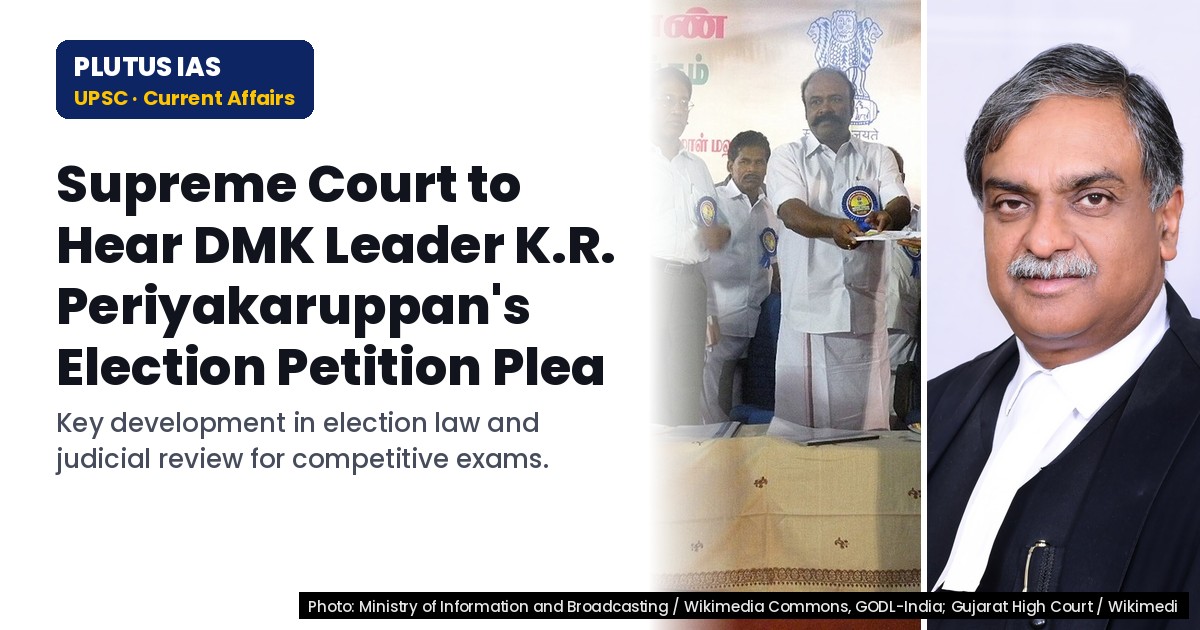
06 Nov Supreme Court to Hear DMK Leader’s Election Petition Plea
✎ Election petitions are legal challenges to election results, heard initially by High Courts, with appeals lying to the Supreme Court, ensuring judicial oversight of the electoral process.
Subject Relevance — Where This Topic Fits
- GS Paper II — Indian Polity and Governance: Structure, Functioning, Conduct of Business, Powers & Privileges and Issues Arising out of these Bodies. | GS Paper II — Indian Constitution: Evolution, Features, Amendments, Significant Provisions and Basic Structure. | GS Paper II — Separation of Powers between various organs Dispute Redressal Mechanisms and Institutions.
- Prelims: Election Petition, Madras High Court, Supreme Court, Representation of the People Act, 1951, Judicial Review, Electoral Disputes, Assembly Elections, High Court’s Original Jurisdiction
- Essay: Judicial Activism and Restraint in Democratic Governance, The Role of Independent Institutions in Safeguarding Democracy
Quick Revision: Election petitions are legal challenges to election results, heard initially by High Courts, with appeals lying to the Supreme Court, ensuring judicial oversight of the electoral process.
Why is this in the news?
The Supreme Court has agreed to hear an appeal challenging the Madras High Court’s rejection of an election petition. This petition contests the victory of a candidate in the Tamil Nadu Assembly elections, where the margin of victory was a single vote. The apex court’s decision to admit the appeal underscores the critical role of the judiciary in reviewing electoral disputes and ensuring the integrity of the electoral process.
Background
- Elections in India are governed by the Representation of the People Act, 1951 (RPA, 1951), which lays down the procedure for the conduct of elections and the resolution of election disputes.
- An election petition is a legal challenge to the outcome of an election, filed by a candidate or elector, alleging irregularities or illegalities in the election process.
- Under Section 80 of the RPA, 1951, no election can be called into question except by an election petition presented in accordance with the provisions of this Part.
- As per Section 80A of the RPA, 1951, the High Court is vested with the jurisdiction to try an election petition.
- Appeals against the orders of the High Court in election petitions lie directly to the Supreme Court of India.
- The present case involves a challenge to an election result decided by a single vote, highlighting the meticulous scrutiny required in such close contests.
- The Madras High Court had initially rejected the election petition at the threshold, which is now being challenged in the Supreme Court.
- The Supreme Court has directed the preservation of all relevant election records, indicating the potential for a detailed examination of the evidence.
What are Election Petitions and their Judicial Scrutiny?
- An election petition is a legal recourse available to challenge the validity of an election result, typically filed by a defeated candidate or an elector.
- The grounds for filing an election petition are stipulated in the Representation of the People Act, 1951, and include corrupt practices, improper rejection/acceptance of nomination papers, non-compliance with constitutional or statutory provisions, and errors in counting votes.
- In India, election petitions challenging elections to Parliament and State Legislatures are heard by the High Courts, as per Section 80A of the RPA, 1951.
- The High Court, while hearing an election petition, functions as an election tribunal, exercising original jurisdiction.
- The procedure for filing and hearing election petitions is detailed in Sections 81 to 109 of the RPA, 1951.
- Appeals against the decisions of the High Courts in election petitions can be made to the Supreme Court of India, which exercises appellate jurisdiction in such matters.
- The Supreme Court’s role is to ensure that the High Court has correctly applied the law and procedure, and that justice has been served in upholding the democratic process.
- The judicial scrutiny of election petitions is crucial for maintaining the purity of elections and ensuring that the elected representatives truly reflect the will of the electorate.
Key Features
| Feature | Significance |
|---|---|
| Election Petition | A formal legal challenge to the validity of an election result, filed by a candidate or elector. |
| Jurisdiction of High Courts | High Courts possess original jurisdiction to hear election petitions concerning state legislative assembly elections. |
| Appellate Jurisdiction of Supreme Court | The Supreme Court exercises appellate jurisdiction over High Court decisions regarding election petitions. |
| Grounds for Rejection | Election petitions can be rejected at the threshold if they lack material facts or particulars, or fail to disclose a cause of action. |
| Preservation of Records | Court orders for the preservation of election records are crucial for ensuring the integrity of evidence during legal proceedings. |
Why it Matters
Judicial Review and Electoral Integrity
- The Supreme Court’s agreement to hear the appeal underscores the judiciary’s role in upholding the integrity of the electoral process and ensuring that election disputes are adjudicated fairly.
- It reinforces the principle of judicial review over electoral matters, allowing for scrutiny of decisions made by lower courts and election authorities.
- The case highlights the importance of transparent and robust mechanisms for resolving electoral disputes, which are fundamental to democratic governance.
Rule of Law and Constitutional Governance
- The legal challenge reaffirms the commitment to the rule of law, where even election outcomes are subject to legal scrutiny and due process.
- It demonstrates the functioning of the constitutional framework for dispute resolution, where aggrieved parties can seek redress through established legal channels.
- The case serves as a reminder that electoral victories, even by narrow margins, must withstand legal challenges if procedural or substantive irregularities are alleged.
Precedent and Legal Interpretation
- The Supreme Court’s eventual ruling could establish important precedents regarding the interpretation of election laws, particularly concerning the grounds for admitting or rejecting election petitions.
- It may clarify the standards for ‘material facts’ and ’cause of action’ in election petitions, influencing future litigation.
- The decision will contribute to the evolving jurisprudence on electoral law, guiding High Courts in their handling of similar cases.
Challenges
1. Ensuring Fair Adjudication of Election Petitions
- The primary challenge lies in ensuring that election petitions are adjudicated fairly, expeditiously, and based on sound legal principles, without undue technicalities hindering justice.
- Balancing the need for prompt resolution of electoral disputes with the requirement for thorough examination of allegations is critical.
UPSC Link: Indian Constitution—historical underpinnings, evolution, features, amendments, significant provisions and basic structure.
2. Maintaining Public Trust in Electoral Outcomes
- Prolonged legal battles over election results can sometimes erode public confidence in the electoral system and the legitimacy of elected representatives.
- The judiciary’s role is to reinforce trust by demonstrating impartiality and adherence to legal standards in resolving disputes.
UPSC Link: Salient features of the Representation of People’s Act.
3. Defining ‘Material Facts’ in Election Petitions
- A recurring challenge is the precise definition and application of ‘material facts’ and ‘particulars’ required in an election petition, as their absence can lead to summary rejection.
- The distinction between ‘proof’ and ‘pleadings’ is crucial, as petitions should be tested on the latter at the initial stage.
UPSC Link: Separation of powers between various organs dispute redressal mechanisms and institutions.
Challenges — UPSC Perspective
| Issue | Concern |
|---|---|
| Summary Rejection of Petitions | The concern that election petitions might be dismissed prematurely on technical grounds without a full examination of the substantive allegations. |
| Timeliness of Resolution | The potential for election disputes to be protracted, affecting the stability of governance and the mandate of elected representatives. |
| Evidentiary Standards | Establishing clear and consistent standards for the evidence required to substantiate claims of electoral irregularities. |
| Judicial Workload | The increasing number of election-related litigations adding to the burden on the higher judiciary. |
Way Forward
- Strengthening the training of judicial officers on electoral law to ensure consistent application of legal principles in election petition cases.
- Developing clear guidelines for what constitutes ‘material facts’ and ‘particulars’ in election petitions to reduce ambiguity and prevent summary rejections on technicalities.
- Implementing fast-track mechanisms for the adjudication of election petitions to ensure timely resolution and uphold the stability of elected governments.
- Promoting greater transparency in the electoral process to minimize grounds for disputes and enhance public confidence in election outcomes.
- Encouraging the use of technology for better record-keeping during elections, making evidence more accessible and verifiable in legal challenges.
- Reviewing and updating the Representation of the People Act to address emerging challenges and streamline the process of election dispute resolution.
UPSC Value Addition
Keywords for Mains Answer-Writing
Election Petition · Representation of the People Act, 1951 · Judicial Review · High Court Jurisdiction · Supreme Court Appellate Jurisdiction · Electoral Disputes · Rule of Law · Fair Elections · Constitutional Governance · Judicial Process
Constitutional & Policy Linkages
- Article 329(b): Bar to interference by courts in electoral matters.
- Article 226: High Courts’ power to issue certain writs.
- Article 136: Special leave to appeal by the Supreme Court.
- Article 324: Superintendence, direction and control of elections.
Concept Flow
Election results declared, candidate alleges irregularities. → Aggrieved candidate files election petition in High Court. → High Court rejects petition, potentially on technical grounds. → Petitioner appeals High Court’s decision to Supreme Court. → Supreme Court admits appeal, orders preservation of records. → Supreme Court adjudicates on the validity of the High Court’s rejection.
Prelims Practice Questions
Q1. Consider the following statements regarding election petitions in India:
1. An election petition challenging the election of a Member of Parliament or a State Legislature can only be filed in the Supreme Court.
2. The grounds for challenging an election are exhaustively enumerated in the Representation of the People Act, 1951.
3. The High Court’s decision on an election petition can be appealed before the Supreme Court.
How many of the above statements are correct?
- Only one
- Only two
- Only three
- None
Answer: Only two — Statement 1 is incorrect: Election petitions challenging the election of a Member of Parliament or a State Legislature are filed in the respective High Courts, not the Supreme Court. Statement 2 is correct: The Representation of the People Act, 1951, specifically Part VI, Chapter III, details the grounds on which an election can be challenged. Statement 3 is correct: An appeal against the decision of a High Court on an election petition lies with the Supreme Court, as per Section 116A of the Representation of the People Act, 1951.
Q2. Which of the following constitutional articles primarily deals with the adjudication of disputes relating to elections to Parliament and State Legislatures?
- Article 324
- Article 329
- Article 327
- Article 328
Answer: Article 329 — Article 329 of the Constitution bars interference by courts in electoral matters, specifically stating that no election to either House of Parliament or to the House or either House of the Legislature of a State shall be called in question except by an election petition presented to such authority and in such manner as may be provided for by or under any law made by the appropriate Legislature. This provision thus lays the constitutional basis for election petitions.
Mains Practice Question
✍ Critically examine the legal framework governing election petitions in India, highlighting the role of the judiciary in ensuring the integrity of the electoral process. Discuss with reference to the Representation of the People Act, 1951, and relevant judicial pronouncements. (15 Marks)
Approach: MODEL-ANSWER SKELETON:
1. Introduction: Briefly define election petitions as the legal mechanism for challenging election results, ensuring free and fair elections.
2. Constitutional Basis: Mention Article 329, which bars judicial interference in electoral matters except through an election petition.
3. Legal Framework (Representation of the People Act, 1951):
– Part VI (Disputes Regarding Elections): Focus on Sections 80-116A.
– Who can file: Candidate or elector (Section 81).
– Where to file: High Court of the State (Section 80A).
– Grounds for challenging: Corrupt practices, improper rejection/acceptance of nomination, improper reception of votes, non-compliance with constitutional/statutory provisions, etc. (Sections 100, 101).
– Procedure: Detailed rules for presentation, trial, and disposal of petitions.
– Appellate jurisdiction: Supreme Court (Section 116A).
4. Role of the Judiciary:
– Upholding democratic principles: Ensuring elections are conducted fairly and legally.
– Interpreting statutory provisions: Clarifying ambiguities in the RPA, 1951.
– Landmark Judgments: Refer to cases like Indira Nehru Gandhi v. Raj Narain (1975) which affirmed the High Court’s jurisdiction, or specific rulings on grounds for challenging elections.
– Judicial activism: Intervening to correct electoral malpractices and strengthen democratic norms.
– Ensuring due process: Adherence to principles of natural justice during the trial of election petitions.
5. Critical Examination:
– Challenges: Delays in disposal of petitions, potential for frivolous litigation, technicalities leading to rejection of petitions on procedural grounds rather than merits.
– Need for reforms: Suggestions for streamlining the process, ensuring timely disposal, and enhancing the effectiveness of the mechanism.
6. Conclusion: Reiterate the indispensable role of election petitions and judicial oversight in maintaining the sanctity of the electoral process and strengthening democratic governance in India.
Source: The Hindu
Generated by AanyaAi for educational purpose.
Related guides on our sites
- Best PSIR optional coaching for upsc
- Best Law optional coaching for upsc
- Best PSIR optional teacher for upsc
- Best teacher of PSIR optional for upsc

- NCST Seeks Report on Nisha Bhagat’s Death in Jharkhand - November 8, 2026
- भारतीय AI स्टार्टअप्स के मूल्यांकन पर वैश्विक तकनीकी शेयरों में गिरावट का प्रभाव - November 8, 2026
- Swachh Survekshan: MP’s 9 Cities Honored by President - November 8, 2026

No Comments