


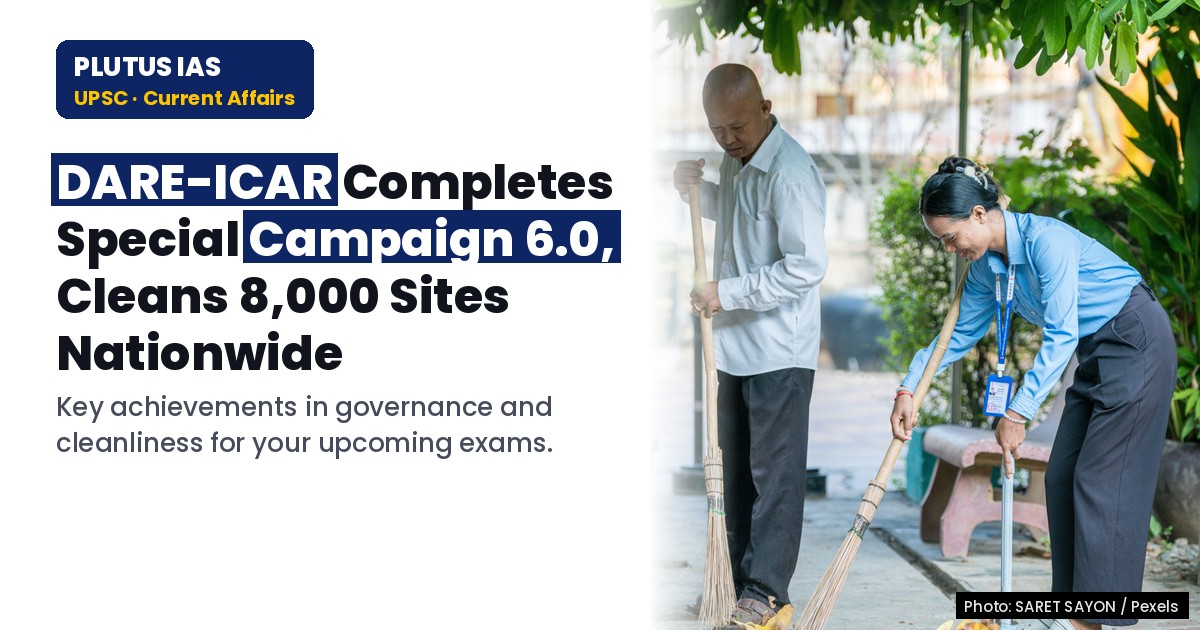
06 Nov DARE-ICAR Special Campaign 6.0: Governance & Cleanliness
✎ Special Campaign 6.0, executed by DARE-ICAR, is a nationwide initiative focused on enhancing cleanliness, optimising office spaces, and promoting efficient record management and sustainable practices within government…
Subject Relevance — Where This Topic Fits
- GS Paper II — Governance, Transparency and Accountability | GS Paper III — Environment and Ecology, Waste Management
- Prelims: Special Campaign 6.0, DARE-ICAR, Swachhta Abhiyan, Record Management, Waste Segregation, Digitisation in Governance
- Essay: The imperative of cleanliness and efficient resource management in public administration, Sustainable practices and their role in national development
Quick Revision: Special Campaign 6.0, executed by DARE-ICAR, is a nationwide initiative focused on enhancing cleanliness, optimising office spaces, and promoting efficient record management and sustainable practices within government establishments.
Why is this in the news?
The Department of Agricultural Research and Education (DARE) and the Indian Council of Agricultural Research (ICAR) have successfully concluded Special Campaign 6.0. This nationwide initiative focused on enhancing cleanliness and improving office spaces across approximately 8,000 of their establishments. The campaign involved extensive record management, digitisation, waste disposal, and environmental-friendly practices, resulting in significant revenue generation and space optimisation.
Background
- Special Campaign 6.0 is an initiative aimed at promoting cleanliness, improving office efficiency, and enhancing citizen-centric services within government organisations.
- The campaign’s activities encompassed a broad spectrum, including meticulous record management, digitisation of documents, and the implementation of environmentally sustainable practices such as tree plantation.
- Key focus areas included responsible waste disposal, electronic waste management, and the overall augmentation of office spaces to foster a conducive working environment.
- Significant outcomes of the campaign included the weeding out of over 13,000 physical and electronic files, generating revenue exceeding INR 14 lakhs, and reclaiming more than 4,000 square feet of office space.
- Awareness camps were organised to educate the public on the importance of sanitation, alongside the provision of free medical camps in several premises and the recognition of sanitation workers (‘Safai Mitras’).
- The campaign emphasised active participation from officials at all levels in cleanliness drives, particularly focusing on comprehensive cleaning of surrounding areas and the segregation of metal and plastic waste.
- The campaign’s achievements surpassed its predetermined targets, underscoring its effectiveness in promoting responsible waste management and hygiene in workplaces.
- The campaign aligns with broader governmental initiatives promoting cleanliness and efficient governance, such as the Swachh Bharat Abhiyan, by extending these principles to public sector workplaces.
About the Department of Agricultural Research and Education (DARE) and Indian Council of Agricultural Research (ICAR)
- DARE is a department under the Ministry of Agriculture & Farmers Welfare, Government of India, responsible for agricultural research and education.
- ICAR is an autonomous organisation under DARE, serving as the apex body for coordinating, guiding, and managing research and education in agriculture, including horticulture, fisheries, and animal sciences, across the entire country.
- ICAR plays a pivotal role in promoting science and technology in agriculture, contributing significantly to India’s food security and agricultural development.
- The council’s mandate includes planning, undertaking, aiding, promoting, and coordinating agricultural education, research, and extension activities.
- It operates a vast network of research institutes, national research centres, and agricultural universities, disseminating knowledge and technologies to farmers.
- ICAR is instrumental in developing new crop varieties, improving farming techniques, and addressing various challenges faced by the agricultural sector through scientific interventions.
- The organisation also focuses on human resource development in agriculture through its educational programmes and capacity-building initiatives.
- Participation in campaigns like Special Campaign 6.0 reflects ICAR’s commitment to good governance, environmental responsibility, and efficient public service delivery within its extensive network of institutions.
Key Features
| Feature | Significance |
|---|---|
| Scope of Operation | Encompassed approximately 8,000 locations across India within DARE-ICAR establishments, demonstrating a wide geographical reach and institutional commitment. |
| Record Management and Digitisation | Involved the segregation and streamlining of over 13,000 physical and electronic files, enhancing administrative efficiency and promoting digital governance. |
| Revenue Generation and Space Optimisation | Generated revenue exceeding INR 14 lakh through the disposal of unserviceable items and reclaimed over 4,000 square feet of office space, indicating efficient resource utilisation. |
| Environmental Sustainability Practices | Included tree plantation, eco-friendly methods, and specific segregation of metal and plastic waste, contributing to environmental conservation and responsible waste management. |
| Community Engagement and Awareness | Organised awareness camps on hygiene, free medical camps, and felicitated sanitation workers, fostering a sense of community responsibility and well-being. |
| Holistic Approach to Cleanliness | Addressed cleanliness not only within office premises but also in surrounding fields, grounds, and roads, promoting a comprehensive approach to sanitation. |
Why it Matters
Governance and Administration
- Demonstrates a commitment to efficient public administration through systematic record management, digitisation, and optimal utilisation of office space.
- Promotes a culture of accountability and transparency by streamlining administrative processes and reducing bureaucratic clutter.
- Enhances the overall working environment for public servants, potentially leading to improved productivity and service delivery.
Environmental Sustainability
- Contributes to environmental protection through responsible waste management practices, including segregation, reduction, reuse, and recycling.
- Fosters ecological consciousness within government institutions by promoting tree plantation and eco-friendly methodologies.
- Addresses the challenge of electronic waste management, a growing concern in the digital age, by ensuring its proper disposal.
Public Health and Well-being
- Raises awareness about the importance of hygiene and sanitation, which are crucial for preventing the spread of diseases.
- Provides direct health benefits to communities through the organisation of free medical camps.
- Acknowledges and respects the contributions of sanitation workers, promoting social equity and dignity of labour.
Economic Efficiency
- Generates revenue from the disposal of obsolete materials, contributing to public exchequer.
- Optimises resource allocation by reclaiming valuable office space, reducing the need for new infrastructure.
- Reduces operational costs associated with inefficient record keeping and cluttered workspaces.
Challenges
1. Sustaining Cleanliness Initiatives
- Maintaining the achieved standards of cleanliness and orderliness beyond the campaign period requires continuous effort and institutionalisation of best practices.
- Ensuring regular monitoring and evaluation mechanisms are in place to prevent regression to previous conditions.
UPSC Link: Governance; Public Administration
2. Waste Management Infrastructure
- The effective segregation and disposal of diverse waste streams, including hazardous and electronic waste, necessitate robust infrastructure and specialised facilities.
- Ensuring compliance with environmental regulations for waste processing and disposal across all locations.
UPSC Link: Environment; Disaster Management
3. Behavioural Change and Awareness
- Cultivating a sustained culture of cleanliness and responsible waste management among all stakeholders, including employees and the public, is a long-term endeavour.
- Overcoming ingrained habits and promoting active participation in cleanliness drives requires continuous awareness campaigns and education.
UPSC Link: Social Justice; Ethics
4. Digitisation and Record Modernisation
- The process of digitising vast amounts of physical records presents challenges related to data security, accuracy, and interoperability of digital systems.
- Ensuring that digital records are easily accessible, searchable, and preserved for future use, while adhering to data protection norms.
UPSC Link: E-governance; Information Technology
5. Resource Allocation and Manpower
- Adequate allocation of financial resources and trained manpower is crucial for the successful implementation and continuation of such large-scale cleanliness and administrative reform initiatives.
- Ensuring that staff are properly trained in modern record management, waste segregation, and environmental best practices.
UPSC Link: Public Finance; Human Resource Management
Challenges — UPSC Perspective
| Issue | Concern |
|---|---|
| Long-term Sustainability | Maintaining the momentum and standards of cleanliness achieved during special campaigns requires institutionalised mechanisms and continuous commitment, rather than episodic drives. |
| Comprehensive Waste Management | Ensuring the proper collection, segregation, processing, and disposal of all types of waste, including e-waste and hazardous materials, across diverse locations. |
| Behavioural Transformation | Instilling a permanent sense of responsibility and ownership towards cleanliness among all employees and visitors, moving beyond mere compliance. |
| Digital Infrastructure and Security | The effective and secure digitisation of records necessitates robust IT infrastructure, data protection protocols, and skilled personnel to manage digital assets. |
| Inter-agency Coordination | Ensuring seamless coordination among various departments and institutions for uniform implementation of cleanliness and administrative reform guidelines. |
| Resource Mobilisation | Securing consistent financial and human resources to support ongoing cleanliness, maintenance, and administrative efficiency initiatives across all establishments. |
Way Forward
- Institutionalise cleanliness and administrative efficiency as core operational principles, integrating them into daily routines and performance evaluations.
- Develop and implement comprehensive waste management policies that include source segregation, recycling, composting, and safe disposal mechanisms for all waste streams, including e-waste.
- Leverage technology for advanced record management, including cloud-based storage, AI-driven indexing, and secure data access, to enhance efficiency and reduce physical clutter.
- Conduct regular audits and inspections to monitor compliance with cleanliness and administrative standards, ensuring accountability at all levels.
- Foster a culture of environmental stewardship and civic responsibility through continuous awareness campaigns, training programs, and employee engagement initiatives.
- Allocate dedicated budgets and trained personnel for the upkeep of premises, waste management, and ongoing administrative reforms.
- Promote inter-departmental collaboration and knowledge sharing of best practices in cleanliness and administrative efficiency across government organisations.
UPSC Value Addition
Keywords for Mains Answer-Writing
Swachh Bharat Abhiyan · Waste management · Digitisation of records · Office space optimisation · Environmental sustainability · Public awareness campaigns · Circular economy principles · Government efficiency · Resource recovery · E-waste management · Citizen-centric governance · Institutional cleanliness
Concept Flow
Special Campaign 6.0 initiated by DARE-ICAR → Focus on cleanliness, record management, and space optimisation → Activities include waste segregation, digitisation, awareness camps → Resulting in improved hygiene, revenue generation, and space reclamation → Leading to enhanced administrative efficiency and environmental sustainability → Contributing to better public service delivery and employee well-being
Prelims Practice Questions
Q1. Consider the following statements regarding ‘Special Campaign 6.0’ by DARE-ICAR:
1. The campaign focused solely on physical file management and office space improvement.
2. It included activities such as tree plantation, e-waste management, and citizen-centric approaches.
3. Revenue generation through waste disposal was an outcome of the campaign.
How many of the above statements are correct?
- Only one
- Only two
- All three
- None
Answer: Only two — Statement 1 is incorrect because the campaign encompassed a wide range of activities beyond physical file management, including digitisation, environmental practices, and citizen-centric approaches. Statement 2 is correct as the campaign explicitly included tree plantation, e-waste management, and citizen-centric methods. Statement 3 is correct, as the campaign generated revenue through the disposal of waste materials.
Q2. Which of the following principles were emphasised in the ‘Special Campaign 6.0’ for waste management?
1. Reduce
2. Reuse
3. Recycle
Select the correct answer using the code given below:
- 1 and 2 only
- 2 and 3 only
- 1 and 3 only
- 1, 2 and 3
Answer: 1, 2 and 3 — The campaign explicitly mentioned ‘Reduce, Reuse, Recycle’ as implemented methods, particularly for composting and vermicomposting, indicating an emphasis on all three principles of waste management.
Mains Practice Question
✍ Discuss the significance of ‘Special Campaigns’ like the one undertaken by DARE-ICAR in promoting good governance and environmental sustainability within government organisations. How do such initiatives contribute to the broader objectives of Swachh Bharat Abhiyan? (15 Marks)
Approach: MODEL-ANSWER SKELETON:
1. Introduction: Briefly define ‘Special Campaigns’ in the context of government initiatives for cleanliness and efficiency, referencing the DARE-ICAR Special Campaign 6.0.
2. Significance for Good Governance:
a. Enhanced Efficiency: Record management, digitisation, space optimisation.
b. Transparency and Accountability: Improved file management, citizen-centric approaches.
c. Employee Morale: Clean work environments, recognition of ‘Safai Mitras’.
d. Resource Optimisation: Revenue generation from waste, optimal use of office space.
3. Significance for Environmental Sustainability:
a. Waste Management: Emphasis on 3Rs (Reduce, Reuse, Recycle), segregation of waste (metal, plastic).
b. E-waste Management: Specific focus on responsible disposal.
c. Green Initiatives: Tree plantation, eco-friendly practices.
d. Awareness Generation: Public and employee awareness camps on cleanliness and environmental protection.
4. Contribution to Swachh Bharat Abhiyan (SBA) Objectives:
a. Holistic Approach: Extending SBA beyond public spaces to government workplaces.
b. Behavioural Change: Fostering a culture of cleanliness and responsible waste management among government personnel.
c. Model for Others: Government institutions setting an example for other sectors.
d. Sustainable Development Goals (SDGs): Alignment with SDG 11 (Sustainable Cities and Communities) and SDG 12 (Responsible Consumption and Production).
5. Conclusion: Summarise the multi-faceted benefits of such campaigns in fostering a cleaner, more efficient, and environmentally conscious public administration, reinforcing the spirit of SBA.
Source: PIB (Press Information Bureau)
Generated by AanyaAi for educational purpose.
Related guides on our sites
- Anthropology VS PSIR
- Best PSIR optional coaching
- Best PSIR optional coaching online
- Best PSIR optional teacher

- DARE-ICAR Special Campaign 6.0: Governance & Cleanliness - November 6, 2026
- ओबीसी क्रीमी लेयर: सुप्रीम कोर्ट ने केंद्र की अर्जी खारिज की - November 6, 2026
- UPSC Service Allocation Delay: OBC Creamy Layer Impact - November 6, 2026

No Comments