


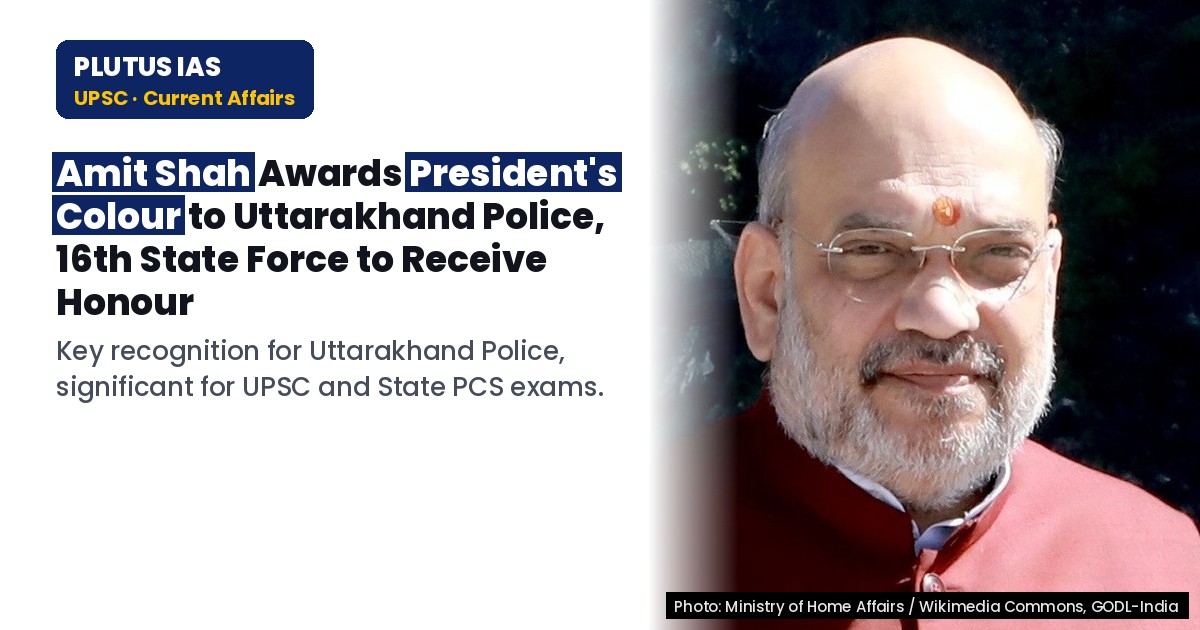
06 Nov Uttarakhand Police Awarded President’s Colour by Amit Shah
✎ The President's Colour is the highest honour conferred by the President of India upon military and police units for exceptional and meritorious service to the nation.
Subject Relevance — Where This Topic Fits
- GS Paper II — Governance, Constitution, Polity, Social Justice and International Relations | GS Paper III — Internal Security, Disaster Management
- Prelims: President’s Colour, Police forces, Internal security, Disaster response, Law enforcement
- Essay: The role of state police forces in national security and development, Recognising excellence in public service: Awards and their impact
Quick Revision: The President’s Colour is the highest honour conferred by the President of India upon military and police units for exceptional and meritorious service to the nation.
Why is this in the news?
The Uttarakhand Police was formally conferred with the prestigious President’s Colour (Presidential Standard) by the Union Home and Cooperation Minister in Dehradun. This distinction marks Uttarakhand as the 16th state in India whose police force has received this esteemed honour, acknowledging its exemplary service, discipline, and commitment to duty.
Background
- The President’s Colour, also known as the ‘Nishan’, is the highest honour bestowed upon any military or police unit in India, recognising exceptional service to the nation.
- The award signifies the unit’s outstanding performance, sacrifice, and adherence to professional standards over a sustained period.
- The tradition of awarding the President’s Colour dates back to the British Raj, with the first such award in independent India presented to the Indian Navy in 1951.
- Units receiving the President’s Colour are authorised to use it as a symbol of their distinguished service, often displayed on ceremonial occasions.
- The Uttarakhand Police has been lauded for its multifaceted responsibilities, including maintaining law and order, managing large-scale pilgrimages and tourist influx, and undertaking critical disaster response operations in challenging geographical terrain.
- The state police force has also been actively involved in national initiatives such as combating drug trafficking and contributing to the ‘Vibrant Villages’ programme for border area development.
What is the President’s Colour?
- The President’s Colour is the highest honour that can be bestowed upon any unit of the armed forces or police forces of India.
- It is awarded by the President of India, who is the Supreme Commander of the Indian Armed Forces, in recognition of exceptional and meritorious service rendered to the nation.
- The award is a flag or standard that is presented to the unit, symbolising its distinguished history, valour, and contribution.
- Units receiving the President’s Colour are permitted to carry this standard on all ceremonial parades and occasions, signifying their esteemed status.
- The criteria for selection typically involve a comprehensive evaluation of the unit’s operational performance, discipline, adherence to ethical standards, and sacrifices made in the line of duty.
- The award serves as a significant morale booster for the personnel, acknowledging their dedication and inspiring future generations of service members.
- Historically, the award has been conferred upon various regiments of the Indian Army, squadrons of the Indian Air Force, ships and establishments of the Indian Navy, and select state police forces.
- The presentation ceremony is a solemn and prestigious event, often attended by high-ranking dignitaries and military/police officials.
Key Features
| Feature | Significance |
|---|---|
| President’s Colour Award | A singular honour bestowed upon a military or police unit in recognition of exceptional service to the nation, symbolising immense pride and distinction. |
| Uttarakhand Police | The 16th state police force in India to receive this esteemed award, marking a significant milestone in its 25-year history. |
| Motto: ‘कर्म सत्यम् शौर्यम्’ (Duty, Truth, Valour) | Reflects the core values and operational ethos that have guided the Uttarakhand Police in its service and contributed to its recognition. |
| Disaster Response Capabilities | Demonstrated proficiency in managing diverse emergencies, including forest fires, landslides, and complex rescue operations such as the Silkyara tunnel incident. |
| Law and Order Management | Effective handling of large pilgrim congregations (Kumbh Mela, Char Dham Yatra) and a significant influx of tourists, ensuring public safety and order. |
| Border Area Security | Active participation in efforts to revitalise border villages, collaborating with Central Armed Police Forces (CAPFs) to address depopulation. |
Why it Matters
Governance and Public Order
- The President’s Colour signifies exemplary performance in maintaining law and order, disaster management, and public service, reinforcing public trust in the police force.
- Recognition of the Uttarakhand Police’s efforts in managing complex security challenges inherent to a state with significant pilgrimage sites and tourist footfall.
- Highlights the importance of state police forces in national security architecture, particularly in regions with unique geographical and demographic characteristics.
Internal Security
- Acknowledges the police’s role in counter-narcotics efforts, aligning with the national objective of a ‘Drug-Free India’ and specific state-level commitments.
- Underscores the police’s contribution to combating Naxalism and other internal security threats, thereby fostering a secure environment for development.
- Emphasises the critical function of state police in disaster response and humanitarian aid, which are integral components of internal security and public safety.
Social and Economic Development
- A secure environment, facilitated by an efficient police force, is crucial for promoting tourism and attracting industrial investment, contributing to state economic growth.
- The police’s role in addressing issues like migration from border villages, through initiatives like the Vibrant Villages Programme, supports balanced regional development.
- Commitment to timely justice delivery under new criminal justice legislations enhances the rule of law, which is fundamental for social stability and economic progress.
Institutional Morale and Professionalism
- The award serves as a significant morale booster for the police personnel, recognising their dedication, sacrifice, and adherence to professional standards.
- It promotes a culture of excellence and accountability within the police organisation, encouraging continuous improvement in service delivery.
- Reinforces the institutional identity and pride of the Uttarakhand Police, motivating future generations of officers and constables.
Challenges
1. Geographical and Environmental Hazards
- Uttarakhand’s mountainous terrain is prone to natural disasters such as landslides, flash floods, and forest fires, requiring specialised police response capabilities.
- The difficult accessibility of remote areas poses challenges for rapid deployment and effective law enforcement, especially during emergencies.
UPSC Link: Disaster Management; Internal Security
2. Managing Tourist and Pilgrim Influx
- The state experiences a massive annual influx of tourists and pilgrims, necessitating robust crowd control, traffic management, and security arrangements.
- Ensuring the safety and security of millions of visitors across diverse religious sites and tourist destinations presents complex logistical and operational challenges.
UPSC Link: Tourism; Law and Order
3. Drug Trafficking and Abuse
- The ‘Drug-Free India’ initiative highlights the persistent challenge of drug trafficking and substance abuse, requiring sustained efforts in enforcement and rehabilitation.
- Geographical proximity to certain drug routes can make the state vulnerable to illicit drug trade, impacting public health and safety.
UPSC Link: Internal Security; Social Issues
4. Border Area Development and Security
- Addressing the depopulation of border villages and ensuring their security requires coordinated efforts with central agencies and sustained developmental initiatives.
- Maintaining vigilance and preventing cross-border illegal activities in remote and sensitive border regions is a continuous challenge.
UPSC Link: Border Management; Internal Security
5. Modernisation and Capacity Building
- Keeping pace with evolving crime patterns, including cybercrime, and adopting advanced investigative techniques requires continuous investment in technology and training.
- Ensuring adequate human resources, modern equipment, and infrastructure for an expanding police force in a dynamic environment.
UPSC Link: Police Reforms; Internal Security
Challenges — UPSC Perspective
| Issue | Concern |
|---|---|
| Natural Disasters | Vulnerability to landslides, floods, and forest fires necessitates specialised training and equipment for police personnel. |
| Pilgrim/Tourist Management | Ensuring safety and security for millions of visitors across numerous religious and tourist sites, requiring extensive logistical planning. |
| Drug Menace | Combating drug trafficking and substance abuse, a national priority, requires sustained enforcement and public awareness campaigns. |
| Border Village Depopulation | Reversing migration from border areas and ensuring security, often requiring collaboration with central forces and developmental initiatives. |
| Technological Advancement | Adapting to new forms of crime and leveraging technology for investigation and surveillance, demanding continuous modernisation. |
Government Initiatives — Must-Memorise for Prelims
- Vibrant Villages Programme
Way Forward
- Sustain and enhance disaster response capabilities through regular training, advanced equipment procurement, and inter-agency coordination.
- Implement comprehensive crowd management strategies for pilgrim and tourist circuits, leveraging technology for real-time monitoring and communication.
- Intensify efforts under the ‘Drug-Free India’ initiative, focusing on intelligence-led enforcement, de-addiction programs, and public awareness campaigns.
- Strengthen community policing initiatives, particularly in remote and border areas, to foster trust and gather actionable intelligence.
- Invest in the continuous modernisation of police infrastructure, technology, and forensic capabilities to combat evolving crime patterns effectively.
- Prioritise the welfare of police personnel, including housing, healthcare, and stress management programs, to maintain high morale and operational efficiency.
- Ensure the effective implementation of new criminal justice legislations, focusing on timely investigation and prosecution to enhance justice delivery.
- Promote inter-state police cooperation and collaboration with Central Armed Police Forces (CAPFs) for addressing trans-border challenges and internal security threats.
UPSC Value Addition
Keywords for Mains Answer-Writing
President’s Colour · Police forces · Law enforcement · Internal security · Disaster management · Community policing · Police reforms · State police · Paramilitary forces · Governance · Rule of law · National security
Constitutional & Policy Linkages
- {‘Article 246’: ‘Distribution of legislative powers (Seventh Schedule)’}
- {‘Seventh Schedule, List II (State List), Entry 2’: ‘Police (organisation, maintenance, etc.)’}
- {‘Seventh Schedule, List III (Concurrent List), Entry 1’: ‘Criminal law, including all matters’}
- {‘Article 355’: ‘Duty of Union to protect States’}
Concept Flow
Exceptional Service by State Police → Recognition through President’s Colour → Enhanced Morale and Professionalism → Improved Law and Order/Disaster Response → Conducive Environment for Tourism/Investment → Contribution to State Development and National Security
Prelims Practice Questions
Q1. Consider the following statements regarding the ‘President’s Colour’ award in India:
1. It is the highest honour bestowed upon any military or police unit in India.
2. The award is presented by the President of India or their designated representative.
3. Only military units are eligible to receive the President’s Colour.
How many of the above statements are correct?
- Only one
- Only two
- Only three
- None
Answer: Only two — Statement 1 is correct: The President’s Colour is indeed the highest honour. Statement 2 is correct: The President or their representative confers the award. Statement 3 is incorrect: Both military and police units are eligible, as evidenced by the Uttarakhand Police receiving it.
Q2. Which of the following bodies is primarily responsible for maintaining law and order within a state in India?
- Central Reserve Police Force (CRPF)
- Border Security Force (BSF)
- State Police
- Indo-Tibetan Border Police (ITBP)
Answer: State Police — The State Police is primarily responsible for maintaining law and order within the geographical boundaries of a state. CRPF, BSF, and ITBP are central armed police forces with different mandates, though they can assist state police.
Mains Practice Question
✍ The conferment of the ‘President’s Colour’ on state police forces acknowledges their exemplary service and contribution to national security and public order. Discuss the multifaceted roles of state police in India, particularly in the context of disaster management and maintaining law and order in challenging geographical terrains. (15 Marks)
Approach: MODEL-ANSWER SKELETON:
1. Introduction: Briefly define ‘President’s Colour’ and its significance as a recognition of exceptional service.
2. Multifaceted Roles of State Police:
a. Law and Order Maintenance: Crime prevention, investigation, apprehension of offenders, traffic management.
b. Public Order: Managing protests, assemblies, maintaining peace during festivals, elections.
c. Internal Security: Counter-terrorism, anti-insurgency operations (in affected regions), intelligence gathering.
d. Community Policing: Building trust, citizen engagement, addressing local issues.
e. VIP Security and Protection of Critical Infrastructure.
3. Role in Disaster Management:
a. First Responders: Immediate relief, rescue operations (e.g., Silkyara tunnel, landslides, floods).
b. Evacuation and Rehabilitation: Assisting in moving affected populations, providing initial aid.
c. Coordination: Working with NDRF, SDRF, ITBP, and other agencies.
d. Specific examples: Uttarakhand Police’s role in forest fires, landslides, and rescue operations in difficult terrains.
4. Challenges in Challenging Geographical Terrains (e.g., Uttarakhand):
a. Accessibility: Difficulties in reaching remote areas.
b. Resource Constraints: Equipment, personnel, training for specialized rescue.
c. Tourist Management: Handling large influx of pilgrims and tourists (Char Dham, Kumbh Mela).
d. Border Security: Assisting CAPF in border areas, addressing migration issues.
5. Conclusion: Summarize the critical importance of state police forces, especially in diverse and challenging environments, and the need for continuous reforms and capacity building.
Source: PIB (Press Information Bureau)
Uttarakhand PCS (UKPSC) — State PCS Practice
Prelims: Which of the following statements is/are correct regarding the recent award presented to the Uttarakhand Police?
I. The President’s Colour was presented by the Union Home and Cooperation Minister, Shri Amit Shah.
II. This prestigious award was presented in Dehradun.
III. The President’s Colour is awarded for exemplary service and bravery.
IV. Uttarakhand is the first state police force in India to receive this honour.
- A. I, II and III only
- B. I and II only
- C. III and IV only
- D. I, II, III and IV
Answer: A. I, II and III only — Statements I, II, and III are correct based on the provided topic and general knowledge about the President’s Colour. Statement IV is incorrect as several state police forces have received this honour previously.
Mains: Discuss the significance of the President’s Colour award for the Uttarakhand Police, particularly in the context of state policing challenges and its potential impact on police morale and public perception within Uttarakhand.
Generated by AanyaAi for educational purpose.
Related guides on our sites
- Current affairs for upsc 2026
- Best Law optional coaching for upsc
- Best law optional teacher for upsc
- How to prepare for GS paper 1 for UPSC CSE mains exam

- Uttarakhand Police Awarded President’s Colour by Amit Shah - November 6, 2026
- वज्र-सैट अभ्यास: पशुधन सुरक्षा हेतु भारत की तैयारियों का सुदृढ़ीकरण - November 6, 2026
- ESIC Faridabad Achieves Corneal Transplant Milestone - November 6, 2026

No Comments