


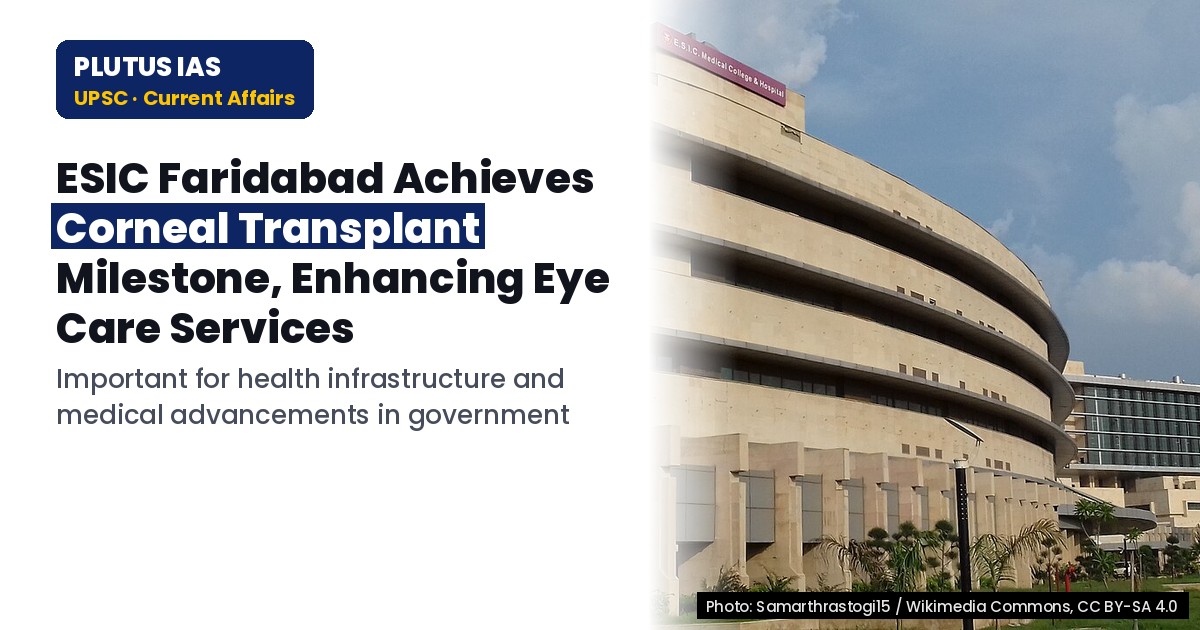
06 Nov ESIC Faridabad Achieves Corneal Transplant Milestone
✎ Corneal transplantation is a surgical procedure to replace a damaged cornea with a healthy donor cornea, crucial for restoring vision in cases of corneal blindness, and its successful execution at ESIC Medical College, Faridabad…
Subject Relevance — Where This Topic Fits
- GS Paper II — Governance, Social Justice (Health), Government Policies and Interventions | GS Paper III — Science and Technology (Biotechnology, Health Technology)
- Prelims: ESIC, Corneal Transplant, Penetrating Keratoplasty, National Programme for Control of Blindness and Visual Impairment, Organ Donation, Healthcare Infrastructure
- Essay: Healthcare Access and Equity in India, Role of Public Institutions in Advancing Medical Science
Quick Revision: Corneal transplantation is a surgical procedure to replace a damaged cornea with a healthy donor cornea, crucial for restoring vision in cases of corneal blindness, and its successful execution at ESIC Medical College, Faridabad, signifies enhanced specialised healthcare access for beneficiaries.
Why is this in the news?
ESIC Medical College and Hospital, Faridabad, successfully performed a Penetrating Keratoplasty, commonly known as corneal transplantation, on October 27, 2026. This surgical achievement represents a significant advancement in the institution’s specialised ophthalmological services and underscores the commitment to providing advanced healthcare facilities to ESIC beneficiaries. The procedure, performed on a 46-year-old patient suffering from corneal opacity, highlights the strengthening of expert medical services within the Employees’ State Insurance Corporation’s healthcare network.
Background
- The Employees’ State Insurance Corporation (ESIC) is a statutory body under the Ministry of Labour and Employment, Government of India, providing social security and healthcare services to workers and their dependents.
- ESIC operates a network of hospitals and dispensaries across India, aiming to deliver comprehensive medical care, including secondary and tertiary services.
- Corneal blindness is a significant cause of visual impairment globally, with corneal transplantation being a primary treatment modality to restore vision.
- The successful execution of a complex procedure like corneal transplantation at an ESIC facility signifies an expansion of high-end medical services accessible to its beneficiary population.
- This development aligns with national health objectives focused on reducing preventable blindness and enhancing the quality of healthcare infrastructure.
- The National Programme for Control of Blindness and Visual Impairment (NPCB&VI), launched in 1976, is a key government initiative aimed at reducing the prevalence of blindness through various interventions, including corneal transplantation.
- Organ donation, particularly eye donation, is crucial for the availability of corneas for transplantation, and public awareness campaigns are often undertaken to promote this cause.
- Medical colleges and hospitals play a dual role in healthcare delivery: providing treatment and serving as centres for medical education and research, thereby contributing to the advancement of medical science and training future healthcare professionals.
What is Corneal Transplantation?
- Corneal transplantation, medically termed Keratoplasty, is a surgical procedure where a diseased or damaged cornea is replaced with a healthy cornea from a deceased donor.
- The cornea is the transparent front part of the eye that covers the iris, pupil, and anterior chamber, playing a crucial role in focusing light onto the retina.
- Corneal opacity, caused by infections, injuries, genetic conditions, or degenerative diseases, can lead to significant vision impairment or blindness.
- Penetrating Keratoplasty (PK) is a full-thickness corneal transplant where the entire damaged cornea is removed and replaced with a donor cornea.
- Other types of corneal transplants include Lamellar Keratoplasty, which involves replacing only specific layers of the cornea, such as Descemet’s Stripping Endothelial Keratoplasty (DSEK) or Deep Anterior Lamellar Keratoplasty (DALK).
- The success of corneal transplantation depends on factors such as donor tissue quality, surgical technique, and post-operative care, including immunosuppressive therapy to prevent rejection.
- Access to corneal transplants is often limited by the availability of donor corneas and the presence of specialised surgical facilities and skilled ophthalmologists.
- The procedure aims to restore visual acuity, reduce pain, and improve the overall quality of life for individuals affected by corneal diseases.
- Eye banks play a vital role in collecting, evaluating, and distributing donor corneas, ensuring their suitability for transplantation.
- Legal and ethical frameworks govern organ donation and transplantation, ensuring transparency and preventing exploitation.
Key Features
| Feature | Significance |
|---|---|
| Successful Corneal Transplant | Marks a significant advancement in the specialized ophthalmic services offered by ESIC Medical College and Hospital, Faridabad. |
| Penetrating Keratoplasty (PKP) | A complex surgical procedure involving the replacement of a damaged cornea with a healthy donor cornea, restoring vision. |
| Beneficiary-Centric Healthcare | Enhances the range and quality of advanced medical facilities available to beneficiaries of the Employees’ State Insurance Corporation (ESIC). |
| Expert Medical Team | Underscores the proficiency and dedicated efforts of the ophthalmic department, led by Dr. S. R. Singh, DMS (Ophthalmologist). |
| Institutional Capacity Building | Demonstrates the hospital’s growing capability to undertake intricate surgical interventions, strengthening its role as a tertiary care provider. |
Why it Matters
Social Significance
- Restoration of vision for individuals suffering from corneal opacity significantly improves their quality of life and enables greater social participation.
- Reduces the burden of preventable blindness, contributing to public health objectives and enhancing community well-being.
- Provides advanced medical care to a segment of the population, particularly ESIC beneficiaries, who might otherwise face barriers to accessing such specialized treatments.
Healthcare Infrastructure Development
- Highlights the progressive enhancement of specialized medical services within public sector hospitals, specifically ESIC institutions.
- Strengthens the capacity of ESIC Medical College and Hospital, Faridabad, as a center for advanced ophthalmic care, potentially serving as a regional referral hub.
- Contributes to the overall improvement of India’s healthcare infrastructure by expanding the availability of high-end surgical procedures beyond metropolitan centers.
Economic Implications
- Enables individuals to regain their productive capacity, thereby contributing to the workforce and reducing economic dependency.
- Reduces out-of-pocket expenditure for ESIC beneficiaries by providing complex surgeries within the ESIC network, promoting financial security.
- Fosters human capital development by ensuring that workers and their families have access to necessary medical interventions that maintain their health and productivity.
Challenges
1. Cornea Availability and Donation
- A significant disparity exists between the demand for corneal transplants and the availability of donor corneas in India.
- Sociocultural factors, lack of awareness, and logistical issues often impede eye donation rates.
- The process of harvesting, preserving, and distributing donor corneas requires robust infrastructure and coordination.
UPSC Link: Health and Human Resource Development
2. Specialized Medical Workforce
- There is a persistent shortage of highly skilled ophthalmic surgeons and support staff capable of performing and managing complex procedures like corneal transplants.
- Continuous training and skill upgradation are essential to keep pace with advancements in surgical techniques and technology.
- Retention of specialized medical professionals in public sector institutions remains a challenge.
UPSC Link: Health Sector Challenges
3. Infrastructure and Equipment
- Performing advanced surgeries necessitates state-of-the-art operating theaters, diagnostic equipment, and post-operative care facilities.
- Maintenance and periodic upgrades of sophisticated medical equipment can be resource-intensive.
- Ensuring sterile environments and infection control protocols is critical for successful surgical outcomes.
UPSC Link: Infrastructure Development
4. Accessibility and Affordability
- Despite schemes like ESIC, geographical disparities in access to specialized ophthalmic care persist, especially in rural and remote areas.
- The overall cost of advanced medical procedures, even with partial coverage, can still be prohibitive for many.
- Ensuring equitable access to high-quality healthcare services for all sections of society remains a policy imperative.
UPSC Link: Social Justice and Healthcare
Challenges — UPSC Perspective
| Issue | Concern |
|---|---|
| Cornea Shortage | Insufficient availability of donor corneas to meet the demand for transplantation, leading to long waiting lists. |
| Skill Gap | Dearth of adequately trained ophthalmic surgeons and specialized support staff for complex procedures. |
| Infrastructure Maintenance | Challenges in sustaining advanced medical equipment and facilities in public healthcare settings. |
| Awareness Deficit | Low public awareness regarding eye donation and its critical role in combating corneal blindness. |
| Geographical Disparity | Uneven distribution of specialized ophthalmic care centers, limiting access for populations in underserved regions. |
Government Initiatives — Must-Memorise for Prelims
- Employees’ State Insurance Scheme (ESIS)
Way Forward
- Intensify public awareness campaigns to promote eye donation, emphasizing its life-changing impact and addressing misconceptions.
- Strengthen the national eye banking network through better coordination, standardized protocols, and efficient logistics for cornea collection and distribution.
- Invest in training and capacity building for ophthalmic surgeons, nurses, and technicians in public health institutions to enhance specialized surgical skills.
- Upgrade and maintain advanced ophthalmic infrastructure and equipment in ESIC hospitals and other public healthcare facilities.
- Implement tele-ophthalmology solutions to extend diagnostic and follow-up care to remote areas, improving accessibility.
- Foster research and development in corneal regeneration and alternative treatment methods to reduce reliance on donor corneas.
- Ensure robust quality control and infection prevention measures in all ophthalmic surgical units to optimize patient safety and outcomes.
UPSC Value Addition
Keywords for Mains Answer-Writing
Corneal transplantation · Penetrating Keratoplasty · ESIC Medical College and Hospital · Specialised medical services · Healthcare access · Public health infrastructure · Employee State Insurance Corporation · Vision impairment · Advanced healthcare facilities · Organ donation
Constitutional & Policy Linkages
- Article 21: Right to life and personal liberty
- Article 47: Duty of the State to improve public health
Concept Flow
Corneal Opacity/Damage → Vision Impairment/Blindness → Need for Corneal Transplant → Availability of Donor Cornea → Penetrating Keratoplasty Surgery → Vision Restoration/Improvement
Prelims Practice Questions
Q1. Consider the following statements regarding corneal transplantation:
1. Corneal transplantation, also known as Penetrating Keratoplasty, involves replacing a damaged cornea with a healthy donor cornea.
2. The cornea is the transparent front part of the eye that covers the iris, pupil, and anterior chamber.
3. ESIC Medical College and Hospital, Faridabad, is a healthcare institution under the Ministry of Health and Family Welfare.
- Only one
- Only two
- Only three
- None
Answer: Only two — Statement 1 is correct: Corneal transplantation, or Penetrating Keratoplasty, is a surgical procedure to replace a diseased or damaged cornea with a healthy donor cornea. Statement 2 is correct: The cornea is indeed the transparent outer layer covering the front of the eye. Statement 3 is incorrect: ESIC Medical College and Hospital operates under the Ministry of Labour and Employment, as part of the Employee State Insurance Corporation (ESIC) framework, not the Ministry of Health and Family Welfare.
Q2. Which of the following best describes the primary objective of the Employee State Insurance Corporation (ESIC)?
- To provide universal health coverage to all citizens of India.
- To offer social security and healthcare benefits to industrial workers and their dependents.
- To regulate the pharmaceutical industry and ensure drug quality.
- To fund medical research and development in specialised fields.
Answer: To offer social security and healthcare benefits to industrial workers and their dependents. — The Employee State Insurance Corporation (ESIC) is a statutory body established under the ESI Act, 1948, primarily aimed at providing social security and healthcare benefits to a specific segment of the workforce, namely industrial workers and their dependents, ensuring their protection against sickness, maternity, disablement, and death due to employment injury.
Mains Practice Question
✍ Discuss the significance of specialised medical procedures like corneal transplantation in enhancing public health outcomes and accessibility to advanced healthcare in India. What challenges persist in scaling up such services across the nation? (15 Marks)
Approach: INTRODUCTION: Briefly define specialised medical procedures and their role in addressing specific health conditions. PART 1: Significance of specialised medical procedures like corneal transplantation – improved quality of life, reduction in disability, contribution to universal health coverage goals, strengthening of public health infrastructure (e.g., ESIC hospitals), role in medical tourism, and fostering medical research and innovation. PART 2: Challenges in scaling up such services – shortage of skilled medical professionals (surgeons, technicians), inadequate infrastructure (operation theatres, post-operative care units), limited availability of donor organs/tissues, high cost of advanced procedures and equipment, geographical disparities in access, lack of public awareness regarding organ donation, regulatory hurdles, and ethical considerations. CONCLUSION: Suggest policy measures such as capacity building, public-private partnerships, awareness campaigns, and technological integration to overcome these challenges and ensure equitable access.
Source: PIB (Press Information Bureau)
Haryana PCS (HPSC / HCS) — State PCS Practice
Prelims: Which of the following medical institutions in Haryana recently achieved a significant milestone by successfully performing a cornea transplant operation?
- PGIMS Rohtak
- Kalpana Chawla Government Medical College, Karnal
- ESIC Medical College and Hospital, Faridabad
- Maharaja Agrasen Medical College, Agroha
Answer: ESIC Medical College and Hospital, Faridabad — ESIC Medical College and Hospital, Faridabad, successfully performed a cornea transplant operation, marking a significant achievement in eye care for the region.
Mains: Discuss the potential impact of advanced medical procedures like cornea transplantation being successfully performed at institutions like ESIC Medical College and Hospital, Faridabad, on healthcare accessibility and quality in Haryana, particularly for the economically weaker sections.
Generated by AanyaAi for educational purpose.

- ESIC Faridabad Achieves Corneal Transplant Milestone - November 6, 2026
- ओडिशा में आदर्श विद्यालय योजना का तीसरा चरण और ₹1,292 करोड़ की परियोजनाएँ - November 6, 2026
- CBN’s ‘Nasha Mukt Yuva’ Mission: UPSC Governance Focus - November 6, 2026

No Comments