


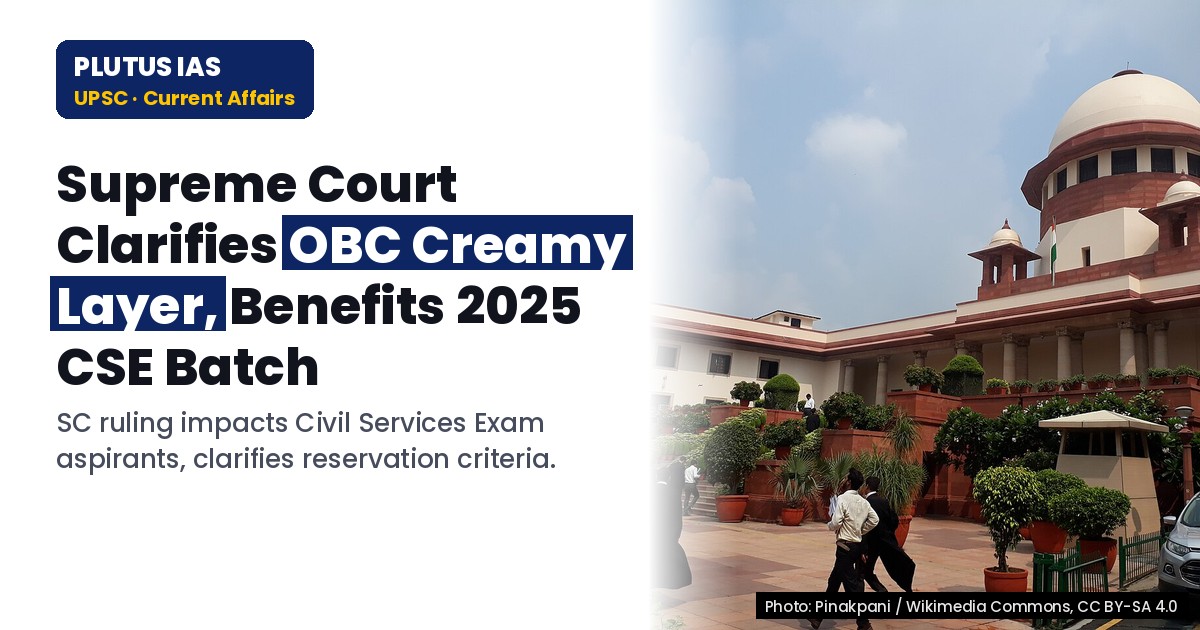
07 Nov OBC Creamy Layer: SC Ruling & CSE Impact
✎ The Supreme Court has clarified that parental salary income alone cannot be the sole determinant for OBC creamy layer status, mandating consideration of the 'status and category of posts' for parents in PSUs, private sector, and…
Subject Relevance — Where This Topic Fits
- GS Paper II — Governance, Constitution, Polity, Social Justice | GS Paper I — Social Empowerment
- Prelims: OBC Creamy Layer, Civil Services Examination (CSE), Reservation Policy, Supreme Court Judgments, Department of Personnel and Training (DoPT), Article 16(4) of the Constitution
- Essay: Affirmative Action and Social Justice in India, The Role of Judiciary in Upholding Constitutional Principles
Quick Revision: The Supreme Court has clarified that parental salary income alone cannot be the sole determinant for OBC creamy layer status, mandating consideration of the ‘status and category of posts’ for parents in PSUs, private sector, and other institutions.
Why is this in the news?
The Supreme Court recently reiterated its March 11 judgment, granting the Central government an additional two months to implement the verdict regarding the determination of the ‘creamy layer’ among Other Backward Classes (OBCs). This ruling clarifies that parental salary income alone cannot be the sole criterion for determining creamy layer status for candidates whose parents are employed in Public Sector Undertakings (PSUs), private sector establishments, or other institutions. The decision is anticipated to facilitate the service allocation and induction of candidates from the 2025 Civil Services Examination (CSE) batch and the Indian Forest Service Examination, potentially benefiting approximately 100 OBC candidates whose caste certificates had been previously rejected.
Background
- The concept of ‘creamy layer’ was introduced to ensure that the benefits of reservation reach the most deserving individuals within the backward classes, preventing the perpetuation of privilege among the already advanced sections.
- The Supreme Court, in its landmark 1992 Indra Sawhney & Ors. vs. Union of India judgment, upheld the 27% reservation for OBCs but mandated the exclusion of the ‘creamy layer’.
- A Government Order (GO) in 1993 outlined criteria for identifying the creamy layer, explicitly excluding salary and agricultural income from the income/wealth test.
- In 2004, the Department of Personnel and Training (DoPT) issued a clarification that included the salary income of PSU and private sector employees for determining creamy layer status, leading to subsequent legal challenges.
- The Supreme Court’s March 11 judgment held that excluding children of OBC parents working in PSUs and the private sector from reservation benefits solely based on salary income, without considering the category of posts (e.g., Group A, B, C, D), constitutes ‘hostile discrimination’.
- The recent ruling by Justices P.S. Narasimha and R. Mahadevan emphasized the lack of reasonable justification for deferring the implementation of the March 11 judgment, which had originally set a six-month deadline for the Centre.
What is the OBC Creamy Layer?
- The ‘creamy layer’ refers to the relatively affluent and advanced sections within the Other Backward Classes (OBCs) who are excluded from the benefits of reservation.
- The concept was introduced to ensure that reservation policies effectively serve their intended purpose of uplifting the truly disadvantaged within the backward classes.
- The criteria for identifying the creamy layer are primarily based on income, property, and the status of parents in terms of employment and position.
- The 1993 Government Order (GO) established specific categories for exclusion, including constitutional post holders, Group ‘A’ and ‘B’ officers in government, those in equivalent posts in PSUs/private sector, and individuals with significant agricultural or non-agricultural income.
- The recent Supreme Court ruling clarifies that for parents in PSUs, private sector, and other institutions, both salary/income and the ‘status and category of posts’ held by them must be considered, not just salary income in isolation.
- This judicial interpretation aims to align the determination of creamy layer status for individuals with parents in non-government employment with the principles applied to government employees, where the ‘status’ of the post is a crucial factor.
- The objective is to prevent situations where individuals from economically sound backgrounds, whose parents hold high-status positions outside government, are denied reservation benefits solely due to their salary, without a holistic assessment of their social and economic standing.
- The determination of the creamy layer is a dynamic process, subject to periodic review and judicial scrutiny to ensure its fairness and constitutional validity.
Key Features
| Feature | Significance |
|---|---|
| OBC Creamy Layer Criterion | The Supreme Court has clarified that parental salary or income alone cannot be the sole determinant for ‘creamy layer’ status for candidates whose parents work in PSUs, private sector establishments, or educational institutions. |
| Equivalence of Posts | The status and category of posts held by parents (e.g., Group A, B, C, D in government service) must also be considered, in accordance with the 1993 government order. |
| Exclusion of Salary and Agricultural Income (1993) | The original 1993 government order explicitly excluded salary and agricultural income from the income/wealth test for determining the creamy layer. |
| 2004 Clarification by DoPT | This clarification included salary income of PSU and private sector employees for creamy layer determination, which was subsequently challenged in the Supreme Court. |
| Hostile Discrimination | The Supreme Court ruled that excluding children of OBC parents in PSUs/private sector from reservation benefits solely based on salary, without considering post category, constitutes “hostile discrimination”. |
| Retrospective Implementation | The Supreme Court initially ordered retrospective implementation of its March 11 judgment within six months, later granting an additional two months due to government-cited difficulties. |
Why it Matters
Social Justice
- The ruling reinforces the principle of equitable access to opportunities for deserving candidates from Other Backward Classes (OBCs) by refining the ‘creamy layer’ exclusion criteria.
- It aims to prevent the unintended exclusion of individuals from reservation benefits based on an incomplete assessment of their socio-economic status.
Administrative Implications
- The decision has direct implications for the service allocation and induction of candidates selected in the Civil Services Examination (CSE) and Indian Forest Service Examination, particularly for the 2025 batch and approximately 100 previously rejected OBC candidates.
- It necessitates a review and potential revision of existing guidelines for determining OBC creamy layer status, especially concerning employees in PSUs and the private sector.
Legal Precedent
- The Supreme Court’s interpretation provides clarity on the application of reservation policies, emphasizing a holistic assessment rather than a singular income-based criterion.
- It underscores the judiciary’s role in ensuring that affirmative action policies achieve their intended objectives without leading to arbitrary exclusions.
Governance and Policy Formulation
- The judgment highlights the need for the Department of Personnel and Training (DoPT) and other relevant government bodies to align their operational guidelines with judicial pronouncements.
- It prompts a re-evaluation of the methodology for establishing equivalence between posts in the government, public, and private sectors for reservation purposes.
Challenges
1. Implementation Complexities
- The retrospective application of the judgment, as directed by the Supreme Court, presents administrative challenges in re-evaluating past cases and adjusting service allocations.
- Establishing a standardized and transparent mechanism for assessing the ‘category of posts’ across diverse public and private sector entities, and equating them with government service classifications (Group A, B, C, D), is inherently complex.
UPSC Link: Governance: Policies & Interventions
2. Defining ‘Creamy Layer’
- The ongoing evolution of ‘creamy layer’ criteria necessitates continuous refinement to ensure that reservation benefits reach the most deserving sections of OBCs while preventing their capture by the affluent.
- Balancing the need for a clear, objective definition with the imperative of avoiding arbitrary exclusions remains a policy challenge.
UPSC Link: Social Justice: Vulnerable Sections
3. Potential for Litigation
- Any new guidelines or interpretations following the judgment may lead to further legal challenges from individuals or groups seeking clarity or contesting their application.
- Ensuring consistency in the application of the revised criteria across various recruitment processes and government departments will be crucial to minimize disputes.
UPSC Link: Polity: Judiciary & Governance
Challenges — UPSC Perspective
| Issue | Concern |
|---|---|
| Retrospective Application | Revisiting and adjusting service allocations for past batches, potentially impacting candidates already allocated or undergoing training. |
| Equivalence of Posts | Difficulty in establishing a uniform and objective framework for equating posts in the private sector and PSUs with government service classifications. |
| Administrative Burden | The need for significant administrative effort and resources to re-evaluate numerous individual cases based on the revised criteria. |
| Policy Harmonisation | Ensuring that all relevant government departments and recruitment agencies uniformly adopt and implement the clarified ‘creamy layer’ guidelines. |
| Preventing Misinterpretation | Developing clear and unambiguous guidelines to prevent varied interpretations and inconsistent application of the Supreme Court’s ruling. |
Way Forward
- The Department of Personnel and Training (DoPT) should expeditiously formulate and issue comprehensive guidelines for determining OBC creamy layer status, incorporating the Supreme Court’s directives regarding parental post category.
- A robust mechanism for establishing equivalence between posts in PSUs, the private sector, and government services (Group A, B, C, D) must be developed and clearly articulated.
- The government should establish a dedicated cell or committee to address and resolve grievances arising from the retrospective application of the judgment, ensuring fair and timely redressal.
- Training and awareness programs should be conducted for all relevant recruitment agencies and administrative bodies to ensure uniform understanding and implementation of the revised creamy layer criteria.
- Regular reviews of the ‘creamy layer’ definition and its application should be undertaken to ensure it remains relevant and effective in achieving the objectives of social justice and inclusive development.
- Public awareness campaigns should be launched to inform eligible candidates about the updated criteria and the process for applying for OBC non-creamy layer certificates.
UPSC Value Addition
Keywords for Mains Answer-Writing
OBC creamy layer · Reservation policy · Supreme Court judgments · Article 16(4) · Social justice · Equality of opportunity · DoPT guidelines · Constitutional provisions · Public employment · Affirmative action
Constitutional & Policy Linkages
- Article 15(4): Special provisions for advancement of any socially and educationally backward classes.
- Article 16(4): Reservation of appointments or posts in favour of any backward class of citizens.
- Article 340: Appointment of a Commission to investigate the conditions of backward classes.
Concept Flow
1993 Government Order excludes salary/agricultural income from creamy layer determination. → 2004 DoPT clarification includes salary income of PSU/private sector employees for creamy layer. → Petitions filed in Supreme Court challenging the 2004 clarification. → Supreme Court rules that salary alone cannot determine creamy layer; post category also essential. → Court deems exclusion based solely on salary as “hostile discrimination”. → Government directed to implement the judgment, impacting CSE/IFoS candidates and future policy.
Prelims Practice Questions
Q1. Consider the following statements regarding the ‘creamy layer’ concept in Other Backward Classes (OBC) reservation:
1. The concept of ‘creamy layer’ was introduced to ensure that reservation benefits reach the most deserving within the OBC category.
2. The 1993 government order explicitly excluded salary and agricultural income from the income-wealth test for determining creamy layer status.
3. A recent Supreme Court ruling has clarified that parental salary income alone cannot be the sole determinant for creamy layer status for individuals whose parents work in PSUs or the private sector.
How many of the above statements are correct?
- Only one
- Only two
- Only three
- None
Answer: Only three — Statement 1 is correct. The ‘creamy layer’ concept aims to exclude the affluent sections of OBCs from reservation benefits, ensuring that the benefits accrue to the genuinely backward.
Statement 2 is correct. The 1993 government order indeed excluded salary and agricultural income from the income-wealth test.
Statement 3 is correct. The recent Supreme Court ruling emphasized that the status and category of posts held by parents must also be considered, not just salary income, for those in PSUs and the private sector.
Q2. Which of the following articles of the Indian Constitution deals with the reservation of appointments or posts in favour of any backward class of citizens which, in the opinion of the State, is not adequately represented in the services under the State?
- Article 14
- Article 15(4)
- Article 16(4)
- Article 17
Answer: Article 16(4) — Article 16(4) of the Indian Constitution specifically empowers the State to make any provision for the reservation of appointments or posts in favour of any backward class of citizens which, in the opinion of the State, is not adequately represented in the services under the State. Article 14 deals with equality before law, Article 15(4) deals with special provisions for the advancement of any socially and educationally backward classes or for the Scheduled Castes and the Scheduled Tribes, and Article 17 abolishes untouchability.
Mains Practice Question
✍ Critically examine the evolution of the ‘creamy layer’ concept in OBC reservation policy in India, with particular reference to recent judicial pronouncements and their implications for social justice. (15 Marks)
Approach: MODEL-ANSWER SKELETON:
1. **Introduction**: Briefly define OBC reservation and the genesis of the ‘creamy layer’ concept.
2. **Origin and Rationale**: Discuss the Indra Sawhney & Ors. v. Union of India (1992) judgment (Mandal Commission case) which introduced the ‘creamy layer’ to ensure benefits reach the truly disadvantaged.
3. **Initial Government Orders**: Detail the 1993 Department of Personnel and Training (DoPT) Office Memorandum, which laid down criteria for identifying the creamy layer, specifically excluding salary and agricultural income from the income-wealth test.
4. **Subsequent Amendments/Clarifications**: Explain the 2004 DoPT clarification that included salary income of PSU and private sector employees for creamy layer determination where equivalence to government posts was not established.
5. **Recent Judicial Pronouncements**: Focus on the Supreme Court’s March 11 judgment and the subsequent November ruling. Emphasize the court’s stance that parental salary alone cannot be the sole determinant for creamy layer status for those in PSUs/private sector; the category/status of posts (e.g., Group A/B vs. C/D) must also be considered.
6. **Implications for Social Justice**: Discuss how these rulings aim to prevent ‘hostile discrimination’ and uphold the principle of substantive equality within affirmative action. Analyze the impact on candidates whose certificates were previously rejected and the broader implications for reservation policy implementation.
7. **Challenges and Way Forward**: Briefly touch upon the administrative challenges in implementing complex creamy layer criteria and the need for clear, consistent policy.
8. **Conclusion**: Summarize the importance of balancing affirmative action with the principle of non-exclusion of genuinely backward sections, reinforcing the constitutional goal of social justice.
Source: The Indian Express
Generated by AanyaAi for educational purpose.
Related guides on our sites
- Best sociology optional coaching
- Best coaching for sociology optional
- Best sociology optional coaching online
- is sociology good optional

- OBC Creamy Layer: SC Ruling & CSE Impact - November 7, 2026
- दिल्ली प्रदूषण निगरानी में खामियां: GRAP-III के बीच कई स्टेशन निष्क्रिय - November 7, 2026
- Himalayan Glacier Melt & Climate Change: UPSC Analysis - November 7, 2026

No Comments